Marketing resource management (or MRM) is the secret weapon behind high-performing marketing departments. Think of it as the central nervous system connecting your people, your money, your content, and your brand—all in one place.
At its core, MRM is a system that turns marketing chaos into a predictable engine for growth.
What Is Marketing Resource Management and Why It Matters

Let's use an analogy. Imagine your marketing team is an orchestra. The strategy is your sheet music, your team members are the musicians, the ad creatives are the instruments, and the budget is the cash to book the concert hall.
Without a conductor, all you get is noise. An MRM system is that conductor.
It acts as the single source of truth that gets every moving part in sync. Everyone is playing from the same music, at the right time, without blowing the budget. This kind of systematic approach is a game-changer for any team drowning in operational headaches.
From Silos to Synergy
Ever seen a marketing department that operates in silos? It’s not pretty. The creative team designs assets completely disconnected from the latest performance data. The content team writes blog posts without knowing when the campaign is actually supposed to launch.
This disconnect is a recipe for wasted effort, inconsistent branding, and flat-out missed opportunities.
An MRM platform tears down those walls. It creates transparent, often automated, workflows where everyone from the CMO down to the junior designer can see project statuses, grab the latest approved assets, and finally understand how their individual work plugs into the bigger picture.
To put it simply, here’s how an MRM system flips the script on common marketing pains.
From Marketing Chaos to MRM Clarity
| Common Challenge | How MRM Solves It |
|---|---|
| "Where's the final version of that logo?" | A centralized digital asset library with version control. |
| "Who needs to approve this ad creative?" | Automated approval workflows that route assets to the right people. |
| "Are we overspending on this campaign?" | Real-time budget tracking and reporting tied to specific projects. |
| "Why is this project so far behind schedule?" | Clear project timelines and visibility into team workloads. |
| "Is our messaging consistent across all channels?" | Shared brand guidelines and templates everyone can access. |
As you can see, an MRM brings a sense of order that lets teams focus on actual marketing instead of just managing the chaos.
The Financial Impact of Operational Efficiency
A solid MRM system does more than just keep you organized—it directly impacts your bottom line. When you get rid of bottlenecks in your creative production and approval cycles, you can launch campaigns faster and jump on market trends before your competitors do.
An MRM framework provides the bird's-eye view needed to see where costs can be cut, where bottlenecks are causing projects to run over budget, and how maximum productivity can be achieved throughout all marketing activities.
This isn't just a "nice-to-have" anymore. As technology gets smarter, operational efficiency is becoming a key differentiator. The MRM market is on track to hit USD 5.5 billion by 2026, largely because teams need better ways to manage their work, especially with the rise of AI.
For growth-focused teams, MRM is becoming non-negotiable for managing bulk ad creation and scaling campaigns effectively.
Plus, it gives you crystal-clear visibility into your spending. When you can track every dollar against specific campaigns and their outcomes, you start making much smarter decisions about where to put your money. This is the foundation of optimizing your marketing budget allocation and proving your team’s value.
Ultimately, a great MRM strategy is about more than just managing resources; it’s about leveraging robust market intelligence to make sure those resources are always aimed at what truly works.
The Core Pillars of an Effective MRM System
To really get what marketing resource management is all about, stop thinking of it as a single piece of software. Instead, picture it as an engine built from four interconnected parts. When these pillars work together, they transform scattered efforts into a well-oiled marketing machine, solving a whole host of operational headaches along the way.
Think of it like building a high-performance car. You need the chassis (your assets), the engine (your workflows), the fuel (your budget), and the dashboard (your analytics). If you’re missing any one of those, you’re not going anywhere fast. Let’s break down what these core pillars actually do.
Pillar 1: Digital Asset Management
At its very core, an MRM system needs a central hub for every creative asset you own. This is so much more than a shared cloud folder—it's the single source of truth for your brand's entire visual identity. The Digital Asset Management (DAM) part of an MRM platform finally solves the chronic problem of people using outdated logos, off-brand images, or unapproved ad copy.
This pillar is all about ensuring brand consistency and speeding up content creation. Instead of wasting hours digging for "final_final_v3.jpg," your team can instantly find approved assets, templates, and brand guidelines. For any team trying to scale ad production without letting quality slip, this kind of structure is non-negotiable.
By organizing and centralizing creative files, companies can reduce content creation costs by over 25% and improve team productivity by ensuring everyone has access to the most current, on-brand materials.
Pillar 2: Workflow and Approval Automation
This is where the real operational magic happens. The workflow and approval pillar is designed to smash through the bottlenecks that slow campaigns to a crawl—think endless email chains, vague feedback, and the constant "just checking in" messages. It automates the entire journey from the initial creative brief to the final approval and launch.
Imagine a clear, predictable path for every single project:
- Step 1: A creative brief is submitted through a standardized form. No more missing info.
- Step 2: The project is automatically routed to the right people with clear deadlines.
- Step 3: Drafts are submitted right in the platform, instantly notifying reviewers.
- Step 4: Stakeholders drop their feedback and sign off in one place, creating a perfect audit trail.
This structured process gets rid of the confusion and dramatically shrinks your time-to-market. For performance marketing teams, that means launching campaigns faster and being able to react to market shifts on a dime. Efficient workflows are the engine of a high-velocity marketing department, and it is here where the right creative automation tools can be plugged in to accelerate production even further.
Pillar 3: Budgeting and Financial Planning
A solid MRM system brings total financial clarity to your marketing operations. This pillar connects every project, campaign, and asset directly to its associated costs, giving leaders a real-time view of spending. It pulls budget management out of disconnected spreadsheets and puts it right where the work is actually happening.
This integration leads to much smarter financial decisions. A manager can see if a campaign is about to go over budget and step in before it becomes a real problem. This pillar helps answer mission-critical questions like:
- How much did we actually spend on video production this quarter?
- What's the true ROI on our latest Meta Ads campaign?
- Are we putting our budget into the channels that are actually performing?
By tying financial data directly to marketing activities, teams can finally justify their spending with hard performance metrics and shift resources to where they'll have the biggest impact.
Pillar 4: Performance and Analytics
The final pillar closes the loop by bringing all your performance data into one place. A truly effective MRM system doesn't just help you build and manage campaigns; it helps you understand what’s actually working. It pulls in key metrics from your ad platforms and analytics tools to create a unified dashboard.
This centralized view lets teams move beyond gut feelings and make decisions driven by data. You can easily compare the performance of different ad creatives, measure campaign results against your original goals, and spot the top-performing assets you should be repurposing. This continuous feedback loop is what drives real improvement, ensuring every marketing dollar is working as hard as possible. It turns raw data into actionable insights, completing the cycle of plan, execute, measure, and optimize.
How MRM Fuels High-Velocity Ad Operations
Talking about operational efficiency in theory is one thing, but seeing it in action is another. The real magic of marketing resource management comes alive in the fast-paced, high-stakes world of digital advertising.
Let's walk through a scenario. Picture a direct-to-consumer (DTC) brand launching a new product line on Meta. First, we'll look at how they do it without an MRM system, and then with one.
The "before" state is probably all too familiar. The marketing team is swimming in a chaotic sea of shared folders. Final creative assets are buried alongside old drafts, and nobody is quite sure which version is the actual final one. Ad variations are tracked in a monstrous, color-coded spreadsheet that only its creator truly understands.
Approvals are a nightmare of scattered email threads and random Slack DMs. Critical feedback gets lost, and a simple request to launch a new ad set can get stuck for days, waiting on a single person's sign-off. This mess makes it nearly impossible to test, learn, and scale campaigns at the speed the market demands.
The Shift from Chaos to Control
Now, let's inject an MRM framework to act as the strategic backbone. The entire process is transformed. What was once reactive and messy becomes proactive and systematic. Every single step of the campaign launch is now defined, automated, and tracked within one central system.
This is where the true value of marketing resource management clicks into place. It’s the foundational structure that allows specialized tools—like ad launchers or analytics platforms—to do their best work. The MRM isn’t just a glorified project manager; it's the operational hub connecting your assets, workflows, budgets, and performance data into a single source of truth.
The diagram below shows how these four core pillars work together to create a smooth, predictable flow.
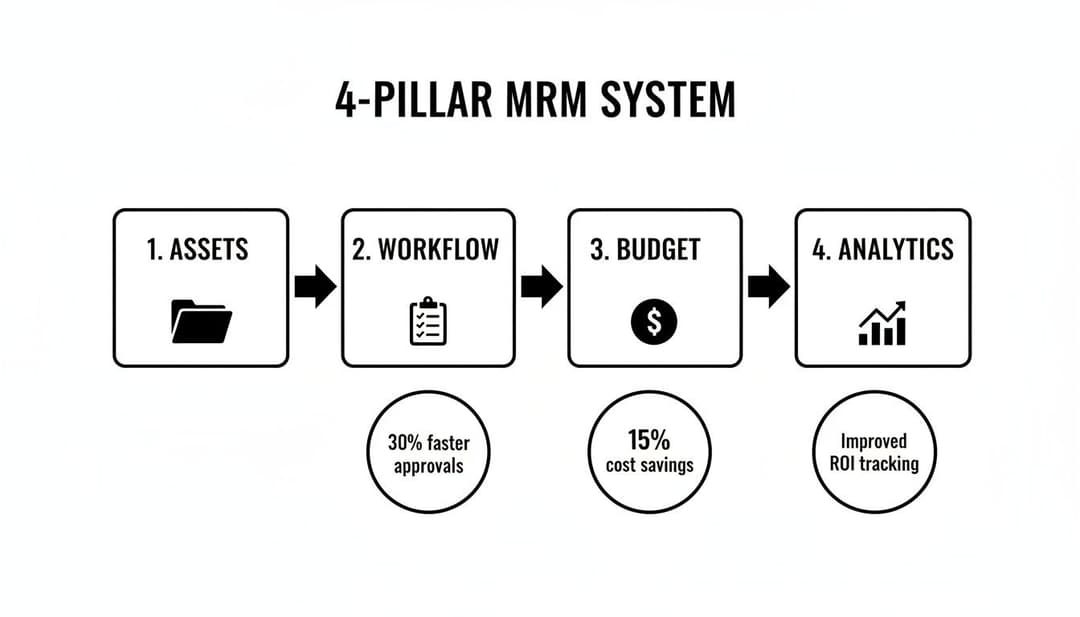
This isn't just a flowchart; it’s a blueprint for how a campaign moves logically from approved creative to automated workflows, all while being governed by budgets and informed by analytics.
Integrating Tactical Firepower with Strategic Oversight
With this orderly framework in place, the brand can now plug in high-powered tools to execute with incredible speed and precision. For example, instead of a media buyer manually building out dozens of ad variations in Meta Ads Manager, the team can use a platform built for that exact job.
An AI-powered tool can hook directly into the MRM's asset library, pulling only the latest, fully approved images, videos, and ad copy. From there, it can generate hundreds of unique ad combinations in minutes. This is a perfect example of MRM providing the strategic guardrails—ensuring every ad is on-brand and compliant—while other platforms provide the tactical firepower.
A well-implemented MRM system acts as a force multiplier for your ad operations. It doesn't just organize the chaos; it creates the ideal conditions for other tools to automate and scale campaigns at a velocity that would be impossible with manual processes alone.
This integrated approach pays off in several key ways:
- Guaranteed Brand Consistency: Only approved assets from the MRM's central library can be used, which kills the risk of running outdated or off-brand creative.
- Real-Time Budget Monitoring: Ad spend from connected platforms funnels back into the MRM, giving you a live, consolidated view of budget pacing against your goals.
- Closed-Loop Analytics: Performance data is automatically pulled back in and organized, making it easy to spot winning creatives and audiences to inform the next campaign cycle.
A Real-World Example in Action
Let’s circle back to our DTC brand. Their new, MRM-driven workflow looks completely different:
- Asset Approval: The creative team uploads new product photos and ad copy to the MRM. The system automatically routes everything through a pre-defined approval chain. No more chasing people down.
- Bulk Ad Creation: As soon as they’re approved, the assets become available to their ad creation platform. A media buyer uses the tool to generate 200 ad variations, targeting different audiences with unique messaging. You can see how platforms enable this kind of bulk ad launching for Meta campaigns to get a feel for the tech.
- Launch and Monitoring: All 200 ads are pushed live to Meta Ads Manager with a single click. The MRM immediately begins tracking the associated budget in real-time.
- Performance Analysis: As performance data flows in, the analytics pillar of the MRM automatically highlights the top-performing assets, which are then flagged for reuse or iteration in future campaigns.
This systematic approach turns a chaotic, week-long scramble into a streamlined, one-day operation. It’s a powerful demonstration of how a solid marketing resource management strategy provides the foundation for high-velocity, scalable, and genuinely data-driven ad operations.
Navigating the Martech Acronym Maze
The marketing tech world can feel like you’re swimming in a bowl of alphabet soup. MRM, DAM, CDP, MDP... every platform claims to be the one magic solution. To really get a handle on what a marketing resource management system does, we need to cut through the noise and see how it stacks up against the other big players.
Let's break it down with a simple analogy. Think of your marketing department as a professional football team. You've got players, a playbook, and a whole lot of gear. To win, everything has to work together. Martech platforms are just the tools the coaching staff uses to make that happen.
Digital Asset Management: The Equipment Room
First up, you have your Digital Asset Management (DAM) system. A DAM is your team’s equipment room—a meticulously organized space for every logo, video, ad creative, and brand guide you own. Its one and only job is to be the single source of truth for your creative assets.
A DAM makes sure everyone on the team is using the right gear. It stops your star player from running onto the field wearing last season's jersey. This is obviously critical, and most MRM systems have DAM capabilities built-in. But a standalone DAM is limited; it manages the what (the assets), but has no say in the how, when, or why they get used in a campaign.
Marketing Data Platform: The Scoreboard
Next is the Marketing Data Platform (MDP) or its close cousin, the Customer Data Platform (CDP). This is your team's analytics department and the giant scoreboard in the stadium. It's totally focused on collecting, organizing, and analyzing customer data from every single touchpoint.
An MDP tells you who your fans are, what they care about, and which ones are ready to buy season tickets. It tracks every stat imaginable—engagement, clicks, conversions—giving you a crystal-clear picture of audience performance. But it looks outward at the customer, not inward at how your own team is operating.
Marketing Resource Management: The Playbook
That brings us to the marketing resource management system. If the DAM is the equipment room and the MDP is the scoreboard, the MRM is the official team playbook and the coaching staff's entire communication network. It's the strategic hub that ties the whole operation together.
An MRM platform is where the plays (campaigns) are designed, roles (tasks) are assigned, and the budget (resources) is managed. It’s how the head coach ensures the right people are doing the right things at the right time, with the right assets, all while staying under the salary cap. It brings order to the chaos.
Marketing Operations is the coach designing the plays; the MRM platform is the official playbook and communication system that ensures the entire team executes flawlessly.
Still a little fuzzy? This side-by-side comparison should make the distinctions crystal clear.
MRM vs Related Marketing Technologies
Each of these platforms plays a vital role, but they solve different problems. A DAM organizes your creative files, an MDP tracks your customer interactions, and an MRM orchestrates your internal team's efforts. The table below breaks down their unique functions.
| Feature | Marketing Resource Management (MRM) | Digital Asset Management (DAM) | Marketing Data Platform (MDP) |
|---|---|---|---|
| Primary Focus | Internal operational efficiency and process | Centralized storage of creative assets | External customer data and analytics |
| Core Function | Manages workflows, budgets, and planning | Manages content creation, versioning, and brand consistency | Manages customer profiles, segmentation, and behavior |
| Key Users | Marketing operations, project managers, and team leaders | Creative teams, designers, and brand managers | Data analysts, performance marketers, and strategists |
Understanding where each tool fits is the key to building a powerful tech stack. Your DAM, MDP, and MRM aren't competing for the same spot on the team—they’re specialists playing different positions. The MRM acts as the operational quarterback, taking the insights from your data and the assets from your library and turning them into a game-winning drive.
Your Practical MRM Implementation Checklist
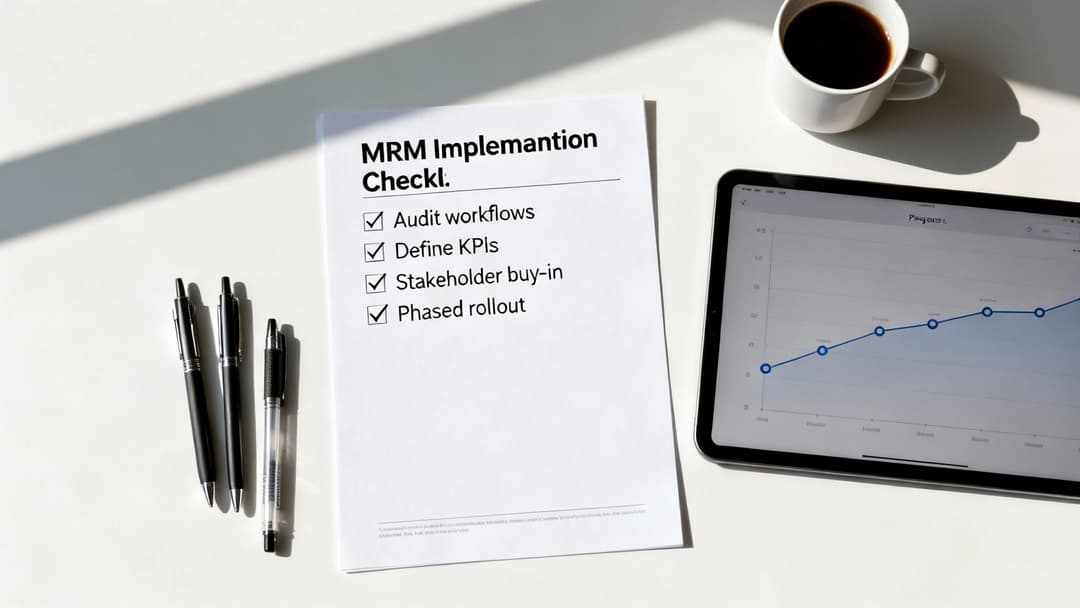
Jumping into a marketing resource management system can feel like a massive undertaking, but when you break it down into clear, manageable steps, it’s not so intimidating. This checklist is your roadmap, designed to take you from the initial head-scratching phase to a smooth rollout that your team actually embraces.
Think of this less as a technical overhaul and more as an operational upgrade. The goal is to smooth out the rough edges in your current process and let your team’s talent shine.
The whole journey starts with an honest look at where things are falling apart today. If you skip this part, you risk buying a fancy solution for a problem you don't actually have.
Audit Your Current State of Operations
Before you can build something better, you have to know exactly what you’re working with. Start by mapping out your key marketing workflows from start to finish. I mean everything—from the first spark of a campaign idea and the creative brief to the final asset approval and the performance report that lands on your boss’s desk.
The real goal here is to find the exact bottlenecks that are secretly draining your time and budget. Where do projects always seem to get stuck? How many hours does your team waste just trying to find the right version of an asset or chasing approvals through endless email chains? Get brutally honest and, wherever you can, put numbers to these pain points.
Your audit should expose the hidden "operational taxes" your team pays every single day. Putting a number on this waste—whether it's 10 hours a week spent on manual reporting or a two-week delay on every campaign launch—builds a rock-solid business case for making a change.
Define Your Goals and Secure Buy-In
Once you’ve identified the pain points, you can set clear, measurable goals for what you want the MRM to achieve. Vague targets like "improve efficiency" won't cut it. You need to get specific. Is the main objective to slash campaign time-to-market by 25%? Or is it to get real-time visibility into ad spend so you can stop blowing the budget?
These specific goals are your secret weapon for getting stakeholders on board. Don't frame this as a software expense; present it as a direct solution to the expensive problems you just uncovered in your audit. Show leadership exactly how an MRM platform drives revenue by getting campaigns out the door faster and making every dollar work harder.
Select the Right Platform for Your Needs
The market for MRM tools is blowing up. By 2026, the industry is projected to hit USD 6.5 billion, growing at a 13.8% CAGR. This boom is driven by cloud-based platforms that are easier to set up and offer low-code automation—a game-changer for modern teams. You can get more details on the trends shaping the MRM market.
When you’re looking at different platforms, stay focused on what you actually need, not just a flashy feature list.
- Integration Capabilities: Can it plug straight into the tools you already use every day, like Meta Ads Manager or your analytics suite?
- User Experience: Is the interface actually intuitive? A system that’s a nightmare to use will never get adopted, no matter how powerful it is.
- Scalability: Will this platform grow with you, or will you outgrow it in a year? Think about where your team will be in three to five years, not just today.
Don't get sidetracked by shiny objects. Pick the tool that solves your biggest operational headaches. Looking into different types of performance marketing software can be a great place to start your research.
Plan a Phased and Strategic Rollout
Finally, whatever you do, resist the temptation to launch everything all at once. A "big bang" rollout is just asking for chaos and will overwhelm your team. A phased approach is smarter, delivering quick wins that build momentum for the long haul.
- Start with a Pilot Group: Find a small, tech-friendly team to be your guinea pigs. Their success stories and feedback will be pure gold.
- Focus on a High-Impact Workflow: Kick things off by using the MRM to fix one of your biggest pains, like the creative approval process that everyone complains about.
- Provide Real Training: Don't just show people where to click. Explain why you’re making the change and how it's going to make their jobs easier.
- Celebrate Early Wins: When the pilot team starts seeing results, shout it from the rooftops. Success is contagious and will get everyone else excited to jump on board.
A thoughtful, step-by-step implementation turns a daunting project into a series of achievable wins. Before you know it, your MRM system will become an engine for growth that you can't imagine living without.
Answering Your Key MRM Questions
Even after seeing all the benefits laid out, you probably have some practical questions rolling around in your head. It's one thing to understand a concept, but another thing entirely to picture how a marketing resource management system would actually work for your team.
Let's dig into the common "what ifs" and "hows" that come up. Thinking through the real-world implications—from team size to the tools you already use—is the only way to make a smart decision.
What Size Company Benefits Most from MRM?
This is a classic question, and the answer has changed over the years. MRM used to be a tool exclusively for massive enterprises, but that’s no longer the case. Today, it’s just as crucial for fast-growing startups and mid-size companies.
The real tipping point isn't your headcount; it's operational complexity. If your team is juggling multiple campaigns, a ballooning library of creative assets, and has a hard time tracking where the marketing budget is actually going, you'll feel the impact of MRM immediately.
Here’s a simple rule of thumb: if managing your projects takes more than a couple of convoluted spreadsheets, it's time to start looking at an MRM solution.
Can an MRM System Integrate with Our Tools?
Absolutely. In fact, if it doesn't, it's not a modern MRM. A core function of any good platform is to act as the central hub for your martech stack, not just another siloed tool you have to log into. They are built to connect with the tools you live in every day, like Meta Ads Manager, Google Ads, creative software, and your analytics platforms.
This connectivity is the secret sauce. It creates a seamless flow of assets and data, killing off tedious manual work and giving you a complete, unified picture of your marketing performance. You can finally connect the dots from operational inputs directly to campaign results.
This is what elevates an MRM from a simple organizational tool into a strategic command center for your entire marketing operation.
How Do You Measure the ROI of an MRM Platform?
Measuring the return on an MRM investment comes down to tracking both hard numbers and critical operational improvements. The key is to connect those newfound efficiencies to real financial outcomes.
You can track its success through a mix of quantitative and qualitative metrics:
- Quantitative ROI: This is the easy stuff to track. Look for faster campaign time-to-market, which gets revenue in the door sooner. Measure the reduced costs from eliminating wasted or off-brand creative work. You can even calculate the increase in team productivity by figuring out how many hours are saved by automating workflows.
- Qualitative ROI: These are the "softer" benefits that have a massive long-term impact. Notice the improvement in brand consistency across all your channels—that builds brand equity. Pay attention to smoother team collaboration and less friction in the creative approval process, which leads to higher morale and, frankly, better work.
When you connect these gains to your business goals, the full financial impact becomes crystal clear. If you want to get more granular on this, you can learn more about different approaches for how to calculate marketing ROI in our detailed guide.
Ready to stop the operational chaos and start scaling your Meta campaigns with precision? AdStellar AI is an AI-powered platform that plugs into your MRM strategy, automating bulk ad creation and using data to pinpoint your top-performing creatives. Launch, test, and scale 10x faster at https://www.adstellar.ai.