Marketing budget allocation isn't some annual "set it and forget it" task anymore—it's a live, data-driven process that fuels agile growth. The sharpest marketing teams have ditched simplistic percentage-of-revenue models for flexible frameworks that let them test fast and scale what works in a ridiculously fast-paced digital world.
Why Your Old Budgeting Methods Are Failing

If your budgeting process still boils down to one big meeting a year where funds get locked in for the next 12 months, you're playing by a rulebook from a different decade. That rigid approach is a massive liability.
Today's market doesn't pause for quarterly reviews. It shifts weekly, sometimes even daily, and your budget has to be nimble enough to keep up. The traditional "percentage of revenue" model, while easy, completely disconnects your spending from real growth opportunities. It basically assumes last year’s winners will win again, totally ignoring new channels, sudden shifts in customer behavior, and what your competitors are up to. Sticking to that old method means you're almost certainly overfunding stale campaigns and starving your next big breakthrough.
The Overwhelming Shift to Digital
This pressure to adapt is only getting more intense as marketing dollars flood into digital channels. As of 2024, digital advertising commands a staggering 72.7% of all worldwide ad investment.
Out of the nearly $1.1 trillion spent on advertising globally, digital channels swallowed up over $790 billion. This isn't just a small trend; it's a complete rewiring of how marketing works. If you want to dig deeper into this global ad spend transformation, you can explore the full report on digital advertising trends from DataReportal.
This digital dominance is a double-edged sword. It offers incredible opportunities but also introduces a ton of complexity. Unlike old-school media, digital channels churn out a constant stream of performance data. Failing to act on that data in real time is where outdated budgeting methods completely fall apart.
A static budget in a dynamic digital world is like trying to navigate a racetrack with a paper map. You have a general direction, but you're blind to the immediate turns, competitor moves, and opportunities to accelerate.
Agile Allocation as a Competitive Edge
High-performing teams have thrown out the rigid annual plan in favor of something much more fluid and agile. They don't see their marketing budget as a fixed expense. They treat it like a portfolio of investments that needs active management.
To get a clearer picture of this evolution, let's compare the old way with the new.
Modern vs Traditional Budget Allocation Models
This table breaks down the fundamental differences between the static, outdated budgeting methods and the agile, data-driven frameworks that high-performing teams are using today. It's a shift from yearly planning to real-time optimization.
| Characteristic | Traditional Approach | Modern Approach |
|---|---|---|
| Frequency | Annual or quarterly planning; funds are locked in. | Continuous, dynamic adjustments made weekly or even daily. |
| Decision Basis | Historical data, gut feelings, percentage-of-revenue rules. | Real-time performance data (ROAS, CPA, CPL). |
| Flexibility | Rigid and slow to adapt to market changes or new opportunities. | Highly flexible; funds are reallocated to capitalize on what's working now. |
| Risk Management | High risk of overfunding underperforming channels for long periods. | Low risk; small-scale tests identify winners before scaling investment. |
| Mindset | "Set it and forget it." | "Test, learn, and scale." |
| Primary Goal | Spend the allocated budget within the planned time frame. | Maximize ROI and drive measurable growth. |
As you can see, the modern approach isn't just a minor tweak—it's a complete philosophical change. It moves teams from being budget administrators to growth drivers who actively manage a portfolio of marketing investments.
So what does this look like in practice? A modern approach involves:
- Continuous Optimization: Shifting funds from underperforming campaigns to high-flyers on a weekly, or even daily, basis. No waiting for the end of the quarter.
- Test-and-Scale Mentality: Ring-fencing a specific part of the budget to systematically experiment with new creatives, audiences, and channels.
- Data-Driven Decisions: Using real-time metrics—like ROAS, CPA, and CPL—to guide every single allocation choice, instead of relying on last year's percentages.
This shift is about more than just efficiency; it's about building a sustainable growth engine. When your budget can react instantly to performance data, you slash waste and multiply your returns. If you're hitting roadblocks with this on certain platforms, our guide on resolving Meta ads budget allocation issues offers some practical fixes. The future of effective marketing budgeting is agile, informed, and relentlessly optimized.
Building a Smarter Budget Framework
Before you can figure out where to put your money, you need a solid framework that ties every dollar you spend back to a real business goal. A smart budget allocation strategy isn't about throwing money at channels; it's about building a financial model that actually drives sustainable growth.
The first move is to ditch simplistic models like the old "percentage of revenue" method. It’s easy, sure, but it chains your growth potential to last year's performance. Instead, you want an objective-based approach that aligns your spending with what you’re trying to accomplish—whether that's breaking into a new market, launching a product, or hitting a specific revenue number.
This mental shift is critical, especially now. Companies are getting their confidence back in marketing's ability to deliver tangible results. In the US, marketing budgets have shot up from 2.6% of company revenue in Fall 2023 to 5.8% in Fall 2024. And they're projected to climb even higher, to 8.6%, over the next year. It’s a clear sign that thoughtful, strategic investment is back on the table.
Grounding Your Budget in Unit Economics
To build a budget around your objectives, you have to know your unit economics cold. Two metrics are completely non-negotiable here: Customer Acquisition Cost (CAC) and Lifetime Value (LTV).
These numbers are the financial guardrails for your entire strategy. Your LTV tells you the absolute most you can spend to get a new customer and still make a profit. The LTV:CAC ratio becomes your north star for efficiency. A healthy benchmark is typically 3:1, which means a customer is worth three times what you paid to acquire them.
If you don't know your LTV and target CAC, you're not allocating a budget; you're just guessing. These metrics transform your spending from an expense into a calculated investment with a predictable return.
Think about a SaaS company with a $3,000 LTV. They can confidently set their target CAC at $1,000, which empowers their marketing team to make smart calls on the fly. They know they have the green light to invest in any channel or campaign, as long as the cost to acquire a customer stays below that $1,000 mark. Of course, knowing your costs is only half the battle; you also need to understand how to calculate marketing ROI to measure the true impact.
Adopting the 70-20-10 Rule for Balanced Growth
Once you have a total budget that's grounded in solid economics, the next question is how to structure it. The 70-20-10 rule is a fantastic starting point because it balances stability with innovation. It keeps you from putting all your eggs in one basket while also preventing you from spreading your budget too thin across a bunch of unproven ideas.
Here's how it breaks down:
- 70% on Proven Winners: This is the lion's share of your budget. It goes straight to the channels and campaigns that reliably and consistently deliver results. Think of your core drivers—like Google Search ads for high-intent keywords or your tried-and-true Meta retargeting funnels.
- 20% on Emerging Opportunities: This slice is for scaling up promising new strategies. These are channels that have shown some positive early signs in testing but aren't quite as predictable as your core performers yet. This might mean expanding your investment on TikTok or putting more fuel behind a content marketing effort that's starting to bring in quality leads.
- 10% on High-Risk Experiments: Consider this your R&D fund. You use this money to test completely new ideas, platforms, or wild creative angles. Most of these experiments will probably fail, and that's okay. The ones that hit can become your next big growth channels.
Let's imagine a DTC brand applying this. Their proven winner is Meta ads (70%). They might use their 20% to go all-in on influencer marketing after a few small, successful tests. Their 10% could go toward an experiment with connected TV ads or maybe a new augmented reality shopping feature. This structure makes sure they keep the sales engine running today while building the machine for tomorrow's growth.
This framework gives you a disciplined yet flexible way to handle your budget. It protects your core revenue streams while systematically funding the next big thing. As you gather more data, you can continuously tweak these percentages, ensuring your budget evolves right alongside your performance. For more on this, check out our deep dive on mastering ad spend optimization to get the most out of every single dollar.
Alright, you've got your total marketing budget locked in. Now comes the real fun: deciding where to actually put that money. This is where strategy meets the pavement—slicing up the pie between channels like Meta, Google, or TikTok to get the most bang for your buck.
The goal isn't just to spend. It's to invest every dollar where it will work the hardest for you.
So, where do you start? You look back. Dive into your historical performance data and get brutally honest about what’s been working and what hasn't. The clearest signals will come from metrics that directly tie to revenue, like Return on Ad Spend (ROAS) and Customer Acquisition Cost (CPA). These cut through the fluff and tell you which platforms are actually making you money.
For instance, if your Google Search campaigns are consistently pulling a 4:1 ROAS but your LinkedIn efforts are barely breaking even, the data is pointing you in a clear direction. That historical performance is your foundation—the proven ground you build on.
This whole process can feel complex, but it boils down to a simple, repeatable cycle. You set your budget, you split it strategically, and you never, ever stop experimenting.
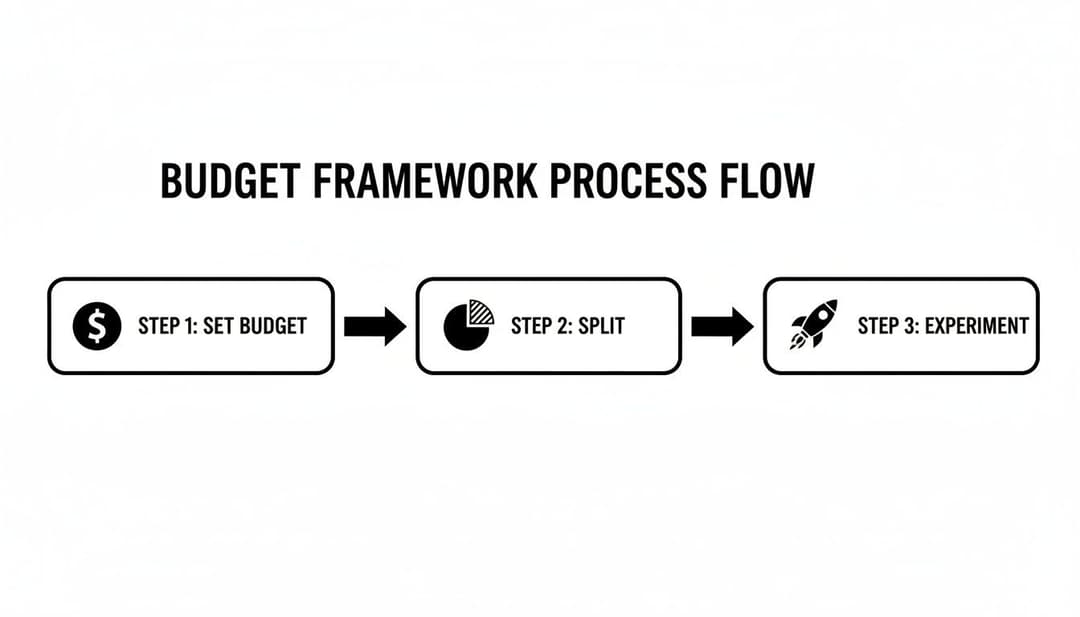
The real takeaway here is that budgeting isn't a one-and-done task. It's a living process where each stage—setting, splitting, and experimenting—feeds back into the others.
Adopting a Test vs. Scale Mentality
Beyond just pouring more money into last year's winners, the best allocation strategies live by a "Test vs. Scale" model. This approach is all about dividing your channel-specific budgets into two separate buckets. It creates a system for milking your current wins while constantly searching for new ones.
It’s a deceptively simple concept:
- Scale Budget: This is the lion's share of your funds. It goes directly to your proven, high-performing campaigns—the ad sets, audiences, and creative combos you know work. The goal here is pure efficiency and maximizing returns.
- Test Budget: This is a smaller, protected pot of money dedicated to disciplined experimentation. It’s your R&D fund for testing new creative concepts, exploring untapped audiences, or trying out that new ad format everyone’s talking about.
This deliberate split keeps you from getting complacent and overly reliant on what works today. At the same time, it stops you from recklessly throwing your entire budget at unproven ideas.
Without a dedicated test budget, innovation dies. Your team will naturally hesitate to risk precious dollars on new ideas, causing your campaigns to stagnate and eventually lose effectiveness as the market evolves.
Determining Your Test vs. Scale Percentage Split
So, what’s the magic number? The right split between testing and scaling is different for everyone; it really depends on your company’s growth stage and where you sit in the market.
An early-stage startup desperately seeking product-market fit has a totally different risk tolerance than an established brand with years of reliable performance data. One needs to learn as fast as possible, while the other needs to protect stable revenue streams. Having a solid grasp of the typical costs of advertising online can also help ground your test budgets in reality.
Here are a few real-world examples of how this split might look:
- Early-Stage Startup: A 60% Scale / 40% Test split is common. Learning is the name of the game. You have to test aggressively to figure out which channels, messages, and audiences actually move the needle before you can scale with any real confidence.
- Growth-Stage Company: An 75% Scale / 25% Test split is often a sweet spot. By now, you have a few proven channels driving consistent growth, so you double down on them. But you still need a healthy test budget to find new growth levers and avoid hitting a plateau.
- Mature, Established Brand: An 85% Scale / 15% Test split is typically enough. Your core business is humming along on highly optimized, predictable channels. The test budget becomes more about incremental improvements and defending market share than discovering foundational growth drivers.
Let's put this into practice. Imagine you're a DTC brand in the growth stage with a $50,000 monthly marketing budget. Using the 75/25 split as a starting point, here’s a sample breakdown of how that money might get allocated.
Sample Budget Split for a $50K Monthly Spend
This table shows how a growth-stage DTC brand might allocate its marketing budget, balancing investment in proven channels with dedicated funds for testing and brand building.
| Category | Channel/Initiative | Allocation (%) | Budget ($) |
|---|---|---|---|
| Scale | Meta Ads (Proven Campaigns) | 40% | $20,000 |
| Scale | Google Ads (Search & Shopping) | 30% | $15,000 |
| Test | Meta & Google (New Creatives/Audiences) | 10% | $5,000 |
| Test | TikTok Ads (Emerging Channel) | 10% | $5,000 |
| Brand | Influencer & Content Marketing | 10% | $5,000 |
This structure creates a repeatable system. It gives your team the confidence to make data-backed decisions, knowing they have a clear mandate to both exploit what’s working and explore what could work next. This balanced approach is the secret to building a growth engine that’s not just powerful, but also adaptable and built to last.
Setting Your Pacing and Optimization Rules
A well-allocated budget is a great start, but let's be honest—without a plan for how to spend it day-to-day, it’s just a number in a spreadsheet. This is where pacing and optimization rules come in. They’re what turn your strategic allocation into a tactical, real-world action plan.
Getting this right is how you avoid that classic end-of-month panic where you’re either scrambling to dump unspent funds or being forced to shut down campaigns that are actually working.
Good pacing starts with some simple forecasting. Just look at your historical data for a specific channel. Let's take Meta ads as an example. Find your average daily spend and your go-to KPIs, like Cost Per Acquisition (CPA). If your monthly budget for Meta is $15,000, your average daily spend target is $500. That simple number is now your baseline.
Creating Your Pacing Calendar
Your pacing calendar, or tracking sheet, is your command center for budget management. It doesn’t have to be some complex dashboard; a simple spreadsheet is all you need. The goal is just to track your actual spend versus your planned spend every single day.
This daily check-in is what separates the pros from the amateurs. If you see that after a week you've only spent $2,500 instead of the planned $3,500, you know you're underspending. This lets you make small, controlled adjustments—like bumping up daily campaign budgets—instead of making a huge, reactive mess later on.
On the flip side, if you've overspent, you can dial back your daily caps to get back on track. This proactive management keeps you from burning through your budget two weeks into the month, especially if you know a high-traffic period like a holiday weekend is coming up.
A pacing calendar turns budget management from a reactive scramble into a proactive, strategic process. It’s the difference between steering the ship and just being along for the ride.
And don't forget to account for the natural ebbs and flows of your business. If you're a B2B company, you'll probably spend less on weekends. For a DTC brand, you’d do the opposite and pump more budget into peak Saturday shopping traffic. Your pacing needs to reflect your reality.
Establishing Ironclad Optimization Rules
Once you have your pacing down, the next step is to take emotion and guesswork out of your day-to-day decisions. You do this by creating a crystal-clear set of "if-then" optimization rules. Think of them as pre-agreed triggers that tell you exactly what to do when a campaign’s performance hits a certain threshold.
These rules create a system that protects your budget and helps you double down on what’s working, fast. Better yet, they empower anyone on your team to make smart, data-backed decisions without needing a committee meeting. The goal is to build a playbook that guides your team's actions almost automatically.
Here are a few practical examples you can adapt for your own playbook:
- Pausing Underperformers: "If a campaign's Return on Ad Spend (ROAS) drops below 2.5 for three consecutive days, pause it. Reallocate its remaining daily budget to the top-performing campaign in the same channel."
- Scaling Winners: "If a new test ad set achieves a CPA 20% below our channel average and generates at least 10 conversions within its first 72 hours, double its daily budget."
- Creative Fatigue Signal: "If an ad's click-through rate (CTR) declines by 30% or more over a 7-day period while frequency rises above 3.5, swap in fresh creative."
Your rules need to be specific, measurable, and tied directly to your core KPIs. They act as automated circuit breakers for poor performance and green lights for success. This disciplined approach is absolutely fundamental to maximizing your marketing budget. By putting these systems in place, you ensure you're not just spending your budget, but actively investing it for the highest possible return.
As you collect more data, you can sharpen these rules even further with insights from real-time ad optimization tools, making your entire process that much smarter.
Supercharge Your Growth with AI-Powered Testing
The frameworks and rules we've gone over are solid, but even the best strategy eventually runs into a major bottleneck: the sheer speed of creative testing.
Let's be honest, manually launching, tracking, and trying to make sense of ad variations is slow, mind-numbing work. That lag time between having a great idea and getting real data on it? That’s where countless opportunities to allocate your budget effectively are lost.

This is exactly the problem that AI-powered platforms were built to crush. Forget spending hours clicking around in Ads Manager to build a handful of ad combinations. You can generate and launch hundreds of them in minutes. This isn't just about doing the same old stuff faster; it's about reaching a scale of testing that’s physically impossible for a human to manage.
Shifting from Manual Guesswork to Automated Wins
The real magic here is in the data you get back. When you can test dozens of creative assets against multiple headlines, different copy angles, and various audiences all at once, you get statistically significant learnings at an incredible speed.
Suddenly, you have a much clearer, data-backed picture of what actually makes your audience tick.
Platforms like AdStellar AI take this even further by automatically crunching the numbers against your main KPI, whether that’s ROAS, CPA, or CPL. The system quickly pinpoints the winning ad components—the specific image, headline, or audience that’s driving the best results.
This lets you immediately shift your test budget away from what's flopping and double down on the combos proven to work. It’s the fastest way to maximize the efficiency of your marketing spend. If you want to go deeper on this, our guide on automating ad testing for efficiency breaks down these workflows in more detail.
Mini-Playbook: How to Validate a New Channel with AI
Let's make this real. Imagine you want to see if TikTok is a viable new channel for your brand. You’ve set aside a small test budget of $5,000. The old manual approach might let you test a few ad concepts, but the results would likely be inconclusive.
Using an AI-powered tool, your strategy becomes much smarter:
- Generate Variations at Scale: Kick things off by creating 50-100 ad variations. Use AI to mix and match your top 5 video creatives, 5 different hooks (the copy), and 2-3 distinct audience segments (like a broad interest group and a lookalike audience).
- Launch with a Small Test Budget: Push all those variations live with a modest daily spend. This gives each one a fair shot to gather some initial data without torching your budget right away.
- Spot the Early Winners: Let the platform’s AI analyze performance over the first 3-5 days. It will automatically flag the top-performing creative angles, copy, and audience combos based on your target CPA.
- Consolidate and Scale: Now for the fun part. Pause the bottom 80% of ads that aren't cutting it. Reallocate that remaining budget into a new campaign built exclusively around the top 20% of winning combinations.
This structured process turns what was once a high-risk gamble into a calculated experiment. You get a clear, data-backed answer on whether the channel can work for you, all while keeping wasted spend to a minimum.
The speed of learning is the ultimate competitive advantage. AI testing platforms compress months of manual creative iteration into a matter of days, allowing you to find winning formulas faster and scale them with confidence.
The advertising world is only getting more crowded and competitive. Global ad spending is projected to blow past $1 trillion for the first time in 2025, with digital channels gobbling up a massive 75.2% of that total. In a market this huge, efficiency and speed are everything.
Your Top Budget Allocation Questions, Answered
Even with a solid framework, the day-to-day reality of managing a marketing budget is messy. Things rarely go exactly as planned. This is where the real skill comes in—navigating the common hurdles that pop up when the data doesn't quite match your beautifully crafted spreadsheet.
Let's get tactical and move beyond the theory. Here are the on-the-ground questions marketers grapple with constantly.
How Often Should I Be Tweaking My Budget?
The old "set it and forget it" annual budget is a relic of the past. In the world of digital marketing, things move way too fast for that.
For your high-feedback channels like Meta or Google, you should be peeking at performance and making small adjustments weekly. Seriously. If a campaign is absolutely crushing its ROAS target, you don’t want to wait a month to pour more gas on the fire. A weekly check-in lets you shift small amounts of cash from underperformers to your winners, compounding those gains.
Now, for the big moves—like shifting 10% of your total budget from paid search over to TikTok—you'll want to be more patient. Major strategic reallocations like that are better handled on a monthly or quarterly basis. You need enough data to be confident you're making the right call, not just reacting to a weird week.
What Do I Do When a Proven Channel Suddenly Tanks?
First thing's first: don't panic and pull the plug. When a reliable channel starts to stumble, it's usually a diagnostic problem, not a sign that the entire channel is dead for you. Your job is to play detective and figure out why things went south.
Start by digging into these usual suspects:
- Creative Fatigue: Is your audience seeing the same ad for the tenth time? Check your frequency metrics. If frequency is climbing while your click-through rate is dropping, your creative is officially stale.
- Audience Saturation: Have you tapped out your go-to lookalike audience? If you've been hammering the same group for months, you might be hitting the point of diminishing returns.
- New Competition: Did a new competitor just jump into the auction and start driving up your costs? Keep an eye on your impression share and CPMs to see if the landscape has shifted.
A dip in performance from a star channel is a puzzle, not a crisis. Your first move should always be to diagnose and test new creative, not to abandon ship.
If you’ve spent a few weeks methodically testing—fresh ads, new audiences, different offers—and performance still hasn't bounced back, then it's time to act. Start by gradually dialing back that channel's budget and reallocating those funds to your other proven performers or back into your testing budget.
How Can I Justify Spending on Experiments to My Boss?
This is the classic marketer's dilemma, and it all comes down to framing. Stop calling it an "experimental budget." Start calling it your marketing R&D for growth.
Think about it: every smart company invests in R&D to find their next big product. Marketing is no different. We have to invest in R&D to find our next big growth channel. To get the buy-in you need, you have to present a structured, disciplined plan—not a wild gamble.
- Define the Box: Be crystal clear about what you're testing (e.g., "a pilot program on programmatic audio ads"), how much you'll spend (e.g., "a capped budget of $5,000"), and for how long (e.g., "30 days").
- Set the Rules for Winning: Define success before you start. For example: "Success for this test means achieving a Cost Per Lead under $50. If we hit that, we'll propose a second, larger test."
- Report on Learnings, Not Just Wins: The main goal of any test is to learn something. A "failed" test that generates valuable data is actually a success. A report that concludes, "We learned this channel is not an efficient path to our target CPA" is a fantastic outcome because it saves the company from wasting more money down the road.
When you treat your experimental spend with this level of rigor, it stops looking like a risky bet and starts looking like a calculated investment in the company's future. That's a conversation leadership understands.
Still have questions? We've compiled some quick answers to other common queries we hear from marketers trying to get their budget allocation just right.
Frequently Asked Questions
| Question | Answer |
|---|---|
| What is the 70/20/10 rule in marketing budgets? | It's a popular model where you allocate 70% of your budget to proven, core channels, 20% to emerging or new channels with some initial traction, and 10% to purely experimental tests. |
| How do I handle budget requests for one-off campaigns? | Carve out a specific portion of your budget for "opportunistic" or "event-based" campaigns. This prevents last-minute requests from derailing your core strategic allocations. |
| Should I allocate budget by marketing funnel stage? | Absolutely. A balanced budget considers the full customer journey. A common split is 20-30% for Top-of-Funnel (awareness), 40-50% for Mid-Funnel (consideration), and 30-40% for Bottom-of-Funnel (conversion). |
| What's a good way to track budget pacing? | Use a simple pacing spreadsheet that compares your actual daily spend against your planned daily spend. This helps you see if you're over or under budget in real-time and make adjustments before it's too late. |
Hopefully, these answers provide some clarity on the trickier parts of managing a modern marketing budget. The key is to stay flexible, be data-informed, and always keep testing.
Ready to stop guessing and start scaling? With AdStellar AI, you can launch, test, and analyze hundreds of ad variations in minutes, not weeks. Our platform gives you the data-backed insights you need to make smarter marketing budget allocation decisions and find your next winning campaign faster. Start your free trial of AdStellar AI today and turn your test budget into a high-powered growth engine.