Ad spend optimization is all about making your marketing budget work harder for you. It's the process of digging into your campaign data, figuring out what's actually driving results, cutting the fat from underperforming areas, and doubling down on the channels and tactics that bring in real sales or qualified leads.
Building a Bulletproof Foundation for Ad Spend

Before you can even think about tweaking campaigns, you need a rock-solid foundation. Real optimization isn't about chasing the latest trend or getting obsessed with vanity metrics like clicks and impressions. It starts with getting crystal clear on what success actually looks like for your business and making sure you can track it accurately.
Without this groundwork, you're just flying blind. You're making decisions based on gut feelings or incomplete data, and that's where the expensive mistakes happen. It's estimated that a staggering 23% of online ad budgets are wasted every year on tactics that just don't move the needle.
Define Your North Star Metrics
First things first: you need to move beyond generic metrics and lock in on the Key Performance Indicators (KPIs) that directly tie back to your bottom line. These are your "North Star" metrics—the numbers that tell you if your ad spend is actually growing the business, not just generating noise.
A few common North Star metrics are:
- Return on Ad Spend (ROAS): This is the classic. It measures the gross revenue you get for every dollar you put into ads. For e-commerce and DTC brands chasing immediate sales, ROAS is king.
- Customer Acquisition Cost (CAC): This tells you the total cost to bring a new customer on board. It’s absolutely essential for subscription models or companies with a longer sales cycle. We've put together a full breakdown on how to properly calculate your Customer Acquisition Cost.
- Cost Per Lead (CPL): If you're in B2B or a service-based industry, this is your bread and butter. It tracks how much it costs to generate a new, qualified lead.
Choosing the right primary metric gets your whole team pulling in the same direction. A SaaS company, for example, might be laser-focused on keeping CAC low, while a retail brand dropping a new product line might be aiming for a hard 4:1 ROAS out of the gate.
Key Takeaway: Stop just tracking conversions; start tracking profitable conversions. A campaign that brings in a ton of conversions but has a sky-high CAC is a resource drain, not a win.
Conduct a Historical Performance Audit
With your goals set, it's time to look back before you charge forward. A historical performance audit is just a fancy way of saying you're going to systematically review your past campaigns to find hidden patterns, costly blunders, and untapped opportunities. This isn't just about finding your "best" ad—it's about understanding why some campaigns knocked it out of the park while others flopped.
Pull your ad data from the last 6-12 months and start digging. Here’s what to look for:
- Top Performers: Find the campaigns, ad sets, and specific ads that delivered the highest ROAS or the lowest CPA. What do they have in common? Was it a certain creative style? A particular audience segment? A unique angle in the copy?
- Budget Sinks: Identify exactly where your money went to die. Look for campaigns that ate up a lot of budget for little to no return. Were you dealing with overlapping audiences driving up your costs? Or ads with tons of impressions but a click-through rate in the gutter?
- Audience Insights: Which targeting segments consistently did well? Did broad audiences beat out your lookalikes? Did you find that specific interest-based groups converted at a much lower cost?
- Creative Fatigue: Hunt for those ads that started off strong but saw their performance tank over time. Pinpoint the moment their frequency got too high and engagement fell off a cliff.
This audit gives you the raw material for all your future tests. It turns your optimization efforts from a guessing game into a data-backed process, making every new dollar you spend smarter than the last.
Designing a High-Impact Ad Testing Framework
Look, optimizing your ad spend isn't about getting lucky with a sudden flash of creative genius. The best in the game know it's a deliberate, structured process. Guesswork is the fastest way to burn through your budget.
If you want to move from hoping for results to engineering them, you need a systematic testing framework. This is how every dollar you spend starts generating valuable, actionable data that you can build on.
The whole process starts with a simple rule: isolate your variables. If you test a new headline, a different image, and a fresh audience all at once, you’ve learned nothing. You have no idea which change actually moved the needle. A solid framework is built on clean, focused experiments designed to answer one specific question at a time.
Formulating Strong Hypotheses
Every meaningful test I’ve ever run started with a strong hypothesis. This isn't just a random idea; it's an educated, testable prediction about what you think will improve performance, and it should be grounded in the data you uncovered in your audit. A good hypothesis is simple, specific, and measurable.
Don't just say, "Let's test some new video ads." That's a wish, not a plan.
A powerful hypothesis sounds more like this:
"We believe that using a user-generated content (UGC) style video ad will decrease our Cost Per Acquisition by 15% compared to our current studio-shot product video. We think this will work because UGC builds more social proof and feels more authentic to our target audience."
See the difference? This format is a game-changer. It clearly defines the variable (UGC vs. studio video), the audience, the expected outcome (15% CPA reduction), and the "why" behind it all. It gives you a clear finish line to measure success or failure.
Structuring Your Creative and Audience Tests
Once you have a clear hypothesis, you can start building out your experiments. In paid ads, the two most powerful levers you can pull are your creative and your audience. Smart optimization is all about systematically testing both to find those winning combinations.
Think of it as a methodical search for your "golden" ad—the perfect message hitting the perfect person at the perfect time.
- Creative Testing: This is where you tinker with the ad itself. We’re talking different headlines, primary text, images, videos, and calls-to-action (CTAs). The goal is to figure out which creative components truly connect with a specific audience.
- Audience Testing: Here, you take a proven, high-performing "control" ad and run it against different targeting groups. You might test a lookalike audience against an interest-based group, or maybe you'll compare different demographic segments to see who responds best.
One of the most common—and costly—mistakes is testing a new creative on a new audience at the same time. You need a control. When you're testing creative, keep the audience consistent. When you're testing audiences, use your best-performing control creative. If you want to dive deeper into the basics, check out our complete guide on what A/B testing is in marketing.
To keep things organized and ensure you're isolating variables correctly, a simple matrix can be incredibly helpful. It forces you to think through each test, define what you're changing, and know what success looks like before you spend a dime.
Creative and Audience Testing Matrix
| Test Category | Primary Variable | Example A | Example B | Success Metric |
|---|---|---|---|---|
| Creative: Headline | Headline Angle | "Save 25% Today Only" | "Tired of X? Try This" | CPA |
| Creative: Visual | Image Type | UGC-style photo | Professional studio shot | ROAS |
| Creative: CTA | Button Text | "Shop Now" | "Learn More" | CTR |
| Audience: Targeting | Audience Type | 1% Lookalike (Purchasers) | Interest: [Competitor A] | CPA |
| Audience: Demographics | Age Range | 25-34 | 35-44 | Conversion Rate |
This framework isn't just about running tests; it's about building a library of insights. Over time, you'll have a clear understanding of what messages, visuals, and audiences truly drive your business forward.
Setting Budgets and Timelines for Significance
A test is completely useless if it doesn't produce statistically significant data. Running an experiment for a single day or with a shoestring budget won't give you reliable results. You’ll just be making decisions based on random noise and daily fluctuations.
As a general rule of thumb, a test needs to run long enough to get out of the platform's "learning phase." For Meta, this typically requires around 50 conversions per ad set within a 7-day period.
Here’s a practical way to approach it:
- Carve out a testing budget. I recommend dedicating about 10-20% of your total ad spend exclusively for testing. This ensures you're always innovating and finding new winners without putting your core campaign performance at risk.
- Set a clear timeline. Plan for each test to run for a minimum of 7-14 days. This helps average out any weird daily spikes or dips and gives the platform's algorithm enough time to find its footing and optimize delivery.
- Define what a "win" looks like before you start. Decide on your primary success metric ahead of time. If your goal is to lower your CPA, then the ad variation that hits the lowest CPA with enough conversion volume wins. Period. Don't get distracted by vanity metrics like a higher click-through rate if they don't directly contribute to your main objective.
This kind of disciplined approach transforms your ad account from a money pit into a learning machine, constantly uncovering new insights that lead to more efficient ad spend and sustainable growth.
Mastering Bidding Strategies and Budget Allocation
Think of your bidding strategy as the engine powering your ad campaigns. Getting it right—and fueling it with a smart budget—is where the real magic of ad spend optimization happens. It’s what tells the ad platforms how aggressively to compete for you in the auction and ultimately decides whether you hit your CPA goals.
Making the wrong choice here is like showing up to a Formula 1 race with regular unleaded. You might get off the starting line, but you won't be efficient, and you'll definitely run out of gas before the final lap.
Choosing the Right Bidding Model
Platforms like Meta and Google serve up a whole menu of automated bidding options, each cooked up for a different result. The right one for you comes down to your campaign objective, whether that's ringing up sales or filling your pipeline with leads.
Here’s a breakdown of the heavy hitters:
- Cost Cap / Target CPA: This is your go-to for stability. You tell the platform the maximum you’re willing to pay for a conversion, and it goes to work finding them at or below that cost. If your break-even CAC is $50, you might set a Target CPA of $45 to lock in a profit margin on every single conversion. It's perfect for maintaining predictable profitability.
- Bid Cap: This gives you maximum control by setting a ceiling on how much you’ll pay in any single ad auction. It's a great way to rein in costs, but be careful—if you set it too low, you might not win enough auctions to get the reach you need. I typically use this when I'm in a super competitive auction and need to keep a tight grip on costs without killing delivery.
- Value Optimization: Instead of just chasing any conversion, this model hunts for the highest-value ones. It’s a game-changer for e-commerce brands with a wide range of product prices. The algorithm prioritizes users who are likely to spend more, which directly juices your Return on Ad Spend (ROAS).
The smartest bid strategy isn't always the one with the lowest cost-per-click. It's the one that aligns perfectly with your most important business metric, whether that's a stable CPA or maximum purchase value.
The entire ad tech world is sprinting toward algorithmic control. In fact, forecasts show that algorithmically-driven ad spend is on track to make up 79.0% of total global ad spend by 2027. This shift makes mastering these automated bidding strategies less of an option and more of a necessity.
This simple loop—hypothesize, test, and analyze—is the core of what drives effective ad spend optimization.
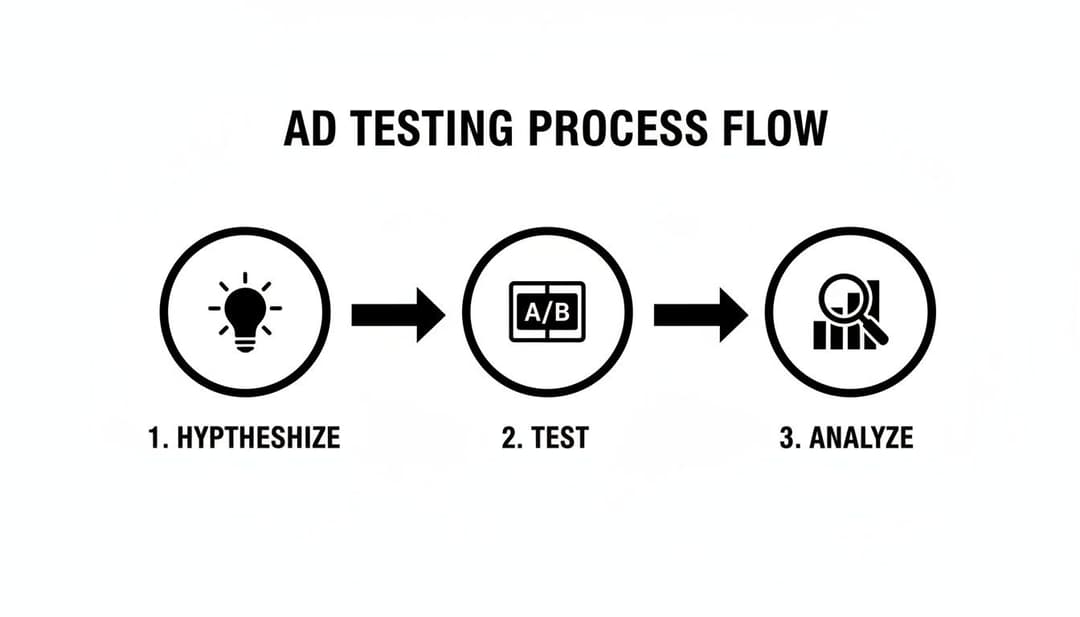
The key thing to remember is that optimization is a continuous cycle. The insights you pull from one analysis become the foundation for your next test.
Structuring Your Budget Across the Funnel
Smart budget allocation isn’t about giving every campaign an equal slice of the pie. It's about strategically funding each stage of the customer journey, from that first "hello" to the final purchase. A classic mistake is dumping the entire budget into bottom-of-funnel retargeting. It works great for a while, but eventually, the well runs dry because you're not bringing anyone new into your world.
A healthy, balanced approach usually looks something like this:
- Prospecting (Top of Funnel): This is where you find new customers, and it should get the lion's share of your budget—typically 60-70%. You'll use broad or lookalike audiences here to keep your growth engine humming.
- Retargeting (Middle/Bottom of Funnel): Earmark about 20-30% of your budget to re-engage people who've already shown interest, like website visitors or video viewers. These audiences are much warmer and almost always convert at a lower cost.
- Retention (Post-Purchase): A smaller 5-10% slice can work wonders for upselling or cross-selling to your existing customers. This is often your most profitable segment, especially when you consider that acquiring a new customer can be five times more expensive than keeping an old one.
This kind of layered structure creates a steady flow of new leads while efficiently converting the people who already know your brand. If you want to dive deeper, you can learn more about how to optimize ad budget allocation in our dedicated guide.
Managing Budget Pacing and Real-Time Adjustments
Finally, let's talk about pacing. Don't just set your daily budget and walk away. You need to keep an eye on your campaign's spend throughout the day to make sure it's pacing correctly. If a campaign blows through its entire daily budget by noon, you’re missing out on a huge chunk of potential customers for the rest of the day.
This is especially critical during your peak conversion hours. For an e-commerce store, that might be in the evenings or on weekends. If your budget is tapped out before those high-intent windows even open, you're leaving money on the table.
Use tools like campaign budget scheduling or automated rules to push more spend during your hot hours and pull back during the lulls. This dynamic approach ensures your ads are front and center when your customers are most likely to buy.
Putting AI To Work: How to Scale Your Winning Campaigns

Let's be honest: manual campaign management is a dead end. If you're still living in spreadsheets and doing daily check-ins, you're not just moving slowly—you're getting lapped by competitors who are working smarter. True ad spend optimization at scale isn't about grinding harder; it's about building a system where AI and automation eliminate human error and speed up your decision-making.
This goes way beyond just setting a budget and hoping for the best. We're talking about a system where technology handles the mind-numbing, data-heavy tasks, freeing you up to think about the big picture. Instead of spending hours building ad variations, you can let AI generate hundreds of combinations in minutes. That means you can test more ideas and find what works faster than ever before.
Speed Up Campaign Creation with AI
The first real bottleneck in scaling is almost always the time it takes to get new campaigns out the door. Manually building dozens of ad variations—each with its own creative, copy, and audience target—is a recipe for burnout and costly mistakes. This is exactly where AI-powered tools give you a massive edge.
Say you’ve found three killer images, four headlines that convert, and five promising audiences. Doing the math, that's 60 unique combinations (3x4x5). Building that by hand would be a nightmare. AI, on the other hand, can assemble all 60 variations and push them live with a single click.
This kind of rapid-fire production lets you:
- Launch deep, comprehensive tests in a tiny fraction of the time.
- Test more variables at once without getting buried in the setup.
- Slash the risk of simple manual errors that throw off your results.
This isn't just about moving faster; it's about accelerating your learning curve. The more you can test, the quicker you can pinpoint the creative and audience pairings that actually deliver the best ROAS. For a deeper dive into how this works on Meta, you can find detailed guides on applying AI for Facebook Ads.
Use AI to Analyze Performance and Spot the Winners
Once your campaigns are running, the next hurdle is digging through a mountain of data to find the gold. Which ad is really driving the lowest Cost Per Acquisition (CPA)? Which audience is bringing in the most revenue? Getting clear answers to these questions, and getting them fast, is the key to smart ad spend optimization.
AI algorithms can chew through performance data in real-time, automatically ranking your best assets based on the KPIs you actually care about. Forget manually exporting reports. You get a clean, data-backed list of your top creatives, copy, and audiences.
This takes the emotion and guesswork out of the equation. The data tells you exactly what’s working, so you can confidently double down on your winners and kill the losers without a second thought.
This capability is only getting more important. In fact, digital ad spending is projected to blow past $750 billion in 2025, accounting for over 75% of all media ad spend for the first time. That growth is fueled by the efficiency AI brings to the table. We’re already seeing that programmatic ads can slash CPA by 30%, and AI-driven targeting improves results for 82% of marketers.
Set Up Automated Rules for Hands-Off Management
The final piece of the puzzle is using automation to act on these insights without you having to be chained to your dashboard. Most modern ad platforms, including Meta Ads Manager, let you create automated rules that act as your 24/7 campaign manager.
These rules are just simple "if-then" commands that trigger actions based on performance thresholds you define. They are an incredibly powerful way to protect your budget and scale efficiently.
Here are a few real-world examples you could set up:
- Cost Control: "If a campaign's CPA goes over $50 in the last 3 days, pause the campaign."
- Scaling Winners: "If an ad set's ROAS is above 4x and it has spent over $100 today, boost its budget by 20%."
- Killing Duds: "If an ad's click-through rate (CTR) falls below 0.5% after 10,000 impressions, turn off the ad."
With rules like these in place, you can be sure your ad spend is always being put to good use, even when you’re offline. To really take your efforts to the next level, check out the best AI tools for ecommerce that can help streamline your entire operation. By combining AI-driven creation, sharp analysis, and smart automation, you build a powerful, scalable system for optimizing every dollar you spend.
Implementing a Cycle of Monitoring and Scaling
Getting an ad campaign live is just the beginning. The real work—and where the real money is made—happens in the ongoing cycle of monitoring, learning, and adjusting. This isn't a "set it and forget it" game. It's a dynamic process.
Without a consistent review process, even your best campaigns will eventually fall victim to creative fatigue or audience saturation. Costs creep up, returns diminish, and suddenly your star performer is barely breaking even. This continuous loop is how you turn short-term wins into predictable, long-term growth.
Building Your Performance Dashboard
First things first: you need to cut through the noise. Ad platforms throw a dizzying amount of data at you, but only a handful of metrics truly matter for making smart budget decisions. A solid performance dashboard is your command center, centralizing the key numbers you need for an at-a-glance health check.
Your dashboard should be built around your North Star metrics. If profitability is the goal, ROAS and CPA need to be front and center.
Consider tracking these key indicators:
- Primary KPIs: The metrics that define success (e.g., ROAS, CPA, Cost Per Lead).
- Leading Indicators: Early-warning signals for future performance (e.g., Click-Through Rate, Cost Per Click).
- Pacing Metrics: Daily and weekly spend to ensure you’re on track with your budget.
- Fatigue Metrics: Frequency and ad-level conversion rates to spot creative decay before it tanks performance.
Having this single source of truth stops you from getting lost in different platform reports and keeps your focus on what actually moves the needle. For a deeper look at what to track, explore our guide on leveraging performance analytics for your ads.
Establishing a Review Cadence
With your dashboard ready, the next step is to lock in a consistent review schedule. This routine is what turns monitoring from a reactive scramble into a proactive strategy. Different check-ins serve different purposes, from catching daily fires to spotting broader monthly trends.
Here’s a look at what an effective monitoring cadence entails.
Ad Performance Monitoring Cadence
A schedule for reviewing key metrics to ensure timely adjustments and prevent wasted spend.
| Frequency | Metrics to Review | Key Questions to Ask | Actionable Next Steps |
|---|---|---|---|
| Daily | Spend, CPA/ROAS, Disapproved Ads | Are we spending the budget? Are costs suddenly spiking? Are there any critical errors? | Pause broken ads, fix disapprovals, investigate major performance shifts. |
| Weekly | Campaign/Ad Set Trends, Test Results | Which campaigns are winning/losing? What did our experiments teach us? | Reallocate budget from underperformers to winners, pause losing ads. |
| Monthly | Funnel Performance, Audience Saturation | How is our overall strategy performing? Are we hitting our growth targets? | Plan next month's testing roadmap, identify new audience opportunities. |
This rhythm helps you make decisions based on meaningful trends instead of reacting to the normal, day-to-day volatility of ad performance.
Pro Tip: Never make a major strategic change based on a single day of data. Performance fluctuates. A disciplined weekly review cadence lets you act on real trends, not random noise.
Knowing When to Scale and When to Pull Back
The million-dollar question in ad spend optimization is when to hit the gas on a winning campaign. Scale too fast, and you can shock the algorithm, torch your efficiency, and exhaust your audience. But if you’re too timid, you’re just leaving money on the table.
Look for these green flags before you increase spend:
- Consistent Performance: The campaign has met or beaten your target CPA/ROAS for at least 3-5 days straight.
- Sufficient Conversion Volume: The ad set is out of the "learning phase" and is generating a stable flow of conversions.
- Stable Frequency: The ad's frequency is still reasonably low, showing you haven't saturated the audience yet.
Once you see these signals, scale methodically. A 20% budget increase every 2-3 days is a reliable rule of thumb. This gradual approach gives the platform’s algorithm time to adapt and find new customers efficiently, preserving the performance that made the campaign a winner in the first place.
This measured strategy is critical, especially on platforms where AI drives growth. With social media ad spend projected to hit $306.4 billion in 2025—and Meta poised to capture a staggering 60% of that market—mastering these AI-driven systems is non-negotiable. You can read more about the upgraded global ad growth forecasts on warc.com.
Your Top Ad Spend Optimization Questions, Answered
As you get deeper into optimizing your ad spend, the questions change. The early days are about getting things running, but true scaling brings a whole new set of challenges. Knowing the right levers to pull—and when—is what separates the campaigns that fizzle out from the ones that drive real, profitable growth.
Let's tackle some of the most common questions that pop up for performance marketers in the trenches.
How Often Should I Actually Be Optimizing My Campaigns?
This is a classic "it depends" situation, but the real answer hinges on your data volume.
If you're running a high-spend account with hundreds of conversions rolling in daily, a quick morning check-in on core metrics like CPA and ROAS is non-negotiable. You have enough data coming in to spot a problem and fix it before it torpedoes your budget.
But for smaller accounts, this daily tinkering is a recipe for disaster. You'll end up making emotional, knee-jerk decisions based on normal daily ups and downs. A weekly deep-dive is a much smarter approach.
The key is to find a sustainable rhythm. I recommend a quick 5-10 minute daily glance to make sure nothing is on fire. Then, block out a dedicated hour each week to really dig into trends, see what your tests are telling you, and map out your next moves. Fight the urge to overreact to one good or bad day—let the data tell a story over a full week.
What’s a "Good" ROAS or CPA, Anyway?
Everyone wants a magic number here, but the honest answer is that there's no universal benchmark for "good."
A 4:1 ROAS might be incredible for a DTC brand with healthy margins. For a low-margin retailer, that same number could mean they're losing money on every single sale. The only benchmark that truly matters is your own break-even point.
Before you even think about industry averages, you have to nail down your unit economics. You need to know:
- Your Product Margins: After the cost of goods, what profit is left from each sale?
- Customer Lifetime Value (LTV): What’s the total revenue you can expect from the average customer over time?
Your target ROAS or CPA has to be built on those numbers to ensure you’re actually making money. The first goal is simple: beat your break-even point consistently. Once you’re there, your new goal is to keep beating your own numbers.
When Is It Safe to Scale a Winning Ad?
This is where so many marketers get burned. You see an ad have a fantastic day, get excited, and dump a ton of money into it. The result? The efficiency almost always crashes.
An ad having one great day isn't a signal to scale. It's a blip. What you're looking for is a pattern of stable, profitable performance.
Look for consistency over 3-7 days, not just a 24-hour anomaly. The golden rule is to scale gradually. Don't ever double the budget overnight—that’s a great way to shock the algorithm and reset the learning phase. Instead, increase the budget by a calm 20-30% every few days. This gives the platform time to find new customers without freaking out.
And while you're scaling, keep one eye glued to your frequency metric. If it starts shooting up, that's a huge red flag. You're saturating your audience, and it's time to either expand your targeting or get some fresh creative in there before fatigue kills your golden goose.
Help! My Best Ad Suddenly Tanked. What Do I Check First?
It's a sinking feeling we all know. A rockstar ad suddenly falls off a cliff, and panic starts to set in. The trick is to diagnose the problem methodically instead of randomly changing things and making it worse.
Run through this quick diagnostic checklist:
- Creative Fatigue: Is your audience just sick of seeing this ad? Check your frequency and click-through rates (CTR). A rising frequency combined with a falling CTR is the classic sign of ad fatigue.
- Audience Saturation: Have you simply run out of people to show it to? Take a look at your audience size and reach metrics. If you’ve hit most of your target pool, performance will naturally drop off.
- Auction Competition: Did a new competitor just jump into the auction with deep pockets? This one is harder to see directly, but you can usually spot the signs: a sudden, sharp increase in your CPMs (Cost Per Mille) or CPCs (Cost Per Click) is a dead giveaway.
- Negative Social Proof: Don't forget to read the comments on your ads, especially on Meta. A wave of negative reactions can absolutely poison an ad's performance and needs to be handled right away.
By working through these steps, you can find the actual problem and apply a targeted fix instead of just guessing.
Ready to stop the guesswork and start scaling your Meta ads with data-backed precision? AdStellar AI automates bulk ad creation, identifies your top-performing creative and audiences, and helps you launch smarter campaigns in a fraction of the time.
Unlock faster, more profitable ad performance today at https://www.adstellar.ai