Welcome to the new way of doing advertising, where artificial intelligence isn't just a buzzword—it's the engine driving real results. An AI ad agency is your modern partner, one that weaves sophisticated AI tools right into its DNA. It’s about leaving slow, manual processes in the past and embracing speed and data-backed precision. This isn't some far-off concept; it's here and it's changing the game.
The New Reality of AI-Powered Advertising
By 2026, the pressure on performance marketers has become intense. The demand is always for better results, delivered faster, and usually on a tighter budget. The old agency model, with its manual campaign setups and slow reporting cycles, is having a hard time keeping up. This is exactly where the AI ad agency steps in, tackling that "do more with less" challenge head-on.
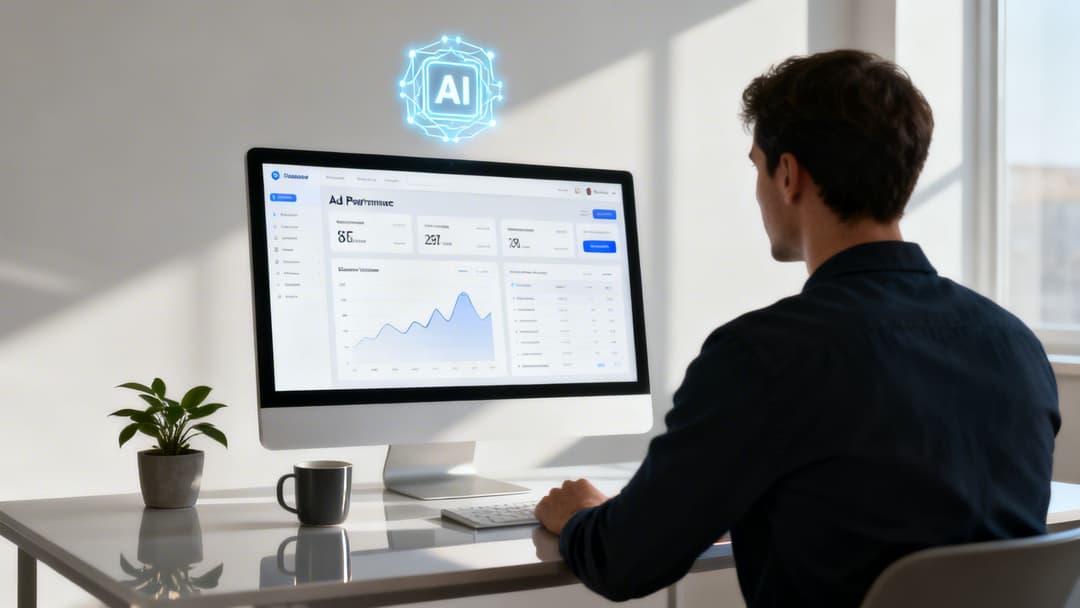
Think of it less as a small tweak and more like upgrading from a bicycle to a high-speed train. The core goals of advertising—reaching the right people with the right message—are still the same. But the way we get there is now exponentially faster and smarter.
The Driving Force Behind AI Adoption
This move toward AI in advertising isn't just a passing trend; it's a massive market shift. The global AI marketing space has ballooned to an incredible $64.6 billion in 2026, with projections showing it will clear $107.5 billion by 2028. That kind of explosive growth tells you one thing: marketers are eagerly swapping tedious manual work for AI-driven efficiency.
This new chapter is increasingly being written by advanced AI agentic workflows, which automate complex, multi-step marketing tasks that once required a whole team. It’s these workflows that give an AI ad agency the ability to operate at a scale and speed that was simply impossible before, turning weeks of work into a matter of hours.
By automating high-volume, data-heavy tasks, an AI ad agency frees up its human strategists to focus entirely on what truly matters: growth, market insights, and creative breakthroughs. The machine does the repetitive lifting, while the experts steer the ship.
What This Means for Your Campaigns
So, what does this actually look like for your campaigns? Instead of painstakingly creating a few ad variations, you can now generate and test hundreds. Instead of waiting for a weekly report to see what’s working, you get real-time feedback that lets you make changes on the fly. It's a level of speed and precision that hands you a serious competitive edge.
This guide will walk you through exactly what an AI ad agency is, how the model works, and how you can put it to work for you. And if you're curious about the specific tech involved, check out our guide on how to use AI for ads.
Defining the Modern AI Ad Agency
So, what exactly is an AI ad agency? The term might bring to mind faceless algorithms and robots running the show, but that's not the reality. Think of it more like a Formula 1 pit crew where expert strategists are geared up with robotic exoskeletons. The humans are still calling the shots, but the AI handles the heavy lifting at a speed and scale no person could ever match.
This hybrid approach completely changes how advertising services are delivered. The agency's real value is no longer just in manual campaign work—it's in the strategic direction of a powerful, semi-automated advertising system.
A Partnership Between Human and Machine
The most important thing to get your head around is that a true AI ad agency runs on a human-AI partnership. This is not a "set it and forget it" system where you just press a button and walk away. Human expertise is absolutely essential for setting the overarching strategy, reading between the lines of complex market signals, and understanding the subtle art of brand storytelling.
The AI acts as the ultimate co-pilot. It crunches massive datasets to spot hidden patterns, spits out hundreds of creative variations in minutes, and adjusts campaign bids 24/7 without ever getting tired or making a mistake.
This is a 'human-in-the-loop' system. The AI provides the data-driven horsepower and scale, but the human strategist brings the context, creativity, and critical thinking. The whole point is to amplify human intelligence, not replace it.
This combination unlocks a level of performance that neither a purely human team nor a standalone AI tool could ever hope to achieve. It’s the perfect marriage of a seasoned marketer's gut instinct and the relentless analytical power of machine learning.
Weaving AI into Every Service
An AI ad agency doesn't just dabble in a few AI tools; it rebuilds its entire service stack around artificial intelligence from the ground up. This is a complete operational overhaul, not just a surface-level change.
Here’s a quick look at how AI gets woven into the day-to-day:
- Strategy and Research: Forget about spending weeks on manual market research. AI models can analyze competitor campaigns, audience sentiment, and market trends in almost real-time. This gives you a rock-solid, data-rich foundation for campaign strategy right from day one.
- Creative Production: Generative AI is a game-changer for producing ad copy, headlines, and even image concepts at an incredible scale. An agency can test hundreds of different ad variations to quickly nail down the exact messages and visuals that click with specific audience segments.
- Media Buying and Targeting: Predictive AI algorithms chew on historical data to forecast which audiences are most likely to convert, slashing wasted ad spend. Then, optimization AI takes over to automate bidding around the clock, tweaking bids based on live performance to squeeze every last drop of ROAS out of your budget.
- Analytics and Reporting: Instead of spitting out surface-level vanity metrics, AI-powered dashboards deliver deep, actionable insights. These systems can pinpoint precisely which creative elements or audience demographics are driving results, allowing strategists to make smarter decisions, faster.
By baking AI into these core functions, the agency evolves from a simple service provider into a strategic partner laser-focused on measurable growth. To see this in action, you can dive deeper into the nuts and bolts of an automated marketing agency and its operational advantages. This fundamental shift frees up the team to spend less time on tedious manual tasks and more time on the high-impact strategy that truly moves the needle for your business.
How an AI Ad Agency Actually Operates
To really get what makes an AI ad agency different, you have to pop the hood and look at how the engine works. It’s not about sprinkling a few AI tools on top of an old process. It’s a complete rethink of how campaigns are researched, built, launched, and fine-tuned.
This new model turns an agency from a group of people checking off tasks into strategic partners managing a sophisticated, automated advertising machine. The biggest change? We’re moving from slow, step-by-step work to rapid, parallel processes. A traditional agency might take weeks on market research, but an AI-powered one can pull deeper insights in hours. That speed is felt at every single stage.
The whole thing is a blend of human strategy and machine execution. This diagram perfectly illustrates the hybrid model that makes an AI agency so effective.
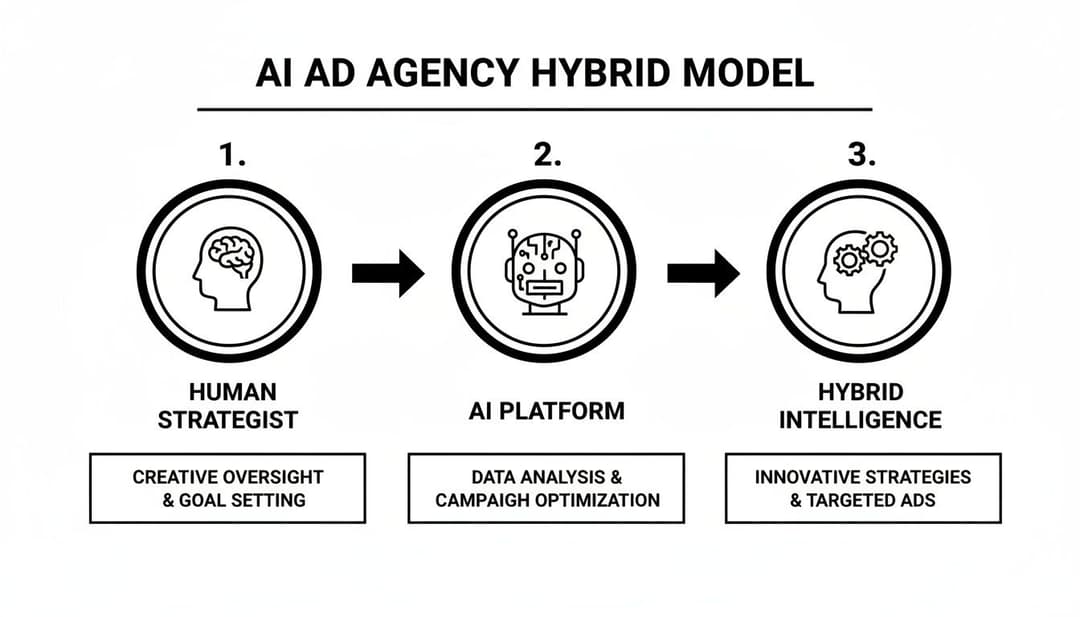
As you can see, human strategists set the direction and goals. The AI platform then amplifies that vision with massive processing power. The result is a hybrid intelligence that drives real campaign success.
AI-Accelerated Research and Strategy
Every great campaign starts with understanding the battlefield. Instead of a person manually sifting through competitor ads or social media feeds, an AI ad agency deploys algorithms to do the heavy lifting. These systems can analyze thousands of data points in an instant.
This covers a few key areas:
- Competitor Intelligence: The AI scans and sorts every ad your competitors are running. It figures out their messaging angles, what they're offering, and where they're spending money.
- Audience Sentiment Analysis: It tears through social media conversations, product reviews, and articles to get a pulse on how the market really feels about certain products, features, or pain points.
- Market Trend Identification: The system flags emerging trends and keywords before they get crowded, giving you a chance to be the first one in the door.
A human strategist takes all these rich, real-time insights and builds a campaign strategy that’s grounded in what’s happening now—not just on what worked last year.
High-Volume Creative Production
Once the strategy is locked in, you hit the classic creative bottleneck. A traditional team might grind out a handful of ad variations. An AI ad agency can generate thousands.
Using generative AI, the agency can produce a massive volume of headlines, ad copy, and even image concepts, all tailored to different audience segments. A crucial part of this is mastering prompt engineering, which is the art of telling the AI exactly what you need to get the best possible creative output. This isn't about replacing creative teams; it’s about giving them superpowers to test ideas at a scale that was pure fantasy just a few years ago.
Predictive Audience Targeting and Launch
With a mountain of creative assets ready to go, the agency uses machine learning to find your best customers. By analyzing your past conversion data, predictive models can build lookalike audiences and identify user groups with the highest probability of converting. This slashes wasted ad spend on people who were never going to be interested anyway.
The campaign launch itself is also automated. An agency can push hundreds of unique ad sets live across multiple platforms with just a few clicks. This includes setting up complex A/B tests to systematically discover the winning combinations of creative, copy, and audience. If you want to dive deeper here, check out our guide on what AI ad campaign automation entails.
Real-Time Performance Optimization
This is where an AI ad agency really leaves the old model in the dust. After launch, AI algorithms are watching campaign performance around the clock. They don’t take breaks, and they never miss a thing.
The system automatically adjusts bids, shifts budgets from underperforming ads to the winners, and can even pause creatives that are starting to show signs of ad fatigue. It’s a 24/7 optimization cycle that a human team simply can’t match manually.
The industry is already shifting this way. Digital advertising now commands 69% of global ad spend, and with U.S. ad spend hitting a staggering $414.7 billion, agencies that don't integrate AI will be left behind. Forward-thinking leaders predict that AI agents will soon replace bloated teams with lean, tech-human hybrids. This operational firepower is exactly how an AI agency delivers better returns.
Choosing Your AI Advertising Partner
So, you’ve decided to bring AI into your advertising mix. That’s the easy part. Now comes the bigger question: how? You’re standing at a fork in the road with two main paths—partnering with a full-service AI ad agency or taking the reins yourself with a self-serve AI platform.
The right answer has everything to do with your team’s resources, in-house skills, and what you’re trying to achieve.
Let’s use an analogy. An AI ad agency is like hiring a world-class private chef. You tell them what you like, and they handle everything else—designing the menu, sourcing the best ingredients, and cooking a gourmet meal served right at your table. It’s a completely hands-off experience designed for premium results with zero effort on your part.
An AI advertising platform, on the other hand, is like getting a high-end meal kit from that same chef. You get all the premium, pre-portioned ingredients and a step-by-step recipe delivered to your door. You’re still creating a gourmet meal, but you have total control over the process, timing, and final presentation.
Agency Service vs. Platform Control
The fundamental difference boils down to service versus control. An AI ad agency offers a complete, done-for-you service. Their team of human experts uses a mix of their own and third-party AI tools to run your campaigns from strategy to execution. This is a perfect fit for companies that don't have the bandwidth or specific know-how to manage complex ad campaigns internally.
A self-serve platform like AdStellar gives your existing team superpowers. It puts sophisticated AI tools directly in their hands, letting your performance marketers automate the tedious work and operate at a scale they could never manage manually. This path is ideal for teams that want to keep direct control over their strategy while making their workflow dramatically more efficient. For a deeper look, our guide to the top AI advertising companies offers some great context.
The choice isn't really about which option is "better." It's about which model best fits how you operate. Do you need to outsource the entire function, or do you need to make your current team more powerful?
Breaking Down the Key Differences
To make a smart decision, you have to weigh the trade-offs. The right solution—whether it’s an agency or a platform—should feel like a seamless extension of your marketing department.
This table gives you a clear, side-by-side look to help figure out which approach makes the most sense for your business.
AI Ad Agency vs. Self-Serve AI Platform
| Factor | AI Ad Agency | Self-Serve AI Platform (e.g., AdStellar) |
|---|---|---|
| Strategy & Expertise | Provides strategic oversight and campaign management with dedicated experts. | Your in-house team drives the strategy, using the platform to execute faster. |
| Control & Transparency | Less direct control; you trust the agency's process. Transparency can vary. | Full control over campaigns, budgets, and creative. Direct access to all data. |
| Cost Structure | Typically higher cost, involving retainers, percentage of ad spend, or project fees. | Generally lower cost, often a monthly or annual SaaS subscription. |
| Speed to Launch | Can be slower due to communication and onboarding cycles between teams. | Extremely fast. Your team can create and launch campaigns in minutes. |
| In-House Skills | Requires minimal in-house ad expertise; the agency handles the workload. | Builds your team's skills and makes your internal experts more valuable. |
| Best For | Companies wanting a hands-off, fully managed solution or those lacking internal teams. | Growth-focused teams that want to scale their own efforts and maintain control. |
At the end of the day, hiring an AI ad agency is about delegating the "how" so your team can focus on other things. Using a platform is about supercharging your team's ability to execute the "how" themselves, only faster and smarter than ever before.
How to Evaluate and Select the Right AI Ad Agency
Picking an agency to manage your ad spend is a big deal. When AI gets thrown into the mix, the stakes get even higher, and it's absolutely critical to get it right.
The problem is, plenty of traditional agencies are guilty of "AI-washing"—they just slap some AI buzzwords onto their same old services. It's a quick way to get burned. You need a simple, clear framework to cut through the marketing fluff and find a genuine AI ad agency that will actually move the needle for your business.
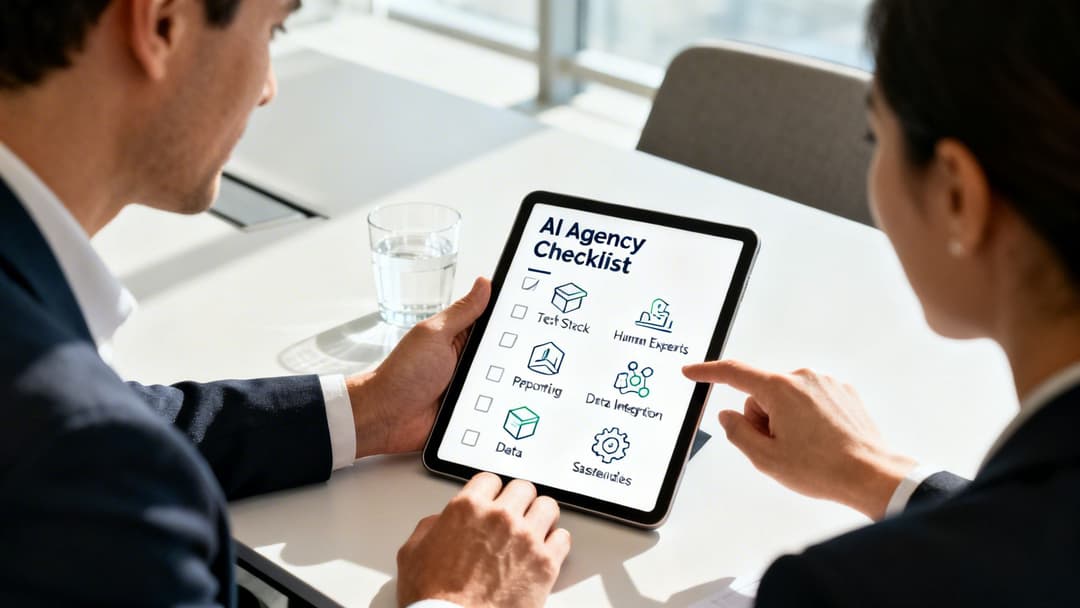
Vetting a potential partner goes way beyond watching a slick demo. It’s about asking the tough, specific questions that show you how their tech and their team really work. This checklist will walk you through exactly what to look for.
Scrutinize Their Tech Stack
First things first, you’ve got to pop the hood. Not all "AI" is created equal, and you need to know what kind of engine is powering their campaigns. Are they using proprietary technology they built from the ground up, or are they just stringing together a bunch of off-the-shelf software?
Get right to the point and ask them:
- Is your AI platform proprietary? If it is, what specific advertising problems was it built to solve?
- What parts of the campaign process does your tech handle? Push for details on creative generation, audience testing, and budget optimization.
- How does your system learn and get better? A real AI model should get smarter over time by learning from your campaign data.
An agency with a custom-built platform usually has a much deeper grasp of the challenges they’re solving. It shows they've invested heavily in creating a solution, not just licensing one. You can explore some of the powerful AI tools for marketing agencies to get a better sense of what's out there.
Verify Their Human Expertise
AI is a powerful amplifier, but it still needs a skilled pilot. The best AI ad agencies pair incredible technology with brilliant human strategists who can interpret the data, guide the machine, and connect campaign performance back to your bigger business goals.
Don't be so mesmerized by the technology that you forget to evaluate the team behind it. The strategists, creative directors, and data analysts are the ones who provide the critical context and direction that makes the AI effective.
During the evaluation process, insist on meeting the people who will actually be working on your account. Ask them about their experience in your industry, their approach to strategy, and how they collaborate with the AI day-to-day.
Demand Transparent Reporting and Insights
One of the biggest red flags you can encounter is a "black box" approach, where the agency can't—or won't—explain why the AI is making certain decisions. A true partner will offer total transparency, showing you not just what’s working but also giving you real insights into why it's working.
Your reporting dashboard should do more than just list a bunch of metrics; it should tell a story. Ask a potential agency to walk you through a sample report and explain how their AI spotted a winning ad creative or uncovered a new high-value audience segment. If their answers are vague, it’s a big sign they might not fully understand their own systems.
This transparency is what gives you the confidence to trust their process and make smart, informed decisions about your marketing strategy. Without it, you’re just blindly handing over your budget and hoping for the best.
Your Next Steps in AI Advertising
The conversation around AI in advertising has officially moved on. We’re no longer asking if we should use AI—the real question now is how to make it a core part of your growth strategy. You’re standing at a fork in the road with two powerful options, and the right one for you comes down to your team, your resources, and your goals.
It’s a choice between bringing in a strategic partner or empowering your team to take the reins. One isn't inherently better than the other; they just solve for completely different business needs.
For Teams Needing a Strategic Partner
If your marketing team is already stretched thin or you don't have deep, specialized expertise in paid advertising, then partnering with an AI ad agency is the clear path forward. Think of it as a fully managed, "done-for-you" service where seasoned strategists command powerful AI systems on your behalf. You’re essentially outsourcing the entire function to experts who live and breathe this stuff.
This approach is the perfect fit for businesses that want to:
- Hand off the complexities of campaign management to a dedicated team.
- Get the benefits of a sophisticated tech stack without the headache of building it.
- Keep your internal team focused on what they do best: core business operations and brand strategy.
If this sounds like your situation, your next move is to start the vetting process. Grab that evaluation checklist from the last section to help you find a genuine partner and sidestep the agencies that are just paying lip service to AI.
For Teams Ready to Take Control
On the other hand, if your main goal is to supercharge your in-house talent and keep full control over your campaigns, an AI advertising platform is your answer. This approach doesn't replace your team—it turns them into their own AI-powered engine. Your strategy, your data, and your creative oversight all stay right where they belong: with you.
An AI platform like AdStellar acts as a force multiplier. It automates the repetitive, high-volume work that bogs down your best people, freeing them up to be faster, smarter, and more strategic.
This is the ideal path for teams determined to build a sustainable, in-house advertising powerhouse. You can see for yourself how AdStellar transforms your Meta campaigns by automating creative production and serving up data-driven insights. It gives your marketers the firepower to achieve agency-level results with the speed and control that only an in-house team can provide.
The right choice will slot perfectly into your company’s growth plan, turning AI from an abstract idea into your new competitive edge.
Frequently Asked Questions About AI Ad Agencies
Even after getting the big picture, you probably still have some practical questions floating around. That’s normal. When marketers start thinking about bringing in a next-gen agency, a few common concerns always pop up. Let's tackle them head-on and get you the straightforward answers you need.
Will an AI Ad Agency Replace My In-House Marketing Team?
Not at all. In fact, it’s the opposite. A good AI ad agency is there to supercharge your existing team, not replace them. Think of the agency as a specialist that takes over the high-volume, repetitive work that often drains your team's time and energy.
We’re talking about tasks like:
- Spinning up hundreds of creative variations for testing.
- Juggling complex A/B tests across dozens of audience segments.
- Adjusting ad bids around the clock to squeeze every last drop of performance out of your budget.
By handing off this heavy lifting, you free your people to focus on what they do best—the high-impact work. This means more brainpower for brand strategy, deep dives into customer research, and mapping out long-term growth. The agency handles the operational "how," so your team can finally own the strategic "what" and "why."
How Does the Cost of an AI Ad Agency Compare to a Traditional One?
This is where things really shift. The cost structure often looks different because the entire value proposition is built on performance and efficiency, not just hours logged. While some might use a familiar retainer model, the real story is their ability to deliver a massively better return on ad spend (ROAS).
The key is to look past the sticker price and compare the total value you get. An AI ad agency's knack for driving better results through pure speed and data-driven optimization often makes them far more cost-effective in the long run.
Since AI is automating work that used to take a whole room of people, their fees are tied more directly to strategic guidance and the results they deliver. When you’re weighing your options, focus on the impact they can have on your bottom-line metrics, like a lower Cost Per Acquisition (CPA) or a higher ROAS. That initial investment can pay for itself surprisingly quickly when the results start rolling in.
What Is the Main Difference Between an AI Agency and Native Platform AI?
This is a critical distinction to make. The AI tools built into platforms like Meta's Advantage+ are incredibly smart, but they're designed to win only on that specific platform. They operate inside their own "walled garden," optimizing for success within a single ecosystem.
An AI ad agency, on the other hand, brings a strategic layer that sits on top of all these tools. They often use their own proprietary tech to get a bird's-eye view of the entire market, spot opportunities across different channels, and run a unified strategy that isn’t siloed.
Most importantly, the agency provides the crucial human oversight needed to steer the AI, interpret the data in the context of your actual business goals, and make sure all the moving pieces are working together. They don't just push the buttons on the tools; they orchestrate them as part of a complete growth plan.
Ready to see how an AI platform can turn your in-house team into its own advertising powerhouse? AdStellar AI automates creative production and campaign launches for Meta, helping you achieve agency-level results with full control. Explore how AdStellar can 10x your campaign speed.