In 2026, manual campaign management is a losing strategy. The advertisers who are scaling effectively are using artificial intelligence to automate tedious workflows, generate data-backed creative insights, and optimize budgets in real time. The gap between those who leverage AI and those who don't is widening daily, directly impacting return on ad spend (ROAS) and market share.
But with hundreds of platforms claiming AI capabilities, finding the right tool feels overwhelming. How do you distinguish genuine performance drivers from marketing buzzwords? This guide cuts through the noise. We've compiled a detailed comparison of the top AI advertising companies, analyzing their core strengths, ideal use cases, and practical limitations for performance-driven teams.
This is not a generic list. It’s a comprehensive resource designed to help you make a strategic decision. You will find:
- In-depth analysis of each platform's unique AI engine.
- Specific use cases for e-commerce, B2B SaaS, and agencies.
- Honest pros and cons based on real-world application.
- Screenshots and direct links to explore each solution further.
Whether you're looking to automate Meta creative testing, enhance programmatic bidding, or find smarter ways to reach your ideal customer profile, this list provides the clarity you need. Beyond just advertising, AI's impact extends to broader sales and marketing functions, providing smarter AI lead generation techniques for businesses looking to stay competitive. Our goal is to equip you with the information necessary to select an AI partner that will deliver a true competitive advantage and tangible results for your business.
1. AdStellar AI
Best for: Rapid, AI-powered Meta campaign creation and optimization
AdStellar AI establishes itself as a premier choice among ai advertising companies by focusing with surgical precision on a critical pain point for performance marketers: the slow, manual process of building, testing, and scaling Meta ad campaigns. It's an AI-first platform engineered to automate the entire campaign assembly workflow, claiming to accelerate the process by up to 10x. By connecting directly to your Meta Ads Manager via secure OAuth, it ingests historical performance data to inform its powerful recommendation engine from day one.
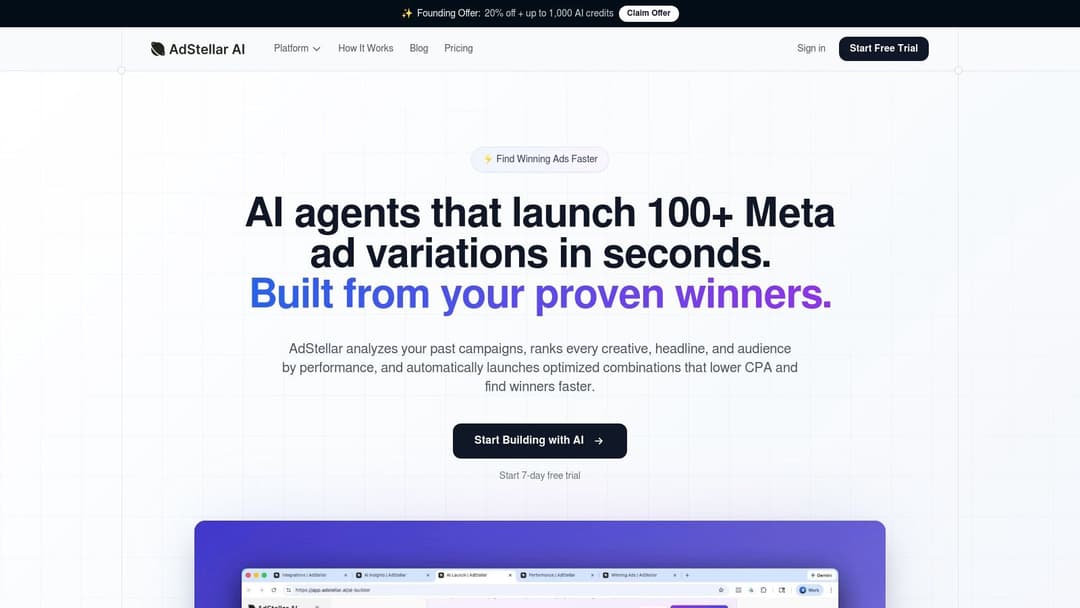
The platform’s core strength lies in its ability to generate hundreds of creative, copy, and audience permutations in minutes, transforming a tedious task into a strategic advantage. Media buyers can move beyond guesswork and deploy a vast array of ad variations to quickly identify winning combinations. This makes it an ideal solution for e-commerce, B2B SaaS, and agencies that rely on high-tempo testing to drive growth.
Standout Features & Capabilities
AdStellar AI centralizes the entire Meta advertising workflow into a cohesive, modular interface. Its key capabilities are designed to replace manual setup with data-backed execution.
- Bulk Ad Creation: A central pillar of the platform, this feature allows you to rapidly build hundreds of ad variations by combining different creative assets, headlines, primary text, and audiences. This is crucial for A/B testing at scale.
- AI Insights: The platform analyzes your live and historical data to rank top-performing creatives, copy, and audiences against your specific business goals (ROAS, CPL, CPA). This feature provides clear, actionable intelligence on what’s working, enabling you to double down on winners.
- AI Launch & Scaling: With a single click, AdStellar can assemble and launch new campaigns using the proven combinations identified by its AI Insights. Its auto-learning models continuously monitor performance, identifying high-potential ads and scaling them as fresh data arrives. To explore this further, you can find more information about AdStellar's AI optimization engine on their website.
- Centralized Workflow: It consolidates campaigns, creatives, audiences, and a media library into one unified dashboard. This modular design streamlines team collaboration and significantly reduces the time spent navigating Meta's native interface.
Pricing and Access
AdStellar AI does not publicly list its pricing. Access typically requires scheduling a demo with their team to assess your specific needs and ad spend, which is a common practice for specialized B2B SaaS platforms in this space.
- Pros:
- Massively accelerates campaign production and testing cycles.
- AI-driven insights are tied directly to business metrics like ROAS or CPA.
- Continuously learns from your account data to automate scaling decisions.
- Centralized workflow improves team efficiency and reduces manual errors.
- Cons:
- Hyper-focused on the Meta ecosystem (Facebook/Instagram), limiting its use for multi-channel campaign management.
- Lack of public pricing or customer testimonials requires a demo and pilot period to validate ROI.
Website: https://www.adstellar.ai
2. Google Ads – Performance Max
No list of top AI advertising companies would be complete without Google’s own powerhouse, Performance Max (PMax). As Google’s unified, goal-based campaign type, PMax leverages machine learning to automate bidding, budget allocation, audience targeting, and creative combinations across the entire Google Ads inventory. This includes YouTube, Display, Search, Discover, Gmail, and Maps, all from a single campaign setup. Its primary strength lies in its expansive reach and simplified management, making it an accessible entry point for SMBs and a powerful scaling tool for enterprise-level advertisers.
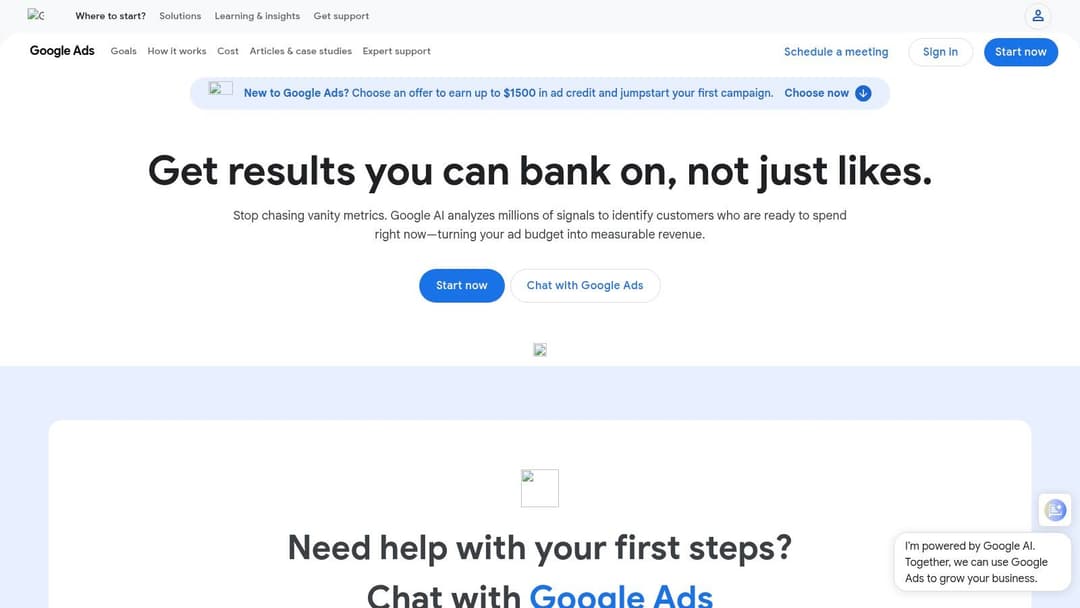
The platform operates by taking advertiser-provided assets (text, images, videos) and audience signals (like customer lists or website visitor data) and then uses its AI to find converting customers wherever they are on the Google network. This reduces manual campaign management and focuses the advertiser’s role on strategic inputs: providing high-quality creative assets and clear conversion goals. However, this automation comes at the cost of transparency and direct control, which can be a significant drawback for experienced marketers who prefer granular adjustments. Getting the campaign structure and asset groups right is crucial for success, as is understanding the subtleties of effective ad placement strategies within Google's ecosystem.
Key Features & Use Cases
- Best For: E-commerce brands, lead generation, and local businesses seeking maximum reach with minimal campaign setup.
- Core AI Capability: Automated, real-time bidding and cross-channel budget optimization to achieve specific conversion goals (e.g., CPA, ROAS).
- Unique Offering: A single campaign structure that accesses all of Google's advertising channels, simplifying what would otherwise require multiple, complex campaigns.
| Feature Analysis | Rating | Details |
|---|---|---|
| Ease of Use | ★★★★★ | The setup is streamlined and goal-oriented. Provide assets, goals, and signals, and Google's AI handles the rest. |
| AI Transparency | ★☆☆☆☆ | Often referred to as a "black box," it provides limited data on specific placements, audience performance, or creative combinations. |
| Customization & Control | ★★☆☆☆ | Marketers sacrifice granular control over bidding, placements, and audience targeting for the sake of automation. |
| Reach & Scale | ★★★★★ | Unmatched access to the entire Google advertising ecosystem, providing extensive opportunities for scaling campaigns. |
Pros & Cons
Pros:
- Broadest Reach: Accesses the full Google inventory in one AI-optimized campaign.
- Efficiency: Significantly reduces setup time and manual management.
- Native Measurement: Seamlessly integrates with Google Analytics for unified performance tracking.
Cons:
- Limited Transparency: Lack of detailed reporting can make deep-dive analysis difficult.
- Asset Dependent: Performance is heavily reliant on the quality and variety of creative assets provided.
- Cannibalization Risk: Can potentially cannibalize traffic from existing Search campaigns if not set up carefully.
Website: https://ads.google.com/intl/en_us/home/
3. Meta Advantage+
For social media advertisers, Meta's Advantage+ suite is the direct equivalent to Google's Performance Max, offering powerful, platform-native AI to automate campaigns across Facebook, Instagram, Messenger, and the Audience Network. Advantage+ campaigns take user-provided creative assets and goals and use machine learning to dynamically find the best audiences, placements, and budget allocations to drive conversions. It's designed to move advertisers away from manual audience segmentation and A/B testing, focusing their efforts on creative strategy and high-level performance goals.
The platform is deeply integrated with the Meta Pixel, Conversions API, and product catalogs, allowing its AI to leverage vast amounts of first-party data for optimization. This makes it particularly effective for e-commerce and lead generation businesses already embedded in the Meta ecosystem. Similar to PMax, the primary trade-off is sacrificing granular control for automated efficiency. Marketers lose the ability to micromanage specific audience segments or placements, trusting Meta’s algorithm to find the optimal path to conversion. Understanding how to best leverage AI for Facebook Ads is key to maximizing results within this automated framework.
Key Features & Use Cases
- Best For: E-commerce brands using product catalogs, app-based businesses seeking installs, and lead generation campaigns with clear conversion events.
- Core AI Capability: End-to-end automation of audience targeting, ad placements, and budget distribution across the entire Meta advertising family.
- Unique Offering: Deep, native integration with Meta’s commerce tools (like product catalogs and Shops) for highly effective Advantage+ Shopping Campaigns.
| Feature Analysis | Rating | Details |
|---|---|---|
| Ease of Use | ★★★★★ | A streamlined, goal-driven setup process simplifies campaign creation, making it accessible even for less experienced advertisers. |
| AI Transparency | ★★☆☆☆ | Provides more audience insights than PMax but still operates largely as a black box regarding why specific optimization decisions are made. |
| Customization & Control | ★★☆☆☆ | Limited control over audience selection and placements. Advertisers guide the AI with suggestions rather than direct commands. |
| Reach & Scale | ★★★★★ | Full access to Meta's massive user base across Facebook, Instagram, Reels, and Messenger, offering significant scaling potential. |
Pros & Cons
Pros:
- Strong Performance Baselines: Quickly establishes effective campaigns that often outperform manually managed setups.
- Deep Platform Integration: Leverages conversion tracking and catalog data seamlessly for powerful optimization.
- Reduced Management Overhead: Automates many tedious tasks, freeing up marketers to focus on creative and strategy.
Cons:
- Loss of Granular Control: Experienced advertisers may find the lack of control over targeting and placements restrictive.
- Minimum Budget Requirements: Some Advantage+ features may require minimum daily spends, limiting accessibility for very small budgets.
- Creative-Dependent: Success is highly dependent on providing a diverse and high-quality range of creative assets for the AI to test.
Website: https://www.facebook.com/business/ads/meta-advantage-plus
4. Microsoft Advertising + Copilot
Microsoft Advertising is integrating generative AI directly into its platform with Copilot, an intelligent assistant designed to streamline campaign creation, management, and optimization. This built-in tool acts as a conversational partner for advertisers, helping draft ad copy, recommend assets, generate images, and troubleshoot campaign performance across the Microsoft network, which includes Bing, Edge, and partner sites like LinkedIn. Its primary value is lowering the barrier to entry and accelerating workflows for teams advertising on Microsoft's ecosystem, making it one of the more accessible AI advertising companies for those new to the platform.

The platform leverages a chat-based interface where advertisers can ask questions and give commands, from "help me create a new search campaign" to "suggest better keywords for my target audience." Copilot assists by generating creative variations and providing data-backed recommendations to improve results. While the AI-generated assets still require human oversight for brand alignment and optimal performance, the assistant significantly reduces the manual effort involved in setup and iteration. This productivity-focused approach makes it a strong contender for advertisers looking to efficiently tap into Microsoft's user base without a steep learning curve.
Key Features & Use Cases
- Best For: B2B advertisers, businesses targeting professional demographics, and marketing teams looking for AI-assisted campaign management on the Microsoft network.
- Core AI Capability: A generative AI chat assistant (Copilot) for campaign setup, creative generation, and performance insights directly within the ad platform.
- Unique Offering: Free, integrated AI assistance for building and troubleshooting campaigns, removing the need for third-party creative or setup tools.
| Feature Analysis | Rating | Details |
|---|---|---|
| Ease of Use | ★★★★☆ | The conversational interface simplifies complex tasks, making campaign setup and management more intuitive for users of all skill levels. |
| AI Transparency | ★★★☆☆ | Copilot explains its recommendations, but the underlying performance automation operates with moderate transparency. |
| Customization & Control | ★★★☆☆ | Offers a good balance. The AI provides strong suggestions and automation, but advertisers retain final control over campaign elements. |
| Reach & Scale | ★★★☆☆ | Provides access to the valuable but smaller Microsoft network, including Bing and LinkedIn, which is less extensive than Google's. |
Pros & Cons
Pros:
- No Extra Cost: Copilot is included with Microsoft Advertising accounts at no additional fee.
- Reduces Learning Curve: Helps new advertisers get started quickly and troubleshoot common issues.
- Rapid Asset Iteration: Useful for quickly generating and testing different ad copy and image concepts.
Cons:
- Smaller Network Reach: The audience size is significantly smaller compared to giants like Google and Meta.
- Requires Human Review: AI-generated creative suggestions are a starting point and benefit from human refinement.
- Separate Product: This is a distinct offering from the paid Microsoft 365 Copilot, which can cause brand confusion.
Website: https://about.ads.microsoft.com/en-us/tools/productivity/copilot-in-microsoft-advertising
5. The Trade Desk (Koa AI / Audience Unlimited)
For large-scale advertisers and agencies focused on the open internet, The Trade Desk stands out as a leading enterprise Demand-Side Platform (DSP). Its power is amplified by Koa AI, a decisioning engine that guides media buying, targeting, and optimization across channels like Connected TV (CTV), display, video, and audio. The platform is designed for programmatic experts who need sophisticated tools to navigate the advertising landscape outside of walled gardens. Its core value proposition is combining massive reach with AI-driven intelligence and greater transparency than many competitors.
The Trade Desk’s Koa AI operates through adaptive trading modes, allowing advertisers to choose between maximizing performance or maintaining tighter control over targeting parameters. A key differentiator is Audience Unlimited, its AI-assisted data marketplace that helps identify valuable audience segments while providing transparent data pricing. This model gives advertisers more clarity on where their budget is going. However, this level of sophistication means the platform is not a self-serve tool for beginners; it typically requires significant ad spend, agency access, or a direct contract, making it a premium choice among ai advertising companies.
Key Features & Use Cases
- Best For: Large agencies and enterprise advertisers managing complex, multi-channel programmatic campaigns, especially with a focus on CTV and retail media.
- Core AI Capability: Koa AI offers adaptive trading modes that optimize bidding, pacing, and audience selection based on campaign goals.
- Unique Offering: The Audience Unlimited marketplace uses AI to suggest optimal data segments with transparent, fixed pricing, moving away from opaque percentage-of-media-spend data fees.
| Feature Analysis | Rating | Details |
|---|---|---|
| Ease of Use | ★★☆☆☆ | A powerful but complex platform designed for programmatic experts. Often requires onboarding, training, or agency management. |
| AI Transparency | ★★★★☆ | Provides significant reporting and control. Koa AI’s suggestions are layered over a platform that values data and pricing transparency. |
| Customization & Control | ★★★★★ | Offers deep, granular control over every aspect of programmatic buying, from bidding strategies to data application and measurement. |
| Reach & Scale | ★★★★★ | Massive reach across the open internet, including premium inventory in CTV, online video, audio, and display advertising. |
Pros & Cons
Pros:
- Advanced Optimization: Koa AI provides sophisticated decisioning for scaled campaigns.
- Transparent Data Pricing: Audience Unlimited offers clarity on data costs, a major advantage in programmatic.
- Strong CTV & Open Web Access: A market leader for reaching audiences on connected television and the broader open internet.
Cons:
- High Barrier to Entry: Not suitable for small teams; requires significant expertise, spend, and often a direct sales contract.
- Complexity: The platform's depth can be overwhelming without dedicated programmatic specialists.
- Variable Platform Fees: Access and contract terms are not standardized and require sales engagement.
Website: https://www.thetradedesk.com/
6. Quantcast Platform
For advertisers looking to master the open internet beyond the walled gardens of Google and Meta, the Quantcast Platform emerges as a powerful, AI-driven solution. This self-serve programmatic platform specializes in display, video, mobile, and CTV advertising, unified within a single interface for planning, activation, and measurement. Its core strength lies in its advanced cookieless technology, which leverages a massive audience graph and predictive modeling to help brands find and influence their ideal customers in real-time, making it one of the most forward-thinking AI advertising companies preparing for a privacy-first world.
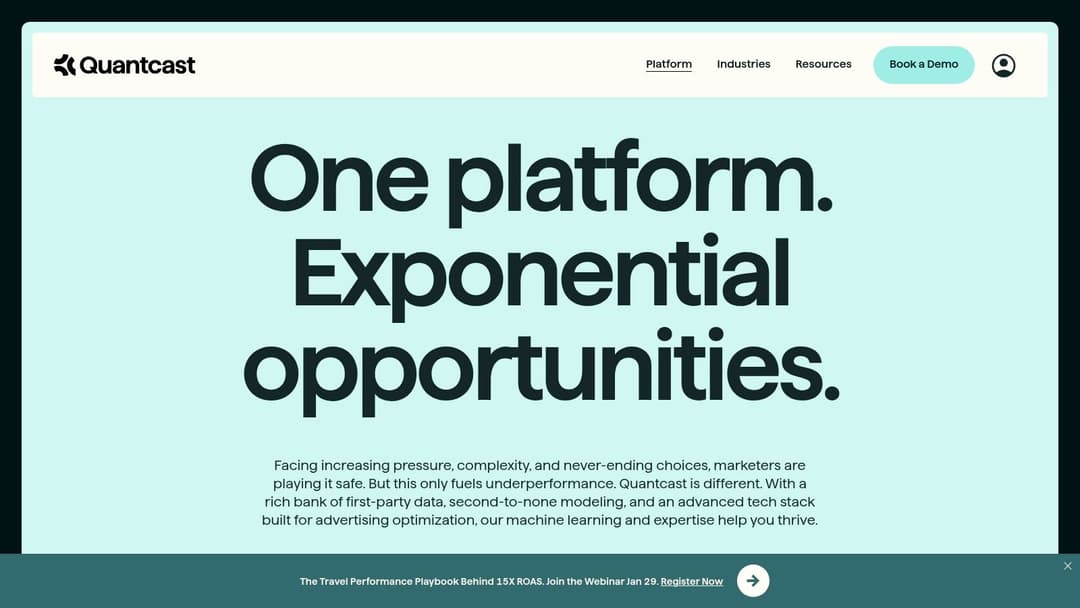
Quantcast empowers both agencies and in-house teams to simplify the complexities of programmatic buying. The platform’s AI not only identifies new prospective audiences but also provides real-time insights into campaign performance, allowing for immediate optimization. While the self-serve model offers significant control, newcomers to programmatic may face a learning curve. The fee structure is transparent, with clear documentation on media costs and feature fees, but advertisers should be mindful that modeling and bidding add-ons are calculated as a percentage of the inventory cost, which can impact the overall budget.
Key Features & Use Cases
- Best For: Agencies and advertisers seeking to scale their programmatic efforts on the open internet with a robust, cookieless-ready solution.
- Core AI Capability: Predictive audience modeling and real-time bidding across the open internet, using a proprietary cookieless audience graph.
- Unique Offering: A unified platform that combines planning, activation, and measurement tools specifically designed for the post-cookie advertising landscape.
| Feature Analysis | Rating | Details |
|---|---|---|
| Ease of Use | ★★★☆☆ | The unified UI is powerful but can have a learning curve for those new to the programmatic ecosystem. |
| AI Transparency | ★★★★☆ | Provides real-time reporting and insights into audience behavior and campaign delivery, offering good visibility into AI-driven decisions. |
| Customization & Control | ★★★★☆ | Offers significant self-serve control over campaign setup, audience targeting, and optimization levers. |
| Reach & Scale | ★★★★☆ | Extensive reach across the open internet, including display, video, CTV, and mobile, enabling significant campaign scale. |
Pros & Cons
Pros:
- Future-Proof Targeting: Strong focus on cookieless modeling and scale.
- Unified Workflow: Simplifies programmatic buying by integrating planning, activation, and measurement.
- Transparent Fees: Clear documentation on media and feature fees helps with budget planning.
Cons:
- Learning Curve: Can be complex for marketers without prior programmatic experience.
- Additive Costs: Modeling and bidding fees are an added percentage of media spend.
- Open-Web Focus: Primarily serves the open internet, not a solution for walled gardens like social media.
Website: https://www.quantcast.com/platform
7. Criteo – Commerce Growth
Criteo is a long-standing leader in programmatic advertising, specifically known for its powerful retargeting capabilities fueled by a sophisticated Commerce AI. Its Commerce Growth platform leverages vast datasets from billions of SKUs and massive daily user signals across the open internet. This positions Criteo as a go-to choice for e-commerce and direct-to-consumer brands that require highly intelligent, product-level advertising, from initial prospecting to customer retention.
The platform’s core strength lies in its dynamic creative optimization (DCO+) and product recommendation engine. By integrating directly with a brand’s product catalog, Criteo's AI can automatically generate personalized ads that showcase the most relevant products to individual users based on their browsing behavior. While this level of personalization is highly effective, it requires a more technical setup involving product feeds and tracking tags before campaigns can launch. Its access to a vast retail media network also makes it one of the more unique AI advertising companies for brands stocked in major online retailers.
Key Features & Use Cases
- Best For: E-commerce businesses, DTC brands, and large retailers focused on driving product sales and maximizing customer LTV.
- Core AI Capability: Commerce-focused AI that uses real-time behavioral data to power dynamic product recommendations and catalog-driven ad creative.
- Unique Offering: A specialized focus on commerce data combined with a large retail media network, enabling ads on top retailer websites.
| Feature Analysis | Rating | Details |
|---|---|---|
| Ease of Use | ★★★☆☆ | Requires a technical setup with product feeds and pixel implementation, which can be a barrier for smaller or less technical teams. |
| AI Transparency | ★★★☆☆ | Provides solid performance reporting on a campaign and product level, but the underlying AI decision-making process is largely automated. |
| Customization & Control | ★★★★☆ | Offers strong control over campaign goals (CPC/CPM), audience segments, and product sets, though creative generation is automated. |
| Reach & Scale | ★★★★☆ | Extensive reach across the open web and premium publisher sites, including a robust retail media network for contextual placement. |
Pros & Cons
Pros:
- Deep Commerce Intelligence: AI is trained specifically on shopping behavior and product data, leading to highly relevant ads.
- Powerful Retargeting: A best-in-class solution for dynamic product retargeting to re-engage interested shoppers.
- Full-Funnel Solution: Supports campaigns for prospecting, consideration, and customer retention.
Cons:
- Technical Setup: Requires product feed and tracking tag integration before launch, which can be complex.
- Enterprise Focus: Pricing and feature access can feel tailored to larger businesses with significant ad spend.
- Niche Application: Less suitable for B2B, lead generation, or service-based businesses compared to retail.
Website: https://www.criteo.com/platform/commerce-growth/
8. Smartly.io
Smartly.io is an enterprise-grade platform designed for large-scale advertisers who need to unify creative production and media buying. It excels at combining AI-powered creative tools with cross-channel campaign optimization, particularly across social and display networks. The platform's core strength is enabling teams to produce, test, and iterate on creative assets at a velocity that would be impossible manually, bridging the gap between creative and media performance teams for more cohesive and effective advertising.
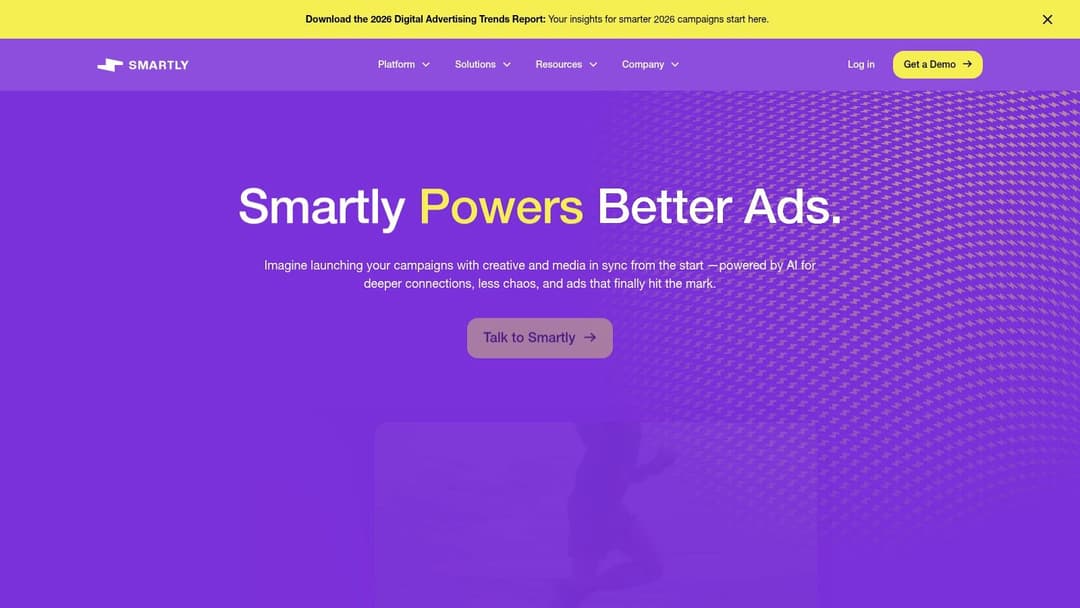
The platform’s AI Studio allows for rapid image and video generation and personalization, which feeds directly into its powerful testing and optimization workflows. By automating both creative versioning and budget allocation, Smartly.io helps advertisers discover winning combinations faster and scale them efficiently. This focus on workflow unification makes it a standout choice for agencies and multi-brand organizations that struggle with siloed processes. Understanding its features requires familiarity with dynamic creative optimization, a core concept the platform masters at scale. However, its enterprise focus means pricing is not public and it's best suited for teams with significant ad spend.
Key Features & Use Cases
- Best For: Large enterprise brands, global agencies, and high-spend e-commerce retailers needing to streamline creative and media workflows.
- Core AI Capability: Predictive budget allocation and AI-powered creative generation for producing and testing ad variations at scale.
- Unique Offering: A unified platform that combines creative production, media buying, and intelligence, fostering collaboration between otherwise separate teams.
| Feature Analysis | Rating | Details |
|---|---|---|
| Ease of Use | ★★★☆☆ | Powerful but complex. It has a steeper learning curve suited for experienced marketing teams rather than beginners. |
| AI Transparency | ★★★☆☆ | Provides robust reporting and testing insights, offering clear data on creative and audience performance to guide decisions. |
| Customization & Control | ★★★★☆ | Offers deep control over creative testing, audience segmentation, and campaign rules, blending automation with expert-level oversight. |
| Reach & Scale | ★★★★☆ | Integrates with major social and display platforms, built specifically for managing high-volume, multi-channel campaigns effectively. |
Pros & Cons
Pros:
- Creative Efficiency: Drastically reduces time spent on creative production and testing.
- Unified Workflow: Excellent for agencies and multi-brand teams by centralizing operations.
- Proven Performance: Case studies demonstrate significant improvements in campaign speed and results.
Cons:
- Enterprise Pricing: Not accessible for SMBs; requires enterprise-level contracts.
- High Spend Requirement: The platform's value is most apparent at a moderate to large ad spend.
- Complexity: Can be overwhelming for smaller teams without dedicated ad operations resources.
Website: https://www.smartly.io/
9. Skai (formerly Kenshoo) – Celeste AI
Skai, formerly known as the search advertising powerhouse Kenshoo, has evolved into a comprehensive omnichannel marketing platform for enterprise-level advertisers. Its intelligence engine, Celeste AI, powers automation and optimization across paid search, social, and retail media channels. Skai’s strength lies in its ability to unify disparate data sources, offering a holistic view of the customer journey and enabling sophisticated, cross-channel budget allocation and strategic planning from a single interface.
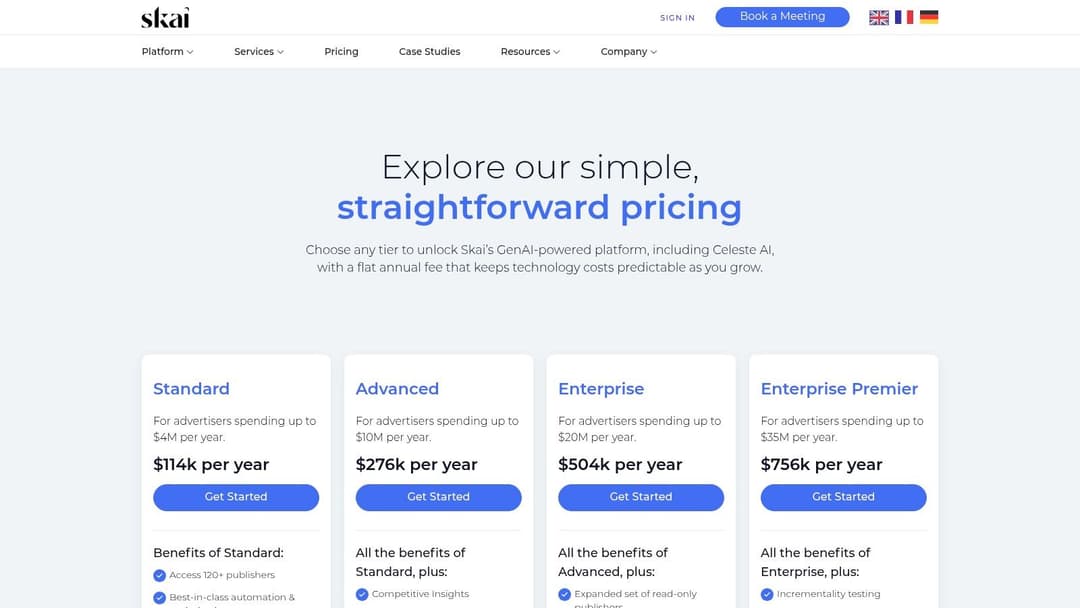
Unlike many AI advertising companies that operate on opaque pricing models, Skai stands out by publishing its flat annual pricing tiers directly on its website, providing rare transparency for prospective clients. The platform is engineered for large-scale operations, providing deep competitive insights, search term analysis, and incrementality testing to validate ad spend effectiveness. However, its robust feature set and enterprise focus mean it comes with a significant price tag and a steeper learning curve, making it less suitable for smaller businesses or teams without dedicated analyst resources.
Key Features & Use Cases
- Best For: Large enterprises and agencies managing significant ad spend across search, social, and retail media who need a unified intelligence layer.
- Core AI Capability: Celeste AI provides predictive forecasting, budget pacing, and cross-channel optimization recommendations to maximize performance.
- Unique Offering: Transparent, flat-fee annual pricing tiers published publicly, which is a major differentiator in the enterprise adtech space.
| Feature Analysis | Rating | Details |
|---|---|---|
| Ease of Use | ★★★☆☆ | Powerful and comprehensive, but the interface requires significant training and expertise to leverage its full capabilities effectively. |
| AI Transparency | ★★★★☆ | Provides detailed insights and data-driven recommendations, offering a clear view into how AI is informing strategic decisions. |
| Customization & Control | ★★★★★ | Highly customizable with deep, granular controls for campaign management, bidding strategies, and reporting across all channels. |
| Reach & Scale | ★★★★☆ | Integrates with all major search, social, and retail media networks, built specifically for managing large-scale, complex campaigns. |
Pros & Cons
Pros:
- Transparent Pricing: Clear, tiered annual pricing based on ad spend, removing guesswork.
- Deep Enterprise Features: Offers advanced tools like incrementality testing and competitive intelligence.
- Omnichannel Integration: Provides a unified platform for managing search, social, and retail media.
Cons:
- High Cost of Entry: Significant annual fees make it inaccessible for many SMBs.
- Steep Learning Curve: The platform's complexity requires dedicated time and resources for onboarding and mastery.
- Overkill for Smaller Teams: The extensive feature set may be more than what smaller advertisers need.
Website: https://skai.io/pricing/
10. StackAdapt
StackAdapt has carved out a strong niche as a self-serve programmatic demand-side platform (DSP) that is particularly popular among agencies and mid-market brands. It distinguishes itself with Ivy, its AI assistant, designed to guide advertisers through campaign planning, launch, and optimization. This makes advanced programmatic advertising more accessible without sacrificing powerful features like Account-Based Marketing (ABM), contextual targeting, and multi-channel orchestration across native, CTV, video, and display. The platform is built for advertisers who need sophisticated, multi-channel capabilities beyond the walled gardens of Google and Meta.
The core of StackAdapt’s AI is about augmenting the strategist, not just automating tasks. Ivy can provide real-time campaign forecasts and suggestions, helping users navigate the complexities of programmatic buying. This blend of AI assistance with user control strikes a balance that many experienced media buyers appreciate. Furthermore, its Data Hub allows advertisers to onboard and activate their first-party data, creating a powerful synergy between programmatic reach and proprietary audience insights. This focus on both AI-driven recommendations and user empowerment makes it one of the more versatile ai advertising companies for those with some programmatic fluency.
Key Features & Use Cases
- Best For: Digital marketing agencies, B2B marketers (using ABM), and mid-market brands running multi-channel programmatic campaigns.
- Core AI Capability: The Ivy AI assistant offers intelligent recommendations for campaign setup, targeting, and optimization.
- Unique Offering: Programmatic + email orchestration, allowing advertisers to sequence and coordinate display, video, and email touchpoints in a single platform.
| Feature Analysis | Rating | Details |
|---|---|---|
| Ease of Use | ★★★★☆ | The UI is well-regarded, and the Ivy AI assistant lowers the learning curve. However, programmatic concepts still require some expertise. |
| AI Transparency | ★★★☆☆ | Provides clear recommendations and forecasts, but the underlying models for optimization are not fully transparent. |
| Customization & Control | ★★★★☆ | Offers significant control over targeting, channels, and strategy, with AI acting as a co-pilot rather than a black box. |
| Reach & Scale | ★★★★☆ | Extensive reach across open web inventory, including high-growth channels like Connected TV (CTV) and native advertising. |
Pros & Cons
Pros:
- Broad Channel Support: Excels in native, video, display, and CTV advertising.
- Excellent Support & Education: StackAdapt Academy is a valuable resource for training teams.
- Flexible Pricing: Supports various models like CPM, CPC, and CPE to align with different campaign goals.
Cons:
- Quote-Based Pricing: Lacks transparent pricing; requires engaging with sales to understand costs and minimums.
- Requires Programmatic Knowledge: While user-friendly, it’s most effective in the hands of users with a foundational understanding of programmatic advertising.
Website: https://www.stackadapt.com/
11. Taboola
For advertisers looking to scale beyond the walled gardens of social media and search, Taboola offers a powerful AI-driven solution for the open web. As a leading native discovery platform, Taboola places sponsored content on thousands of premium publisher websites, appearing as "recommended for you" articles. Its AI focuses on predictive placement, analyzing user behavior, context, and publisher data to serve ads to audiences most likely to engage and convert, driving traffic and leads from sources that competitors might overlook.
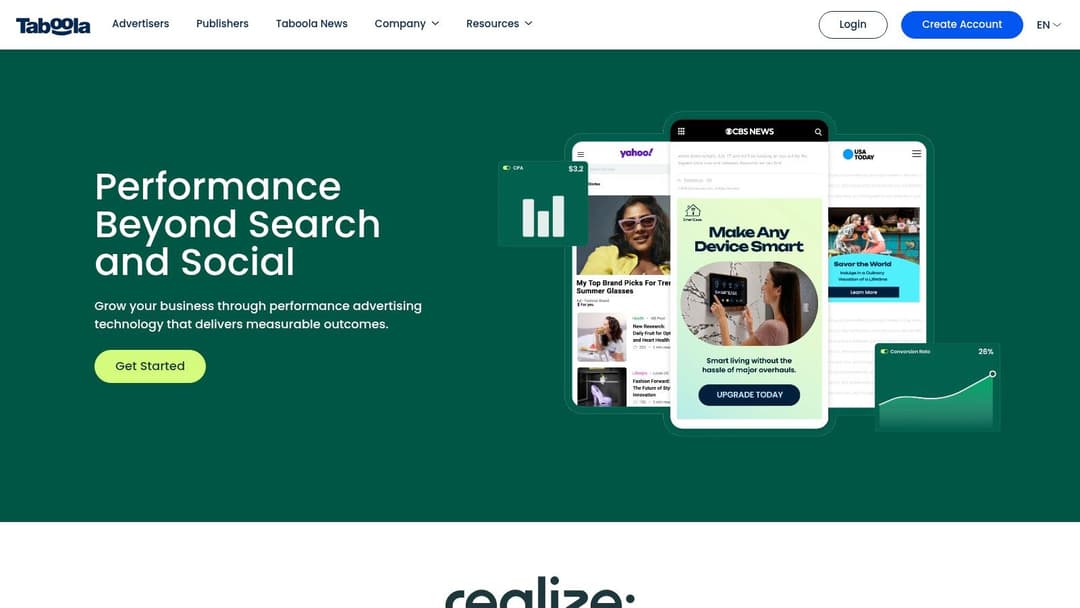
The platform's core AI bidding technology, SmartBid, automates bid adjustments to maximize campaign performance based on conversion goals. While this simplifies optimization, success on Taboola requires a different approach than on social platforms. Marketers must actively manage creative quality and publisher placements to maintain brand safety and performance. The self-serve platform and extensive help-center documentation provide a solid foundation, but there is a learning curve. Its straightforward workflow and flexible billing options make it an accessible, if hands-on, choice among AI advertising companies for open-web expansion.
Key Features & Use Cases
- Best For: Content marketers, e-commerce brands, and publishers aiming to drive qualified traffic and conversions from premium editorial environments.
- Core AI Capability: A predictive engine that matches content to users based on real-time signals, paired with SmartBid for automated bid optimization.
- Unique Offering: Massive scale on the open web, allowing advertisers to reach audiences in a content-discovery mindset outside of traditional ad formats.
| Feature Analysis | Rating | Details |
|---|---|---|
| Ease of Use | ★★★☆☆ | The self-serve platform is straightforward, but mastering publisher lists and creative optimization requires a learning period. |
| AI Transparency | ★★★☆☆ | Provides good reporting on publisher-level performance but less insight into the specific signals driving the AI's bidding decisions. |
| Customization & Control | ★★★★☆ | Offers granular control over publisher and site blocklists, plus manual bidding overrides, giving marketers significant leverage. |
| Reach & Scale | ★★★★★ | Taps into a vast network of premium publisher websites, offering enormous potential for scaling campaigns on the open web. |
Pros & Cons
Pros:
- Large Open-Web Reach: Access to a huge discovery network beyond social and search platforms.
- Straightforward Workflow: The self-serve interface and documentation make campaign setup relatively simple.
- Flexible Billing Options: Supports various payment terms, including auto-billing, invoicing, and prepay.
Cons:
- Requires Active Management: Creative quality and placement controls need constant monitoring to ensure performance.
- Learning Curve: The platform's logic and optimization levers differ significantly from traditional social ad platforms.
- Potential for Fees: Credit-card processing fees may apply for certain billing methods.
Website: https://www.taboola.com/
12. G2 – Demand‑Side Platform (DSP) Category
While not a direct AI platform itself, G2’s Demand-Side Platform (DSP) category serves as an indispensable research and discovery hub for advertisers. This software marketplace allows teams to efficiently discover, compare, and shortlist the leading AI-powered DSPs like StackAdapt, Viant, and Google Marketing Platform. It aggregates verified user reviews, feature lists, and market presence data into Grid reports, providing a crucial starting point for any team looking to evaluate and onboard new ad tech.
The platform's value lies in its ability to streamline the vendor due diligence process. Instead of starting from scratch, marketers can use G2's filters to identify solutions with specific AI capabilities, such as creative or machine learning optimization, and see how they are rated by real users. This peer-review-driven approach helps cut through marketing jargon and provides honest insights into a platform’s strengths and weaknesses. Understanding the landscape of these tools is a key step in seeing how the modern ad tech stack compares to AI vs traditional advertising methods.
Key Features & Use Cases
- Best For: Marketing teams and agencies evaluating and comparing AI-driven DSPs and other ad tech before committing to a trial or demo.
- Core AI Capability: Acts as a meta-resource for discovering platforms with features like predictive bidding, lookalike audience modeling, and dynamic creative optimization.
- Unique Offering: Verified peer reviews and comprehensive Grid reports that benchmark vendors based on user satisfaction and market presence.
| Feature Analysis | Rating | Details |
|---|---|---|
| Ease of Use | ★★★★★ | The interface is highly intuitive, with powerful filters that make it easy to narrow down a long list of potential vendors. |
| AI Transparency | ★★★☆☆ | While not an AI tool itself, the user reviews often provide valuable insights into the transparency and effectiveness of each listed DSP's AI. |
| Customization & Control | ★★★★☆ | Users have extensive control over their research process via filters for company size, features, and industry focus. |
| Reach & Scale | ★★★★★ | As a leading software marketplace, G2 offers one of the most comprehensive directories of DSPs and ad tech solutions available. |
Pros & Cons
Pros:
- Saves Time: Significantly speeds up the vendor research and shortlisting process.
- Review-Driven Insights: Provides honest, real-world feedback from actual users, not just vendor marketing materials.
- Free to Use: Browsing, comparing, and reading reviews is completely free for users.
Cons:
- No Published Pricing: Exact pricing is rarely available on listings, requiring direct vendor contact.
- Sponsored Placements: Users should be aware that some vendor visibility can be influenced by sponsorships.
- Requires Further Vetting: Serves as a starting point; vendor demos and trials are still necessary to confirm a good fit.
Website: https://www.g2.com/categories/demand-side-platform-dsp
Top 12 AI Advertising Companies — Feature Comparison
| Product | Core features | AI & Optimization | Target audience | Control & transparency | Pricing & value |
|---|---|---|---|---|---|
| AdStellar AI | Bulk ad creation, AI Insights, AI Launch, Meta Ads OAuth | Goal‑tied ranking (ROAS/CPL/CPA), continuous learning, auto‑scaling winners | Performance marketers, e‑commerce/DTC, agencies, B2B SaaS, growth teams | Centralized workflows, one‑click launches; Meta‑focused (single‑platform) | Pricing not public — demo/pilot recommended; high production speed & efficiency gains |
| Google Ads – Performance Max | Cross‑channel reach (Search, YouTube, Display, Discover, Gmail, Maps), asset auto‑assembly | Google AI real‑time bidding & asset combos for conversions/ROAS | SMBs to enterprise seeking maximum Google inventory reach | Low transparency vs manual campaigns; limited granular control | Auction pricing; minimal setup time, broad reach/value for volume campaigns |
| Meta Advantage+ | End‑to‑end audience, placement & budget automation; templates for shopping/leads/apps | Native Meta auto‑optimization across FB/IG/Reels with pixel/CAPI integration | Paid social teams, retailers, app marketers | Fast setup, strong platform integration; trade‑offs for granular control | Standard Meta billing; quick baselines but min budgets may apply |
| Microsoft Advertising + Copilot | Copilot assistant, asset recommendations, search/display/LinkedIn network support | Generative Copilot for setup, creative drafts & troubleshooting | Advertisers using Bing/Microsoft inventory, retail search, niche audiences | Helpful automation but creative needs human review; moderate control | Copilot included with accounts; smaller reach than Google/Meta |
| The Trade Desk (Koa AI) | Enterprise DSP, CTV/display/video/audio, Audience Unlimited data marketplace | Koa AI trading modes, adaptive trading & transparent data pricing | Large advertisers/agencies focused on CTV and open‑web programmatic | High transparency & control; requires expertise/onboarding | Enterprise contracts, platform fees; pricing via sales |
| Quantcast Platform | Cookieless planning, activation & measurement in one UI | AI‑driven modeling, audience graph, real‑time insights | Agencies & advertisers seeking cookieless scale | Medium control; clear docs but modeling add‑ons apply | Fees include modeling/bidding add‑ons (% of inventory); self‑serve options |
| Criteo – Commerce Growth | Commerce AI, dynamic product recommendations, DCO+, retail media | Product‑level AI, LTV optimization, catalog‑driven ads | E‑commerce, DTC and retailers needing catalog intelligence | Feed & tag setup required; strong product integrations | IO/contract pricing; enterprise orientation, value for commerce use cases |
| Smartly.io | AI Studio (image/video), dynamic creative, predictive budget allocation | Strong creative generation & large‑scale testing, predictive allocation | Agencies, multi‑brand enterprises needing creative+media orchestration | Robust governance & workflow unification; enterprise tooling | Enterprise pricing (quote); best ROI at moderate‑to‑large spend |
| Skai (Celeste AI) | Omnichannel management, Celeste AI, planning & intelligence | Customer‑journey intelligence, automation across channels | Enterprise advertisers seeking full‑suite capabilities | Deep features and support; steeper learning curve | Published tiered annual pricing; higher annual fees |
| StackAdapt | Self‑serve DSP, Ivy AI assistant, CTV/native/video, Data Hub | Ivy AI for planning/optimization, forecasting, dynamic creative | Agencies and mid‑market brands using programmatic channels | Flexible controls; advanced features require programmatic fluency | Quote‑based pricing (CPM/CPC/CPE); flexible for mid‑market |
| Taboola | Native discovery, predictive placement, SmartBid, flexible billing | Predictive placement & SmartBid optimization for open‑web | Advertisers seeking discovery/traffic beyond social platforms | Self‑serve; creative & placement need active management | Predictable billing options (prepay/invoice); self‑serve value |
| G2 – DSP Category | Marketplace for DSP discovery, reviews, Grid reports & filters | N/A (research & peer insights) | Procurement, marketers evaluating DSPs & ad tech | Helps shortlist vendors but requires vendor trials | Free to browse; pricing typically not published on listings |
Final Thoughts: Integrating AI Into Your Advertising Strategy
The era of manual, guess-driven advertising is rapidly coming to an end. The AI advertising companies detailed in this guide represent a fundamental shift in how campaigns are conceived, executed, and optimized. From automating creative production on Meta with tools like AdStellar AI to orchestrating complex programmatic buys via The Trade Desk or harnessing the massive data sets of Google and Meta, these platforms offer tangible solutions to drive both efficiency and performance.
The key to success, however, is not simply adopting any AI tool. It's about strategically choosing the right partner for the right job. A B2B SaaS company will have vastly different needs than a high-volume DTC e-commerce brand. The former might prioritize the sophisticated audience targeting of StackAdapt, while the latter could see massive gains from the automated campaign structures of Meta Advantage+.
How to Choose the Right AI Advertising Partner
Navigating the landscape of ai advertising companies can feel overwhelming. To cut through the noise, start by performing an internal audit of your current advertising workflow. Identify your most significant bottleneck or your biggest area of opportunity.
Use these questions as a starting point for your evaluation:
- Creative Production: Is your team spending too much time iterating on ad creatives and copy? A solution like Smartly.io or a specialized creative AI tool could be the answer. Beyond optimizing bidding and targeting, AI also plays a crucial role in creative development, with AI-powered description tools enhancing the impact of ad copy across platforms like YouTube.
- Audience Targeting: Are you struggling to find new, high-intent audiences and move beyond basic lookalikes? Platforms like Quantcast or Criteo excel at using predictive intelligence to uncover new customer segments.
- Budget Allocation: Do you manage campaigns across multiple channels and find it difficult to allocate budget effectively? A cross-channel platform like Skai can provide the unified data and optimization engine you need.
- Campaign Management: Is the day-to-day management of bids, budgets, and campaign rules consuming too many resources? The native AI suites from Google (Performance Max) and Microsoft (Copilot) are designed to automate these exact tasks.
Implementing AI for Maximum Impact
Once you’ve selected a platform, remember that implementation is just as critical as the technology itself. Treat these tools not as "set it and forget it" solutions, but as powerful co-pilots for your marketing team. The most successful teams provide these AI systems with high-quality first-party data, clear business objectives (e.g., ROAS targets, CPA goals), and high-performing creative assets.
Continuous learning is essential. Monitor performance closely, stay informed about platform updates, and be willing to test new features. The true value is unlocked when human strategy guides machine execution. By strategically integrating the right AI partner into your workflow, you can move faster, make smarter decisions based on data, and ultimately unlock new levels of sustainable growth for your business.
Ready to stop guessing and start performing? The ai advertising companies listed here offer powerful capabilities, but for teams focused on mastering paid social, the right tool makes all the difference. See how AdStellar AI can automate your creative testing, optimize your campaign structures, and unlock scalable performance on Meta and TikTok. Get started with AdStellar AI today.