The placement of advertising is all about deciding where your ad shows up to connect with the right people. This choice has become one of the most powerful levers you can pull for campaign success.
It’s the "where" that truly defines an ad's impact, whether it's a high-energy TikTok In-Feed video or a simple banner ad on a niche blog. This single decision ends up dictating your costs, the creative formats you can use, and, ultimately, your return on investment.
Why Your Ad Placements Are More Important Than Ever

Let’s be honest, ad placement often feels like just another checkbox to tick during campaign setup. But in reality, it's one of the most critical decisions you'll make.
Think of it like real estate. A flashy billboard in Times Square serves a completely different goal—and comes with a totally different price tag—than a targeted flyer in a local neighborhood. Each has its purpose, but confusing the two is a surefire way to burn through your ad spend.
The exact same principle applies online. The environment where your ad appears gives it essential context, shaping how people perceive it and respond. An ad someone sees during a high-intent Google search lands very differently than one they stumble upon while scrolling through Instagram Stories. Getting a handle on this context is the first step to turning placement from a simple task into a real competitive advantage.
The Decisive Shift to Digital Placements
Over the last decade, the center of gravity for advertising has shifted decisively into the digital world. This isn't just about changing channels; it's a fundamental change in strategy, driven by where attention is most measurable and targetable.
In 2024, digital channels captured a staggering 72.7% of the nearly $1.1 trillion global ad spend—a figure that was below 50% as recently as 2018. This massive flow of money highlights one undeniable truth: marketers are following the audience, and the audience is online.
Choosing the right placement is about more than just getting impressions; it's about delivering the right message, in the right format, at the exact moment a user is most receptive.
The explosion of digital channels has made this choice incredibly complex, but it's also created a wealth of opportunity. Every platform offers a unique inventory of ad placements, each with its own strengths:
- Social Media Feeds: Perfect for grabbing attention during casual browsing.
- In-Stream Video: Ideal for engaging a captive audience before or during the content they want to watch.
- Search Results: The best way to connect with users who are actively looking for solutions.
- In-App Banners: Great for reaching highly specific user segments based on the apps they use.
This guide will give you the actionable frameworks real performance marketers use to master both the art and the science of ad placement. You'll learn how to select, test, and optimize your choices to drive real business results.
Navigating The Digital Advertising Landscape
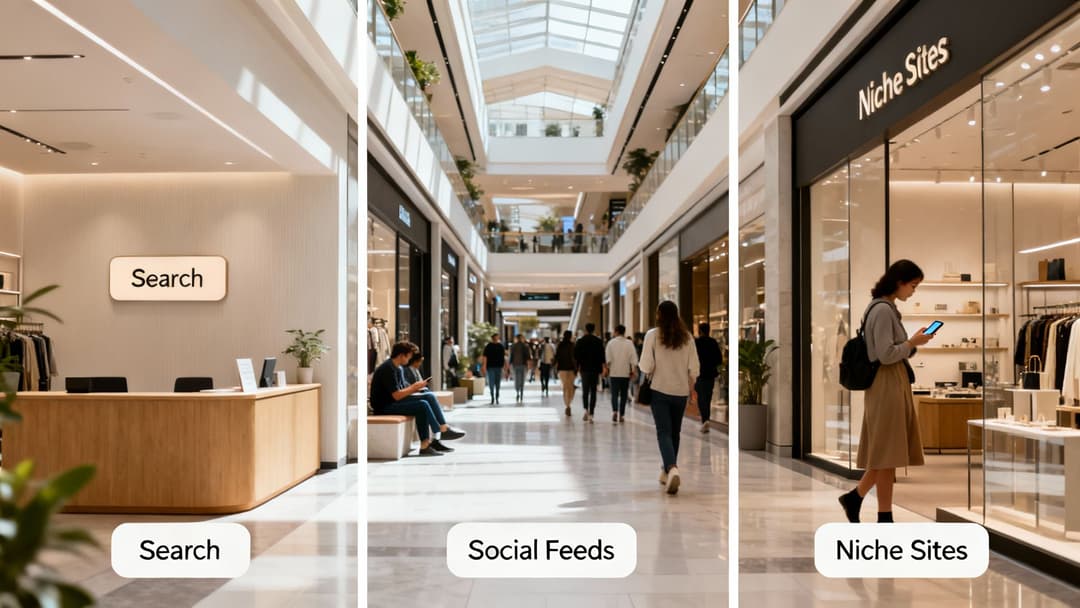
Feeling overwhelmed by all the ad placement options out there? You’re not the only one. The secret isn't to memorize every single ad format. It’s about understanding the core ecosystems where your ads actually live.
Each of these environments attracts people with a totally different mindset. Aligning your message with that mindset is what separates a killer campaign from a complete waste of money.
Think of the digital world as a massive shopping mall. Every section of the mall serves a unique purpose for its visitors. The placement of advertising you choose is like picking where to set up your store—it directly impacts who walks by and what they’re looking for.
The Information Desk: Google
Google is the mall's information desk. People show up with a specific problem or a question they need answered, and they are actively looking for a solution. This is a high-intent environment. They aren’t just window shopping; they're on a mission.
Placements here are all about giving people direct answers:
- Google Search Ads: These pop up the instant someone types in a search for your product or a related problem. Their intent is crystal clear, making this a beast for capturing existing demand.
- YouTube Ads: You can catch people searching for "how-to" videos or product reviews, mixing problem-solving with entertainment.
- Google Display Network: This lets you reach people across millions of websites, but its real power is in retargeting users who’ve already checked out your site and shown interest.
The Bustling Corridors: Meta
Meta's platforms—think Facebook and Instagram—are the mall's crowded hallways and social plazas. People are there to connect with friends, discover new things, and kill some time. They're in a passive, lean-back mode, scrolling through Feeds, Stories, and Reels.
Your job is to be the scroll-stopper. You need an ad so compelling it makes them pause. User intent here is low, but the potential for discovery is massive. To get the full picture on reaching these users, check out our guide on targeted advertising on social media.
The goal isn't to answer a question they already have. It’s to create a new one: "Whoa, what's this?"
The Specialty Boutiques: Programmatic Ads
Programmatic advertising is your key to all the specialty shops and boutiques tucked away in the mall—the niche blogs, industry news sites, and hobbyist forums. This is the open web.
Here, user intent is all about context. Someone reading a deep-dive review of hiking boots on an outdoor blog is in a completely different headspace than someone scrolling through celebrity gossip. Programmatic placements let you find these super-specific, high-value audiences wherever they hang out.
For advertisers ready to tap into this world, getting familiar with the various CTV advertising platforms is a smart move, as this slice of programmatic just keeps getting bigger.
To get a clearer picture of how these environments stack up, here’s a quick comparison.
Ad Placement Ecosystems at a Glance
| Ecosystem | Primary Placement Types | Typical User Intent | Best For |
|---|---|---|---|
| Search Ads, YouTube, Display Network | High (Active Search): Seeking solutions, comparing options, ready to buy. | Capturing existing demand, lead generation, direct sales, retargeting. | |
| Meta | Feeds, Stories, Reels, In-Stream Video | Low (Passive Discovery): Browsing, connecting, being entertained. | Brand awareness, creating new demand, community building, top-of-funnel engagement. |
| Programmatic | Display, Native, Video, Audio, CTV | Contextual (Varies): Reading content, researching interests, consuming media. | Niche targeting, scaling reach on the open web, reaching specific interest groups. |
Ultimately, understanding these three core environments is the first real step toward making smarter placement decisions. Each one gives you a unique shot at connecting with customers, but only if your message and creative are a perfect match for their mindset.
How Placements Shape Your Campaign from Top to Bottom
Picking an ad placement isn't the last thing you do; it's one of the first. This single decision sends ripples through your entire campaign strategy. The "where" you decide to show up dictates everything that comes next, from the creative you build to the price you pay for a moment of someone's attention.
Think of it like choosing a venue for a concert. A quiet, acoustic set in a small club needs a totally different setup, sound system, and ticket price than a rock show in a massive stadium. In the same way, your ad placement sets the rules of the game. You have to play by them to win.
Creative and Placement: A Perfect Match
The most immediate and obvious impact of placement is on your creative. The format, the dimensions, even the tone of your ad are completely tied to where it’s going to run. There’s absolutely no one-size-fits-all ad.
An Instagram Story, for example, demands a vertical, sound-on video with quick cuts and bold text overlays to grab attention in just a few seconds. If you tried to run a slow, cinematic, horizontal ad there, it would be an absolute disaster. But that same cinematic ad might be the perfect pre-roll for a YouTube video, where people are already primed for a more traditional video format.
It breaks down like this:
- Vertical Video: Placements like TikTok, Reels, and Stories are built for 9:16 aspect ratio videos. They're designed for a full-screen mobile experience.
- Static Images: That gorgeous, high-resolution lifestyle photo? It'll look fantastic in a Facebook Feed. But it's completely useless in a placement that only accepts video.
- Text-Heavy Ads: LinkedIn is a professional context where you can get away with more text and a formal tone. That same ad would get scrolled past in a heartbeat on a visual-first platform like Pinterest.
A mismatched creative is one of the fastest ways to burn through your ad budget. The ad feels jarring and out of place, it annoys the user, and the platform's algorithm will bury it, leaving you with terrible delivery and sky-high costs.
How Targeting and Bidding Change
Your choice of placement also completely changes your targeting and bidding strategy. Some placements offer incredibly unique ways to dial in on an audience. Running an in-app ad, for instance, lets you target users of a specific piece of software—a level of precision you just can't get from a broad social feed.
Bidding is a whole different ballgame, too. A premium, high-visibility spot like the top of a social media feed will always have a higher cost-per-impression (CPM) than a less-seen banner ad tucked away on an Audience Network site. That’s because the platforms know exactly which placements drive the most engagement and, ultimately, the most conversions.
Today's advertising world is dominated by social and performance-focused environments. On a platform like Meta, you're not just buying one placement; you have access to a whole ecosystem of surfaces—Feed, Stories, Reels, in-stream video, and more. Each one comes with its own CPMs and click-through rates. AI-driven systems chew through granular performance data across all these placements, using historical trends to figure out the best mix of creative and audience to get you the lowest cost-per-acquisition. You can learn more about how AI is shaping 2025 ad spend benchmarks.
Aligning Measurement with Placement
Finally, your Key Performance Indicators (KPIs) have to make sense for the placement. Not every placement is built to drive an immediate click or an instant sale, and trying to measure them that way is a recipe for frustration.
An in-stream video ad, for example, is a classic top-of-funnel play. Its job is brand awareness. Judging it on click-through rate would be a huge mistake. Instead, you should be looking at metrics like video completion rate or view-through conversions. On the flip side, a retargeting ad on the Google Display Network is all about getting that final click. For that, Cost Per Acquisition (CPA) is the only KPI that really matters.
When you align your creative, targeting, bidding, and measurement with your placement from the start, you build a coherent strategy. Every piece works together, helping you avoid costly mistakes and get the best possible return on your investment.
Building a Placement Testing Strategy That Actually Works
Let's be honest: a lot of advertisers just guess where their best customers are. But you don't have to. A solid testing strategy is your playbook for turning placement optimization into a repeatable, high-impact process that consistently improves your return on ad spend.
The first big decision you'll face is the classic trade-off: manual control versus algorithmic power. Platforms like Meta offer automated options—think Advantage+ Placements—that use machine learning to sniff out the most efficient spots to run your ads across their entire network. For new campaigns, this is often the perfect place to start. It casts a wide net.
But leaning only on automation can leave you blind to some crucial insights. Going manual gives you the control to test very specific ideas and get clean data on what really works for your brand, your creative, and your audience. The winning move is often a hybrid approach. Start broad with automation, then use the data you gather to run targeted, manual tests on the most promising placements.
This whole process is a chain reaction. Your placement decision is the first domino that falls, directly influencing your creative and bidding strategy.
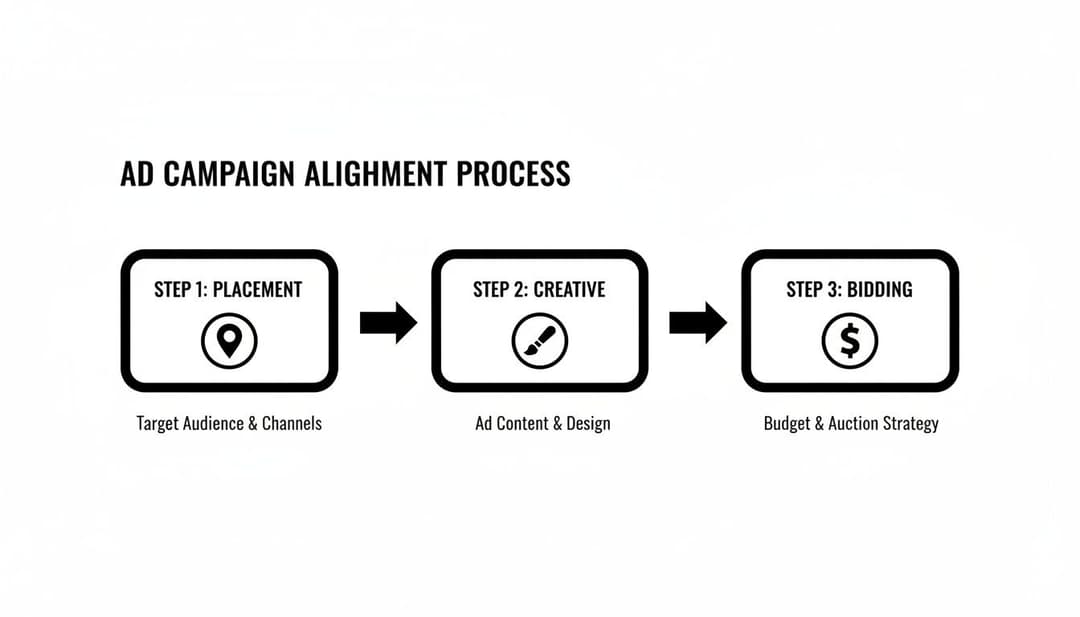
As you can see, a successful campaign depends on getting each piece aligned, and it all starts with where you choose to show up.
Crafting a Clean A/B Test for Placements
A truly effective A/B test is built on a clear, simple hypothesis. The whole point is to isolate one variable—in this case, the placement—so you can confidently say that any difference in performance was because of that single change.
Your hypothesis needs to be specific and measurable. Something like this: “Hypothesis: Running ads exclusively in Instagram Reels will drive a lower Cost Per Acquisition (CPA) than running the same ads in Facebook Feed for our Q3 promotion.”
Once you have a sharp hypothesis, structuring a clean test is straightforward. Here’s a simple framework:
- Isolate the Variable: Create two identical ad sets. I mean identical—same creative, same copy, same audience targeting, same budget.
- Assign Placements: In Ad Set A, select only "Facebook Feed." In Ad Set B, select only "Instagram Reels." That's it.
- Run the Test: Launch both ad sets at the same time. Then, let them run until you have enough data to make a call you can stand behind.
This disciplined approach is what keeps your results from getting muddied by other factors. If you find yourself wanting to test a bunch of placements at once, you might want to learn more about what multivariate testing is and how it can help you untangle those complex combinations.
Allocating Budget and Measuring Success
So, how much should you spend on a test? There's no magic number, but your budget absolutely has to be big enough to achieve statistical significance. That’s just a fancy way of saying you have enough data to be confident the results weren't a random fluke.
As a rule of thumb, aim for at least 50-100 conversions per variation before calling a winner. If your target CPA is $20, you'd need a minimum test budget of $1,000-$2,000 per ad set to gather meaningful data.
When the test is done, it's time to analyze the results against the main KPI from your hypothesis.
- Primary KPI: Did Reels actually hit a lower CPA than Feed?
- Secondary KPIs: How did other metrics like Click-Through Rate (CTR) or Cost Per Mille (CPM) stack up? These can add valuable color to the story.
If one placement is the undisputed champion, it's time to scale. Start shifting more of your budget toward the winner. But what if the results are a wash? That’s still a win. It tells you both placements perform about the same for that offer, giving you more flexibility. This cycle of hypothesizing, testing, and scaling is how you turn good campaigns into truly great ones.
Avoiding the Most Common Ad Placement Mistakes
 Even the sharpest marketers can fall into common traps that drain ad spend and grind a campaign’s momentum to a halt. Nailing your placement of advertising is about more than just hitting the launch button; it’s about staying vigilant and sidestepping the unforced errors that quietly bleed your budget dry.
One of the biggest culprits is what I call the "set it and forget it" syndrome. It’s easy to enable automatic placements, put your full trust in the algorithm, and never circle back to check the performance breakdown. Automation is a fantastic tool, but when left unchecked, it can pour your money into corners of the internet that just don't perform, killing your return on ad spend (ROAS).
Mismatched Creative and Mobile Neglect
Another costly mistake is running creative that just doesn't fit. This happens all the time: a beautiful, cinematic horizontal video gets awkwardly forced into a vertical, fast-paced Instagram Story. The result? A jarring user experience that screams "low-effort" to both the user and the platform's algorithm, leading to poor delivery.
Just as damaging is forgetting that we live in a mobile-first world. The vast majority of ad impressions today are served on mobile devices. If you're still designing ads for a desktop view and just shrinking them down for mobile, you're setting yourself up for failure. Text becomes impossible to read, and calls-to-action are too small to tap, crippling your campaign from the get-go.
The fix is simple but absolutely non-negotiable: Audit your placement performance weekly. And for goodness' sake, build creative assets specifically for the environments where they'll live. A mobile-first mindset isn't just a good idea anymore; it's essential for survival.
If you've checked all these boxes and your campaign is still struggling to get delivered, other issues might be at play. You can dig deeper into troubleshooting with our guide on what to do when your ad is not delivering on Facebook.
The Lure of Low-Quality Placements
Finally, let's talk about the temptation of cheap clicks. Many advertisers get drawn in by placements that promise incredibly low costs—think certain Audience Network sites or random in-app banners. While the cost-per-click (CPC) looks amazing on your spreadsheet, this traffic is often junk, made up of accidental clicks and completely unengaged users.
This leads to a classic scenario where your click-through rate is soaring, but your conversion rate is flatlining at zero. To avoid this trap, you have to obsess over the metrics that actually matter to your business.
- Cost Per Acquisition (CPA): What are you really paying to get a paying customer?
- Return On Ad Spend (ROAS): Is this placement actually generating revenue?
When you shift your focus to bottom-line results instead of vanity metrics, you'll quickly spot the cheap, low-value placements that deliver clicks but zero real growth. Cut them without mercy.
The Future of Ad Placement Is AI-Powered
Trying to manually manage ad placements today is like trying to direct city traffic with a hand-held stop sign. The digital advertising space has just gotten too big and moves too fast for that to work anymore. This is where AI and automation stop being buzzwords and become your most powerful allies, turning a logistical nightmare into a real strategic advantage.
Modern ad platforms are now smart enough to analyze millions of signals in the blink of an eye—everything from a user’s immediate behavior to the context of the page they’re on. They use this data to predict which placement will deliver the best bang for your buck. This isn't just about speeding up a tedious task; it's about making smarter, more profitable decisions at a scale no human team could ever hope to match.
Letting the Algorithm Drive
The best part? These AI-driven tools are always learning. They get better with every impression, ensuring your campaigns don't just start strong but stay ahead of the curve to deliver the highest possible return. For performance marketers, leaning on algorithmic optimization isn't just a "nice-to-have" anymore. It's quickly becoming table stakes for success.
The entire economy of ad placement has been reshaped by programmatic and AI-driven buying, with the vast majority of impressions being auctioned off in real time. With programmatic now accounting for roughly 90% of all display ad buys globally, the market is so fragmented that manual management is practically impossible if you want to scale.
AI doesn't guess where your customers are. It uses data to calculate the most profitable path to reach them, analyzing thousands of placement options in the time it takes you to check your email.
The Strategic Value of Automation
When you let AI handle the heavy lifting of placement selection, you get your time back. Precious time that can be spent on what really moves the needle: your strategy and creative. For more on how to measure the financial impact of this shift, check out this guide on maximizing your marketing automation ROI.
This frees up your team to brainstorm stronger messaging and develop more compelling visuals, which the AI can then put to the test across all its optimized placements. If you’re running campaigns on Meta, figuring out how to work with these tools is crucial. To get a better handle on this, dive into our detailed guide on using AI for Facebook Ads and see exactly how it works in practice.
Common Questions About Ad Placement
Even with the best strategy, you're going to have questions pop up when you're in the weeds managing ad placements. Let's tackle some of the most common ones I hear from marketers, breaking down the key concepts with some practical advice.
Should I Use Automatic or Manual Placements?
This is the classic debate, and the right answer really depends on where you are with your campaign.
For beginners or any campaign targeting a broad audience, Automatic Placements (like Meta's Advantage+) are your best friend. Just turn it on and let the platform's algorithm do the heavy lifting. It will test your ads across every available spot, gathering a ton of data way faster than you could manually.
You'll want to switch to Manual Placements when you have solid historical data telling you exactly where your winners are. For instance, if you know from past campaigns that Instagram Stories blow everything else out of the water, it makes sense to focus your budget there. Manual is also a must if your creative is specifically designed for one format and would look terrible anywhere else.
The smartest move is usually a hybrid approach. Kick things off with automatic placements to let the algorithm learn and find pockets of opportunity. Then, once the data starts rolling in, you can double down on what’s working by switching to a more manual, refined setup.
How Does Ad Placement Affect My Campaign Budget?
Placements have a huge, direct impact on your costs, specifically your CPM (Cost Per Mille) and CPC (Cost Per Click).
Think of it like real estate. A spot in a high-traffic, high-engagement area like the Instagram Feed or a YouTube pre-roll ad is going to cost you a lot more than a less prominent spot on the Audience Network. Those premium placements command higher CPMs because there's more competition for them.
A winning strategy isn't about chasing the absolute cheapest placements. Those often deliver low-quality clicks that don't convert, which is just throwing money away. Instead, shift your focus to the metrics that actually matter: Cost Per Acquisition (CPA) or Return On Ad Spend (ROAS). Judge each placement by the actual value it brings to your business, not just its price tag.
How Often Should I Review and Change Ad Placements?
For new campaigns, you should be checking in on your placement performance at least weekly. Dive into the reporting dashboards and look at the performance breakdowns. The data is all there.
But—and this is a big but—don't be too quick to pull the trigger on changes. Ad platform algorithms need time to figure things out, usually a learning phase of about 3-7 days. Making drastic cuts too early is a great way to kill a potentially great placement before it has a chance to stabilize.
If a placement is consistently underperforming after that learning period (think high costs, low conversions), then it's time to consider cutting it from the rotation. For older, more stable campaigns, you can ease up a bit. A bi-weekly or monthly check-in is usually enough to keep things running smoothly and efficiently.
Ready to stop guessing and start scaling? With AdStellar AI, you can launch, test, and optimize hundreds of ad variations in minutes, not days. Our platform uses AI to identify your winning placements, creatives, and audiences, helping you maximize ROAS and eliminate wasted spend on Meta. Discover how performance marketers are building better campaigns faster at https://www.adstellar.ai.