So, you want to get into website advertising. Great. But before you dive headfirst into the world of ad networks and campaign settings, you need to answer one fundamental question: are you trying to sell ads or buy them?
This isn't just semantics—it's the core of your entire strategy. Getting advertisements for your website really boils down to two completely different goals:
- Monetization: Selling ad space on your site to make money from your traffic.
- Acquisition: Buying ad space elsewhere to drive traffic to your site.
Each path requires a different playbook, a different set of tools, and a different way of measuring success. This guide will break down both, helping you figure out which direction makes sense for you and how to get started.
Your Blueprint for Website Advertising Success
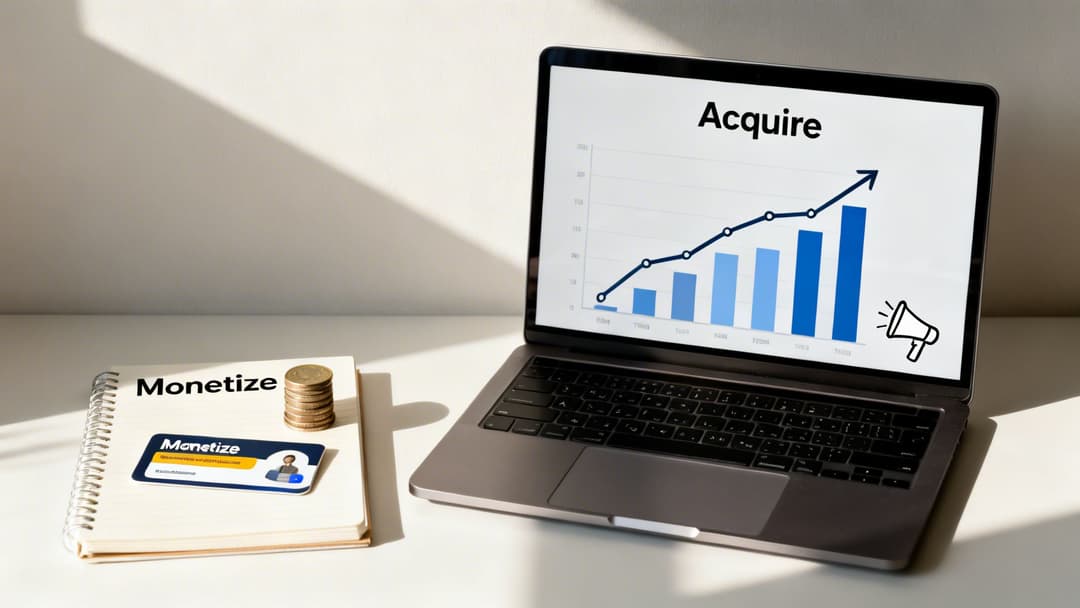
Before we get into the weeds, let's be crystal clear on your objective. Are you a publisher with a growing audience, looking to turn those pageviews into a reliable income stream? Or are you a business owner who needs to get your product in front of new customers?
Your answer changes everything.
The opportunity, whichever path you choose, is massive. The global digital ad spending market rocketed to $650 billion in 2025 and is on track to blow past $750 billion by 2026. This isn't just a trend; it's a seismic shift in how businesses grow and how content creators get paid. There's more than enough room for you to carve out your piece of the pie.
Two Paths to Advertising Success
Choosing your direction is the first real strategic move you’ll make. Let's break down what each one actually involves.
Monetization (Selling Ads): This is the world of creators, publishers, and niche site owners. Here, your website is the product. Your job is to build a dedicated audience and create killer content that advertisers are dying to be associated with. Success is measured in the revenue your traffic generates, whether that's through RPM (Revenue Per Mille) from an ad network or a direct sponsorship deal.
Acquisition (Buying Ads): This is for e-commerce stores, SaaS companies, and service providers. In this scenario, your website is the destination. You're spending money on platforms like Meta, Google, or TikTok to pull targeted traffic back to your site, hoping to turn those visitors into leads or paying customers. Here, you live and die by your ROAS (Return On Ad Spend) and CPA (Cost Per Acquisition).
Here's a simple way to think about it: Monetization turns your audience into revenue. Acquisition turns your revenue into an audience. Knowing which game you're playing clarifies every single decision that comes next.
Choosing Your Advertising Path Monetization vs Acquisition
Still not sure which bucket you fall into? This table should make it crystal clear. It breaks down each path to help you quickly identify your goal and what your first move should be.
| Your Goal | Primary Strategy | Key Channels | Your First Action |
|---|---|---|---|
| Earn money from website traffic | Monetization | Ad Networks, Direct Sales, Sponsorships | Build a Media Kit & Analyze Audience |
| Drive new customers to my business | Acquisition | Paid Search, Paid Social, Display Ads | Define Your Target Audience & Budget |
Ultimately, figuring out how to get advertisements for your website starts right here. Once you clarify whether you’re a seller or a buyer, you can build a focused, effective strategy that actually moves the needle.
For those of you ready to jump into buying ads, you might want to check out our guide on the top ad networks for advertisers. In the sections ahead, we’ll lay out a detailed roadmap for both approaches.
Turning Your Traffic Into Revenue Through Ad Sales
For any publisher or creator, your website traffic is far more than just a number on an analytics dashboard—it's a real, monetizable asset. The trick is to move beyond a simple, single-source approach and start building a layered system for bringing in revenue. While a lot of sites get their start with Google AdSense, the real money is made when you diversify your ad sales strategy.
This means learning how to get advertisements for your website by blending automated platforms with high-touch, premium deals. We’ll get into the nitty-gritty of programmatic advertising, the art of selling your own ad space directly, and the high-value world of sponsorships.
Automating Your Ad Sales with Programmatic Advertising
For most sites, the easiest and fastest way to start monetizing traffic is through programmatic advertising. Think of it as an automated system where ad networks and platforms buy and sell your ad space in real-time auctions. It's the engine running behind the scenes for most of the display ads you see every day.
Instead of hunting down advertisers one by one, you just connect your site to a network that handles all the heavy lifting. This is the perfect setup for publishers who want a consistent, hands-off revenue stream that scales right alongside their traffic.
You've got two main paths to get started here:
- Ad Networks: Platforms like Google AdSense or Media.net are the simplest entry point. You drop a bit of code on your site, and they start filling your ad spaces with ads from their massive pool of advertisers. It’s pretty straightforward.
- Supply-Side Platforms (SSPs): Consider SSPs like Ezoic or Mediavine as the next level up. They plug you into multiple ad exchanges and networks at the same time, which forces more competition for your ad space and almost always drives up your revenue (your CPMs).
While programmatic is incredibly efficient, it’s really just the starting line. The next level of monetization means taking back control and selling your most valuable ad placements yourself.
Securing Premium Deals Through Direct Sales
This is where you cut out the middlemen. Direct-selling is exactly what it sounds like: you negotiate ad placements directly with brands. This strategy is where the big money is, as it typically yields the highest revenue per ad because you keep 100% of the income. The trade-off? It takes more work, from outreach and negotiation to managing the relationships.
To even get your foot in the door, you need a professional and compelling media kit. This is your sales brochure, and it has to look the part.
A great media kit doesn't just list a bunch of stats; it tells a story. It needs to communicate the value of your audience and paint a clear picture of why an advertiser’s message will hit home with them. It’s your chance to prove you’re a genuine partner, not just a digital billboard.
Your media kit should be a polished PDF document that includes:
- An Introduction: A quick summary of your website, your mission, and what makes your content stand out.
- Audience Demographics: Who actually reads your stuff? Include real data on their age, gender, location, interests, and even income levels if you have it.
- Website Statistics: Showcase your key metrics like monthly unique visitors, pageviews, average session duration, and where your traffic comes from. Be honest and always use current numbers.
- Ad Placement Opportunities: Use screenshots to visually map out the ad spots you’re selling (e.g., the 728x90 leaderboard, 300x250 sidebar MPU, in-content banners). Always include dimensions and technical specs. If you want some inspiration, it's worth learning about effective advertising banner design.
- Pricing and Packages: Clearly list your rates for each placement. You'll also want to offer package deals (like a three-month bundle with a 10% discount) to encourage bigger, longer-term commitments.
- Contact Information: Don't make them hunt for it. Make it incredibly easy for an interested brand to get in touch.
Once your media kit is ready, you can start your outreach. Find brands that are a natural fit for your audience and send a personalized email introducing your site and attaching your kit.
Exploring High-Value Sponsorships
Sponsorships and sponsored content are really the top tier of website monetization. Instead of just selling some banner space, you’re offering a much deeper, more integrated partnership. For the advertiser, this can be far more effective, and for you, it's a whole lot more profitable.
Here are a few of the most popular sponsorship models:
- Sponsored Articles: An advertiser pays you to write and publish an article that features their product or service in a natural, editorial style that fits your site.
- Dedicated Emails: You send an email to your subscriber list that is exclusively focused on promoting the sponsor’s brand or offer.
- Site-Wide Sponsorship: A brand "sponsors" your entire website for a set period (like a month), and their logo appears prominently on every single page.
To really make your pitch compelling, show them you know how to increase online sales for the brands you work with. When you're pitching sponsorships, focus on the value that goes way beyond simple impressions. You're offering them brand alignment, the trust you've built with your readers, and direct access to a loyal community.
This powerful combination of programmatic ads, direct sales, and high-value sponsorships is what creates a truly robust monetization engine, turning all that traffic you've worked so hard for into predictable, scalable revenue.
Acquiring Customers by Buying Digital Ads
When your main goal is growth, learning how to get advertisement for your website flips the script. Instead of selling ad space, you start buying it. This is the world of customer acquisition, where you make strategic investments in paid channels to pull in targeted traffic that actually converts to leads and sales. Your website is the destination, and your ad campaigns are the engine getting people there.
This isn’t about just throwing money at ads and hoping something sticks. It's a calculated process of picking the right platforms, crafting messages that resonate, and then optimizing relentlessly based on performance. Let's break down the core channels that deliver real results: paid social, paid search, and programmatic display.
Choosing Your Battleground: Paid Social vs. Paid Search
The first big decision is where to put your budget. Paid social and paid search are the two titans of the ad world, and they each serve different parts of the customer journey.
Paid Social (Meta, TikTok, LinkedIn): Think of these platforms as demand generation engines. You aren't waiting for someone to look for you; you're proactively putting your brand in front of a highly targeted audience based on their interests, demographics, and online behaviors. It’s all about creating awareness and sparking desire.
A great real-world example? An e-commerce brand selling custom pet portraits can use Meta's ridiculously detailed targeting to reach users interested in "Dog Lovers," "Pet Supplies," and "Etsy." From there, they can use dynamic ads to retarget anyone who looked at a product but didn’t buy, showing them the exact portrait style they were considering. That's a classic full-funnel strategy, all within one platform.
Paid Search (Google Ads): This channel is about capturing existing demand. Here, you target users who are actively typing search queries for a product or service just like yours. The intent is sky-high, which makes it an incredibly powerful channel for driving conversions from people ready to buy.
For instance, a B2B SaaS company with project management software can bid on keywords like "best project management tool for small teams" or "Asana alternative." Their ad pops up at the exact moment a potential customer is researching solutions, driving incredibly qualified traffic to a landing page for a free trial.
These channels aren't an either/or choice. In fact, the strongest strategies use both in tandem. You can get into the nitty-gritty of building a winning strategy in our complete guide to running successful paid social ad campaigns.
Before diving deeper, let's compare these channels side-by-side.
Comparing Top Channels for Customer Acquisition
This table breaks down the core differences between the main acquisition channels, helping you decide where to focus your initial efforts based on your specific goals and audience.
| Channel | Best For | Targeting Capabilities | Typical Cost Model |
|---|---|---|---|
| Paid Social | Building brand awareness, demand generation, and retargeting based on interests and behavior. | Demographics, interests, lookalike audiences, custom audiences (e.g., email lists), online behaviors. | CPM (Cost Per Mille), CPC (Cost Per Click) |
| Paid Search | Capturing high-intent users actively searching for a solution; driving bottom-of-funnel conversions. | Keywords, search intent, remarketing lists for search ads (RLSA), location, device. | CPC (Cost Per Click) |
| Programmatic Display | Large-scale brand awareness and, most powerfully, sophisticated multi-channel retargeting. | Contextual (website content), behavioral, audience segments from 3rd party data, geo-fencing. | CPM (Cost Per Mille) |
Each channel has its place, and the most sophisticated marketers blend them to create a full-funnel strategy that guides customers from awareness right through to purchase.
The Power of Programmatic Display
Outside the walled gardens of search and social is the vast open web, and programmatic display is your key to unlocking it. This means using automated platforms to buy ad space—like banners and videos—across millions of websites, blogs, and apps. While you can use it for prospecting, its real superpower lies in retargeting.
Imagine someone visits your pricing page but leaves without signing up. With programmatic retargeting, you can serve them follow-up ads as they browse their favorite news site or check the weather app. It keeps your brand top-of-mind and nudges them to come back and finish what they started.
Programmatic advertising is the silent workhorse of many acquisition strategies. It acts as a powerful echo, reinforcing your message across the digital ecosystem and significantly improving the efficiency of your primary channels like search and social.
To truly master customer acquisition, it's essential to understand the full range of top digital ad strategies available for building a profitable, cohesive plan.
This diagram breaks down the primary ways publishers monetize their websites.
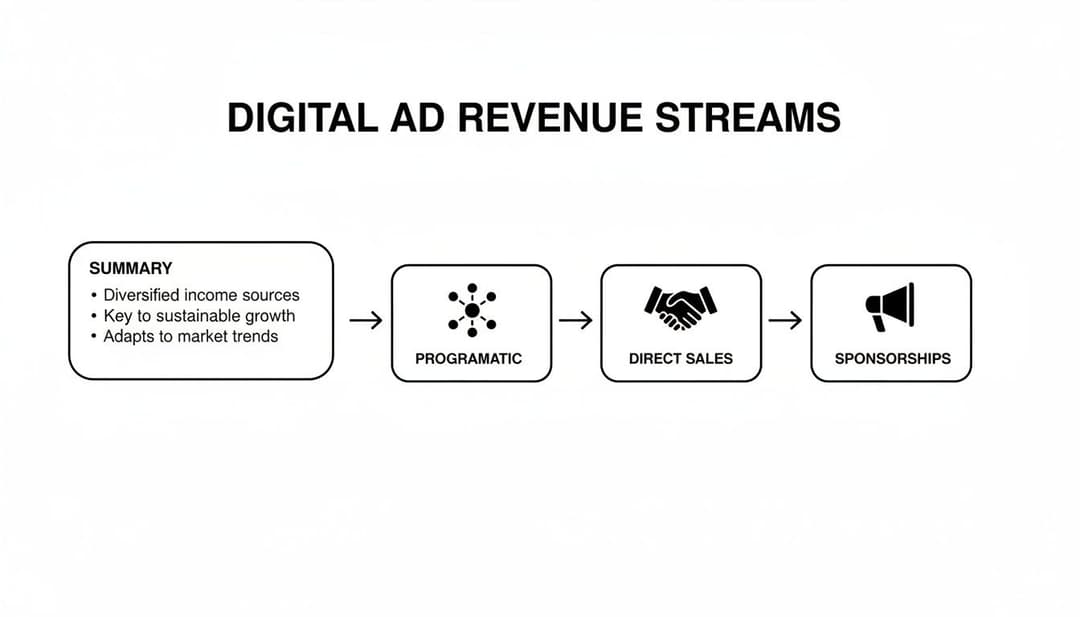
The image clearly shows the mix of automated systems and direct deals that fuel modern digital advertising.
Structuring Campaigns for Measurable Growth
No matter which channel you pick, success lives or dies by your campaign structure. A sloppy setup gives you messy data, making it impossible to figure out what's actually working.
Here are the foundational building blocks for a scalable campaign structure:
- Campaigns: This is the highest level, organized around one single objective. Think "Lead Generation - Q3" or "Holiday Sale - E-commerce." Every ad set inside shares that one goal.
- Ad Sets (or Ad Groups): This is where you define your targeting. Each ad set should isolate one specific audience, like "US - Women 25-34 - Interested in Yoga" or "Keyword Group - Branded Terms." This stops your audiences from competing against each other and gives you clean data on which segments are your winners.
- Ads: This is the creative layer. Inside each ad set, you need to test multiple ad variations—different images, videos, headlines, and copy—to find the combination that performs best.
This granular structure is your secret weapon for unlocking performance insights. It allows you to A/B test properly, push budget to your best-performing audiences, and turn your advertising from a pure expense into a predictable engine for business growth.
Preparing Your Website for Peak Ad Performance
Think of your website as the main stage. Every ad dollar you spend or earn performs right there. Before you launch a single campaign or sell one ad spot, you have to make sure that stage is rock-solid. A clunky, slow, or poorly planned site will absolutely sabotage your efforts, burning cash on the acquisition side and leaving money on the table if you're trying to monetize.
So, whether you're selling ad space or buying traffic, getting your website in order is step zero. Let's walk through the essential prep work for both scenarios.

Optimizing Your Site to Sell Ad Space
If you're a publisher looking to monetize, your job is to create a premium environment where advertisers want to be seen. This goes way beyond just having good content; it's about the entire user experience and being technically ready for business.
First things first, you need to map out your ad inventory. This is just a fancy way of saying you need to identify every single spot on your site where an ad could possibly go. Don't just stick to the obvious—get strategic.
Your basic ad inventory will likely include:
- Leaderboard (728x90): That classic banner you see at the top of most pages.
- MPU (300x250): The workhorse medium rectangle, perfect for sidebars or nestled within your content.
- Skyscraper (160x600): The tall, vertical ad that fits neatly into sidebars.
Once you know what you're selling, you need to create clear ad guidelines. These are the rules of the road that protect your users' experience and your brand's integrity. They should spell out what's not allowed (e.g., gambling, adult content) and any technical specs. A great way to get started is to study the professional placement of advertising on major publisher sites you admire.
Your site's technical health is everything when you're selling ads. A slow website is an absolute revenue killer. We've all seen the data—even a one-second delay in page load time can tank conversions by 7%. For ad-supported sites, that directly craters your ad viewability and CPMs.
Finally, get your tech in order. This means getting your ad server tags implemented correctly and, most importantly, obsessing over page speed. A fast, clean website doesn't just keep your visitors happy. It ensures ads load quickly and reliably, which is exactly what you need to maximize your earnings.
Building Landing Pages That Convert Traffic
Now, if you're on the other side of the coin—buying ads—your website's job is completely different. It's not the product; it's the conversion engine. Your entire focus narrows down to the specific landing pages where you're sending all that paid traffic.
A high-converting landing page is built for one thing and one thing only. It needs a killer headline that directly reflects the ad the visitor just clicked, instantly telling them, "Yep, you're in the right place." And the call-to-action (CTA)? It needs to be so obvious it's almost impossible to miss. Think big, bold, and clear.
Here are the non-negotiable parts of a landing page that actually works:
- A Powerful Headline: It has to speak directly to the user's problem or desire.
- A Clear CTA: Tell people exactly what to do next. "Get Your Free Trial" or "Shop the Collection" leaves no room for confusion.
- Mobile-First Design: Over half of all web traffic is on mobile. If your page is a mess on a smartphone, you're throwing money away. Period.
- Trust Signals: Sprinkle in testimonials, customer logos, or security badges to show you're the real deal.
Beyond the page itself, you need a deep bench of creative assets. Don't just make one ad and call it a day. Build a library of different images, headlines, and video hooks. This is what fuels continuous A/B testing—the engine that turns good campaigns into great ones by showing you what actually connects with your audience.
Measuring What Matters and Optimizing Your Results
Launching your ad campaign isn’t the finish line; it’s the starting whistle. The real game is won in the trenches of relentless, data-driven optimization. Whether you're on the sell-side pushing inventory or the buy-side hunting for traffic, success isn’t a matter of guesswork. It’s all about measuring what actually moves the needle and taking decisive action based on what the numbers tell you.
This is where you stop spending and start investing. Let's break down how you translate raw data into real growth, covering the essential metrics for both monetization and acquisition. We'll show you how to turn those complex reports into a clear roadmap for a better bottom line.
Key Metrics for Monetization Success
If you're a publisher selling ad space, your entire world revolves around one goal: squeezing every last drop of revenue from your traffic. To do that, you have to look past vanity metrics like pageviews and zero in on the KPIs that directly impact your bank account.
These three metrics are your north stars:
- CPM (Cost Per Mille): This tells you how much advertisers are willing to pay for every 1,000 ad impressions on your site. Think of it as the raw value of your ad inventory. A higher CPM is always a good sign.
- Fill Rate: This is the percentage of your ad requests that actually get filled with a paid ad. A low fill rate is a huge red flag—it means you're leaving money on the table because ad spaces are sitting empty.
- RPM (Revenue Per Mille): This is the ultimate health check for publishers. It calculates your total earnings per 1,000 pageviews, blending both your CPM and fill rate into one powerful number. It answers the simple, critical question: "How much am I actually making from my traffic?"
Keeping a close eye on these helps you spot opportunities hiding in plain sight. For example, a high CPM but a low fill rate could mean your primary ad network is struggling to find relevant ads for your audience. That’s your cue to bring another network into the mix. On the flip side, a high fill rate with a disappointingly low RPM suggests your ad placements are undervalued, and it might be time to test new ad formats or get serious about direct sales.
The Acquisition Metrics That Drive Business Growth
For advertisers, the script flips entirely. You're not trying to earn revenue from impressions; you're trying to drive tangible business outcomes. Success isn't measured in clicks—it's measured in profitable customer actions.
Here are the metrics that really matter for acquisition:
- CPA (Cost Per Acquisition): This is your all-in cost to get one new customer or lead. It directly ties your ad spend to a real business result, whether that's a product sale, a free trial sign-up, or a completed lead form.
- ROAS (Return On Ad Spend): This is the classic efficiency metric. It measures the gross revenue you generate for every single dollar you spend on ads. A 3:1 ROAS means you made $3 for every $1 you spent. To really get this right, check out our guide that details how to calculate and improve your ROAS.
- LTV (Customer Lifetime Value): This is the big-picture number—the total revenue you can reasonably expect from a single customer over their entire relationship with your business. Comparing LTV to your CPA is the ultimate test of a sustainable acquisition strategy.
If your CPA is $50 but your LTV is $300, you’ve built a healthy, profitable acquisition engine. But if your CPA is $50 and your LTV is only $45, you're actively losing money on every new customer. It's time to hit the brakes and rethink everything.
Setting Up Your Tracking Foundation
Let's be blunt: you can't optimize what you don't measure. Before you even think about spending a dollar, you need to make sure your tracking infrastructure is airtight. This is the central nervous system of your advertising, feeding you the data you need to make smart, profitable decisions.
Your essential tracking toolkit should include:
- Google Analytics 4 (GA4): This is your home base for understanding everything users do on your website.
- Platform-Specific Pixels: If you're running paid social, the Meta Pixel or TikTok Pixel aren't optional. They're non-negotiable for tracking conversions.
- UTM Parameters: These are simple tags you add to your ad URLs. They act like little breadcrumbs, telling Google Analytics exactly which campaign, ad set, and creative brought you a visitor.
When configured correctly, this setup lets you draw a straight line from ad performance to on-site actions, giving you a complete, unvarnished view of your customer journey.
The global ad market isn't slowing down. Projections show total ad spend is set to grow 8.8% in 2025, hitting a staggering $1.14 trillion. But that growth isn’t spread evenly. The United States is leading the charge with a $240 billion forecast for digital ad spending, with China right behind at $150 billion. For website owners, this means the biggest opportunities are concentrated in specific markets and verticals, with gaming and e-commerce advertising showing incredible momentum. You can find more insights on these global advertising trends at WPPmedia.com.
Turning Data into Actionable Insights
With your tracking locked in, the real work begins. Your ad dashboards will throw a ton of data at you, but the real skill is cutting through the noise to find the story it's telling you.
Start by looking for the obvious winners and losers.
- Creative Analysis: Which ad images or videos are bringing in the lowest CPA? Double down on those styles and formats, and ruthlessly pause the underperformers.
- Audience Performance: Is your "Lookalike Audience" crushing your "Interest-Based Audience"? It's time to shift more budget to the winner.
- Placement Breakdown: Are your Instagram Stories ads converting better than your Facebook Feed ads? Reallocate your spend to where it works best.
Optimization is never a "set it and forget it" task. It’s a constant loop: analyze, form a hypothesis, test it, and scale what works. By consistently asking "What's working?" and "Why?" you can methodically improve your results and turn your advertising efforts into a predictable, profitable engine for growth.
Your Top Website Advertising Questions, Answered
Even with a solid plan, the world of website advertising can feel a bit like alphabet soup. Whether you're selling ad space or buying it, a few questions always seem to pop up.
Think of this as your quick-reference guide. We’ll cut through the jargon and get straight to the practical answers you need to make smarter moves.
How Much Traffic Do I Need to Sell Ads on My Website?
There's no single magic number here—it really depends on how you want to make money.
For automated ad networks like Google AdSense, you can get in the game with a pretty small audience, sometimes just a few thousand visitors a month. These platforms are built for accessibility.
But if you’re chasing high-value direct deals or big-name sponsorships, the game changes. To get on the radar of premium advertisers, you’ll want to be hitting 50,000+ unique monthly visitors, consistently.
Keep in mind, advertisers aren't just buying traffic numbers; they're buying access to a specific type of person. A smaller, super-engaged niche audience can be way more valuable to the right brand than a massive, generic one. Quality almost always trumps quantity.
What's the Difference Between CPM, CPC, and CPA?
These three acronyms are the bread and butter of digital advertising pricing. Getting a handle on them is non-negotiable, whether you're on the buying or selling side.
CPM (Cost Per Mille): This is just a fancy way of saying "Cost Per Thousand" views. With CPM, money changes hands based on how many times an ad is shown, clicks or not. It's the go-to for brand awareness campaigns where the goal is simply getting eyeballs on the brand.
CPC (Cost Per Click): Here, you only pay (or get paid) when someone actually clicks on the ad. This model is all about driving traffic and is a cornerstone of search engine ads and a lot of social media campaigns.
CPA (Cost Per Acquisition): Also called Cost Per Action, this is a pure performance model. Payment only happens when a user does something specific and valuable—like buying a product, signing up for a newsletter, or filling out a lead form. It ties every ad dollar directly to a business result.
Can I Sell Ad Space and Also Buy Ads for My Own Site?
Absolutely. In fact, it’s a smart and very common strategy. Plenty of successful online businesses play on both sides of the advertising fence.
Think about it: a big industry blog might sell banner ads and sponsored content to generate revenue. At the very same time, that blog might be running its own paid campaigns on Meta or Google to promote a new course, sell an ebook, or just pull in new readers to grow its audience.
The trick is to keep a clear separation between the two. You have to make sure your own promotional efforts don't sour the user experience you’ve worked so hard to create for your audience.
How Do I Find Companies to Advertise Directly on My Site?
Landing direct advertisers is all about smart, targeted outreach. Don't just wait for them to find you.
Start by brainstorming companies that are trying to reach the same audience you are. Look for non-competing businesses whose products would be a natural, helpful fit for your readers. A great shortcut is to see who's already advertising on similar sites in your niche.
Once you’ve got a shortlist, polish up your media kit. Then, start reaching out with personalized emails or LinkedIn messages that clearly spell out the unique value your audience brings to the table.
At AdStellar AI, we're obsessed with turning data into predictable growth. Our AI-powered platform helps performance marketers and agencies launch, test, and scale Meta ad campaigns faster than ever, eliminating guesswork and maximizing ROAS. Discover how you can build winning campaigns in minutes at https://www.adstellar.ai.