In the world of e-commerce, advertising isn't just another line item in the marketing budget—it's the engine. It's how you both capture the people already looking for what you sell and create new demand from scratch.
Getting this blend right is the difference between stalling out and hitting exponential growth. Let's break down how to build a powerful, profitable advertising machine for your brand.
Why E-Commerce Advertising Is Your Most Critical Growth Lever
Welcome to the new battlefield of digital retail. Back in the day, a great product and a slick website might have been enough. In 2026? Not even close.
The virtual shelves are overflowing. To get seen, you need a smart, deliberate paid media strategy. For any brand with serious growth ambitions, mastering advertising in e commerce has gone from a "nice-to-have" to the absolute core of the business.
The money tells the story. Global digital ad spending is on track to blow past $700 billion by 2025, which is more than 65% of all ad budgets on the planet. Brands are pouring that cash in to get a slice of the $7.4 trillion global online retail pie, where almost a quarter of every dollar spent will soon happen on an e-commerce platform.
With that much competition, just showing up isn't a strategy. You have to advertise effectively, or you'll get drowned out.
The Core Pillars of E-Commerce Advertising
Think of your advertising channels like different tools in a workshop. You wouldn't use a sledgehammer to hang a picture frame, right? Each channel has a specific job.
- Paid Search: This is your demand harvester. Someone types "running shoes for flat feet" into Google, and boom—your ad is right there, meeting them at their exact moment of need. It’s direct, powerful, and intent-driven.
- Paid Social: This is your demand creator. You use platforms like Meta and TikTok to get in front of people who fit your ideal customer profile but weren't actively searching for you. It’s about discovery and building a brand connection.
- Marketplace Ads: This is how you win at the point of purchase. Advertising on Amazon or Walmart gets your products seen on the digital shelf where millions of people are already swiping their credit cards.
A smart strategy knows how to weave these together. You might run a TikTok campaign to introduce your new skincare line (demand creation), then use Google Search ads to capture all the people who later search for your brand by name.
To get a feel for how these channels impact your bottom line, it's worth understanding your marketing efficiency ratio and how it all connects.
On top of these pillars, new tech is changing the game. For example, using augmented reality for e-commerce to boost sales and slash returns is becoming a huge advantage, letting customers "try on" products virtually before buying.
This guide is your roadmap. We’ll dig into each of these components to help you turn your ad spend into predictable, scalable growth.
Figuring out where to put your first ad dollar can feel like staring at a map with a thousand different roads. It’s paralyzing.
But here’s the secret: these channels aren’t competing against each other. Think of them as specialized tools in your workshop. You wouldn't use a hammer to saw a board, right? The same logic applies here.
Picking the right tool for the right job is the first real step toward building an advertising machine that actually makes you money. Let's break down the four big ones so you can start making smarter bets with your budget.
This map shows how Search, Social, and Marketplace ads are designed to work together, feeding a healthy, growing business.
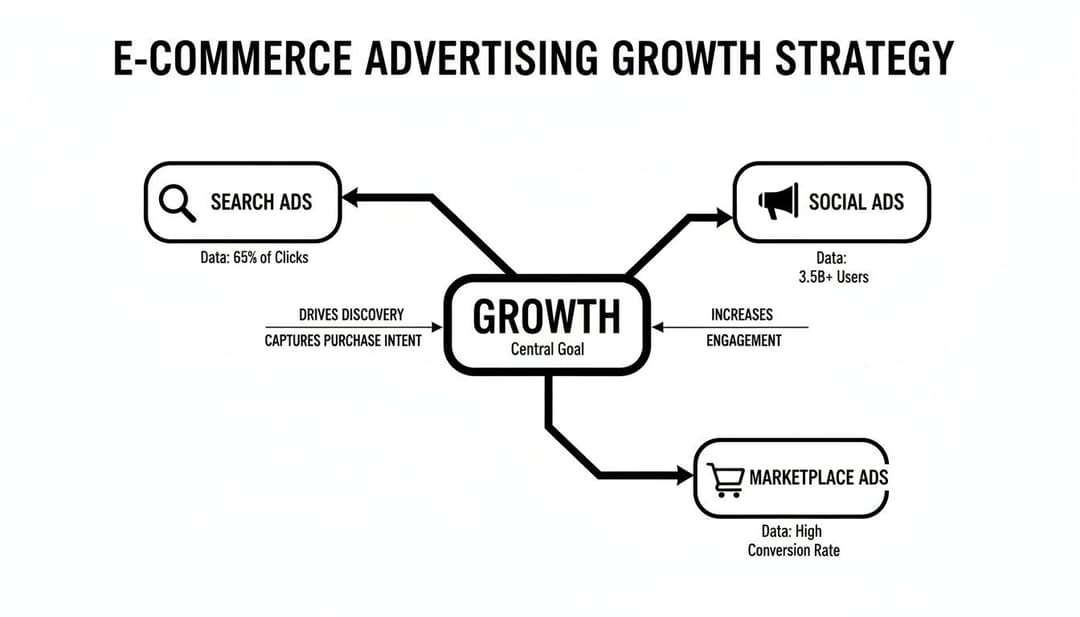
As you can see, each one opens up a different path to your customer. A truly great strategy connects them all.
Paid Search: The Digital Storefront
Paid search ads, like the ones you see on Google, are your digital storefront on the busiest street in the world. You’re not trying to convince someone they need a new pair of hiking boots; you’re showing up the second they type "waterproof hiking boots for men" into the search bar. This is what marketers call capturing intent.
These shoppers have a problem and they are actively looking for a fix right now. Your only job is to prove you have exactly what they need. Because the intent is so high, paid search often delivers some of the best conversion rates you'll see.
Paid search is less about persuasion and more about perfect timing. It’s about being the best answer to a direct question, which is why it's a cornerstone for most e-commerce businesses.
Google Shopping ads are an absolute powerhouse here. They’re visual, showing product images and prices right in the search results. In fact, they now pull in 76% of all retail search ad spend, which tells you just how vital these shoppable formats have become for getting clicks and closing sales.
Paid Social: The Town Square Megaphone
If paid search is about capturing demand that already exists, paid social is all about creating it.
Think of platforms like Meta (Facebook and Instagram) or TikTok as a massive festival or town square. People aren't there specifically to shop; they're there to connect, scroll, and be entertained. Your ads are like grabbing a megaphone in that square. You get to introduce your brand to enormous audiences who match your ideal customer profile but have probably never even heard of you.
This is non-negotiable for top-of-funnel growth. It's how you build the brand awareness that will fuel all your other channels down the road. But before you jump in, it's worth reading up on the key considerations before running TikTok Ads to make sure your investment pays off.
Marketplace Advertising: Winning the Digital Shelf
Running ads on Amazon or Walmart is the digital version of paying for that prime, eye-level shelf space at a massive superstore. Millions of shoppers are already walking the aisles with their wallets out, ready to buy. Your goal is to make damn sure they see your product instead of your competitor’s.
This strategy is a no-brainer for a few reasons:
- High Purchase Intent: People on these sites are there to buy, period.
- Built-in Trust: Customers already trust Amazon, which removes a huge piece of friction from the buying process.
- Prime Placement: You can bid to show up right at the top of search results and on product pages, getting in front of the most motivated buyers.
For any brand selling on these platforms, a marketplace ad strategy isn't just an option—it's essential for getting seen and driving sales. It's also a key piece of the much larger ecosystem of top ad networks for advertisers.
Programmatic Display: The Brand's Memory
Have you ever looked at a product online, only to have ads for it seem to follow you across the internet for the next few days? That’s programmatic display at work, and its most common use is retargeting.
Think of it as your brand's persistent memory.
It works by showing visual banner ads to people who visited your site but left without buying anything. It’s a gentle nudge, a simple reminder to bring them back and finish their order. While it can be used to find new customers, its real power is in re-engaging a warm audience and recovering sales that would have otherwise been lost for good.
This blend of advertising and e-commerce has completely changed the game. Digital formats now make up 72% of global ad revenue and are expected to hit a staggering 80.4% by 2029.
How to Craft Creatives and Messaging That Convert
Let’s be honest: even the most perfectly targeted audience won’t matter if your ad is boring, confusing, or just plain bad. Once you’ve picked your channels, the creative itself—the images, videos, and words—is the heart of your entire advertising in e commerce strategy. It’s the only part the customer actually sees.
The goal isn't just to get a click. It's to stop the endless scroll, spark an emotional connection, and push someone to take a specific action. This is where art and science collide, from writing a headline that snags attention to crafting a call-to-action that feels both urgent and effortless.

Your first big decision is the format. A punchy static image might be all you need to show off a beautiful product. A carousel ad, on the other hand, can tell a story or showcase a whole collection. For anything more complex, a quick, engaging video can demonstrate value in seconds.
The Science of Compelling Ad Copy
Great ad copy doesn't just describe a product; it sells a solution to a problem. You need to get out of your own head. Think less about your product’s features and more about the customer's world and what they're trying to achieve.
Here’s a simple framework that just works:
- Hook with the Headline: Kick things off with a question, a bold claim, or a clear benefit that hits a known pain point.
- Agitate the Problem: Briefly twist the knife. Remind the reader of the frustration they’re trying to escape.
- Introduce the Solution: This is where you swoop in. Position your product as the obvious, simple answer.
- Provide a Clear Call-to-Action (CTA): Tell them exactly what to do next. "Shop Now," "Learn More," or "Claim Your Discount." No ambiguity.
This structure walks a potential customer from awareness to action in just a few short lines. For more ideas, check out our guide on creating powerful digital marketing creatives.
Visuals That Stop the Scroll
In a crowded social feed, your visual is your one shot to earn a few seconds of someone's time. Whether it’s an image or a video, your creative has to be thumb-stopping.
The cardinal rule of e-commerce ad creative is clarity over clutter. Your audience should be able to understand what you're selling and why it matters within three seconds.
The best-performing visuals almost always have a few things in common:
- High-Quality Imagery: Blurry or poorly lit photos scream "amateur hour" and erode trust instantly.
- Focus on the Product: The product should be the undeniable hero of the shot.
- Human Element: Showing real people using or loving your product builds a connection that static product shots can't.
- Bold Colors and Branding: Your ads should be instantly recognizable as yours.
The Power of Relentless Testing
The single biggest mistake I see in e-commerce advertising is assuming you know what will work. The hard truth is, nobody really knows. The only way to find winning ads is to test constantly.
This is where most modern advertisers hit a wall. Manually creating dozens of different image-copy-headline combinations to find what actually resonates is painfully slow and expensive.
Here’s where AI-powered tools become a massive advantage. Personalized ads aren't a luxury anymore; they're a necessity. In fact, they can generate 80% higher conversion rates than generic one-size-fits-all approaches. AI-driven platforms enable this level of personalization at a scale that was previously impossible.
Imagine launching hundreds of creative and copy variations, then letting AI analyze the results in real-time to pinpoint the top performers based on ROAS or CPA. Platforms like AdStellar AI are built to solve this exact problem, turning the slow, manual grind of creative testing into a fast, automated workflow that uncovers winning ads and drives real growth.
Mastering Audience Targeting and Segmentation

Great advertising in e commerce isn’t about shouting your message to the biggest crowd you can find. It’s about whispering the right message to the right person, right when they’re ready to hear it. This is the whole game of audience targeting—carving up the massive digital world into smaller, much more relevant groups.
Imagine you sell high-performance running shoes. You could show your ads to everyone online, but you’d burn through your budget showing them to people who’d rather be on the couch. Targeting lets you zero in on people who follow marathon runners, join running clubs on Facebook, or just searched for new running gear on Google. That precision is what separates wasted ad spend from real profit.
The Foundational Layers of Targeting
At its core, targeting starts with the basics: who people are and what they’re into. These are the building blocks for nearly every ad campaign you’ll run.
Demographic Targeting: This is the “who.” It’s all about objective data points like age, gender, location, language, and even income level. It's the first filter you apply to make sure you aren't trying to sell parkas to people in Miami during a heatwave.
Interest Targeting: This is the “what.” It digs into a user's hobbies, passions, and the kind of content or brands they follow online. This adds a ton of context, letting you find people interested in things like “sustainable fashion” or “vegan cooking.”
These layers are your starting point for finding new customers. But the real leverage comes from using your own data to build audiences that are unique to your brand. For a closer look at the advanced techniques, check out these audience segmentation strategies.
Leveraging Your Own Data with Custom Audiences
Hands down, the most valuable audiences you have are the ones you already own. These are people who’ve already raised their hands and shown they’re interested in what you offer. Ad platforms let you create Custom Audiences using this first-party data, giving you a direct line to your warmest prospects.
You can build these incredibly powerful segments from a few key sources:
- Customer Lists: Upload a list of emails or phone numbers from your CRM. This is perfect for targeting existing customers with new product launches or exclusive offers.
- Website Visitors: By installing a tracking pixel (like the Meta Pixel), you can create an audience of everyone who’s visited your site. You can get super granular, too—targeting people who viewed a specific product or even abandoned their cart. This is the engine behind retargeting.
- App Users: If you have a mobile app, you can target users based on in-app actions, like reaching a certain level in a game or making a purchase.
Think of Custom Audiences as your inner circle. These are people who know your name, and they’re way more likely to convert than someone seeing your brand for the very first time.
The Ultimate Growth Engine Lookalike Audiences
So what if you could find millions of new people who look and act just like your best customers? That’s exactly what Lookalike Audiences do, and it’s one of the most potent tools for scaling an e-commerce brand.
Here’s how it works. Imagine you have a list of your top 1,000 customers—the ones who buy often and have the highest lifetime value. You feed this list to a platform like Meta. Its algorithm then crunches tens of thousands of data points on those people to build a hyper-detailed "clone" profile.
The platform then scans its entire user base to find millions of other people who match that profile with startling accuracy. What you get is a massive, high-quality audience of brand-new prospects who are statistically predisposed to love what you sell. It’s like finding a digital twin of your perfect customer and then multiplying them by the thousands. This is how you break out of your existing bubble and fuel predictable, profitable growth.
Audience Targeting Strategies Comparison
To help you decide where to start, here's a quick breakdown of how these different targeting methods stack up and where they fit into your overall strategy.
| Targeting Method | Best For | Complexity Level |
|---|---|---|
| Demographic & Interest | Top-of-funnel awareness, finding new customers | Low |
| Custom Audiences (Retargeting) | Mid/Bottom-of-funnel, re-engaging warm leads | Medium |
| Custom Audiences (Customer Lists) | Bottom-of-funnel, driving repeat purchases & loyalty | Medium |
| Lookalike Audiences | Top-of-funnel, scalable customer acquisition | High |
Each method has its place. Early on, you'll rely heavily on broad targeting to build awareness. As you gather data, you can layer in retargeting and Lookalikes to create a sophisticated, full-funnel machine that drives consistent results.
How to Measure and Optimize Your Ad Performance
You can’t grow what you don’t measure. Pouring money into ads without a clear way to track what’s working is like trying to navigate a new city without a map. Sure, you’re moving, but you have no idea if you’re actually getting closer to your destination.
In e-commerce advertising, data is the raw material for growth.
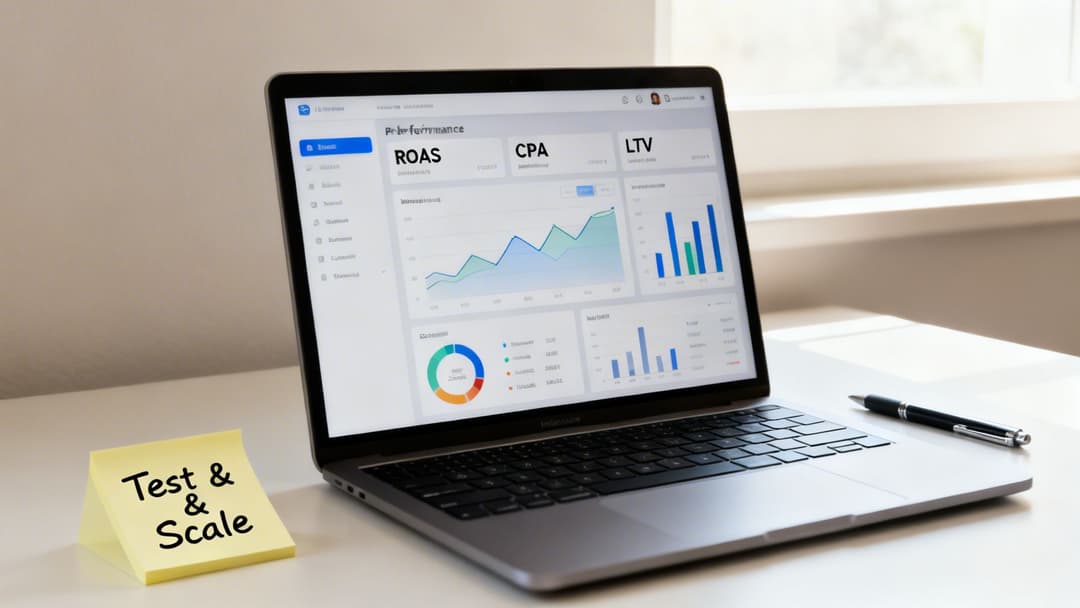
The trick is to tune out the noise. Vanity metrics like "likes" or "impressions" might feel good, but they don't pay the bills. The real pros laser-focus on the numbers that directly connect ad spend to revenue.
The Core Metrics That Actually Matter
To make smart, profitable decisions, you need to speak the language of performance. These three metrics are the bedrock of any serious advertising in e commerce strategy.
- Return On Ad Spend (ROAS): This is the ultimate bottom-line question. For every dollar you put into ads, how many dollars did you get back? If you spend $100 on a campaign that brings in $400 in sales, your ROAS is 4x. Simple. Powerful.
- Cost Per Acquisition (CPA): This tells you exactly how much it costs to win a new customer. If that same $100 campaign brought you five new customers, your CPA is $20. Knowing this number is critical for understanding if your growth is actually profitable.
- Customer Lifetime Value (LTV): This is where you zoom out and play the long game. LTV is the total profit you expect to make from a single customer over their entire relationship with your brand. It's the key that unlocks your true marketing budget, telling you how much you can afford to spend on your CPA and still come out ahead.
A classic rookie mistake is killing a campaign based on its immediate ROAS. If your CPA is $30 but your LTV is $200, you’ve found a winning formula that you should be scaling—even if the initial return feels a little light.
Building Your Optimization Flywheel
Measurement is only half the equation. You have to use that data to make better decisions, creating a repeatable system for constant improvement.
This system is built on A/B testing, also known as split testing. It’s a beautifully simple concept: run two slightly different versions of an ad (Ad A vs. Ad B) to see which one performs better.
Here’s a simple workflow to get you started:
- Isolate One Variable: This is the golden rule. Change just one thing at a time—a new headline, a different image, a tweaked call-to-action—but never all at once. Otherwise, you'll never know what actually made the difference.
- Run with Sufficient Budget: Give each ad enough fuel to gather meaningful data. Don't pull the plug after just a handful of clicks.
- Identify the Winner: Once one version is clearly outperforming the other on your key metric (like CPA or ROAS), you have a winner.
- Iterate and Repeat: Pause the loser and create a new challenger to run against your current champion. This turns optimization into an ongoing process, not a one-off task.
For a deeper dive, our guide to essential performance marketing metrics can help you set up your dashboards for success.
The real challenge here is doing this at speed and scale. Manually setting up, monitoring, and iterating on tests across dozens of ads is a massive time sink—and a common bottleneck for growth.
This is where automation platforms become a secret weapon. Tools like AdStellar AI can launch hundreds of tests in minutes, using AI to automatically spot and scale the winning combinations. It helps you make data-driven decisions faster and more accurately than any human team ever could.
The Role of AI in Scaling E-Commerce Advertising
So far, we've walked through the channels, creatives, audiences, and metrics that make up a killer advertising in e commerce strategy. But trying to manage all those moving parts by hand creates two huge problems that stop growth in its tracks: speed and scale.
This is where AI stops being a buzzword and starts being a real competitive advantage.
Think of AI as the engine that lets modern ad teams do more, do it faster, and get better results. It takes over the repetitive, soul-crushing tasks, spots patterns hidden deep in your performance data, and makes smart calls on where your budget will have the biggest impact. It’s like giving your small team the analytical horsepower of a hundred data scientists.
For any e-commerce brand that’s serious about growth, AI isn’t here to replace marketers. It’s here to supercharge them, freeing them from the slog of manual campaign setup and number crunching so they can focus on big-picture strategy.
Automating Ad Creation and Testing at Scale
One of the biggest headaches in performance marketing is just producing enough ad variations to figure out what actually works. Manually building dozens of different creative and copy combinations is painfully slow and often feels like throwing spaghetti at the wall to see what sticks.
AI-powered platforms crush this problem. They can spin up hundreds of ad variations in minutes, mixing and matching different images, headlines, and calls-to-action automatically.
The magic of AI isn't just in making the ads; it's in learning from them. By analyzing performance in real-time, AI can spot the winning combinations and shift budget to the top performers way faster than any human ever could.
This flips creative testing from a slow, manual chore into a lightning-fast, automated workflow. It systematically weeds out the duds and pours fuel on the winners, making sure every dollar of your budget is working as hard as possible. This is exactly what platforms like AdStellar AI are built for—helping teams launch, test, and scale their Meta campaigns at a pace that used to be unthinkable.
Intelligent Scaling and Performance Optimization
Beyond just making creatives, AI is a beast at real-time data analysis and optimization. Instead of you spending hours buried in dashboards trying to figure out which audience segment is driving the best ROAS, AI systems are doing it for you, 24/7.
Here’s how that intelligence changes the game for campaign management:
- Predictive Analytics: AI models can look at your past performance to forecast which new campaigns are most likely to hit it big, taking a lot of the guesswork out of launching something new.
- Auto-Learning and Scaling: The system gets smarter with every bit of new performance data. When an ad starts showing signs of being a winner, the AI can automatically ramp up its budget to ride the wave.
- Insight Discovery: AI can connect dots a human analyst might completely miss. Think discovering that a specific creative works like a charm, but only with a certain demographic on weekends.
This level of automation ties your entire advertising strategy together. It makes sure your best creative gets in front of your highest-value audiences and that your budget is constantly shifting to whatever is working right now. For brands focused on growth, this is more than just an efficiency boost—it’s the key to unlocking new revenue by letting an intelligent system do the heavy lifting.
Got Questions? We've Got Answers
Diving into e-commerce advertising can feel like you’re learning a new language. Practical questions pop up all the time, especially when you're starting out or trying to keep up with the latest shifts. Let’s tackle some of the most common ones head-on.
How Much Should I Really Budget for Ads When I'm Just Starting?
Forget about finding some magic industry-standard number. There isn't one. Instead, think of your initial budget as an investment in data. A smart starting point is around $500-$1,000 per month, but here’s the key: put it all into a single, focused channel like Meta Ads.
The goal here isn't to get rich overnight. It's to learn what actually works. Use that first month to aggressively test different audiences and ad creatives. Once you land on a combination that delivers a solid Return on Ad Spend (ROAS), you’ve found your winner. From there, you can start reinvesting your profits and scale up with confidence. The biggest mistake you can make is spreading a small budget thin across five different channels—you'll just end up with muddy data everywhere and no clear path forward.
What Are the Biggest Mistakes New E-Commerce Advertisers Make?
New advertisers almost always trip over the same few hurdles. Knowing what they are ahead of time can save you a whole lot of money and frustration.
The top three rookie errors are:
- Botched Tracking Setup: The Meta Pixel or Google Ads Tag is installed incorrectly or not at all, making it impossible to know what’s actually driving sales.
- Aiming Too Broadly: Instead of zeroing in on a niche, high-intent audience, they cast a massive net and hope for the best. This just burns cash on people who will never buy.
- Forgetting About Ad Fatigue: They let the same ads run for weeks on end. Performance always craters when your audience has seen the same creative a dozen times.
If you take one thing away from this, it's this: double and triple-check your tracking setup before you spend a single cent. Without clean data, you're just gambling.
How Are All These Privacy Changes Affecting E-Commerce Ads?
The recent privacy updates have completely rewritten the advertising playbook. The biggest shift? Your own data—your email list, your customer purchase history—is now your most valuable marketing asset.
These changes also give the "walled gardens" like Meta and Google an even stronger hand, since their on-platform targeting is still incredibly effective. For advertisers, this means a two-pronged strategy is essential. First, you have to get serious about building your first-party data to create powerful Custom Audiences. Second, it's time to lean into the platforms' own AI tools, like Meta's Advantage+ campaigns. These tools are built to find high-value customers inside their ecosystem, making you less reliant on the third-party tracking that’s become so unreliable.
Ready to stop the guesswork and scale your ads faster? AdStellar AI automates bulk ad creation, testing, and optimization for Meta, helping you find winning campaigns in a fraction of the time. Learn how you can unlock more revenue with less manual work at https://www.adstellar.ai.