The Marketing Efficiency Ratio (MER) is your business's ultimate marketing report card. It's a simple, powerful metric that tells you exactly how much total revenue you generate for every single dollar you pour into marketing.
Unpacking The Marketing Efficiency Ratio

Think of your business as a large ship. You could obsessively check the performance of every single sailor (your individual ad campaigns), or you could just check the ship's overall speed and direction. That's MER. It gives you a high-level, brutally honest view of whether your entire marketing engine is actually moving the business forward.
In an era where privacy changes make tracking every customer touchpoint a nightmare, MER cuts through the noise. It sidesteps the messy, often unreliable world of multi-touch attribution to answer one simple question: Are we making more money than we're spending on marketing as a whole?
Why MER Is a North Star Metric
For smart marketers focused on real, sustainable growth, this one number has become indispensable. It gives you a holistic perspective that platform-specific metrics like Return On Ad Spend (ROAS) just can't match. ROAS is great for seeing how one channel is doing, but MER zooms out to show the combined impact of everything you're doing.
The Marketing Efficiency Ratio captures the total revenue impact of your full campaign—including the upper-funnel influence of brand awareness and the retargeting boost from various channels. It provides the clearest lens into what’s truly working across your entire marketing mix.
MER is so critical because it ties marketing directly to the company's bottom line. When you walk into a meeting with your MER, you're not talking about clicks or impressions; you're speaking the language of revenue and profitability.
Here's what it helps you do:
- Gauge Overall Health: Instantly see if your marketing investments are paying off for the business.
- Make Smarter Budget Decisions: Understand the top-line impact of your spend, which is vital for effective marketing budget allocation and planning.
- Navigate Attribution Blind Spots: Get a reliable performance measure even when user-level tracking is spotty or just plain gone.
By focusing on this blended, big-picture number, you can ignore the conflicting reports and focus on what really matters: driving profitable growth. The question isn't which specific ad "worked," but whether your entire marketing ecosystem is functioning efficiently.
Calculating Your Marketing Efficiency Ratio with Real Examples

Alright, let's get our hands dirty and move from theory to reality. This is where the true value of the Marketing Efficiency Ratio (MER) really shines. The beauty of this metric is its simplicity—it gives you a powerful, big-picture snapshot of how your marketing is actually impacting the business.
The calculation itself is refreshingly straightforward.
MER = Total Revenue / Total Marketing Spend
That one number tells you so much. If your MER is 4.0, it means for every single dollar you put into marketing, you got $4 back in total company revenue. Simple. Direct. Powerful.
What Really Goes into Your Total Marketing Spend?
Getting an accurate MER depends entirely on what you count as "Total Marketing Spend." This is where many marketers trip up. It’s not just your ad budget. For a true, holistic view, you need to account for every dollar you’ve dedicated to your marketing engine.
Think bigger than just your ad platforms. A comprehensive marketing spend includes:
- Ad Spend: The obvious one—your direct costs on Meta, Google, TikTok, you name it.
- Agency & Freelancer Fees: Payments to your external partners who help make the magic happen.
- Creator & Influencer Payouts: The cost of collaborations and sponsored content.
- Software & Tool Subscriptions: Your marketing automation platforms, analytics tools, and creative software all have a cost.
- Salaries: For a fully-loaded MER, you can even include a portion of your marketing team’s salaries.
Tallying up all these costs gives you a much more honest picture of your marketing efficiency. It stops you from just looking at ad spend, which can easily inflate your numbers and hide the true cost of acquiring customers. While this bird's-eye view is different from platform-specific metrics, you can still dive deeper with our guide on how to calculate Return On Ad Spend.
Real-World MER Calculation Examples
Let’s plug some numbers into the formula to see how MER works for a few different types of businesses. It's the best way to see the concept in action.
Here’s a quick look at how the numbers shake out for an e-commerce brand, a SaaS company, and a local service business.
MER Calculation Examples Across Different Business Models
| Business Type | Total Revenue (Monthly) | Total Marketing Spend (Monthly) | MER Calculation | Calculated MER |
|---|---|---|---|---|
| E-Commerce Store | $300,000 | $75,000 | $300,000 / $75,000 | 4.0x |
| B2B SaaS Business | $150,000 | $30,000 | $150,000 / $30,000 | 5.0x |
| Local Service Provider | $80,000 | $10,000 | $80,000 / $10,000 | 8.0x |
As you can see, what’s considered a "good" MER can vary quite a bit depending on the business model, profit margins, and industry. Let’s break down each example.
1. E-Commerce Brand Example
An online apparel store is sizing up its performance from the last quarter.
- Total Revenue: $300,000
- Total Marketing Spend: $75,000 (this includes ads, influencer fees, and their email marketing platform)
- Calculation: $300,000 / $75,000 = 4.0
Their MER comes out to 4.0x. In plain English, every dollar they spent on marketing brought in four dollars of revenue. For the fast-moving world of e-commerce, that’s a pretty solid number. Many direct-to-consumer brands aim for a MER somewhere between 3x and 5x to stay healthy and profitable. You can dig into more benchmarks on marketing efficiency for retailers on Headlinema.com.
2. B2B SaaS Company Example
A software company is doing its monthly marketing review.
- Total Revenue (New MRR + Expansion): $150,000
- Total Marketing Spend: $30,000 (covering ad spend, content creation, and webinar software)
- Calculation: $150,000 / $30,000 = 5.0
This SaaS company is sitting at a 5.0x MER. Because SaaS customers often have a high lifetime value, this 5.0x indicates a very efficient marketing engine that's likely fueling sustainable, long-term growth.
3. Service-Based Business Example
A local digital marketing agency is running the numbers on its quarterly performance.
- Total Revenue (from new client retainers): $80,000
- Total Marketing Spend: $10,000 (this includes LinkedIn ads, event sponsorships, and sales collateral)
- Calculation: $80,000 / $10,000 = 8.0
Wow. The agency's 8.0x MER is impressive. This reflects a highly effective strategy, probably getting a boost from strong word-of-mouth referrals and a targeted approach that lands high-value clients without a massive marketing spend.
How to Read Your MER for Smart, Strategic Growth
Getting your marketing efficiency ratio calculated is the easy part. The real work—the stuff that separates the pros from the rookies—is figuring out what that number actually means. A 4.0x MER might look good sitting on a dashboard, but on its own, it’s just a number floating in space.
Think of your MER less like a final grade and more like a strategic compass. Its true power isn't in the number itself but in the story it tells about your business’s health and where it's headed. A “good” MER isn’t some universal standard; it’s a figure that’s deeply personal to your company's unique financial reality.
For instance, a scrappy startup running on thin profit margins would likely pop the champagne for a 3.0x MER. Why? Because it means their marketing is profitable and the business is sustainable. But for a high-margin B2B SaaS company, that exact same 3.0x MER could be a serious red flag, pointing to underinvestment and a massive missed opportunity to grab more of the market.
Setting Your Own MER Benchmark
Instead of chasing generic industry averages, your goal is to define what an effective MER looks like for you. This means taking a hard look at your own business model and financials. The right MER for your brand is found where your profit margins, growth plans, and operational costs all meet.
To get started, ask yourself a few critical questions:
- What are your gross profit margins? A business with an 80% margin has a lot more wiggle room than one with a 20% margin. Higher margins mean you can afford a lower MER to fuel growth without killing your profitability.
- What are your growth goals? Are you in hyper-growth mode, backed by venture capital, or are you aiming for steady, bootstrapped expansion? Aggressive scaling often demands a lower, less efficient MER in the short term to gobble up customers and build a market presence.
- What is your customer lifetime value (LTV)? If a new customer is going to spend thousands with you over the next few years, you can absolutely justify a lower MER upfront. You're playing the long game, and you know the eventual payoff will be huge.
A healthy marketing efficiency ratio isn't just about covering your ad spend; it's about funding your future. It needs to be high enough to keep you profitable but not so high that you're clearly leaving growth on the table by being too timid with your marketing budget.
This kind of internal check-up turns MER from a simple report card metric into a powerful tool for planning your next move.
Understanding Industry-Specific MER Targets
While your own numbers are king, it’s still smart to see how you stack up against the competition. Different industries play by completely different rules, which means "good" MERs can vary wildly.
Take performance-driven e-commerce and DTC brands—they often live and die by their efficiency. One analysis of over 200 brands found that the top performers hit an average 5.8x MER, which is just elite-level efficiency. In contrast, retail and CPG brands, which typically have slimmer margins, usually shoot for a tighter 3x to 4x range. Then you have high-LTV SaaS businesses, which can thrive with MERs climbing as high as 6x to 8x. You can dig into more detailed industry benchmarks for MER at Northbeam.io.
Use these numbers as a guidepost, not a gospel. If your MER is way below your industry peers, it could be a sign that your channel mix is off or your creative isn't landing. On the flip side, if it's much higher, you should be asking yourself: are we investing enough to actually scale this thing? This perspective helps you set realistic targets that will actually push your business forward.
Understanding MER vs ROAS and Other Key Metrics
Marketers swim in a sea of acronyms—ROAS, CAC, LTV, you name it. Figuring out where the Marketing Efficiency Ratio (MER) fits in is critical for building a measurement strategy that actually works. If you mix these up, you risk making poor budget decisions and leaving growth on the table.
The easiest way to get it is with a photography analogy. Think of Return On Ad Spend (ROAS) as your magnifying glass. It’s built for a hyper-detailed, zoomed-in view of one specific thing, like a single ad campaign or channel. It answers the question, "Are my Meta ads actually making money?"
MER, on the other hand, is the wide-angle lens. It pulls back to show you the whole scene—the combined effect of every single marketing dollar you've spent, across every channel. It tackles the bigger, more strategic question: "Is my entire marketing ecosystem driving overall business revenue?"
MER vs. ROAS: The Strategic Difference
While both are about returns, their scope and purpose couldn't be more different. ROAS is purely tactical. It helps you tweak individual campaigns on the fly. A killer ROAS on a Google Ads campaign tells you that specific tactic is hitting the mark.
But ROAS has a massive blind spot. It can't see the messy, cross-channel journey that real customers take. An awareness campaign on TikTok might have a lousy ROAS but could be the very reason your branded search campaigns are crushing it. ROAS only gives credit to the last click, completely missing the bigger story.
This is where MER steps in to provide that crucial context. It captures the total revenue impact, including all the upper-funnel work and brand-building efforts that rarely lead to a direct, trackable click.
MER gives you the clearest view of what’s truly working across your entire marketing mix. It accounts for the "halo effect"—where one channel lifts another—something channel-specific ROAS can never see.
Ultimately, ROAS is for optimizing the parts, while MER is for evaluating the whole machine. The sharpest marketers use both to get a complete performance picture. To explore other essential metrics, check out our detailed guide on the key performance marketing metrics that fuel growth.
How MER Complements LTV to CAC
Another vital metric pairing is Lifetime Value (LTV) and Customer Acquisition Cost (CAC). The LTV:CAC ratio is a go-to indicator of a business's long-term health and scalability. It tells you how much a customer is worth over their entire relationship with your brand compared to what you spent to get them. A healthy business usually aims for an LTV that is at least 3x its CAC.
MER functions as a leading indicator for your LTV:CAC ratio. While LTV:CAC is a long-game metric that reveals sustainability, MER gives you an immediate pulse check on your marketing's ability to generate revenue right now. If your MER is consistently in the gutter, it’s a huge red flag that your CAC is probably too high, which will eventually wreck your LTV:CAC ratio.
Think of it this way: MER measures the efficiency of your customer-getting engine today, while LTV:CAC predicts the long-term profitability of that engine down the road.
This concept map helps visualize the different goals tied to your marketing efficiency ratio, from warning signs to optimal balance and ambitious growth.
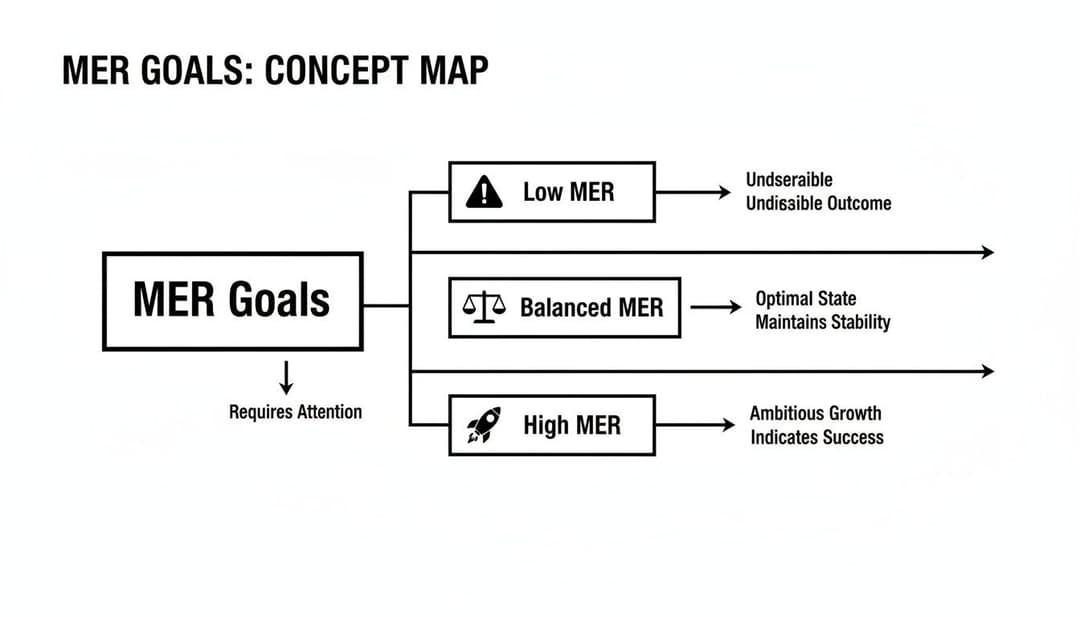
As you can see, a low MER is a sign of inefficiency, a balanced MER suggests a healthy and sustainable strategy, and a high MER points toward efficient, scalable growth.
Comparison of Key Marketing Performance Metrics
No single metric tells the whole story. To help you choose the right tool for the right job, here’s a quick breakdown of how MER, ROAS, and LTV to CAC stack up against each other.
| Metric | What It Measures | Scope | Best For |
|---|---|---|---|
| MER | Total revenue generated for every dollar of marketing spend | Holistic (All marketing efforts) | High-level strategic planning, budget allocation, and assessing overall marketing health. |
| ROAS | Gross revenue generated for every dollar of ad spend | Granular (Specific channel or campaign) | In-the-weeds tactical optimization, A/B testing, and making quick campaign adjustments. |
| LTV to CAC | Customer lifetime value relative to the cost of acquiring that customer | Long-term (Entire customer lifecycle) | Evaluating long-term business model viability, scalability, and investor reporting. |
Using these metrics together gives you a panoramic view of your marketing performance, from the 30,000-foot strategic level right down to the individual ad click.
Building a Complete Marketing Dashboard
The most successful marketers don't rely on a single number. They build a dashboard that uses MER, ROAS, and LTV:CAC together to get a comprehensive view of performance from every possible angle.
Here’s how they fit together in a smart strategy:
- MER (The Wide-Angle Lens): Your north star for overall marketing health. Use it for high-level planning, allocating your budget, and reporting up to the finance team or C-suite.
- ROAS (The Magnifying Glass): Your tool for tactical, in-platform optimization. It helps you fine-tune campaigns, test creative, and make quick decisions on bidding strategies.
- LTV:CAC (The Telescope): Your lens for long-term forecasting and judging the fundamental health of your business model. It makes sure your short-term wins are building a profitable company for the future.
By combining these different perspectives, you stop just reporting on numbers and start making genuinely informed, strategic decisions that drive both immediate revenue and sustainable, long-term growth.
Actionable Strategies to Improve Your Marketing Efficiency Ratio
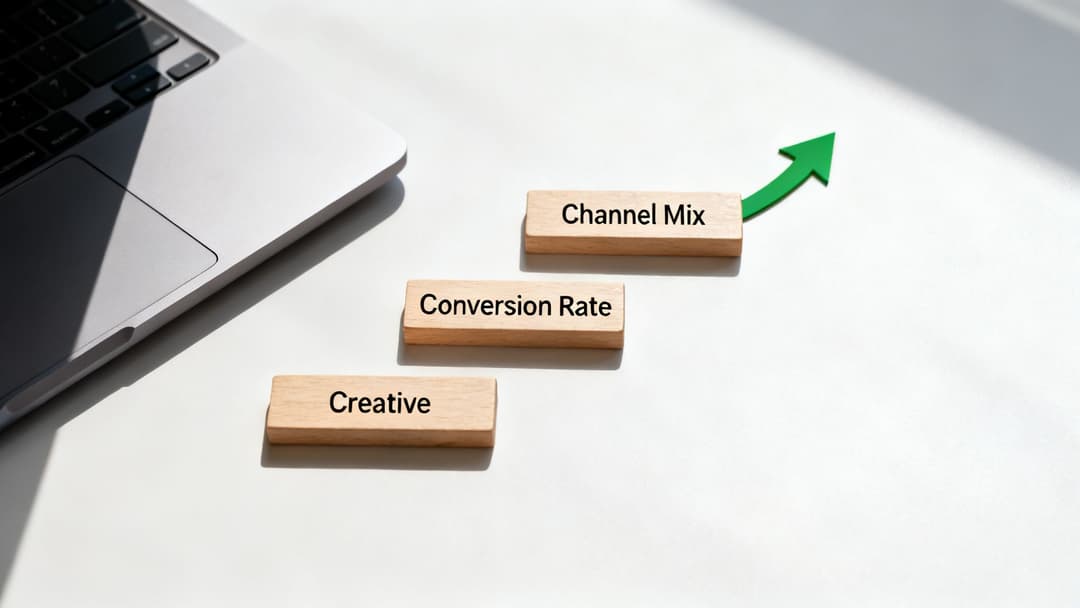
Knowing your Marketing Efficiency Ratio (MER) is a bit like checking your car's fuel gauge. It tells you where you stand, but it doesn't actually get you anywhere. The real work begins when you start tuning the engine to get more miles out of every gallon. Boosting your MER is all about making every single marketing dollar work harder, transforming your budget into a revenue-generating powerhouse.
This isn't about finding one silver bullet. Improving your MER is a systematic process that involves pulling several key levers at once. When you start refining your channel mix, sharpening your audience targeting, and nailing your creative, you create a flywheel effect that lifts your overall profitability.
So, let's get past the theory and into the practical, on-the-ground strategies that will actually move the needle on your MER and drive sustainable growth.
Refine Your Marketing Channel Mix
Not all channels are created equal, and what worked last year might be a dud today. A high MER is built on a marketing mix that perfectly matches your budget, where your audience hangs out, and what you’re trying to achieve. Too many marketers either spread their budget thin across a dozen platforms or get stuck on channels that have stopped delivering results.
The first step is a no-nonsense audit of your current channels. Figure out which ones are your heavy hitters—the ones bringing in the most revenue for the least cost—and which ones are just eating up your budget.
Key Actions for Channel Optimization:
- Double Down on Winners: Shift more of your budget to the channels with proven, high efficiency. If your Meta ads are crushing it while another platform is lagging, it's time to reallocate those funds.
- Test and Scale Methodically: When you're trying a new channel, don't go all in. Start with a small, controlled budget. Set clear MER targets from the get-go. Only ramp up your spending once the channel proves it can deliver efficiently.
- Understand Channel Synergy: Remember that some channels play a supporting role. A brand awareness campaign on YouTube might not have a great direct return, but it can give a serious boost to things like branded search. You have to look at your MER holistically to spot these "halo effects."
Improving your MER isn't just about cutting costs; it's about reallocating resources from low-impact activities to high-impact ones. Smart resource shifting is the fastest way to see a meaningful lift in your overall efficiency.
This constant pruning and nurturing of your channel mix is how you ensure your money is always flowing to where it will generate the best possible return.
Sharpen Your Audience Targeting
There is no faster way to tank your MER than spending money to reach the wrong people. Your creative could be a masterpiece and your offer a total no-brainer, but if you show it to an audience that doesn't need or want your product, it’s all for nothing. For a high MER, precision targeting is absolutely non-negotiable.
Improving your MER hinges on knowing exactly who you're talking to and how to reach them. A deep understanding of your ideal customer profile (ICP) lets you build audiences that are primed to convert, which cuts down on wasted ad spend dramatically. For a masterclass on this, check out this guide on finding your target market.
Think about a B2B SaaS company. MER gives them a bird's-eye view that cuts through the channel-specific noise. If a SaaS firm spends $120,000 on marketing and brings in $900,000 in new revenue, that’s a stellar 7.5x MER, blowing past the typical 5.0 benchmark for mature SaaS businesses. When you pair MER with LTV (and aim for a 3x LTV:CAC ratio), you have a clear path to profitable growth.
Elevate Your Creative and Messaging
In today's crowded digital world, generic ads are invisible. Your ad creative is your digital salesperson, and if it’s boring, you’re essentially paying for impressions that do nothing. Great creative grabs attention, shows value, and pushes people to act—all of which directly feeds into a better MER.
The only way forward is through relentless testing and iteration. Stop guessing what works. You need a system to constantly test different ad variations—images, videos, headlines, calls-to-action—to find the magic combination that resonates with your audience. This data-driven approach takes the guesswork out and makes sure your budget backs proven winners. Our guide on ad spend optimization can offer even more insight here.
This is where AI platforms like AdStellar AI become an absolute game-changer. Manually creating and testing hundreds of ad variants is a soul-crushing, slow process that just drains your resources. AdStellar AI automates the entire thing.
- Bulk Ad Creation: Whip up hundreds of creative, copy, and audience combos in minutes.
- Automated Testing: Launch all those variations to quickly see what sticks, without the manual grind.
- AI-Driven Insights: The platform crunches the numbers and tells you exactly which creative elements, headlines, and audiences are hitting your MER goals.
By using AI to put your testing on hyperdrive, you find winning ad formulas faster, shift your budget to what's working, and directly increase the revenue you generate from your ad spend.
Enhance Your Conversion Rate Optimization
Finally, you can have the perfect channels, laser-focused targeting, and killer creative, but if your website or landing page can’t seal the deal, your MER will still be in the gutter. Conversion Rate Optimization (CRO) is the last, critical piece of the efficiency puzzle. It’s all about making your on-site experience as smooth and persuasive as possible.
Every little bit of friction—a page that loads too slowly, a confusing checkout, a lack of trust signals—is a chance for a potential customer to bail. Improving your conversion rate means you squeeze more revenue out of the exact same traffic, which is a direct and powerful way to boost your MER.
Focus on these high-impact CRO activities:
- Improve Page Load Speed: A one-second delay can kill your conversion rates. Seriously.
- Simplify Your Forms: Only ask for what you absolutely need. Every extra field is another reason for someone to give up.
- Add Social Proof: Slap customer reviews, testimonials, and trust badges everywhere they make sense.
- A/B Test Key Pages: Never stop testing variations of your landing pages, product pages, and checkout process to find what works best.
When you treat your website like a dynamic conversion tool instead of a static brochure, you ensure the valuable traffic you paid for has the best possible shot at becoming revenue.
Common Questions About the Marketing Efficiency Ratio
As you start working the Marketing Efficiency Ratio (MER) into your regular reporting, some practical questions will naturally pop up. Getting a handle on these common sticking points is the key to using the metric with confidence.
Let's walk through a few of the most frequent questions we hear from marketers about MER.
What Is the Difference Between MER and Blended ROAS?
This one's easy: there is no difference. Marketing Efficiency Ratio (MER) and Blended ROAS are just two different names for the exact same formula: Total Revenue / Total Marketing Spend.
The term "Blended ROAS" gained traction as a way to separate this big-picture metric from the specific ROAS numbers you see inside your Google Ads or Meta Ads manager. Over time, however, MER has become the more common and standardized term in the industry.
Just think of them as synonyms for the same north-star metric that keeps your entire marketing strategy on track.
How Often Should I Track My Marketing Efficiency Ratio?
There’s no single right answer here—it really depends on the natural rhythm of your business. The trick is to match your tracking schedule to how quickly (or slowly) your customers make a purchase.
- Daily or Weekly: This is perfect for fast-moving e-commerce and DTC brands. Shorter feedback loops let you see the immediate results of a new campaign, a flash sale, or a creative swap.
- Monthly or Quarterly: This cadence makes more sense for businesses with a longer sales cycle, like B2B SaaS companies or anyone selling high-ticket services. It gives your marketing efforts enough time to actually mature and turn into real revenue.
The most important thing is to pick a rhythm that makes sense for your decision-making and then stick with it for consistent tracking.
An unusually high MER isn't always something to celebrate. It can actually be a warning sign that you're underinvesting in marketing and leaving growth on the table.
A sky-high MER might just mean you're only targeting people who were already about to buy. While that’s incredibly efficient, it ignores all the brand-building and awareness work you need for sustainable, long-term growth. The real goal is finding that sweet spot between efficiency and aggressive scaling.
Can a High MER Ever Be a Bad Thing?
Yes, absolutely. It might seem strange, but an extremely high MER can be a red flag that your marketing is playing it too safe. You could be missing out on acquiring a ton of new customers and growing your market share simply because your budget is too tight.
This often happens when a company gets hyper-focused on bottom-of-funnel tactics like retargeting or branded search ads, which always deliver high returns. The problem is, that approach starves the top of your funnel. Eventually, you’ll run out of new people to retarget.
Real, lasting growth requires a balanced diet of activities that nurture people at every stage. To get a better sense of what it takes to bring new people in, it's worth exploring the fundamentals of customer acquisition cost calculation.
How Do I Calculate MER for a Hybrid Business Model?
For businesses that juggle different revenue streams—say, a brand that sells products online but also generates leads for a sales team—calculating MER takes a bit more thought. You have two solid options for getting a clear view of your performance.
- Calculate Separate MERs: The simplest way is to treat each part of the business as its own unit. Calculate one MER for your e-commerce side using direct sales, and a completely separate MER for your lead generation efforts.
- Create a Blended MER: If you want a single, unified metric, you’ll need to put a dollar value on your leads. You can estimate this based on your historical lead-to-close rate and the average value of a new client. Once you have that, add this projected lead revenue to your direct sales revenue and calculate one comprehensive MER for the whole business.
Ready to boost your MER by finding winning ad combinations faster? AdStellar AI helps you launch, test, and scale your Meta campaigns in a fraction of the time, so you can reallocate your budget to what works best and drive more revenue from every dollar spent. Unlock more efficient growth with AdStellar AI.