Great ad copy isn't just about stringing together clever words. It’s about building a strategic bridge between a customer’s real-world problem and your product’s solution.
The most common mistake I see is marketers trying to create desire. You can't. The best copy simply channels the hopes, fears, and needs that already exist in your audience and focuses them squarely on what you're offering. That psychological connection is the engine behind every ad that actually works.

The Blueprint of Great Advertising Copy
Before we get into specific formulas and frameworks, we need to understand what makes ad copy work. Think of it like an architect designing a building. You wouldn't just start throwing up walls and hope for the best, right? You need a solid blueprint grounded in fundamental principles.
For copywriters, that blueprint is a deep understanding of human psychology. Great ads connect with people on an emotional level, making them feel seen and understood.
This isn’t just some fluffy creative theory; the data backs it up. Research has consistently shown that an ad's likeability and recall are the top predictors of its sales performance—beating out traditional persuasion tactics. You can dig into the history of this research over at Copytesting.org. It just confirms what the best copywriters have always known: connection drives conversion.
So, let's break down the three foundational pillars that separate ads that convert from those that get ignored. Once you get these down, you'll be able to instantly diagnose why some of your ads are thriving while others fall flat.
The Three Pillars of High-Converting Copy
Every single piece of high-performing ad copy—no matter the platform or product—is built on a foundation of empathy, clarity, and persuasion. These aren't just buzzwords. They’re the core components that guide a potential customer from just scrolling to actually taking action.
Here’s a quick rundown of what each pillar actually means and why it's non-negotiable for getting conversions.
The Three Pillars of High-Converting Copy
| Pillar | Core Question It Answers | Impact on Conversions |
|---|---|---|
| Deep Audience Empathy | "Do you truly understand my problem?" | Builds immediate trust and rapport, making the audience feel heard and receptive to your message. |
| Undeniable Clarity | "What is this and what's in it for me?" | Eliminates confusion and friction. If they don't get it in 3 seconds, they're gone. |
| Compelling Persuasion | "Why is this the best choice for me?" | Presents a logical and emotional case for action, turning interest into a purchase decision. |
Mastering these three pillars is the first real step toward crafting messages that not only grab attention but also build the conviction someone needs to click "buy."
For a more detailed breakdown of what to include in your ads, check out our guide on what to include in ad copy.
Classic Copywriting Frameworks for Modern Ads
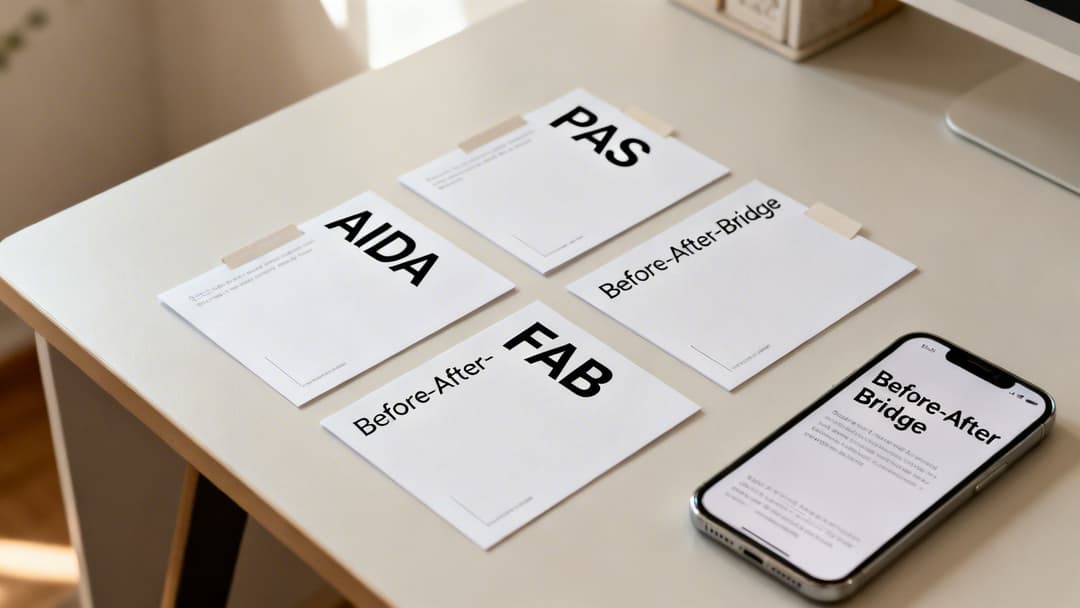
Starting with a blank page is the fastest way to get writer’s block. The good news? You never have to. The best marketers don’t pull brilliant copy out of thin air; they rely on proven, psychologically-backed frameworks that guide customers from awareness to action.
Think of these not as rigid rules, but as reliable recipes for great advertising copy. They're timeless because they tap directly into how people make decisions. By adapting them for today’s fast-scrolling platforms like Meta, you can structure your message to stop thumbs, spark interest, and drive real results. Let's break down four of the most effective models you can start using today.
AIDA: The Universal Persuasion Path
AIDA is probably the most famous copywriting framework in history, and for a simple reason—it just works. It breaks the customer journey down into four simple, sequential steps that gently guide someone from being a total stranger to becoming a happy customer.
This structure is incredibly versatile, working for everything from a quick Instagram ad to a detailed landing page. Its power lies in its logical, human-centric progression.
- Attention: First, you have to stop the scroll. Grab them with a disruptive headline, a surprising statistic, or a captivating image. Your only job here is to earn a few seconds of their time.
- Interest: Now that you have their attention, you have to hold it. Present an interesting fact, a relatable problem, or a unique angle that makes them lean in and want to know more.
- Desire: This is where you pivot. You connect their interest directly to your product, shifting from talking about the problem to showing how your solution makes their life better. Paint a vivid picture of the successful outcome they're craving.
- Action: Finally, tell them exactly what to do next. Use a clear, direct, and low-friction Call to Action (CTA) like “Shop Now,” “Learn More,” or “Get Your Free Quote.” Don't make them guess.
PAS: Solving Problems Directly
The Problem-Agitate-Solution (PAS) framework is a powerhouse for connecting with audiences who are actively feeling a pain point. It’s direct, empathetic, and incredibly effective because it mirrors the way we naturally look for solutions.
You start by validating their struggle, making them feel seen and understood. Then, you gently amplify the emotional cost of that problem before presenting your product as the clear, obvious relief they’ve been searching for.
PAS in Action (SaaS Tool for Freelancers)
- (Problem) Juggling invoices, contracts, and client emails is a full-time job on its own.
- (Agitate) Every late payment, missed deadline, and administrative task is costing you billable hours and adding a mountain of stress.
- (Solution) Streamline your entire freelance business with [Your Tool]. Get back to doing the work you actually love.
FAB: Turning Features Into Benefits
One of the most common mistakes in advertising is focusing on what a product does (its features) instead of what it does for the customer (its benefits). The Features-Advantages-Benefits (FAB) framework is your secret weapon for making that critical connection.
This framework forces you to translate dry specs and product attributes into compelling emotional payoffs. It ensures your copy always answers the customer's most important question: "What's in it for me?"
- Feature: What does your product have or do? (e.g., "Our hiking boots are made with a waterproof Gore-Tex lining.")
- Advantage: Why is that feature helpful? (e.g., "This means your feet stay completely dry, even in a downpour or on wet trails.")
- Benefit: What is the real-world, emotional outcome for the customer? (e.g., "So you can hike longer, stay comfortable, and actually enjoy your adventure without worrying about painful blisters.")
For those looking to see how these frameworks come to life, exploring some well-crafted sample ad copy can provide excellent inspiration.
The Before-After-Bridge
The Before-After-Bridge (BAB) is a storytelling framework that excels at creating a powerful narrative of transformation. It’s so effective because it sells an outcome, not just a product.
You start by painting a relatable picture of the customer's current, frustrating reality (the "Before" state). Next, you show them a vision of their ideal future—where that frustration is gone (the "After" state). The final, crucial step is presenting your product as the simple, elegant bridge that gets them from here to there.
This framework is a masterclass in selling the destination, making the journey (buying your product) an easy and obvious decision.
Analyzing a Real-World Ad Copy Makeover
Theory is great, but let's be honest—the real learning happens when you see principles put into practice. It's time to make these frameworks tangible by dissecting a few ad copy makeovers, piece by piece.
We'll look at the "before" to spot the common mistakes that hold ads back, and then break down the "after" to see how a few strategic tweaks can create great advertising copy that actually converts. Think of this as your repeatable playbook for auditing and improving your own ads.
DTC Example: The All-Natural Skincare Serum
First up, a direct-to-consumer brand launching a new, plant-based facial serum. Their initial ad is functional, sure, but it completely misses the mark on creating an emotional connection or any real sense of urgency.
The Original 'Before' Copy
Headline: New Botanical Serum Primary Text: Our new serum is made with 10 powerful plant extracts. It features Vitamin C and Hyaluronic Acid to help your skin. Our product is all-natural and vegan. Get yours today!
This is a classic case of "feature-dumping." It lists ingredients without ever telling the customer what those ingredients do for them. It’s informative, but it’s definitely not persuasive.
The Improved 'After' Copy
Headline: Your 30-Second Morning Ritual for a Radiant Glow Primary Text: Tired of complicated skincare routines that don't deliver? Get visibly brighter, smoother skin in just 30 seconds a day.
Our potent botanical serum combines stabilized Vitamin C to fade dark spots and Hyaluronic Acid to lock in all-day hydration. Feel the difference of plant-powered skincare without any harsh chemicals.
✨ Finally get the effortless, radiant glow you deserve.
Shop now and get 15% off your first order!
Now this is a huge improvement. The magic here is the shift in focus from the product's features to the customer's desired transformation. It’s no longer selling a bottle of serum; it’s selling an "effortless, radiant glow."
SaaS Example: The Project Management Tool
Let's switch gears to a B2B SaaS company selling a project management tool for small teams. The original copy is drowning in technical jargon and fails to connect with the real, everyday frustrations of its audience.
The Original 'Before' Copy
Headline: Advanced Project Management Software Primary Text: Our platform offers Gantt charts, Kanban boards, and robust API integrations. Increase team productivity with our all-in-one solution. Sign up for a free trial.
This ad tells you what the software is, but it gives a busy project manager zero reason to care. It’s cold, impersonal, and incredibly easy to scroll right past.
The Improved 'After' Copy
Headline: Stop Drowning in Project Chaos Primary Text: Is your team buried under messy spreadsheets, missed deadlines, and endless email chains? It’s time to get organized without the hassle.
[Your Tool] brings all your tasks, files, and team communication into one clear, visual dashboard. Finally, everyone knows exactly what to do and when—so projects actually get finished on time.
Stop managing the chaos. Start leading your team.
Get started with a free 14-day trial.
The makeover is a perfect execution of the Problem-Agitate-Solution (PAS) framework. It hooks you with a relatable pain point ("drowning in project chaos"), twists the knife by listing specific frustrations, and then presents the tool as the hero. That final line—"Stop managing the chaos. Start leading your team"—is brilliant. It sells a new, better identity, not just a piece of software.
Ad Copy Makeover Analysis
Let's zoom in on the SaaS example to see a side-by-side breakdown of the strategic changes that made the "After" copy so much more effective.
| Copy Element | Original 'Before' Copy | Why It Underperforms | Improved 'After' Copy | Why It Converts |
|---|---|---|---|---|
| Headline | Advanced Project Management Software | Generic and feature-focused. It's a label, not a hook. | Stop Drowning in Project Chaos | Pain-point driven and instantly relatable. It grabs attention by naming the problem. |
| Opening Line | Our platform offers Gantt charts, Kanban boards... | Immediately dives into technical jargon that alienates non-technical users. | Is your team buried under messy spreadsheets...? | Uses a question to empathize with the user's biggest frustrations, creating an immediate connection. |
| Value Proposition | Increase team productivity with our all-in-one solution. | Vague and overused. "Productivity" is a buzzword without context. | ...everyone knows exactly what to do and when—so projects actually get finished on time. | Translates features into a tangible, desirable outcome: clarity and on-time project completion. |
| Closing Line | Sign up for a free trial. | A weak, standard command that lacks any emotional punch. | Stop managing the chaos. Start leading your team. | Aspirational and empowering. It sells a transformation in their professional identity. |
| Call to Action | Sign up for a free trial. | Standard and uninspired. | Get started with a free 14-day trial. | More specific ("14-day") and uses active, encouraging language ("Get started"). |
This table clearly shows that great copy isn’t about just listing features; it’s about reframing those features into solutions for your customer’s biggest headaches.
Local Service: The Landscaping Company
Finally, let's look at a local landscaping business trying to drum up clients for the spring. Their first attempt is so generic it's practically invisible.
The Original 'Before' Copy
Headline: Professional Landscaping Services Primary Text: We offer lawn mowing, garden design, and tree trimming. We have over 10 years of experience. Call us for a free estimate.
This copy could belong to any landscaper in a 50-mile radius. It gives a potential customer absolutely no reason to choose this company over the dozen others they could call.
The Improved 'After' Copy
Headline: The Best-Looking Yard on the Block—Guaranteed. Primary Text: Dream of a perfect lawn but have no time for the upkeep? Imagine coming home to a beautifully manicured yard every single day, without lifting a finger.
We help busy homeowners in [Your City] create stunning outdoor spaces they're proud of. From weekly lawn care to complete garden makeovers, we handle it all so you can just relax and enjoy your home.
Ready for a yard you'll love? Book your free, no-obligation design consultation before April 30th and lock in our spring special!
This version works so much better. It uses the Before-After-Bridge framework, painting a vivid picture of the customer's current reality (no time) and their desired future (a beautiful yard without the work). The headline is bold and benefit-driven, and the call-to-action creates real urgency with a deadline-based offer.
These makeovers prove that effective copy isn't about using bigger words or more jargon. It's about forging a deeper, more empathetic connection with your audience. For more inspiration, you can see a variety of other powerful advertising copy examples in our dedicated guide.
Selling an Aspiration, Not Just a Product
Let’s be honest. Truly great ad copy rarely talks about the product itself. Instead, it does something far more powerful: it sells a better version of the customer. It taps into our fundamental human desire to improve, to belong, or to just find a little more peace of mind.
People don’t really want a new pair of running shoes; they want the feeling of crossing a finish line. This is the critical leap from a transactional message (“Buy our shoes”) to a transformational one (“Become the runner you were meant to be”). When you sell an identity, you forge a connection that a simple feature list can never touch. Your brand stops being a commodity and starts becoming a symbol.
Think back to 1988. Wieden+Kennedy unleashed the "Just Do It" campaign for Nike, and it was more than just an ad—it was a cultural reset. Nike stopped selling athletic gear and started selling an entire ethos of grit and personal achievement. If you want to see how that one campaign rewrote the rules, you can check out this retrospective on iconic advertisements.
This is how you build brand equity that pays dividends long after a single campaign ends.
Uncovering Your Audience’s Deeper Drivers
To sell an aspiration, you first have to know what people secretly aspire to. This means digging deeper than surface-level demographics and getting into the real, messy, emotional drivers that guide their decisions. What are they worried about at 3 AM? What are the quiet ambitions they barely admit to themselves?
You get there by asking better questions.
Instead of: "What problems does our product solve?"
Ask: "What better version of themselves does our product help them become?"
Instead of: "What are the key features?"
Ask: "How does using this product make them feel?"
The power, the force, the overwhelming urge to own that makes advertising work, comes from the market itself, and not from the copy. Copy cannot create desire for a product. It can only take the hopes, dreams, fears and desires that already exist... and focus those already existing desires onto a particular product.
The legendary copywriter Eugene Schwartz nailed it. Your job isn't to invent desire out of thin air. It’s to find the desire that’s already there and connect it directly to your product. By understanding these core emotions, you can perfectly align your brand with your customer's own personal journey. We cover this in-depth in our guide to the psychology of advertising.
From Product Features to Identity Benefits
Once you’ve pinpointed that core aspiration, your next move is to weave it into every word you write. This is all about reframing your product’s features as identity-level benefits.
Here’s what that looks like in the real world:
- A financial planning app isn't selling budgeting tools. It's selling the identity of someone who is "in control," "financially savvy," and "building a secure future."
- A luxury watch isn't just selling a way to tell time. It's selling the status and success that says you’ve "made it."
- A meal-kit delivery service isn’t just selling convenient food. It's selling the identity of a "healthy," "organized," and "caring" person who puts good food on the table for their family.
You're building a bridge from what your product does to how it makes your customer feel about themselves. That’s where the magic happens.
Practical Techniques for Aspirational Copy
So, how do you actually put this into practice and start writing great advertising copy that connects on that deeper level? It's simpler than you think.
- Lead with the "After" State: Don’t start with the product. Start by painting a vivid picture of the customer's life after your product. Describe the feeling of success, relief, or confidence they're chasing.
- Use "Identity" Language: Sprinkle in words that speak directly to who they want to become. Phrases built around words like "Become," "Transform," "Achieve," "Master," and "Finally" are incredibly powerful triggers.
- Focus on the Feeling, Not the Function: Instead of saying, “Our software automates your reports,” try something like, “Imagine leaving work on time every Friday, knowing everything is handled.” The first is a function; the second sells a feeling of freedom.
When you focus on who your customer wants to be, you create advertising that does more than just sell—it inspires. And that’s how you build a brand that people don't just buy from, but truly believe in.
How to Scale Winning Ad Copy with AI
Writing one piece of killer ad copy feels like an art. But consistently finding and scaling ads that actually work? That’s a system. This is where the best marketers today operate, blending creative gut feelings with hard data to turn one-off wins into predictable growth.
The old way was a painful, manual grind. You'd A/B test a couple of headlines here, maybe tweak a line of body copy there. It was slow, expensive, and the results were often murky at best. Sure, you might find a small winner, but you’d rarely uncover the game-changing angle that completely transforms a campaign.
The Modern Workflow From Testing to Scaling
A modern, systemized approach is all about testing every single component of your ad at a scale that was once unthinkable. We're not just talking about changing a few words. It's about systematically throwing entire messaging concepts against your key audience segments to see what sticks.
This workflow turns creative testing into a science:
- Hypothesize: Start with your core value props, customer pain points, and the big, aspirational outcomes they dream of. These are your messaging "pillars."
- Generate Variations: For each pillar, crank out tons of different headlines, primary text, and CTAs. The mission is to explore every possible way to frame a single idea.
- Launch and Measure: Get these variations live in a structured test, keeping a close eye on the metrics that matter, like Return on Ad Spend (ROAS) or Cost Per Acquisition (CPA).
- Analyze and Identify Winners: Dig into the data to find the exact words, phrases, and frameworks that consistently deliver the goods.
- Scale and Iterate: Put your money where the data is. Double down on the winning components, shift budget to the top performers, and use what you’ve learned to inspire the next round of creative.
This is an incredibly powerful system, but trying to do it by hand is a logistical nightmare. Imagine creating, launching, and tracking hundreds of ad variations across multiple campaigns. This is exactly where AI changes the game.
Using AdStellar AI as Your Scaling Engine
Tools like AdStellar AI are built to put this entire process on steroids. It acts as an engine for lightning-fast generation and smart analysis. Instead of getting bogged down in spreadsheets for hours, you can generate hundreds of creative and copy variations in minutes. All that tedious manual work that kills creativity and slows you down? Gone.
But the platform does more than just churn out ads; it learns from them. AdStellar’s AI analyzes performance data against your most important KPIs to tell you exactly which messages are connecting with your audience. For those looking to innovate and streamline, an AI-powered YouTube title generator can help scale the creation of catchy headlines, echoing the advancements in scaling ad copy with AI.
This workflow is perfectly captured in the aspirational selling process, which is all about connecting a product to a customer's desired identity to build real, lasting loyalty.
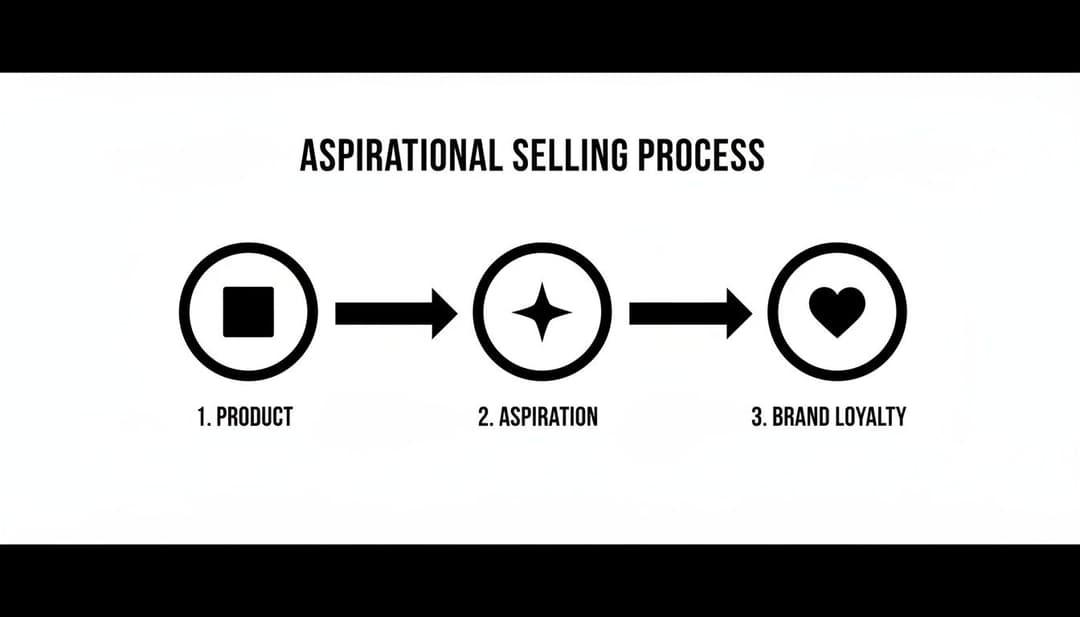
This flow shows that the real goal isn't just a sale—it's a transformation that ties your customer's success directly to your brand.
AdStellar AI helps you find the copy that makes this connection, turning your creative intuition into a predictable, revenue-generating machine. You can learn more about how to leverage AI for your ads and finally move past the manual guesswork.
Turning Creative Intuition Into Predictable Revenue
The real magic of using AI for ad copy isn't just about speed. It’s about getting a much deeper, data-backed understanding of what makes your customers tick. An LLM can chew through massive datasets and spot patterns a human brain would almost certainly miss.
For example, AI can analyze thousands of customer reviews to pinpoint the exact language people use to describe their problems and what they hope to achieve. It then spins that "voice of customer" gold directly into high-performing ad copy.
AI can get you 80% of the way to finished copy in a fraction of the time. The final 20%—the human touch of refinement, brand voice, and strategic oversight—is where your expertise creates the most value.
This partnership between human creativity and machine intelligence lets you test more ideas, learn faster, and scale your wins with confidence. You’re no longer just guessing what works. You’re building a system that continuously finds and amplifies your best messages, making sure every dollar you spend is working as hard as possible to grow your business.
The Unchanging Power of a Great Idea
In an industry obsessed with algorithms, automation, and a never-ending stream of performance metrics, it’s easy to forget what actually moves the needle. Beyond all the frameworks and testing systems, the real engine of advertising has always been, and will always be, a single, powerful idea.
Think about it. Every tool and tactic we’ve covered is designed to do one thing: find, refine, and scale your best ideas. They are amplifiers, not creators. They can’t generate that initial spark that comes from genuine audience empathy and a crystal-clear message that taps into a fundamental human need.
This isn’t some new revelation. Just look at the legendary direct mail letter Martin Conroy wrote for The Wall Street Journal. For 28 years, that one piece of copy was the undisputed champion, bringing in an estimated $2 billion in revenue by 2003. This staggering success, which works out to about $2.58 million per word, was built purely on the back of persuasive writing. You can read the full story of this historic campaign to see just how powerful it was.
The Timeless Principles of Connection
The Journal letter worked for the exact same reasons a great digital ad works today. It understood its audience’s ambitions, dismantled their unspoken objections before they could even form, and told a compelling story about personal transformation. The medium was paper and ink, but the psychology is identical to what stops the scroll on a Meta feed.
A great idea is timeless. While platforms and technologies evolve at a dizzying pace, the core principles of human psychology—our hopes, fears, and desires—remain constant. Your job is to connect those unchanging drivers to your product with clarity and conviction.
Let that sink in, because it should feel empowering. The frameworks, the makeover examples, and the testing workflows we've gone through are your toolkit. But your single greatest asset is your ability to champion the craft of writing great advertising copy as a core driver of business growth.
Bringing Your Best Ideas to Life
Now, it’s time to put it all into practice. Use the models we’ve covered to structure your next ad. Go back and audit your existing copy with a fresh eye for empathy, clarity, and persuasion. But most importantly, commit to a system of testing that lets your best ideas prove their worth.
With a platform like AdStellar AI, you can take your strongest concepts, instantly generate hundreds of variations, and measure their true impact with data-backed confidence. It’s time to stop guessing and start scaling what really works.
A Few Common Questions About Ad Copy
If you've spent any time in the trenches of performance marketing, you know that the same questions about ad copy pop up again and again. Let's tackle some of the big ones with clear, no-nonsense answers.
What’s the Ideal Length for Meta Ad Copy?
The honest answer? There isn’t one. Anyone who tells you there's a single "best" length is selling something. The right length depends entirely on your product, your audience, and how much you need to say to make a compelling case. The only way to find out what resonates with your customers is to test relentlessly.
A solid testing strategy always includes a few different lengths running at the same time:
- Short & Punchy: Think 2-3 lines. This is your hook for the fast scrollers. It's got to be sharp, direct, and intriguing enough to stop a thumb in its tracks.
- Medium-Length: A solid paragraph that gets straight to the point. This is where you lay out the core benefits and show people what's in it for them.
- Long-Form: A more detailed, story-driven approach. This is your chance to tackle complex objections, build a deeper connection, or walk the reader through a more considered purchase.
Trying to generate all these versions by hand is a massive time sink. This is where an AI tool becomes your best friend, letting you spin up and test dozens of variations to see what actually moves the needle.
Should I Focus More on the Headline or the Primary Text?
They're both absolutely essential, but they have very different jobs. Think of it this way: the headline has one goal, and one goal only: to stop the scroll. It’s the bouncer at the door of your ad. If it can't grab someone's attention in that first split second, nothing else you've written matters.
Once the headline has earned you those precious few seconds, the primary text takes over. It’s the salesperson that builds interest, explains the value, and ultimately persuades someone to click. A great strategy is to test 3-5 totally different headline angles for every primary text idea. This lets you find the hook that really connects before you start putting serious budget behind it.
So many marketers get this backward. They’ll agonize over the perfect primary text but then slap on a generic, boring headline. Remember: the headline sells the click, and the primary text sells the offer.
How Many Ad Copy Variations Should I Test at Once?
If you're doing it all manually, trying to test more than 3-5 variations at a time is a recipe for a headache. You’ll spread your budget too thin, and it becomes almost impossible to get clean, statistically significant results.
But with a platform built for this, the game changes completely. You can launch dozens of combinations—mixing and matching headlines, primary text, and CTAs—all at once. The system tracks the performance data automatically, figures out which components are driving results, and shows you the winners. It’s a level of speed and scale that’s just not possible for a human to manage, and it gets you to optimized campaigns way faster.
Ready to stop guessing and start scaling what works? AdStellar AI automates ad creation and testing, giving you the data-backed insights to turn your best ideas into predictable revenue. Launch, test, and scale your Meta ads 10x faster.