In the crowded landscape of Meta and display advertising, generic copy gets ignored. Your ads aren't just competing for attention; they're competing for action. Every headline, every benefit, and every call-to-action is a chance to turn a passive scroller into an active lead or a paying customer. But what separates copy that converts from copy that costs?
It’s not about flashy buzzwords or clever taglines. It's about strategic frameworks that connect with specific audience pain points and guide them toward a solution. The best advertising copy examples are built on a foundation of proven psychological triggers and structured formulas designed to elicit a direct response. Understanding the mechanics behind high-performing ads is the first step toward creating them yourself.
To truly unlock the performance of your ad copy, it's crucial to understand the broader landscape of persuasive advertising techniques. These foundational principles are what give the examples below their power, turning simple text into a compelling argument for your product or service.
This guide moves beyond theory and dives straight into application. We will break down 10 proven advertising copy examples, from classic persuasion formulas like PAS and AIDA to modern narrative-based approaches. For each example, we’ll dissect:
- The Core Strategy: Why the framework is so effective.
- Actionable Templates: Copy-and-paste structures you can adapt for your own campaigns.
- Key Takeaways: Quick optimization tips to implement immediately.
Get ready to transform your ad creation process from a manual grind into a strategic, repeatable engine for growth. Let's analyze what works and why, so you can stop guessing and start scaling your results.
1. Benefit-Driven Copy with Social Proof
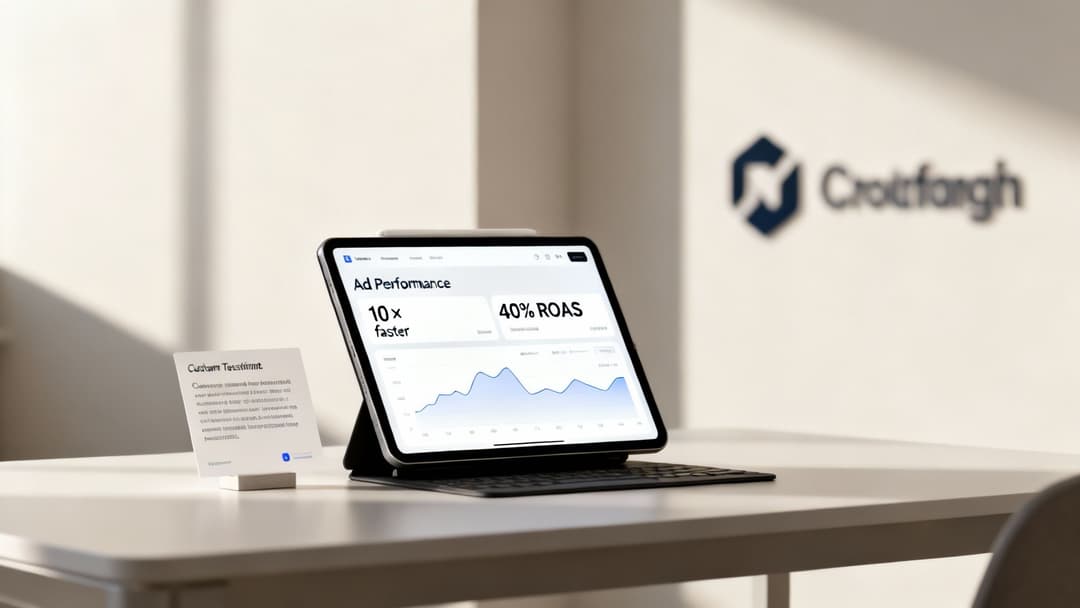
This approach to writing advertising copy is a powerful one-two punch for performance marketing. It leads with a specific, quantifiable benefit your product delivers and immediately backs it up with credible social proof. Instead of just promising results, you're proving them with hard data, user testimonials, or impressive statistics. This combination directly addresses a potential customer's core question: "What's in it for me, and can I trust this?"
This method is particularly effective for B2B SaaS, tech tools, and any high-consideration purchase where buyers need to justify their decision with tangible ROI.
Why It Works: The Breakdown
- Quantifiable Benefits: Numbers cut through the noise. A claim like "Increase ROAS by 40%" is far more compelling than a vague promise to "improve your ads." Specificity builds instant credibility.
- Built-in Trust Signal: Social proof acts as a risk-reversal mechanism. When prospects see that 68% of marketers or companies like theirs achieve a specific outcome, it lowers their hesitation and validates their potential decision.
- Focus on Outcomes, Not Features: This copy speaks the language of results. The customer cares less about the feature itself and more about the outcome it creates, such as time saved or revenue gained.
Real-World Advertising Copy Examples
- AdStellar: "Launch 100+ ad variations in minutes, not weeks. Watch ROAS increase by 40% on average."
- Unbounce: "68% of marketers see conversion increases within their first month."
- HubSpot: "Companies using HubSpot grow 40% faster."
Actionable Tips & Takeaways
- Isolate Your Top Metric: Dig into your platform analytics or customer case studies. Identify the single most impactful metric your product moves (e.g., CPL, ROAS, time-saved) and lead with it.
- Test Benefit Hierarchies: Your audience segments may value different outcomes. Test which benefit resonates most by running A/B or multivariate tests. To dive deeper, you can learn more about how to set up these experiments by reading up on what is multivariate testing.
- Keep Data Fresh: Update your social proof statistics quarterly. Stale data can erode trust. Use fresh case studies and performance data to keep your claims potent and relevant.
2. Problem-Agitate-Solve (PAS) Framework
The Problem-Agitate-Solve (PAS) framework is a classic, high-impact copywriting formula that hooks readers by tapping into their core challenges. It first identifies a specific, relatable problem, then amplifies the frustration or pain associated with it, and finally presents your product as the clear, indispensable solution. This structure creates an immediate sense of urgency and relevance, making it exceptionally effective for paid social ads where grabbing attention in the first few seconds is critical.
This method works well for any product or service that solves a clear pain point, from B2B SaaS tools that eliminate tedious manual work to DTC products that address a common lifestyle frustration.
Why It Works: The Breakdown
- Creates Instant Empathy: By starting with a problem the audience experiences daily, the copy immediately says, "We get you." This builds a quick connection and makes the reader feel understood.
- Leverages Loss Aversion: The "Agitate" step highlights what the prospect is losing, whether it's time, money, or professional credibility. Humans are psychologically wired to avoid pain more than to seek pleasure, making this a powerful motivator. You can explore more about how this works by understanding the core principles of psychology in commercials.
- Positions the Solution as a Relief: After heightening the tension, the "Solve" phase offers a clear path to relief. Your product isn't just a feature; it's the answer to a pressing problem, which makes the call-to-action much more compelling.
Real-World Advertising Copy Examples
- AdStellar: "Managing Meta campaigns manually? That's 40+ hours lost each week. Meanwhile, your competitors test 200+ variations monthly while you're stuck at 20."
- Grammarly: "Embarrassing typos damaging your professional reputation? Your emails, posts, and documents get flagged in seconds."
- Calendly: "Back-and-forth scheduling emails wasting 15+ hours weekly? Replace chaos with one scheduling link."
Actionable Tips & Takeaways
- Identify Audience Pain Points: Use audience research from platforms like Meta Ads Manager or customer surveys to pinpoint the top three frustrations your target audience faces. Lead with the most resonant one.
- Test Agitation Angles: Experiment with different agitation tactics. Some audiences respond more to financial costs ("...wasting thousands in ad spend"), while others are moved by emotional pain ("...damaging your professional reputation").
- Segment Your PAS Copy: Don't use a one-size-fits-all problem. Customize the pain point for different audience segments. For example, an agency's pain is client reporting, while an in-house team's pain might be creative fatigue.
3. Feature-to-Benefit Translation Copy
This advertising copy technique focuses on translating technical product features into tangible, desirable outcomes for the customer. Instead of describing what your product is or what it does, you explain what it achieves. This method bridges the critical gap between your platform's functionality and the real-world value it delivers, directly answering the user's implicit question, "How does this actually help me?"
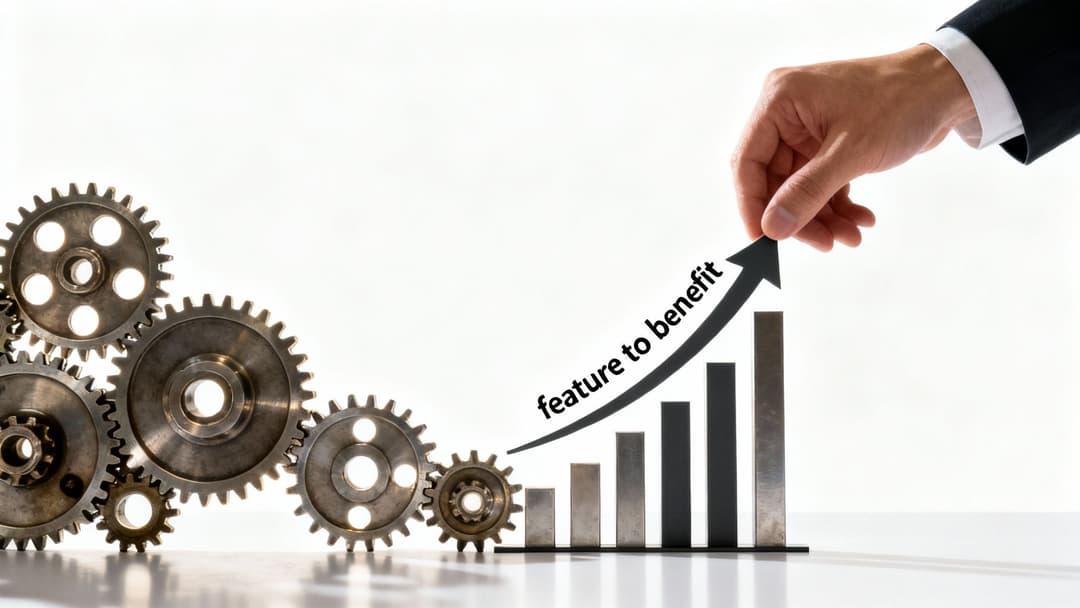
This approach is essential for tech, SaaS, and complex B2B products where features can seem abstract or overwhelming. It makes sophisticated technology accessible and immediately relevant to a user's goals, like saving time, cutting costs, or boosting revenue.
Why It Works: The Breakdown
- Speaks the Customer's Language: Buyers don't purchase "AI-learning models"; they purchase the outcome of having their best-performing ads scaled automatically. This copy focuses on the end result, which is what truly motivates a decision.
- Clarifies Value Proposition: It removes the burden from the prospect of having to figure out why a feature matters. By explicitly stating the benefit, you make your value proposition crystal clear and compelling.
- Highlights Competitive Advantage: While competitors might list the same features, framing them as unique benefits can differentiate your product. The benefit is your interpretation of the feature's power.
Real-World Advertising Copy Examples
- Feature: "AI-powered bulk ad creation." → Benefit Copy: "Generate 100+ complete ad variations in 3 minutes."
- Feature: "OAuth-connected Meta Ads Manager integration." → Benefit Copy: "Your campaign performance syncs automatically. No manual data entry, no errors."
- Feature: "Centralized workflow module." → Benefit Copy: "Your entire team collaborates in one place. Cut Slack and email chaos by 60%."
Actionable Tips & Takeaways
- Create a Feature-Benefit Matrix: Before writing a single ad, map out every product feature and its corresponding customer benefit. This matrix becomes your source of truth for all marketing copy.
- Quantify Everything Possible: Vague benefits like "faster" are weak. Be specific. Use hard numbers like "cut approval time by 50%" or "launch campaigns in 5 minutes" to make the benefit concrete and believable.
- Segment Benefits by Audience: An agency might value time-saving benefits ("launch client campaigns 10x faster"), while an e-commerce brand may prioritize ROAS ("find winning ad combinations that boost ROAS"). Tailor your feature-to-benefit ads to the segment's primary motivation.
4. Curiosity-Driven Headline with Value Promise
This advertising copy technique leverages human curiosity to stop the scroll. It works by posing an intriguing question, presenting an unexpected angle, or making a bold claim that demands an answer. This hook is then immediately followed by a clear value proposition in the body copy, satisfying the curiosity it created and guiding the user toward a solution.
This approach is highly effective on crowded platforms like Meta, where grabbing attention in the first second is critical. It's ideal for top-of-funnel awareness campaigns, driving traffic to educational content like blog posts or webinars, and warming up cold audiences before hitting them with a harder sell.
Why It Works: The Breakdown
- Creates an "Information Gap": Inspired by the "information gap theory," this copy makes the reader feel like they're missing a crucial piece of knowledge. This creates a psychological need to close the gap by clicking and learning more.
- Interrupts Scrolling Patterns: An unexpected or contrarian headline breaks the monotony of a user's feed. A question like "What's your move?" or a claim about a common "mistake" forces a mental pause and encourages engagement.
- Builds Authority and Trust: By promising and then delivering valuable information, you position your brand as a helpful expert. You're not just selling; you're educating and solving a problem, which builds trust early in the customer journey.
Real-World Advertising Copy Examples
- AdStellar: "We're launching 200+ ad variations monthly. Here's how we do it in 15 minutes."
- Copyblogger: "Meta advertisers are making this ONE mistake. It's costing them 60% in lost ROAS."
- Gong: "Your competitors just scaled their ad testing 10×. What's your move?"
Actionable Tips & Takeaways
- Promise and Deliver, Instantly: Always fulfill the headline's promise within the first line of your body copy. If your headline teases a "secret," reveal it immediately to avoid frustrating the user and losing credibility.
- A/B Test Curiosity Angles: Not all hooks work for all audiences. Test different angles: a contrarian take ("Why more testing is hurting your ads"), a secret-reveal ("The one metric that actually matters"), or a direct challenge ("Your competitors are doing this").
- Use for Cold Traffic Segmentation: This is a perfect strategy for cold audiences. Pair these ads with pixel tracking; you can then retarget users who engaged with the curiosity-driven ad with more direct, benefit-focused copy. This warms them up for conversion.
5. Competitor Comparison Copy
This advertising copy strategy directly contrasts your solution with a competitor or the status quo. Instead of operating in a vacuum, it frames your product as the superior choice by highlighting key differentiators, saving time, or improving on a known pain point. This method is exceptionally effective for performance marketers and B2B buyers who are actively evaluating options and need a clear, logical reason to choose you.
This approach speaks directly to an audience in the consideration phase. It acknowledges they have other options and helps them justify the switch by making the value proposition explicit and measurable. It answers the prospect's question: "Why is this better than what I'm already using or what I'm considering?"
Why It Works: The Breakdown
- Creates a Clear Frame of Reference: By mentioning a competitor or a common manual process, you anchor your product's value to something the audience already understands. This makes complex benefits feel tangible and easy to grasp.
- Highlights Your Unique Value Proposition (UVP): Comparison copy forces you to be sharp and specific about what makes you different. It moves beyond generic benefits and focuses on the unique mechanisms that deliver superior results.
- Speeds Up the Decision-Making Process: For buyers stuck in analysis paralysis, this copy provides a clear argument. It shortcuts their research process by laying out the key differences, helping them make a faster, more confident decision.
Real-World Advertising Copy Examples
- AdStellar: "Manual campaign setup: 4 hours per 20 variations. AdStellar: 3 minutes for 200 variations. That's 80× faster."
- Slack: "Slack vs. Email: Give your team a better way to work." (A classic campaign that positioned Slack against the ultimate status quo).
- Figma: "Stop managing multiple design files. Figma brings everything together in one place." (Directly addresses a pain point of using competing, file-based tools).
Actionable Tips & Takeaways
- Focus on Differentiation, Not Demeaning: The goal is to highlight what you do better, not to attack a competitor. Frame the comparison around positive outcomes for the customer (e.g., "Save 40+ hours weekly") rather than negative attacks.
- Use Verifiable Facts: Base your comparisons on specific, quantifiable data. Compare features, time spent on tasks, or average results. Vague claims like "we're better" are weak; "we're 80x faster" is powerful.
- Target the Right Audience: This type of advertising copy works best on warm or retargeting audiences who are already aware of the problem and potential solutions. Cold audiences may not have the context to understand the comparison.
6. AIDA Framework Copy (Attention-Interest-Desire-Action)
The AIDA model is a foundational copywriting framework that guides potential customers through a logical four-stage journey from awareness to conversion. It's a classic for a reason: it structures your ad copy to align perfectly with the prospect's decision-making process. The framework systematically moves a cold audience member from simply noticing your ad to taking a specific, desired action.
This methodical approach is highly effective for audiences who are unfamiliar with your brand or solution. It builds a narrative that first captures their Attention with a bold hook, then builds Interest by connecting to a pain point, creates Desire by showcasing a solution with proof, and finally prompts Action with a clear next step.
Why It Works: The Breakdown
- Psychological Sequencing: AIDA mirrors a natural persuasion process. It doesn't rush the sale; instead, it warms up the prospect by first establishing relevance and then building a case for the solution.
- Clarity and Focus: The framework forces you to have a single, clear objective for each part of your copy. This prevents your message from becoming muddled and ensures every word serves a purpose in moving the user to the next stage.
- Versatility: While a classic, AIDA is adaptable to nearly any product or service. It provides a reliable structure for crafting compelling advertising copy examples for platforms from Meta to LinkedIn.
Real-World Advertising Copy Examples
- AdStellar (Example 1):
- Attention: "10x faster ad launches."
- Interest: "For growth teams drowning in manual campaign setup."
- Desire: "Used by 50+ growth teams scaling $100M+ in ad spend."
- Action: "See how in 3 minutes."
- AdStellar (Example 2):
- Attention: "Your competitors are testing 200 ad variations. You're testing 20."
- Interest: "It's killing your ROAS."
- Desire: "AdStellar automates this. Most teams see 40% ROAS improvement in 30 days."
- Action: "Get started free."
Actionable Tips & Takeaways
- Stop the Scroll with Your Hook: The "Attention" phase is the most critical on crowded feeds. Use a shocking statistic, a direct question, or a bold claim that targets a deep-seated pain point for your ideal customer.
- Quantify the Desire Stage: Vague promises don't create desire. Use hard numbers, such as "% improvement," "time saved," or "number of happy users," to make the outcome tangible and believable. To write even better ad copy using this framework, you can explore how the AIDA model works in detail.
- Make the Action Low-Friction: The "Action" step should feel easy and low-risk, especially for a cold audience. Instead of "Buy Now," test CTAs like "Get a Free Demo" or "See it in Action." To effectively guide your audience to take action, consider reviewing these high-converting Call to Action examples.
7. Storytelling and Narrative-Based Copy
Storytelling copy frames your product or service within a brief narrative, often highlighting a customer's transformation. Instead of listing features, it takes the reader on a 'before and after' journey. This creates an emotional connection and helps the audience envision themselves as successful users, making it a powerful technique for building brand affinity and moving engaged audiences toward conversion.

This method is highly effective for services, educational products, and any solution that facilitates a significant personal or professional transformation. It connects on a human level, making the solution feel more attainable and relatable.
Why It Works: The Breakdown
- Creates an Emotional Hook: A well-told story resonates deeper than a list of benefits. It taps into the audience's aspirations and pain points, making the ad memorable and persuasive.
- Illustrates Transformation: The 'before and after' structure clearly demonstrates the value of your product. Prospects don't just see a feature; they see the direct impact it has on someone just like them.
- Builds Relatability and Trust: Using a character, even a simple one, makes the solution feel more human. Audiences can see themselves in the protagonist's struggle, which builds credibility for the eventual triumph.
Real-World Advertising Copy Examples
- AdStellar: "Sarah spent 35 hours weekly manually creating ad variations. Three months with AdStellar, her team tests 200+ variations daily while she focuses on strategy. Her ROAS jumped 45%."
- DTC Brand Story: "A year ago, this DTC brand tested 20 ads per month. Manually. Today, they automate 500+ variations weekly through AdStellar. Revenue tripled."
- Agency Story: "The agency owner who couldn't scale. Then they found AdStellar. Now 6 clients, 3× revenue, and the team has actual free time again."
Actionable Tips & Takeaways
- Source Real Customer Journeys: Pull authentic stories and quantified results from your user base. Use specific names, timelines, and metrics to make the narrative credible and impactful.
- Keep it Concise for Feeds: In a crowded feed, your story needs to be incredibly brief. Stick to a two or three-sentence structure that introduces the problem, presents the solution, and shows the result.
- Test Protagonist Angles: Your audience has diverse roles and goals. Test different protagonists (e.g., in-house marketer, agency owner, DTC founder) to see which narrative resonates best with specific segments. You can explore a variety of advertising copy examples on adstellar.ai to see this in action.
8. Urgency and Scarcity-Based Copy
This powerful psychological trigger leverages the fear of missing out (FOMO) to compel immediate action. By creating a sense of time-bound pressure or limited availability, urgency and scarcity-based copy disrupts the user's tendency to delay a decision. It signals that waiting could mean losing an opportunity, whether it's special pricing, exclusive access, or a limited-quantity product. This approach effectively shortens the consideration phase of the customer journey.
This tactic is extremely effective for product launches, seasonal promotions, and B2B SaaS offers like limited beta access or early-adopter pricing. It answers the prospect's question, "Why should I act on this right now?"
Why It Works: The Breakdown
- Triggers Loss Aversion: Humans are wired to avoid losing something more than they are driven to gain something. Scarcity frames the offer as a potential loss if the user doesn't act quickly.
- Increases Perceived Value: When something is limited, it is often perceived as more valuable or exclusive. This elevates the desirability of your offer without changing the product itself.
- Creates Decisive Action: Urgency removes the "I'll do it later" option from the table. A clear deadline or capacity limit forces a clear yes-or-no decision, which can significantly boost conversion rates.
Real-World Advertising Copy Examples
- AdStellar: "Limited: Beta access to AI Insights ends in 14 days. Book a demo for early access."
- ConvertKit: "First 100 signups get 60 days free. After that, standard pricing applies. Lock in now."
- ProductHunt: "We're capping new accounts at 50 this quarter. Applications close when we hit capacity."
Actionable Tips & Takeaways
- Use Genuine Scarcity: Only use real limits. Fabricated urgency erodes brand trust if customers discover the "limited-time" offer is always available. Use actual beta program capacity or genuine time limits.
- Explain the "Why": Pair scarcity messaging with a reason. Explaining why there's a limit (e.g., "to provide dedicated onboarding support for our first users") makes the scarcity feel credible and customer-focused, not just a sales tactic.
- Test Scarcity Types: Experiment with different forms of scarcity to see what resonates. Test time-based limits ("Offer ends Friday"), capacity-based limits ("Only 50 spots left"), and exclusive access ("Early-bird pricing for beta users").
9. Authority and Credibility-Based Copy
This advertising copy approach centers on establishing your brand as a trusted expert. It leverages external validation, impressive credentials, and powerful associations to build instant trust with your audience. Instead of just stating benefits, you're proving your worth through industry recognition, high-profile customer usage, or official partnerships. This method directly answers the prospect's subconscious question: "Why should I listen to you over everyone else?"
This strategy is crucial for B2B, SaaS, and high-ticket services where buyers are making significant investments and need confidence in their choice. It shifts the conversation from a simple sales pitch to a consultation from a recognized authority.
Why It Works: The Breakdown
- Borrowed Trust: Associating your brand with well-known, respected entities (like Meta or Shopify) allows you to "borrow" their credibility, creating a powerful shortcut to trust.
- Reduces Perceived Risk: When a prospect sees that hundreds of other agencies or major industry players use your solution, it significantly lowers their fear of making the wrong decision.
- Validates Quality: Credentials, certifications, and media mentions act as third-party proof that your product or service meets a high standard of excellence, justifying a premium price and encouraging faster adoption.
Real-World Advertising Copy Examples
- AdStellar: "Built by Meta-certified growth experts. Used by 100+ agencies managing $500M+ in annual ad spend."
- Salesforce: "The #1 CRM, recommended by industry analysts at Gartner and Forrester."
- Stripe: "The payments infrastructure for millions of companies of all sizes, from startups to public companies."
Actionable Tips & Takeaways
- Show, Don't Just Tell: Instead of saying you're an expert, prove it. Lead with your strongest credential, whether it's an official partnership, a major client logo, or a powerful statistic about your user base.
- Quantify Your Authority: Use specific numbers to add weight to your claims. "Used by 100+ agencies" is more impactful than "Used by many agencies." Combining this with a financial metric like "$500M+ in ad spend" creates an even stronger impression.
- Feature a Logo Bar: If you have multiple high-profile customers or partners, create a "Trusted By" or "As Seen In" logo bar in your ad creative or landing page. This visual proof is often more compelling than text alone.
10. Conversational and Personality-Driven Copy
This advertising copy approach trades formal, buttoned-up marketing language for a natural, human-like tone. It reads less like an advertisement and more like advice from a knowledgeable friend or peer. By using conversational language, you lower the audience's natural resistance to being sold to and build instant rapport, which is especially effective on social media platforms where users expect authenticity and personality.
This method is perfect for brands wanting to stand out in crowded B2B or B2C markets. It helps position a product not just as a tool, but as a partner in solving the customer's real, everyday problems.
Why It Works: The Breakdown
- Builds Instant Rapport: Conversational copy feels personal and direct. It breaks down the barrier between company and consumer, fostering a sense of connection and trust that traditional copy often struggles to achieve.
- Increases Memorability: A unique brand voice is a powerful differentiator. In a sea of generic marketing messages, a bit of personality helps your ads stick in the user's mind long after they scroll past.
- Addresses Pain Points Directly: This style excels at cutting straight to the user's frustration in their own language. It validates their feelings and presents the solution in an empathetic, relatable way.
Real-World Advertising Copy Examples
- AdStellar: "Honest question: How much time are you spending on manual ad setup when you could be thinking strategy? Yeah, we thought so. That's why we built AdStellar."
- Slack: "Your Meta campaigns are smart. Your campaign setup process probably isn't. Let's fix that."
- Dollar Shave Club: "No one loves creating 200 ad variations by hand. Here's the tool that makes it feel less like punishment."
Actionable Tips & Takeaways
- Use Your Audience's Language: Dive into customer interviews, support tickets, and online communities to find out how your audience actually talks about their problems. Use their words, not just industry jargon.
- Test Personality Levels: Not every segment responds to the same tone. A/B test a friendly-professional voice against a more casual-funny one to see what resonates. The goal is authenticity, not just being clever.
- Balance Personality with Clarity: While personality is key, the primary goal is still to communicate your value proposition. Ensure your conversational flair doesn't obscure the core message or the call to action. Exploring how various tools accomplish this can be insightful; you can see a comparison of AI writing tools and their different tones by checking out these Jasper AI alternatives.
10 Advertising Copy Types Comparison
| Approach | Implementation complexity | Resource requirements | Expected outcomes | Ideal use cases | Key advantages |
|---|---|---|---|---|---|
| Benefit-Driven Copy with Social Proof | Medium — needs verified metrics and proof | Customer data, testimonials, analytics, creative assets | Higher conversion rates, stronger trust, measurable ROI | Performance marketing, growth-tool trials, retargeting | Builds credibility quickly with quantifiable claims |
| Problem-Agitate-Solve (PAS) Framework | Low–Medium — requires strong emotional framing | Audience research, skilled copywriting | Increased engagement and urgency-driven responses | Cold social ads, awareness-to-consideration journeys | Drives emotional resonance and clarifies value |
| Feature-to-Benefit Translation Copy | Medium — requires mapping features to outcomes | Deep product knowledge, customer metrics, case data | Clear ROI understanding, reduced buyer friction | Landing pages, demos, technical product marketing | Translates technical details into tangible business value |
| Curiosity-Driven Headline with Value Promise | Low — craft compelling hooks; must deliver promise | Creative headline testing, aligned landing content | Higher CTRs and initial engagement, improved awareness | Top-of-funnel social ads, content promotion | Scroll-stopping; increases clicks and initial interest |
| Competitor Comparison Copy | Medium–High — needs accurate competitive intel | Competitive research, verifiable claims, legal review | Faster consideration, clearer differentiation, switching motivation | Consideration stage, comparison pages, retargeting | Clarifies differentiation and justifies switching costs |
| AIDA Framework Copy (Attention–Interest–Desire–Action) | Medium — must execute all four stages coherently | Copywriting, social proof, CTAs, creative sequencing | Predictable funnel progression, consistent conversions | Full-funnel campaigns, demo signups, long-form ads | Proven, versatile structure that guides decision-making |
| Storytelling and Narrative-Based Copy | Medium–High — needs authentic stories and pacing | Customer interviews, narrative craft, longer formats (video) | Strong brand affinity, memorability, warmer leads | Brand-building, video/social stories, warm-audience nurturing | Creates emotional connection and vivid transformation |
| Urgency and Scarcity-Based Copy | Low — message is simple but must be authentic | Genuine limited offers, timing coordination, tracking | Immediate lift in conversions, faster decisions | Trials, limited promotions, product launches | Reduces indecision; drives immediate action when genuine |
| Authority and Credibility-Based Copy | High — requires documented proof and endorsements | Case studies, certifications, media mentions, logos | Increased trust, higher conversion for high-consideration buys | B2B/SaaS, enterprise sales, high-ticket offers | Establishes trust and defends against skepticism |
| Conversational and Personality-Driven Copy | Low–Medium — tone consistency is key | Audience tone research, brand voice guidelines, skilled writers | Higher engagement, shareability, stronger rapport | Social content, awareness, younger/digital-native audiences | Lowers marketing resistance; feels like peer advice |
From Examples to Execution: Your Next Steps
We've journeyed through a comprehensive collection of high-performing advertising copy examples, breaking down the strategic frameworks that make them so effective. From the direct appeal of Benefit-Driven headlines to the psychological pull of the Problem-Agitate-Solve formula, each example offers a powerful template for capturing attention and driving action.
The goal was to move beyond simple admiration of good copy and into a deeper understanding of its mechanics. You now have a strategic playbook filled with ten distinct, replicable approaches. But memorizing frameworks is only the first part of the equation. True mastery lies in the application, testing, and continuous optimization of these principles.
Synthesizing the Core Lessons
Across all the diverse examples, a few universal truths emerged. The most compelling copy is rarely about the product itself; it's about the customer. It speaks directly to their pains, validates their aspirations, and presents a clear, low-friction path to a better reality.
Let's recap the most critical takeaways:
- Clarity Over Cleverness: Your primary goal is to be understood instantly. A clever pun that requires a moment of thought is a moment lost in the fast-scrolling world of social feeds.
- Empathy is Your Superpower: The best copy feels like it was written by someone who truly understands the audience's world. It uses their language, acknowledges their frustrations, and reflects their desires.
- Specificity Builds Trust: Vague claims like "best-in-class" or "revolutionary" are easily ignored. Concrete details, quantifiable results ("cut reporting time by 50%"), and specific use cases are far more persuasive.
- The Framework is a Foundation, Not a Cage: The PAS, AIDA, and other models are starting points. The most innovative ads often blend elements from multiple frameworks, adapting them to a specific audience and offer.
Building Your High-Velocity Testing System
The single greatest differentiator between struggling advertisers and elite growth teams is the speed and intelligence of their testing. A single "winning" ad is a temporary success. A system for consistently finding the next winner is a long-term competitive advantage.
This is where you translate inspiration into impact. Instead of picking one framework from this list and hoping for the best, a systematic approach is essential. Your next steps shouldn't be just to write one new ad, but to design a process for discovery.
- Hypothesize and Prioritize: Select 2-3 frameworks from this article that you believe will resonate most with a specific audience segment. For a B2B audience, you might start with Competitor Comparison and Authority-Based copy. For a D2C product, perhaps Storytelling and Urgency-Based copy are better starting points.
- Generate Variations at Scale: For each chosen framework, brainstorm multiple angles. If you're using the PAS model, what are three different "problems" your audience faces? For each problem, what are three ways to "agitate" it? This multiplies your creative output.
- Isolate Your Variables: To get clean data, test one thing at a time. Start by testing multiple headlines against a single image and primary text. Once you find a winning headline, test different primary text variations with it.
- Analyze and Iterate: Don't just look at which ad won. Dig deeper. Why did it win? Did the pain-focused copy outperform the benefit-focused copy? Did a conversational tone get more engagement than an authoritative one? Use these insights to inform your next round of tests.
This process transforms you from an ad creator into an advertising scientist. You're no longer guessing; you're using data to systematically uncover the messages that unlock growth. By constantly feeding performance data back into your creative strategy, you build a powerful engine for predictable and scalable results. The collection of advertising copy examples in this article is your fuel; now it's time to start the engine.
Ready to turn these frameworks into a scalable testing engine? AdStellar AI connects directly to your ad accounts, using AI to generate hundreds of on-brand copy variations based on proven formulas and then tells you which messages, angles, and creative elements drive the most conversions. Stop guessing and start building your next winning campaign with data-driven creative intelligence.