Great ad copy is what separates an ad that gets scrolled past from one that actually drives sales. It's not about yelling features into the void; it's about sparking a conversation that connects a real person's problem with your solution and gets them to click, buy, or just learn more.
What Is Great Ad Copy and Why It Matters

Think of great ad copy like an expert barista. They don't just list the types of coffee beans they have. Instead, they build a quick rapport, understand what you're in the mood for without you saying much, and suggest the perfect drink. That's what your ad copy should do—bridge the gap between a fleeting thought in someone's head and a confident purchase.
Before we get into the nitty-gritty, it's worth understanding the core differences between content writing vs copywriting. Content writing is about informing or entertaining, but copywriting is built from the ground up to persuade and drive one specific action.
The Goals of Effective Ad Copy
The best ad copy isn't just clever—it's ruthlessly efficient. It has three specific jobs to do, and it does them fast to turn passive scrollers into active customers. This isn't just about creativity; it’s a calculated mix of psychology and clear communication.
Great ad copy must:
- Stop the Scroll: In a feed that never ends, your first few words are everything. They have to be sharp enough to interrupt someone's mindless scrolling and grab their focus.
- Forge an Emotional Connection: People use logic to justify a purchase, but emotion is what makes them want it in the first place. Your copy has to hit on a real pain point, a deep desire, or an aspiration to make someone feel like you get them.
- Inspire a Single, Clear Action: Too many choices lead to no choice at all. Great copy points the user to one obvious next step, whether that's "Shop Now," "Learn More," or "Claim Your Free Trial."
For performance marketers, great ad copy isn’t just a nice-to-have. It’s the engine that drives your entire ROI. It directly impacts your click-through rates, the quality of your leads, and how much you pay for every single acquisition.
The Power of Aspirational Messaging
Some of the most iconic campaigns ever created barely mention the product itself. They sell a feeling, an identity. Think about Nike's 'Just Do It.' When they launched that slogan in 1988, they weren't just a sneaker company anymore; they were selling motivation in a box. The result? Sales skyrocketed from $877 million to $9.2 billion in just ten years because they tapped into a universal desire to achieve something great.
That's the real power of compelling copy. For growth teams, it's undeniable proof that the right words can build empires. Getting this foundation right is critical, as it shapes everything from the words you choose to the metrics you obsess over. A great place to start is by digging into how to improve click-through rate with smarter copy.
The Core Frameworks of High-Converting Copy
While a spark of creative genius definitely helps, truly great ad copy isn’t magic—it’s architecture. Behind almost every ad that makes you click is a time-tested psychological framework. Think of it as a blueprint that guides a potential customer from "What's this?" to "I need this."
Learning these formulas transforms copywriting from a guessing game into a repeatable science. They aren't rigid, unbreakable rules. Instead, they’re proven structures for persuasion that tap into how we naturally process information, identify problems, and decide to act.
Once you get the hang of them, you’ll never have to stare at a blank page again. You'll have a clear, strategic starting point for crafting messages that don't just get seen—they get results.
AIDA: The Perfect First Date Formula
One of the oldest and most reliable frameworks in the book is AIDA, which stands for Attention, Interest, Desire, and Action. The easiest way to think about it is like a successful first date. You don’t jump straight to proposing marriage; you build a connection one step at a time.
Here's how the AIDA framework plays out:
- Attention: This is your opening line. It has to be compelling enough to stop someone mid-scroll and make them listen. In an ad, this is your killer headline or that critical first sentence.
- Interest: Okay, you’ve got their attention. Now you need an engaging conversation. You share intriguing details, relate to their experiences, and keep them hooked. Your copy does this by highlighting fascinating facts or benefits that genuinely pique their curiosity.
- Desire: This is where the chemistry happens. The conversation shifts from just being interesting to feeling personally relevant. Your copy has to connect your product's benefits directly to their wants, making them feel, "Wow, I really need this."
- Action: The date went great, but if you don't ask for a second one, the moment is lost. Your ad needs a crystal-clear, easy-to-follow Call-to-Action (CTA) that tells the user exactly what to do next, like "Shop the Collection" or "Start Your Free Trial."
PAS: The Problem-Solving Powerhouse
Another brutally effective framework is PAS: Problem, Agitate, Solve. This formula works so well because it taps directly into a customer's pain points, making your solution feel like a necessary relief, not just another product they could buy.
Think of it like a leaky faucet. First, you notice the constant drip, drip, drip—that's the Problem. It's an annoyance you're aware of. Then, you see the growing water stain on the ceiling below—now the problem is Agitated. The consequences are real, and they're getting worse. Finally, you call the expert plumber with five-star reviews—that's the Solve.
This framework is especially powerful for products or services that solve a very specific, tangible problem. By first validating the reader's frustration and then amplifying it slightly, you position your offer as the perfect, timely solution they've been searching for.
For a deeper dive into applying these concepts, check out our guide on what to include in ad copy for maximum impact.
USP: The Secret to Standing Out
Finally, every single piece of great ad copy is built on the foundation of a strong Unique Selling Proposition (USP). This isn't just a cool feature; it's the one thing that makes you the only choice in a crowded market. Your USP directly answers the customer's silent question: "Why should I buy from you and not from one of your ten competitors?"
To nail down your USP, ask yourself:
- What specific problem do we solve better than anyone else?
- What tangible benefit can only we deliver?
- What is our most valuable and defensible quality?
A powerful USP could be unbeatable speed ("Get it delivered in an hour"), unmatched quality ("Handmade from Italian leather"), or a totally risk-free guarantee ("Love it or your money back, no questions asked"). It’s the core of your promise, and when you weave it into your AIDA or PAS framework, your message becomes truly irresistible.
Comparing Classic Copywriting Frameworks
To make it even clearer, let's break down how these three frameworks stack up against each other. Each one serves a slightly different purpose, and knowing when to use which is key to crafting copy that converts.
| Framework | Core Purpose | Best For | Example Snippet |
|---|---|---|---|
| AIDA | Guiding a customer through a journey from awareness to purchase. | Top-of-funnel ads, new product launches, general brand awareness. | "Tired of dull skin? Our new Vitamin C serum delivers a radiant glow in just 7 days. Feel the difference yourself. Shop now!" |
| PAS | Highlighting a pain point and presenting the product as the ideal solution. | Problem-aware audiences, solution-based products, direct response ads. | "Losing sleep over deadlines? The constant stress is ruining your focus. Our project tool organizes everything so you never miss a beat." |
| USP | Differentiating your brand from all competitors in the market. | Crowded markets, brand positioning, highlighting a core competitive advantage. | "While other meal kits use frozen ingredients, we deliver farm-fresh produce picked the same day. Taste the difference." |
Ultimately, the best copywriters don't just stick to one formula. They understand the psychology behind each one and mix and match them to fit the audience, the offer, and the platform. Start with these, practice them, and you'll be well on your way.
Analyzing Great Ad Copy Examples in the Wild
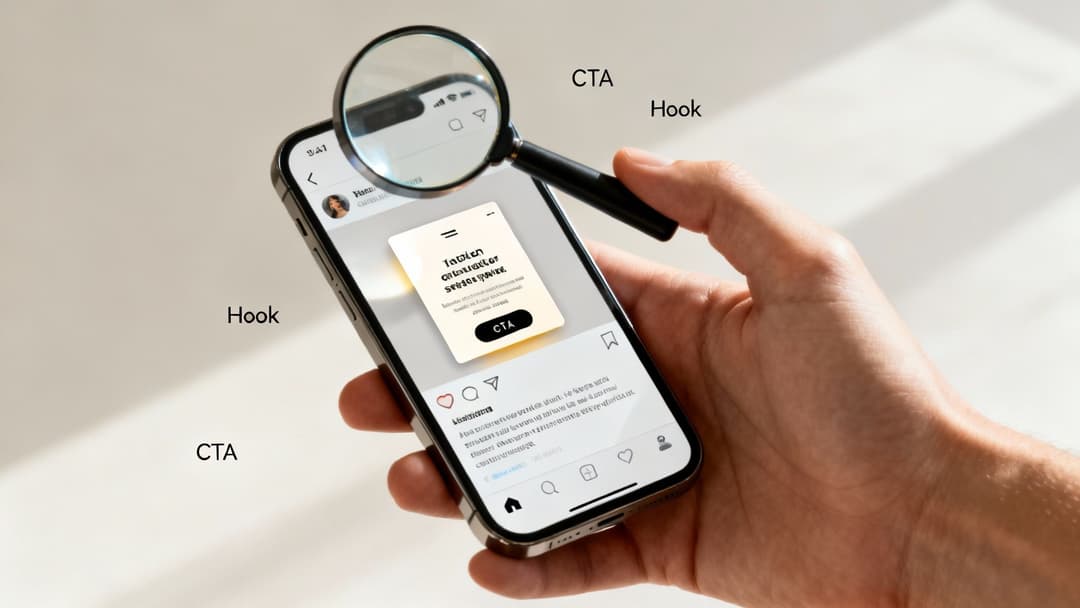
Knowing the theory behind frameworks like AIDA and PAS is one thing, but seeing them work their magic in a live ad feed is where the real learning happens. The fastest way to get good at writing ad copy is to break down what’s already cutting through the noise in crowded, competitive spaces.
When you start dissecting high-performing ads, you build a mental library of what works. You’ll begin to spot the scroll-stopping hooks, the benefit-packed headlines, and the urgent calls-to-action that nudge passive scrollers into becoming active customers.
Anatomy of a High-Performing Meta Ad
Let’s pull apart a typical, effective ad you’d see on a Facebook or Instagram feed. The visual is obviously the first thing people see, but it’s the copy that does the heavy lifting to convince them to act. A stunning image without compelling words is just a pretty picture.
A solid Meta ad almost always has these pieces working in harmony:
- The Hook (Primary Text): These are the first one or two sentences. Their only job is to stop the scroll and earn you a few more seconds of attention. This is where the PAS framework often comes into play, hitting a pain point right away.
- The Headline: This is the bold text sitting right below the creative. It needs to deliver the core promise or biggest benefit in a quick, punchy way. It's often the most-read part of the entire ad.
- The Description (Link Description): That smaller text under the headline is your supporting actor. It adds context, a dash of credibility, or a secondary benefit. It's the perfect spot for social proof or to tackle a common objection head-on.
- The Call-to-Action (CTA): This is the button that tells people exactly what to do next. Clarity is everything. "Shop Now" or "Learn More" leave zero room for confusion.
The best ads don't just sell features; they sell an outcome. The copy is relentlessly focused on the customer's transformation, constantly answering the silent question, "How is this going to make my life better?"
Learning from a Legendary Turnaround
History is full of great ad copy lessons. Back in 1962, Avis rental cars was the perpetual #2, always trailing Hertz. Then they launched their "We Try Harder" campaign, and everything changed. This witty, self-aware tagline leaned into their underdog status, and it clicked with consumers who were tired of corporate arrogance.
The result? Within a year, the campaign helped Avis become profitable for the first time in over a decade. It’s a masterclass in how framing a supposed weakness the right way can turn it into your greatest strength. You can find more breakdowns of iconic copywriting ads on filestage.io.
Your Ad Copy Swipe File
You don’t have to stare at a blank page every time. The best copywriters I know all keep a "swipe file"—a collection of proven formulas and templates they can adapt for their own campaigns.
Here are a few powerful snippets to get you started.
Benefit-Focused Headline Formulas:
- The Only [Product Category] That [Solves a Specific Problem].
- Finally, A Way to [Achieve Desired Outcome] Without [Common Pain Point].
- Get [Specific Benefit] in Just [Timeframe].
- For People Who Want [Goal] But Can't [Obstacle].
Engaging Body Copy Templates:
- Problem/Agitate Style: "[Ask a relatable question about a pain point]. It's frustrating when [elaborate on the problem]. Our [Product Name] was designed specifically to [solve the problem] by..."
- Benefit-Led Style: "Imagine [describe the ideal outcome]. That's the feeling our customers get every day. With [Key Feature], you can finally..."
These templates give you a solid foundation, letting you plug in your own unique value proposition.
Of course, the copy is only half the story. You need to make sure your visuals are just as persuasive. Check out our guide on designing high-impact ad banners to round out your creative strategy. Use these examples and templates as your launchpad for writing great ad copy that doesn't just get attention—it gets results.
How to Test and Optimize Your Ad Copy
Writing what you think is great ad copy is just the starting line. The real magic isn't in the initial flash of genius; it's in the methodical, data-driven process that follows. The best copy isn't just written—it's proven. This is where you separate the hopeful campaigns from the profitable ones through relentless testing, measuring, and optimizing.
A systematic testing rhythm is the engine that drives performance marketing. It’s how you get out of the guessing game and build a repeatable process for discovering what truly connects with your audience and, most importantly, drives your bottom line.
Mastering the Art of A/B Testing
The bedrock of copy optimization is the A/B test, sometimes called a split test. The idea is wonderfully simple: you run two (or more) versions of an ad against each other to see which one performs better. But there's one golden rule: isolate one variable at a time. If you change the headline, the body copy, and the CTA all at once, you’ll have no idea which change actually made the difference.
Start by testing the elements that have the biggest impact first. A disciplined approach usually looks something like this:
- Test the Hook: Start with the very first line. Pit a question against a bold statement, or a pain point against a benefit. The only goal here is to find what reliably stops the scroll.
- Test the Headline: Once you have a winning hook, keep it and test two different headlines. See how a direct, benefit-driven headline stacks up against one that sparks curiosity.
- Test the Call-to-Action: With a winning hook and headline in place, it's time for the CTA. Does "Shop Now" get more action than "Get 20% Off Today"? A tiny tweak here can make a massive difference in conversions.
This one-variable-at-a-time method is the cleanest way to build a high-performing ad from the ground up. If you're feeling more adventurous and want to test multiple changes at once, you might be interested in our guide on what is multivariate testing, which breaks down that more advanced approach.
Identifying Your Control and Your Challenger
In the world of direct response, your top-performing ad is your "control." Think of it as your reigning champion—the ad that has proven it can get results. Every new ad you create is a "challenger," and its only job is to beat the control. If it wins, it becomes the new control. If it loses, you learn something and go again.
This "champion vs. challenger" mindset turns your ad creation into a scientific process. One of the most legendary examples of an unbeatable control is The Wall Street Journal's "Two Young Men" letter. This one piece of direct mail ran for an incredible 28 years and is estimated to have generated $2 billion in revenue. It's a powerful reminder that a winning message can have unbelievable staying power. You can read the full story of this historic advertisement on sofii.org.
Tracking Metrics That Actually Matter
Clicks are nice, but they don't pay the bills. To really know if your ad copy is working, you have to look past vanity metrics like Click-Through Rate (CTR) and focus on the numbers that hit your bottom line.
Great copy doesn't just get clicks; it gets profitable customers. If your CTR is high but your conversion rate is low, your message is likely attracting the wrong audience or setting false expectations.
Your key performance indicators (KPIs) should always tie directly back to business goals.
- Cost Per Acquisition (CPA): How much are you spending to get one new customer? Winning copy should drive this number down.
- Return On Ad Spend (ROAS): For every dollar you put into ads, how many dollars in revenue do you get back? This is the ultimate report card for your campaign's profitability.
- Cost Per Lead (CPL): If you're generating leads, this tells you how efficiently your copy is getting people to raise their hands.
When you obsess over these core business metrics, you ensure your optimization efforts are always pointed toward real growth. Your goal is to find the great ad copy that doesn't just grab attention, but drives sustainable, profitable results.
Using AI to Scale Your Ad Copy Creation
Let’s be honest: creating great ad copy is a craft. But scaling that craft to keep up with the demands of modern marketing? That’s a whole different beast. Pumping out dozens of variations for A/B testing is enough to drain any team's creative well.
This is where AI tools come in—not to replace human creativity, but to act as a powerful strategic partner.
Think of an AI platform as a force multiplier for your marketing team. It can take a single killer concept, a well-defined pain point, or your USP and instantly spin up dozens of copy variations. This lets you test far more angles, hooks, and CTAs than you ever could manually, often uncovering performance breakthroughs you wouldn't have found otherwise.
How AI Acts as a Co-Pilot for Copywriters
The real magic of AI in ad creation isn't just about spitting out text; it's about creating a powerful feedback loop. Advanced platforms can integrate directly with your Meta Ads Manager, digging into your historical performance data to figure out what’s already clicked with your audience.
The AI then uses these insights to generate new copy based on your all-time best ads. It spots the patterns, tones, and benefit statements that drove your highest ROAS or lowest CPA and creates fresh variations modeled on those wins. It’s a data-driven approach that takes a lot of the guesswork out of the creative process.
Of course, to get the most out of these tools, you need to give them clear direction. Knowing how to write compelling inputs is crucial. To really maximize the impact, learn how to create effective AI prompts that guide the AI toward high-quality, on-brand results.
A Practical AI-Powered Workflow
Bringing AI into your workflow completely changes how you launch and optimize campaigns. Instead of a slow, step-by-step process, you can adopt a rapid, iterative cycle that consistently dials up your results.
The process boils down to a simple but incredibly effective loop: test, analyze, and optimize.
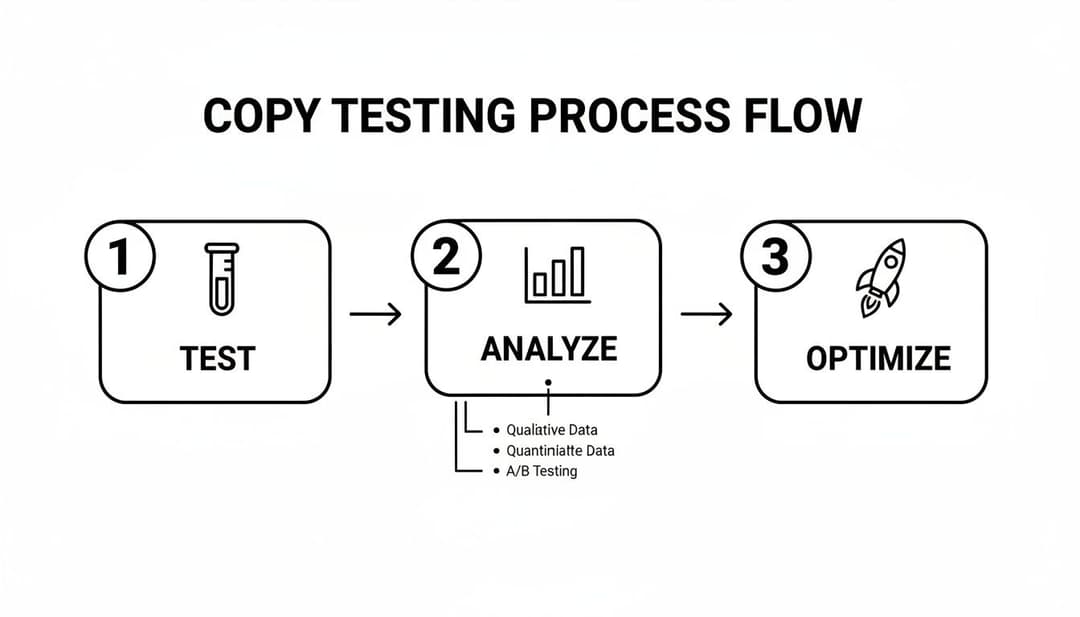
This flow shows a continuous cycle where data from live tests feeds right back into the system. This data then informs the next round of AI-generated copy, leading to ongoing, intelligent optimization.
Platforms built for this purpose streamline the whole operation, from bulk ad creation to performance analysis. For a deeper dive into how this works on specific channels, see how you can leverage AI for Facebook Ads to seriously speed up your campaign launches.
From Bulk Creation to Intelligent Scaling
The true advantage here is moving from tedious, one-off ad creation to a system of intelligent scaling. It’s not just about making more ads faster; it's about making smarter ads that learn from real-world performance.
Here’s how this approach helps your team scale winning campaigns:
- Rapid Variation Testing: Generate hundreds of ad variations in minutes to quickly find the winning mix of copy, creative, and audience targeting.
- Data-Driven Suggestions: Get AI-powered insights that highlight your best-performing messages, helping you understand why certain ads are crushing it.
- Automated Optimization: Let the AI identify top-performing ads and suggest new campaigns built around those proven winners.
By automating the repetitive parts of ad creation and testing, AI frees up your team to focus on high-level strategy and creative direction. It gives them the power to make better decisions based on data, not just a gut feeling.
Ultimately, this workflow helps you discover great ad copy that drives real results and then scale those successes across all your campaigns with incredible speed and efficiency. You're not just making ads; you're building a smarter, more agile advertising engine for your brand.
Your Actionable Ad Copy Playbook
Alright, let's put all this theory into practice. We’ve covered the psychological hooks, picked apart real ads, and talked about testing. Now it's time to build a repeatable process you can lean on for every single campaign.
Think of it this way: writing great ad copy isn’t a one-shot deal. It’s a loop. You create, you test, you learn, and you optimize. Every ad you launch is another chance to figure out what makes your audience tick. The real goal is to build a system where each campaign is smarter than the last—driven by hard data, not just a gut feeling.
This is the mindset that separates the good marketers from the truly great ones. It’s how you keep your messaging sharp and consistently hitting its mark.
Your Pre-Launch Ad Copy Checklist
Before any ad sees the light of day, run it through this quick sanity check. These questions are designed to make sure your creative is actually grounded in strategy, not just clever words. It’s your final quality control before you hit "publish."
Challenge every piece of copy with these prompts:
- The Hook: Does that first sentence grab them by the collar? Does it speak directly to a pain point or desire they already have? Will it stop someone from scrolling right past it?
- The Value Proposition: Can someone understand exactly why you’re better than the competition within three seconds? Is your unique selling proposition blindingly obvious?
- The Framework: Is there a deliberate structure here, like AIDA or PAS? Or is the copy just... wandering? A solid framework guides the reader from point A to point B.
- The Clarity: Is this written in plain English? Ditch the jargon. Read it out loud—does it sound like a real person talking?
- The Call-to-Action (CTA): Is the CTA specific and compelling? Does it give them a clear reason to click right now? Ambiguity kills conversions.
Answering these five questions for every ad builds discipline. You’ll stop hoping your copy works and start knowing why it’s built to succeed.
This playbook isn't about memorizing rules; it's about developing a strategic reflex. You now have the frameworks, examples, and testing mindset to turn ideas into ads that don't just get views—they get results. Now go build something that works.
Frequently Asked Questions About Ad Copy
When you're deep in the trenches of paid advertising, questions are going to pop up. It's just part of the game. Getting solid answers is what separates the campaigns that just spend money from the ones that actually make it. Here are a few of the most common questions we hear from performance marketers.
What Is the Ideal Length for Ad Copy?
Everyone wants a magic number here, but the truth is, there isn't one. The "ideal" length depends entirely on the platform, your audience's mindset, and just how much you need to explain. The only length that matters is the one that gets you the highest return on your ad spend.
Think about it: on a platform like Instagram Stories, where everything is visual and fast-paced, you need short, punchy copy that gets out of the way of the creative. But if you're targeting a high-intent audience on Facebook for a more complex purchase, longer, story-driven copy can absolutely crush a shorter version.
The only way to know for sure is to test it. Pit short, medium, and long copy against each other and let the data—specifically your ROAS—tell you which one wins.
What Is the Biggest Mistake in Ad Copywriting?
This one is easy. The single biggest mistake is talking about product features instead of customer benefits. It's a classic trap, and even seasoned pros fall into it. Your customers don't really care that your mattress has "dual-layer memory foam" (that's a feature). They care that they'll get "the best night's sleep of their life" (that's the benefit).
Always, always frame your copy around the outcome or the transformation your product provides. Another huge miss is using vague, generic language. Be specific. Use vivid words. Write like you're talking to one person, not a crowd. Specificity builds trust and makes what you're saying feel real.
How Often Should I Refresh My Ad Copy?
The simple answer? Refresh your copy when your performance starts to dip. When you see your CPA creeping up or your ROAS going down, it’s usually a sign of ad fatigue. Your audience has seen the ad too many times, and they're tuning it out.
But the smarter answer is to be more proactive. Instead of waiting for an ad to die, you should always have a system for continuous testing. Constantly rotate new copy variations to challenge your current winners. This way, you're finding your next breakout ad before your best one burns out. This is where AI-powered tools really shine, by automating the testing and keeping your campaigns fresh without you having to live in the ad manager.
Ready to create and test hundreds of ad copy variations in minutes? AdStellar AI is an AI-powered platform that launches, tests, and scales your Meta ad campaigns 10x faster. Learn how AdStellar AI can help you find your next winning ad today.