Improving your click-through rate really just boils down to one simple idea: making your ads more relevant and appealing to the people who see them. It’s about fine-tuning everything from the headline and creative all the way down to the call-to-action, making sure every single piece works together to earn that click.
Why Your Click-Through Rate Is So Important
Chasing a higher click-through rate (CTR) isn't just about hitting a vanity metric. It's a direct lever you can pull to improve campaign profitability and a huge signal you're sending to ad platforms like Google and Meta. When your CTR is high, you're telling their algorithms that your ads are hitting the mark—that they're relevant and engaging. And they reward you for it.
This relevance translates into some very real, tangible benefits for your business:
- Higher Quality Score: The platforms see that users find your ad useful, which boosts its overall quality score.
- Lower Cost-Per-Click (CPC): A better Quality Score almost always means you pay less for each click. This makes your budget go a whole lot further.
- Improved Ad Placement: Relevant ads get preferential treatment and are more likely to show up in top positions, getting you more visibility.
- Stronger ROAS: When your costs are lower and engagement is higher, your Return on Ad Spend naturally improves.
This guide gives you a repeatable playbook for spotting performance issues, dialing in your creative and copy, and running smart tests to get these kinds of results.
Setting a Performance Baseline
Before you can start improving, you have to know where you stand. What’s considered a "good" CTR can vary wildly depending on the channel and your industry. You need context.
For example, on Google Search, a solid CTR might be anywhere from 3-6%. But on Facebook and Instagram, you might be thrilled with 1.5%. And if you're in a high-intent B2B niche, it's not unheard of to see search campaigns hitting 5-8%.
Your first step is always to compare your numbers against these benchmarks to see where you have room to grow.
To give you a clearer picture, here’s a quick look at some general benchmarks across different channels.
Cross-Channel CTR Benchmarks A Starting Point
This table provides a quick reference for average and high-performing CTRs across key digital advertising channels, helping marketers contextualize their own performance.
| Channel | Average CTR | High-Performing CTR |
|---|---|---|
| Google Search | 3.17% | 6.00%+ |
| Google Display | 0.46% | 1.00%+ |
| Facebook Ads | 1.11% | 2.50%+ |
| Instagram Ads | 0.65% | 1.50%+ |
| LinkedIn Ads | 0.52% | 1.25%+ |
| TikTok Ads | 1.00% | 2.00%+ |
Keep in mind, these are just starting points. Your industry, audience, and offer will all cause these numbers to shift, but it’s a good way to get a directional sense of your performance.
Tools like AdStellar AI make this process simple by visualizing your performance data right next to industry benchmarks. You can see at a glance which campaigns are crushing it and which ones are falling behind, so you know exactly where to focus your energy.
A low CTR is often the first symptom of a deeper problem. It could be a mismatch between your ad and your audience, a weak value prop, or creative that just doesn't grab attention. Fixing it requires a systematic approach, not just random guessing.
Of course, CTR is just one piece of the puzzle. To really understand what’s driving performance, you need to look at the whole picture. Our guide on how to measure ad effectiveness gives you a solid foundation on the other key metrics you should be tracking. When you see how all these numbers work together, you can make smarter decisions that lead to real, scalable wins.
Diagnosing Underperforming Ads Like an Expert
Before you can fix a low click-through rate, you have to play detective. A low CTR is almost never a single, obvious problem. Instead, it's usually a symptom of a deeper issue hiding in your campaign data. Jumping straight to solutions without a proper diagnosis is like trying to fix an engine without looking under the hood—you’re just guessing, and that gets expensive fast.
The first move is to stop looking at your campaign performance as one big, monolithic number. You have to break it down. Start by segmenting your data to uncover the hidden patterns and pinpoint exactly what's dragging you down.
This diagnostic flowchart gives a simple overview of the process, from spotting a low CTR all the way to optimization and achieving a better ROAS.
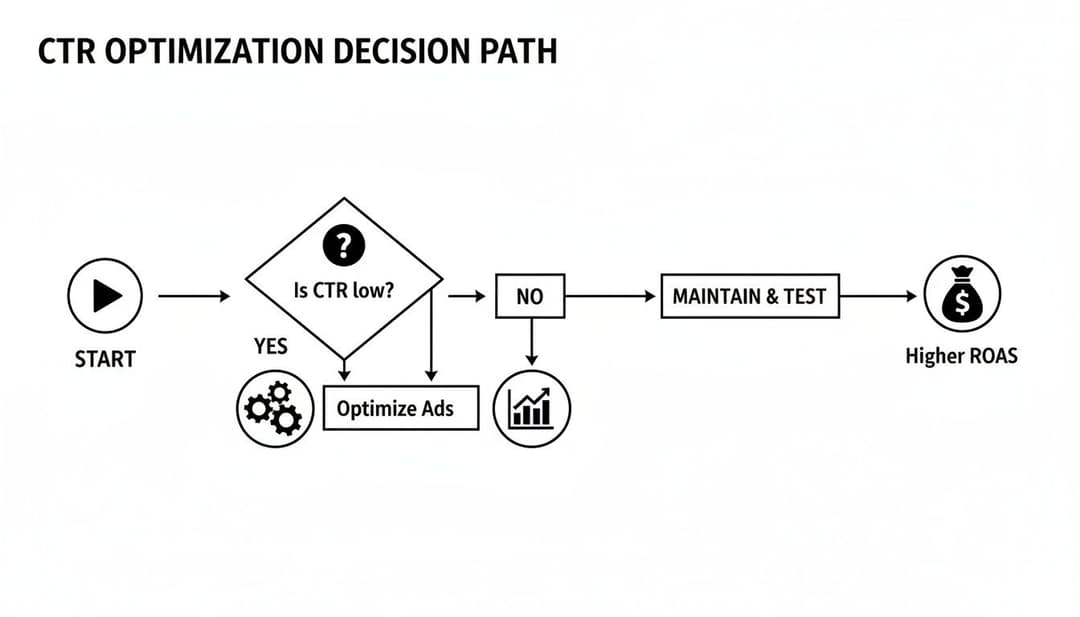
As the visual shows, there’s a clear path from identifying a low CTR to systematically optimizing it for higher returns. It all starts with a structured diagnosis.
Finding the Weakest Link in Your Campaign
Your goal here is to isolate the variables that are tanking your overall CTR. A campaign might look like a total failure on the surface, but a closer look often reveals that just one or two elements are the real culprits.
Start by asking a series of targeted questions and slicing your data to find the answers:
- Placement Performance: Is your CTR bombing on Instagram Stories but killing it on the Facebook Feed? Maybe your vertical video creative isn’t landing, or the audience on that placement just isn't receptive to your offer.
- Device Discrepancies: Are mobile users clicking way less than desktop users? This could be a huge red flag that your ad's value prop is getting lost on small screens. Or worse, your landing page isn't mobile-friendly, creating a terrible pre-click experience.
- Demographic Dissonance: Is a specific age group or gender completely ignoring your ads? That’s a classic sign of a creative-audience mismatch. The humor, imagery, or language that connects with a 25-34 demographic might completely miss the mark with an audience aged 55+.
- Audience Fatigue: Are you seeing your CTR slowly die within a specific custom audience? This almost always points to creative fatigue. They've seen your ad a dozen times, and now it’s just background noise.
By drilling down into these segments, you can go from a vague problem like "my CTR is low" to a specific, actionable insight: "my CTR is low among women aged 45-54 on mobile placements." For a deeper dive into this kind of granular investigation, our guide on how to analyze ad performance provides a more detailed framework.
Looking Beyond Your Own Data
Your internal metrics only tell you half the story. Sometimes, external factors completely out of your control can have a massive impact on your campaign performance.
Always consider these outside influences when you're diagnosing a low CTR:
- Seasonality: A campaign for winter coats is naturally going to see a lower CTR in the middle of July. You have to understand the seasonal trends in your industry to set realistic performance expectations.
- Competitor Actions: Did a major competitor just launch a massive promotional campaign or a disruptive new product? Their increased ad spend and aggressive messaging can temporarily steal attention—and clicks—from your ads.
- Market Shifts: Broader economic changes or shifts in consumer behavior can also affect how people respond to advertising. Being aware of these trends helps you figure out if a dip in CTR is a campaign-specific issue or a wider market phenomenon.
A thorough diagnosis combines the quantitative data from your ad platform with qualitative insights about your market and audience. You need to understand both the "what" and the "why" behind your numbers.
One of the most powerful ways to get these qualitative insights is by listening directly to your customers. Using Conversation Intelligence can give you incredible insights from actual customer interactions. By analyzing real conversations, you can uncover the exact language, pain points, and desires of your audience. This turns diagnosis from a numbers game into a customer-centric strategy, allowing you to craft ads that speak their language and demand a click.
Crafting Ad Creative That Demands a Click

Alright, you’ve pinpointed where your ads are underperforming and who you’re failing to connect with. Now comes the fun part: fixing the what. We're diving headfirst into your ad creative.
This is where art and science really collide. You can have the most dialed-in targeting in the world, but if your creative doesn't stop the scroll and give someone a genuine reason to care, it's dead on arrival. We're talking about crafting something that connects on a psychological level, and often, it's the small tweaks that make the biggest difference.
Mastering Copywriting Frameworks That Actually Work
Great ad copy is rarely a stroke of genius; it's engineered. For decades, advertisers have relied on proven frameworks that tap directly into how people make decisions. Two of the most reliable are AIDA and PAS.
The AIDA Framework (Attention, Interest, Desire, Action): This is a classic for a reason. It guides the user on a journey from "what's this?" to "I need this."
- Attention: Snag them immediately. A bold headline, a surprising statistic, or a provocative question works wonders.
- Interest: You've got their eye. Now, hold it by speaking to a problem they understand.
- Desire: Pivot from the problem to the solution. Paint a clear picture of the better life your product offers.
- Action: Don't be shy. Tell them exactly what to do next with a strong, clear call-to-action (CTA).
The PAS Framework (Problem, Agitate, Solution): This one is a bit more direct and fantastic for hitting pain points.
- Problem: State the core issue your audience faces. Be specific and make it instantly relatable.
- Agitate: Now, twist the knife a little. Describe the frustrating consequences of that problem. What happens if they do nothing?
- Solution: Present your product as the obvious, simple way to make all that frustration disappear.
Using these frameworks gives your copy structure and purpose, ensuring you hit the right emotional triggers to earn that click.
The Science of Compelling Visuals
In a feed overflowing with content, your visual is your opening act. If your image or video doesn't stop the thumb, your brilliant copy might as well not exist. A visual refresh is often the fastest way to boost your CTR.
Here’s what consistently moves the needle:
- High Contrast and Bold Colors: Your ad is fighting for attention against photos of babies and memes. High-contrast colors are your best friend. A splash of a bright, on-brand color can make your ad leap off a screen dominated by blues and whites.
- Faces and Human Emotion: We are wired to connect with other people. Ads featuring faces, especially those looking directly at the viewer, create an instant subconscious connection. Show emotions that match your message—joy for a fun product, concentration for a B2B tool.
- Authenticity with User-Generated Content (UGC): Glossy, perfect studio shots have their place, but today's audiences crave authenticity. A simple phone video of a customer unboxing your product often feels more like a recommendation from a friend than an ad, which builds trust and drives clicks.
The first three seconds of a video ad are everything. Your value proposition and core message must be communicated almost instantly. If a user has to wait to figure out what you're offering, they've already scrolled past.
Testing and Scaling Your Creative Wins
Building great creative isn't a "set it and forget it" task. It’s a constant loop of testing, learning, and iterating. But who has the time to manually build and test dozens of ad variations—swapping out images, headlines, and body copy?
This is where automation becomes your secret weapon.
Platforms like AdStellar AI are built for this exact challenge. Instead of spending hours in a spreadsheet, you can generate hundreds of creative variations in minutes, effortlessly mixing and matching every component against different audience segments. To do this effectively, it helps to get familiar with the principles of dynamic creative optimization and see how AI can find the winning combinations for you.
This approach flips creative optimization from a slow, manual grind into a rapid, data-driven system. You can quickly spot the elements that resonate, double down on what works, and scale your wins across every campaign. For example, if you want to truly stand out, you need to understand how to boost social media engagement with short-form video. By applying these principles and testing them at scale, you can turn your creative into a predictable driver of higher CTR.
Writing a Call-To-Action That Actually Converts

You can have the most stunning creative and perfectly polished copy, but if your call-to-action (CTA) is weak, the whole ad crumbles. The CTA is that final, crucial moment—the handshake that turns a passive viewer into an active lead. It’s where interest becomes action, and frankly, it’s one of the most critical levers you can pull to improve your CTR.
A CTA is so much more than a button. It's a psychological nudge. Everything from its color and size to the specific words you choose can have a massive impact on whether someone clicks. I’ve seen tiny, seemingly insignificant tweaks in this area produce some of the biggest performance lifts in a campaign.
The Psychology of a Powerful CTA Button
Think about the last ad you clicked. What pushed you over the edge? I’m willing to bet the CTA felt like the natural next step, almost an obvious conclusion to what you were seeing. Great CTAs are built on a foundation of clarity, urgency, and a clear value exchange. They eliminate friction and make the decision to click feel easy.
Your button's visual design is the first thing people notice. It has to pop, standing out from the rest of the creative without being obnoxious. It's been proven time and again: simple design changes work. Button-shaped CTAs with clean borders consistently outperform plain text links because our brains are conditioned to see them as clickable.
Size matters, too. You don't want a button that screams at the user, but it needs to be prominent enough to draw the eye. Research from platforms like Sender.net has shown that simply making CTA buttons larger can boost CTR, especially on mobile where thumbs need a clear target.
From Generic Phrases to Action-Oriented Language
The words you use are your final, direct instruction to the user. We've all seen the lazy, overused phrases like "Learn More" or "Submit." They’re functional, sure, but they’re completely uninspired. They create zero urgency and communicate almost no value.
To write a CTA that actually gets clicks, you need to use specific, action-oriented language that’s packed with benefits.
- Instead of "Sign Up," try "Create My Free Account." That simple word, "My," creates a sense of ownership before they've even clicked.
- Instead of "Download," try "Get My Free Ebook." This frames the action as receiving something valuable, not just performing a task.
- Instead of "Contact Us," try "Get a Free Quote Today." It's specific, time-sensitive, and highlights a clear, immediate benefit.
A good gut check is to see if your CTA completes the sentence, "I want to ______." It should fill in that blank perfectly from your customer's point of view. For a deeper dive on how compelling copy leads to a great CTA, check out our guide on what to include in ad copy.
A simple test we run all the time is switching from a generic CTA to a personalized one. Just changing "Get a Free Plan" to "Get My Free Plan" can increase clicks. It personalizes the offer and makes the value feel more tangible to that individual user.
Creating Urgency and Scarcity Without Being Gimmicky
Urgency and scarcity are powerful psychological triggers that push people to act now. When you use them right, they can give users that final nudge they need to click instead of putting it off. But there's a fine line between effective motivation and sounding like a cheap, late-night infomercial.
The key is authenticity. If your sale genuinely ends at midnight, say so. If you truly have a limited number of seats for a webinar, highlight that scarcity. Don't invent it.
Here are a few ways to add real urgency:
- Time-Based Urgency: "Shop Now, Sale Ends Tonight" or "Offer Expires in 24 Hours."
- Quantity Scarcity: "Only 5 Spots Left!" or "Limited Edition - Get Yours Before It's Gone."
- Implied Scarcity: "Join Thousands Already Saving" hints that others are getting a benefit that the user is missing out on.
When you thoughtfully combine strong visuals, action-driven language, and authentic urgency, you can turn your CTA from a simple button into a conversion machine. It’s often the final piece of the puzzle in your quest to improve CTR and drive real campaign success.
Building a Repeatable Experimentation Framework
Guesswork is the enemy of scalable growth. If you want to consistently improve your click-through rate, you can't just rely on random creative refreshes or gut feelings. What you need is a structured, repeatable system for testing—an experimentation framework that turns optimization into a predictable process, not a game of chance.
Think of this framework as your roadmap for running clean, insightful tests that actually teach you something. It’s all about moving from "I think this will work" to "I know this works because the data says so." The real goal here is to get into a rhythm of continuous improvement, where every test, win or lose, makes your next campaign that much smarter.
Forming a Clear and Testable Hypothesis
Every truly meaningful experiment starts with a strong hypothesis. And no, a hypothesis isn't just a vague idea; it's a specific, measurable statement that you can actually prove or disprove. Without one, you're just throwing spaghetti at the wall, and you’ll never understand the "why" behind your results.
A solid hypothesis should follow a simple structure: "If I change [X], then [Y] will happen because [Z]."
- Independent Variable: The one thing you are changing (the headline, the main image, the CTA button color).
- Dependent Variable: The metric you expect to move as a result (in our case, the click-through rate).
- Rationale: Your educated guess for why this change will work (e.g., "...because a more urgent headline will create scarcity and drive immediate action.").
For example, a weak hypothesis is just "Let's test a new video." A strong one sounds more like this: "If we replace our polished studio video with a user-generated content (UGC) style video, our CTR will increase because it will feel more authentic and trustworthy to our target audience."
That level of specificity is what forces you to isolate a single variable. When you change multiple things at once—like the headline, image, and CTA—and your CTR goes up, you have no real clue which change actually did the heavy lifting. Clean tests produce clean data. Simple as that.
Running A/B and Multivariate Tests for CTR
Once your hypothesis is locked in, it’s time to pick your testing method. For CTR optimization, you’ll mainly be using two common approaches: A/B testing and multivariate testing.
A/B Testing (or Split Testing)
This is the most straightforward method and your go-to for most tests. You create two versions of an ad (Version A and Version B) that are identical except for that one variable you're testing. You then show each version to a different segment of your audience and see which one performs better.
A/B testing is your workhorse for making steady, incremental gains. A simple headline test this week, a new image next week, a different CTA the week after—these small, consistent tests compound over time into some seriously significant performance improvements.
Multivariate Testing
This is a more advanced approach where you test multiple variables at the same time to see which combination performs best. For instance, you could test two headlines, two images, and two CTAs all at once. The platform then creates every possible combination (2 x 2 x 2 = 8 ad variations) and finds the winning formula.
While it’s incredibly powerful, multivariate testing needs a lot more traffic to get statistically significant results. It’s best saved for high-volume campaigns where you can gather enough data quickly without waiting forever.
Scaling Your Wins with Automation
Let's be real: manually setting up, monitoring, and analyzing dozens of tests is a massive bottleneck. This is exactly where AI-powered tools come in and change the game. A platform like AdStellar AI can launch hundreds of ad variations at once, automatically shifting budget to the top performers and giving you clear insights on what’s actually driving clicks.
This automated approach lets you move beyond simple A/B tests and build a true culture of constant experimentation. The platform’s ability to learn from performance data is a massive advantage, as it spots winning patterns across creatives, audiences, and messaging that would be nearly impossible for a human to find manually. You can see more about how this works with AdStellar’s continuous learning features.
The impact of a disciplined testing rhythm can be huge. We’ve seen a team get incredible results by shifting to UGC-style video Reels, using urgent captions, and targeting tight audiences. This strategy boosted their CTR to 2.6%, slashed their Cost Per Acquisition by 31%, and lifted ROAS from 2.8x to 4.3x in just six weeks. By simply refreshing their ads every 3-4 weeks through structured A/B tests, they consistently raised their CTR by an additional 40%. You can check out the full story behind these impressive CTR benchmarks.
Ultimately, building this framework is all about making data your co-pilot. It creates a sustainable system where every dollar you spend teaches you something new, helping you improve your click-through rate and drive more profitable outcomes with every single campaign you launch.
Burning Questions About Improving CTR
Even with the best playbook, you're bound to hit a few snags when you're in the trenches trying to bump up your click-through rate. Let's tackle some of the most common questions we hear from marketers.
Think of this as your quick-reference guide for those moments you need a fast, practical answer to keep things moving.
How Long Do I Need to Run a Test Before Calling a Winner?
This is the classic "how long is a piece of string?" question. The real answer isn't about time, but about statistical significance. Pulling the plug after a day or two, even with a flood of traffic, is a great way to make a decision based on random noise.
As a solid rule of thumb, shoot for at least 1,000 impressions per ad variation and let the test run for a minimum of 7-14 days. This window helps you average out the weird peaks and valleys between weekdays and weekends. Most ad platforms will flag a result as statistically significant—trust that data, not your gut feeling.
What's More Important for CTR: The Headline or the Image?
That’s like asking what’s more important for a car: the engine or the wheels? You need both, and they have to work together. But in the blink-and-you'll-miss-it scroll of a social feed, the visual almost always wins the first fight for attention.
Your image or video is the pattern interrupt—it’s what stops the thumb. The headline, however, is what seals the deal and convinces them to actually click. A gorgeous visual paired with a confusing headline is a recipe for failure. Same goes for a killer headline attached to a boring, generic stock photo.
Your visual earns the glance, but your copy secures the click. They're a team. But if you're trying to fix a struggling ad, swapping out the visual is often the fastest way to see a meaningful lift.
Is It Possible for a CTR to Be Too High?
It sounds crazy, but yes, an abnormally high CTR can sometimes signal a problem. When you see a sky-high CTR but a rock-bottom conversion rate on your landing page, you’ve likely got a major disconnect. We call this "clickbait syndrome."
It usually means your ad is writing checks your landing page can't cash. Maybe the ad creative is misleading, or the promise is just too good to be true. An ad promising a "Free iPhone" will get an insane CTR, no doubt. But if the landing page reveals it's just an entry into a contest, your bounce rate will go through the roof, and you'll have paid for a ton of completely useless clicks. Always look at CTR in the context of your post-click metrics.
Does My Organic Search Ranking Impact My Ad CTR?
While they're separate channels, they can definitely influence each other. Brand familiarity is a huge factor in whether someone decides to click. If a user sees your brand ranking organically and in a paid ad on the same search results page, it builds a layer of trust that makes them more likely to click on something of yours. It creates a powerful "surround sound" effect.
Plus, a high organic ranking is a signal of relevance to search engines. Recent data from an Advanced Web Ranking analysis showed just how much this matters. For branded searches, websites in positions 2-6 on desktop saw a combined 8.71 percentage point increase in CTR. It proves that strong brand recognition and relevance can lift all boats. You can dig into their full study on how search rankings influence CTR on advancedwebranking.com.
My CTR Is Low. What's the Very First Thing I Should Fix?
Always start with the lowest-hanging fruit—the elements that are easiest to change but have the biggest impact. Before you tear down your landing page or rethink your entire audience, just look at the ad creative itself.
- The Headline: Is it too vague? Try making it more specific, benefit-focused, or urgent.
- The Image/Video: Does it grab you? Test a completely different concept, like a person's face instead of a product shot.
- The Call-To-Action: Is your CTA a generic "Learn More"? Try testing something more direct and value-driven like "Get My Free Template."
These three components are the frontline of your ad. A quick A/B test on just one of them will give you the fastest feedback and the biggest potential win as you work to improve your click through rate.
Ready to stop guessing and start scaling your Meta ads? AdStellar AI is the AI-powered platform that helps you launch, test, and optimize hundreds of ad variations 10× faster. Cut the manual work and let our AI find your winning campaigns. Unlock your ad potential at adstellar.ai.