Ever wonder why you can still hum a jingle from a commercial you saw as a kid? Or why a particular ad scene just pops into your head years later? It’s not a fluke. It's psychology in action.
The commercials that truly connect with us aren't just selling a product. They're tapping into our subconscious minds, using powerful emotional hooks and cognitive shortcuts to steer our decisions.
Why Some Commercials Stick and Others Fade
This guide pulls back the curtain on the psychological triggers that make an ad unforgettable. The secret is that people rarely make decisions based on pure logic. Our choices are almost always colored by feelings, memories, and the mental shortcuts our brains have relied on for thousands of years.
Great advertising goes way beyond a simple list of features. It weaves its message into these deep-seated psychological patterns. When you understand the 'why' behind what people do, you can build campaigns that click on a much deeper level and drive real results. This is absolutely critical on crowded platforms like Meta, where you have mere seconds to grab someone's attention.
Think of it like this: successful ads are built on three core pillars of psychology—emotion, logic, and memory.
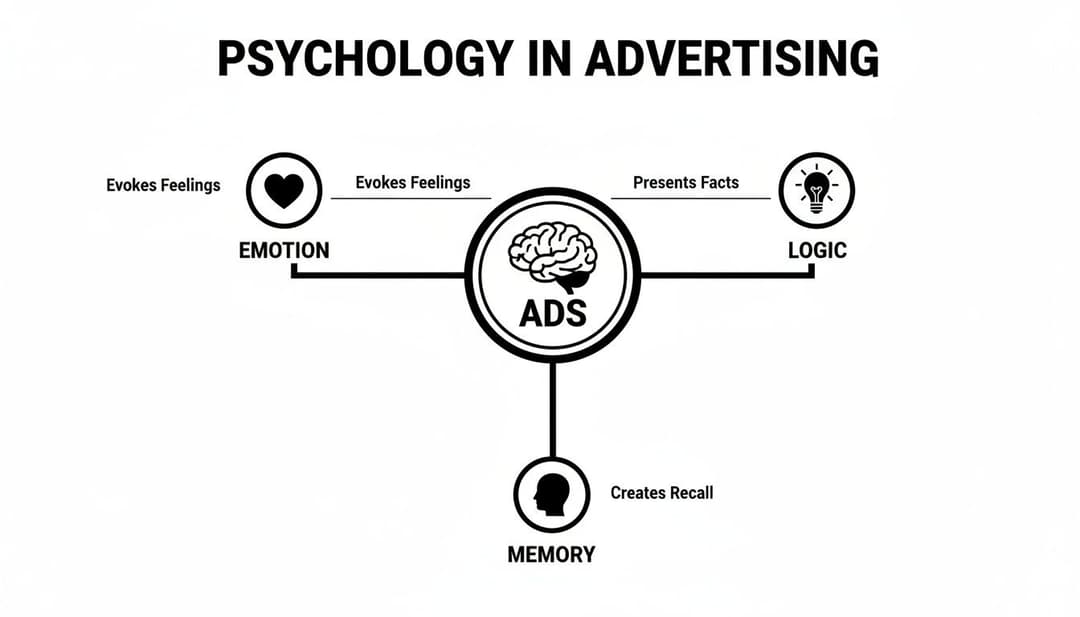
As you can see, it's never just one thing. The most effective commercials are a strategic blend of emotional connection, a touch of logical justification, and memorable creative that ensures the ad lives on in the customer's mind long after they've scrolled away.
Before we dive deep into specific principles, this table offers a quick overview of the key concepts we'll be covering.
Key Psychological Principles in Advertising at a Glance
This table provides a high-level summary of the core psychological concepts covered in this guide and their primary application in advertising.
| Psychological Principle | Core Idea | Primary Commercial Application |
|---|---|---|
| Social Proof | People follow the actions of others. | Using testimonials, reviews, and user-generated content. |
| Reciprocity | We feel obligated to give back to those who have given to us. | Offering free samples, valuable content, or exclusive discounts. |
| Scarcity | We place a higher value on things that are rare or limited. | Creating urgency with limited-time offers or low stock alerts. |
| Authority | We tend to obey authority figures. | Featuring expert endorsements or credible sources. |
| Liking | We are more easily persuaded by people we like. | Using relatable influencers, brand mascots, or storytelling. |
| Commitment & Consistency | We have a deep need to be seen as consistent. | Encouraging small initial actions that lead to larger purchases. |
| Loss Aversion | The pain of losing is stronger than the pleasure of gaining. | Framing offers around what the customer stands to lose. |
| Cognitive Dissonance | We seek consistency in our beliefs and perceptions. | Reassuring customers they made the right choice post-purchase. |
Each of these principles offers a powerful tool for building more persuasive and effective ad campaigns, as we'll explore in the sections to come.
The Science of Connection
The brands that win are the ones that build a bridge directly to our subconscious. They do this by zeroing in on a few key areas that we're about to unpack.
Emotional Resonance: This is about creating ads that stir up powerful feelings like joy, nostalgia, or that comforting sense of belonging. An emotional reaction forges a much stronger and more durable brand association than a purely rational pitch ever could.
Cognitive Ease: It’s all about making your ads simple and easy to digest. Our brains are hardwired to prefer clarity. Commercials with a straightforward message and a single, obvious call-to-action almost always outperform complicated ones.
Trust and Credibility: This involves using social proof, authority, and other signals to make a purchase feel less risky. When we see that other people trust a brand, it makes us far more likely to do the same.
By mastering these principles, you can shift your advertising from a game of guesswork to a predictable science. The visual elements of your ads play a massive role in this. For a deeper look, check out our guide on effective banner ad design.
Connecting Through Emotion, Not Just Logic
Sure, data sheets and feature lists have their place. But if you want to tap into the most powerful force in advertising, it's all about emotion. Ads that make us feel something—whether it’s joy, nostalgia, a sense of belonging, or even a little bit of sadness—almost always crush the ones that just lay out the rational benefits.
Why is that? Because emotional responses build deep, sticky brand memories that completely bypass the slow, analytical part of our brain.
Think about the last holiday ad that made you genuinely smile, or maybe one that even made you tear up a little. You remember the feeling, and because of that, you remember the brand. This connection is nearly instant. It's the difference between an ad showing a happy family piling into a car for a road trip versus one listing the car's horsepower and gas mileage. The spec sheet is forgettable. The feeling of adventure? That sticks with you.
Why Feelings Outperform Facts
Our brains are hardwired to prioritize emotional information. A strong feeling acts like a mental shortcut, telling us what's important and what we should value without needing a long, drawn-out internal debate. In the lightning-fast world of a social media feed, where you have maybe two seconds to make an impact, this is a massive advantage.
An ad that sparks an emotional reaction doesn't politely ask to be remembered; it just plants itself in our memory. This isn't just a hunch; the data backs it up. For years, emotional appeals in commercials have consistently outperformed rational arguments. In fact, research shows that 31% of ads leveraging emotional content succeed, while only 16% of those focused on rational messaging do. Feelings like pride, love, or empathy just resonate more strongly with consumers than product specs ever will. You can dig deeper into the science in this USC analysis on advertising psychology.
Putting Emotion into Practice on Paid Social
Turning this theory into real-world tests on your paid social campaigns is where you'll see the performance lift. The goal is to stop just showing your product and start showing the emotional outcome it creates.
Key Takeaway: Don't sell the mattress; sell a perfect night's sleep. Don't sell the software; sell the feeling of relief and accomplishment it gives your customers. Your creative should be all about the human experience your brand makes possible.
Here’s a dead-simple A/B test framework to get you started:
- Ad A (The Control): This is your standard, polished, product-focused ad. Think studio shot of your product, maybe with some text overlays calling out its best features and benefits.
- Ad B (The Emotional Test): Run creative featuring authentic user-generated content (UGC). Show a real customer unboxing your product with a genuine look of delight on their face, or a short clip of them using it to solve a problem. If you need some inspiration for telling these kinds of stories, check out these examples of great ad copy.
Keep an eye on metrics like Click-Through Rate (CTR), Conversion Rate, and of course, Return on Ad Spend (ROAS). More often than not, you'll find that the authentic, emotional creative doesn't just get more thumbs-ups and comments—it drives more profitable conversions because it forges an immediate, relatable connection.
Designing Ads for Our Fast Brain

We all know emotional appeals are powerful, but understanding why they work is the real key to unlocking their potential. The secret is buried deep in our brain's wiring. Nobel laureate Daniel Kahneman gave us a brilliant model for this, splitting our thinking into two modes: System 1 and System 2.
Think of System 1 as your "fast brain." It's your gut reaction—instant, intuitive, and completely automatic. It makes snap judgments based on feelings and shortcuts, operating almost effortlessly in the background.
System 2, on the other hand, is your "slow brain." This is your deliberate, analytical mind. It’s the part that kicks in when you’re solving a complex problem, carefully weighing pros and cons, or trying to do long division in your head. It requires focus and real effort.
Speaking Directly to System 1
Here’s the insight that should change how you look at advertising forever: the overwhelming majority of our daily decisions are driven by the fast, impulsive System 1. This is especially true for the quick purchase decisions people make while scrolling.
They aren't in an analytical mindset. Their System 2 is switched off. They grab candy at the checkout on a whim, not after a deep cost-benefit analysis. To get their attention, your ad has to bypass their rational filter and speak directly to their gut.
Key Takeaway: Your ad isn't trying to win a logical debate; it's trying to get an instant nod of approval from the viewer's fast brain. The goal is immediate clarity and connection, not a list of features.
To pull this off, you need to nail three core elements:
- Bold, Simple Visuals: Use high-contrast colors and clear focal points. Your imagery should communicate a single idea or feeling instantly. Learning to create effective video hooks that stop scrolling is a non-negotiable skill here.
- Clear, Simple Messaging: Forget paragraphs. Think concise headline and maybe a few bullet points. The entire message should be understood in a single glance.
- A Single-Minded Call-to-Action (CTA): Give the brain one clear, easy job to do. "Shop Now" or "Learn More" are direct and require zero thought.
A Practical Test for System 1 Thinking
Ready to put this into practice? Here’s a simple A/B test to see which approach best captures your audience’s fast brain.
- Ad A (System 2 Focus): This ad is complex. Think a carousel with multiple products, each with its own unique discount code, forcing the user to stop and think.
- Ad B (System 1 Focus): This ad is clean and simple. One hero image, one clear offer (like "Free Shipping On All Orders"), and one "Shop Now" button.
You can automate this process to test dozens of simple, focused concepts in no time. Our guide on what is dynamic creative optimization breaks down exactly how to scale these tests.
Keep an eye on your Cost Per Acquisition (CPA) and Conversion Rate. I’d bet good money the simpler, System 1-focused ad drives far more efficient results. Why? Because it completely eliminates decision friction.
Building Instant Trust with Social Proof and Authority

When we’re unsure about a decision, what’s the first thing we do? We look around to see what everyone else is doing. It’s a survival instinct baked into our DNA. This mental shortcut is called social proof, and it’s one of the most powerful forces in advertising.
Think about it. A restaurant with a line out the door feels like a safe bet. A product with thousands of five-star reviews feels like a smart purchase. We're wired to follow the herd because, historically, the herd knew where to find food and avoid danger. Commercials tap into this by showing us that people just like us already use and love a product, which instantly lowers our guard and builds a bridge of trust.
Then there's the second shortcut: authority. From our first day in school, we're taught to listen to experts. When a credible, respected figure endorses something, we automatically transfer some of their credibility onto the product.
Translating Trust Signals into Meta Ads
These principles aren't just for multi-million dollar TV spots. They're incredibly potent and easy to test on paid social platforms like Meta. Instead of you telling everyone how great your product is, you can let your customers and fans do the talking for you.
Here are a few simple, powerful ways to weave trust into your ad creative:
- Feature Customer Testimonials: Don't just tell people your product is great—show them. Use video clips or pull quotes from your happiest customers. The raw, genuine praise of a real person will always be more convincing than polished brand copy.
- Showcase Ratings and Reviews: Slap those five-star graphics and glowing review screenshots right onto your ad visuals. A high number of positive reviews is a massive signal that you’re a trustworthy choice.
- Highlight Influencer Endorsements: An endorsement from a creator your audience already follows is like a recommendation from a friend. Partner with influencers and experts who genuinely align with your brand.
- Display User-Generated Content (UGC): Encourage your customers to share photos and videos of your product in action. Featuring authentic UGC shows your product in the real world and builds a sense of community.
Key Takeaway: Social proof works because it answers the one subconscious question every new customer has: "Can I trust this?" By showing that plenty of others already do, you make the decision to buy feel much safer and smarter.
How to A/B Test for Trust
Want to see the impact for yourself? Run a simple split test to measure how these trust signals stack up against your standard brand messaging. It's easier than you think.
- Creative A (The Control): This is your business-as-usual ad. Use a high-quality product shot with a headline focused on features or benefits (e.g., "Durable, Lightweight, and Stylish").
- Creative B (The Social Proof Test): Use the exact same product image, but swap the headline for a powerful customer quote (e.g., "I've tried 5 different brands, and this is by far the best!").
Keep a close eye on your Engagement Rate (likes, comments, shares) and, most importantly, your Conversion Rate. More often than not, you'll find the social proof ad doesn't just get more love—it drives more sales by tackling customer doubt right from the start.
Getting Inside Their Heads: Using Cognitive Biases in Your Ad Creative

While things like social proof and authority are fantastic for building trust, they're really just scratching the surface of marketing psychology. The human brain is wired with dozens of mental shortcuts—known as cognitive biases—that quietly guide our decisions every single day.
Think of these biases as the brain's energy-saving mode. Instead of meticulously analyzing every single detail, it falls back on established patterns to make snap judgments. As a marketer, you can tap into these natural thought processes to make your ads far more persuasive.
When you understand these shortcuts, you can stop just presenting a product and start framing your offer in a way that aligns with how people already think.
The Anchoring Effect: First Impressions Stick
The Anchoring Effect is our tendency to latch onto the first piece of information we receive when making a decision. That initial "anchor" value colors every judgment that follows.
You’ve seen this in action. A boutique displays a ridiculously expensive $1,200 leather jacket right at the entrance. All of a sudden, the $300 jacket next to it feels like a total bargain, even though it's still a premium product. That first number completely reframes your perception of value.
For paid social ads, this is a classic and powerful pricing tactic.
A/B Test Idea: Run two ads for the same product. Ad A just states the price. But in Ad B, show a higher "original" price crossed out next to the current sale price (e.g., "
$99Now $59!"). That crossed-out number becomes the anchor, making the actual price feel like an incredible deal. Keep a close eye on your Return on Ad Spend (ROAS) to see how this perceived value boosts profitability.
Scarcity: The Power of FOMO
The principle of scarcity is simple: we place a higher value on things we think are about to run out. The fear of missing out (FOMO) is a potent motivator that can jolt a hesitant buyer into action.
This is your classic "Limited Time Offer!" or "Only 3 Left!" It works because it changes the customer's internal monologue from "Should I buy this?" to "If I don't buy this right now, I might never get the chance." It’s a core psychological trigger used to drive immediate conversions. For more inspiration on how to message this, check out these compelling Facebook ad copy examples.
Here’s a straightforward way to test scarcity in your campaigns:
- Test A (Control): Your standard, evergreen ad with a clear call to action.
- Test B (Scarcity): The same ad creative, but with a headline or text overlay that introduces urgency. Try phrases like "Sale Ends Tonight," "Limited Stock," or "Last Chance."
The metric to watch here is your conversion velocity—how quickly you get conversions after someone first sees your ad. A good scarcity message should dramatically shorten the time it takes for a user to go from click to purchase.
How to Test and Scale Your Psychological Insights
Knowing the psychological hooks behind great commercials is one thing. Actually using them to grow your business? That's a whole different ballgame. The real competitive advantage comes when you stop guessing and start testing these insights systematically. This is how you move from theory to a data-backed growth engine, discovering exactly which triggers make your audience click, buy, and convert.
Modern ad platforms are practically built for this. Forget clunky, one-off A/B tests. You can now spin up hundreds of creative and copy variations automatically, letting you test everything from emotional angles to social proof formats and scarcity triggers all at once. Instead of wondering which customer testimonial will hit home, you can run ten of them simultaneously and let the data tell you the answer. This is how abstract psychological principles become a predictable part of your execution.
From Theory to Data-Driven Execution
The goal is to build a repeatable process for finding—and scaling—the psychological angles that work. This means diving into your performance data and drawing a straight line from a specific tactic to the metrics that actually matter.
- Emotional Hooks: Run an ad featuring pure joy against one that pulls on nostalgic heartstrings. Which one delivers a lower Cost Per Acquisition (CPA)?
- Social Proof: Pit a clean, five-star rating graphic against a raw, user-generated video testimonial. Does one format crush the other on Return on Ad Spend (ROAS)?
- Scarcity Tactics: Test a classic "Limited Time Offer" against a more urgent "Low Stock" warning. Which message gives you a better conversion velocity?
This isn't just busy work; it's essential. In fact, neuromarketing studies show a huge shift toward using physiological and behavioral data to figure out what makes an ad effective. Over 70% of research now focuses on tracking emotional responses, attention, and memory to predict an ad's success.
When you test these elements systematically, you create a powerful feedback loop. You’re no longer just making ads; you're building a library of proven psychological tactics you can deploy over and over again for predictable growth.
For those looking to get even more advanced, tools like AI for cognitive bias detection and leveraging can help you spot and strategically use these mental shortcuts in your campaigns. By blending creative gut feelings with rigorous, data-driven testing, you can turn psychological insights into your most powerful asset.
And if you want to go deeper into the mechanics of running these large-scale experiments, our guide on what is multivariate testing is the perfect next step.
Common Questions Answered
Which Psychological Principle Is Most Effective in Digital Ads?
There's no single silver bullet, but if I had to pick one, it’s almost always emotional appeal. Time and time again, the data shows that ads connecting on an emotional level outperform purely rational ones. Why? Because emotions create powerful memory associations and tend to sidestep our logical, critical filters.
For most brands, testing core emotions like joy, nostalgia, or even a sense of security is a fantastic starting point. The goal is to forge a human connection first before you start listing features. That's how you build a memorable brand.
How Can I Test These Psychological Tactics Without a Huge Budget?
You don't need a massive budget to get started—platforms like Meta Ads are perfect for small, focused experiments. The trick is to isolate a single variable for each A/B test.
For example, pit your current control ad against a new version that simply adds a customer testimonial (social proof). Or, test a headline that dials up the urgency (scarcity) against your standard, evergreen copy. Keep a close eye on your key metrics like CTR and CPA, and you'll quickly see which psychological triggers make your audience click.
The goal is to create a genuine connection and demonstrate value, not to manipulate or deceive. Authentic marketing builds long-term customer trust and brand loyalty.
Are There Ethical Concerns When Using Psychology in Commercials?
Absolutely, and it's something every marketer needs to take seriously. It's crucial to use these principles responsibly. Stay away from creating fake scarcity, using misleading testimonials, or preying on people's insecurities.
Authentic marketing—using psychology to better communicate a product's true benefits—will always be the most sustainable path to growth. When you help customers feel understood and solve a real problem for them, you build a loyal following that trusts you.
Ready to stop guessing and start scaling your Meta ads with data-driven insights? AdStellar AI helps you launch, test, and scale hundreds of creative combinations in minutes, automating the process of finding which psychological triggers drive the best results.