Writing Facebook ad copy that consistently converts is a major challenge for marketers. With rising ad costs and an increasingly saturated news feed, generic messaging simply gets ignored. High-performing, strategic copy is no longer just a competitive advantage; it's a critical lever for campaign survival and growth. Getting it right means breaking through the noise, capturing attention, and persuading users to take a specific action, whether it's clicking, signing up, or making a purchase. The difference between a campaign that drains your budget and one that delivers a positive ROAS often comes down to the words you choose.
This article moves beyond theory and dives straight into actionable strategy. We will deconstruct 8 powerful facebook ad copy examples, each built on a proven psychological framework. You won't just see what works; you'll understand why it works. For each example, we provide a detailed breakdown of the underlying strategy, a reusable template, and specific testing variations you can apply to your own campaigns across different funnel stages, from awareness to conversion. Mastering these frameworks is a foundational step, and understanding broader strategies for AI content creation for social media can further enhance your drafting process.
Our goal is to give you a replicable system for crafting compelling ad copy. We'll analyze everything from Problem-Agitate-Solve (PAS) to curiosity-driven hooks and data-backed benefit statements. Later, we'll even touch on how advanced tools like AdStellar AI can help you automate and scale the generation of these winning copy variations, turning a time-consuming task into a streamlined process. Let's get started.
1. The Problem-Agitate-Solve (PAS) Copy Framework
The Problem-Agitate-Solve (PAS) framework is a classic, high-impact copywriting formula that hooks your audience by tapping directly into their pain points. It's one of the most effective Facebook ad copy examples because it creates an immediate sense of relatability and urgency. The formula is simple yet powerful: first, you identify a specific problem your audience faces. Next, you agitate that problem by amplifying its emotional consequences or frustrations. Finally, you present your product or service as the definitive solution.
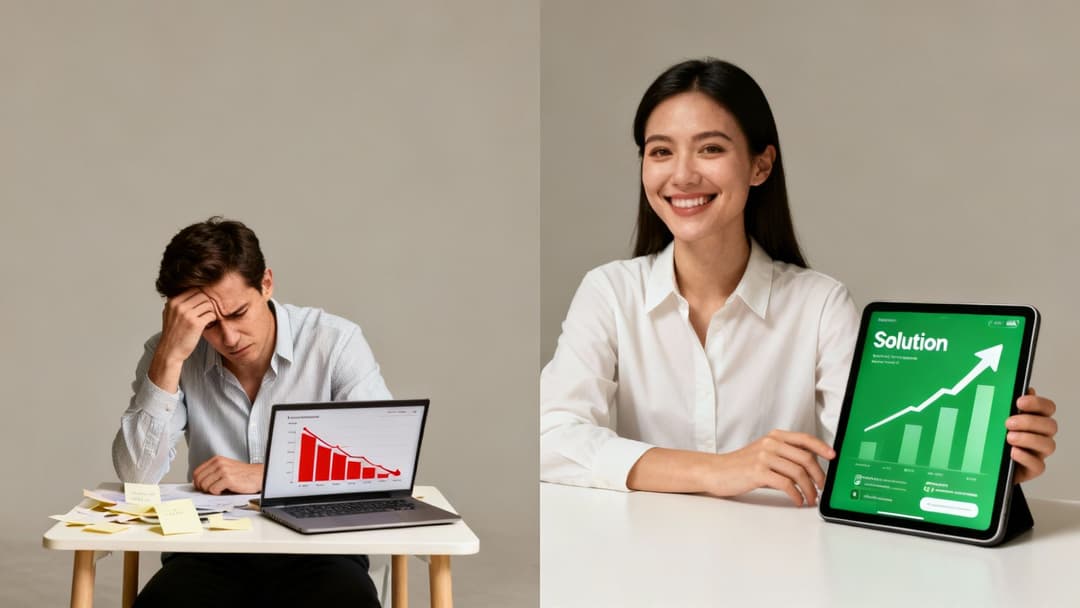
This structure works exceptionally well for awareness and consideration stage campaigns. It grabs attention from users who are problem-aware but not yet solution-aware, making them feel understood before you even introduce your offer. By focusing on the "agitate" step, you connect on an emotional level, which is far more persuasive than listing features alone.
Why This Framework Works
- Problem: "Your Facebook ad performance is declining."
- This opening line directly addresses a common and significant fear for marketers, instantly capturing the attention of the target audience.
- Agitate: "You're stuck guessing which creatives work, wasting budget on campaigns that don't deliver."
- This amplifies the initial problem. It highlights the frustration, financial waste, and uncertainty that comes with poor ad performance, making the pain more tangible.
- Solve: "AdStellar's AI ranks your winners by ROAS, so you scale with confidence. Launch campaigns 10x faster and find your next winning ad in minutes."
- The solution is presented as a clear, quantifiable remedy. It directly counters the agitation by offering confidence, speed, and data-backed results.
Actionable Tips & Takeaways
To implement the PAS framework effectively, focus on specificity and emotion.
- Be Hyper-Specific: Instead of saying "save time," say "stop spending 8 hours a week on manual campaign setup." Quantifiable problems make the solution feel more valuable.
- Test Emotional Intensity: Some audiences respond to the fear of loss (e.g., "losing market share"), while others are motivated by the fear of missing out (e.g., "your competitors are already doing this"). A/B test different agitation angles.
- Pair with a Clear CTA: The "solve" should lead directly into a low-friction call to action. Use CTAs like "Start Your Free Trial" or "See How It Works" to guide users to the next step.
For more in-depth strategies, explore our guide on crafting great ad copy that converts.
2. Social Proof, Authority & FOMO Copy Combo
This powerful combination leverages three core psychological triggers to build trust and drive immediate action. Social proof (testimonials, user counts) shows your product is popular and vetted. Authority (expert endorsements, well-known client logos) establishes credibility. FOMO (Fear of Missing Out) uses scarcity or time limits to create urgency. Together, they form one of the most compelling Facebook ad copy examples for conversion-focused campaigns.

This approach is especially effective for bottom-of-funnel audiences who are aware of the problem and your solution but need a final nudge to convert. It works by answering two critical questions in a potential customer's mind: "Can I trust this?" and "Why should I act now?". By preemptively addressing doubt and hesitation, you dramatically shorten the path to purchase.
Why This Framework Works
- Social Proof & Authority: "Join 2,000+ e-commerce brands that doubled their ROAS with AdStellar. Used by performance marketers at Glossier & Allbirds."
- This immediately establishes credibility and reduces perceived risk. Naming specific, respected brands (authority) and quantifying the user base (social proof) makes the claims believable.
- FOMO (Urgency): "Early adopters get lifetime discounts—ends Friday."
- This element introduces scarcity. The limited-time offer creates a compelling reason to stop scrolling and take action, preventing procrastination.
- Solve (Implied): The copy implies the solution by showcasing the results others have achieved ("doubled their ROAS").
- The focus is less on explaining the 'how' and more on showing the 'who' and 'what results,' letting the success of others sell the product.
Actionable Tips & Takeaways
To effectively combine these elements, you need authenticity and precision.
- Use Real, Specific Metrics: Instead of "thousands of users," say "5,000+ performance marketers." Pull verifiable data from your CRM or analytics to build genuine trust.
- Make Scarcity Authentic: If you offer limited spots, make sure they are truly limited. Audiences can spot fake urgency, which erodes trust. Use real constraints like beta program capacity or a seasonal promotion deadline.
- Layer Your Proof Points: Combine different types of proof for maximum impact. Pair customer logos with a direct testimonial and a user count in the same ad creative. To make these elements stand out, explore how to pair them with effective ad banner design.
- Keep Testimonials Fresh: Rotate your customer quotes and case study results quarterly. Stale proof can make your brand seem outdated, while fresh stories show ongoing success and relevance.
3. The Curiosity Gap Copy Hook
The Curiosity Gap hook is a psychological copywriting technique that deliberately withholds key information to spark intrigue and compel users to click. Popularized by content giants like BuzzFeed, this approach creates an "information gap" between what your audience knows and what they want to know, triggering a powerful need for closure. It is one of the most effective Facebook ad copy examples for driving high click-through rates because it turns your ad into a mini-mystery that can only be solved by visiting your landing page.
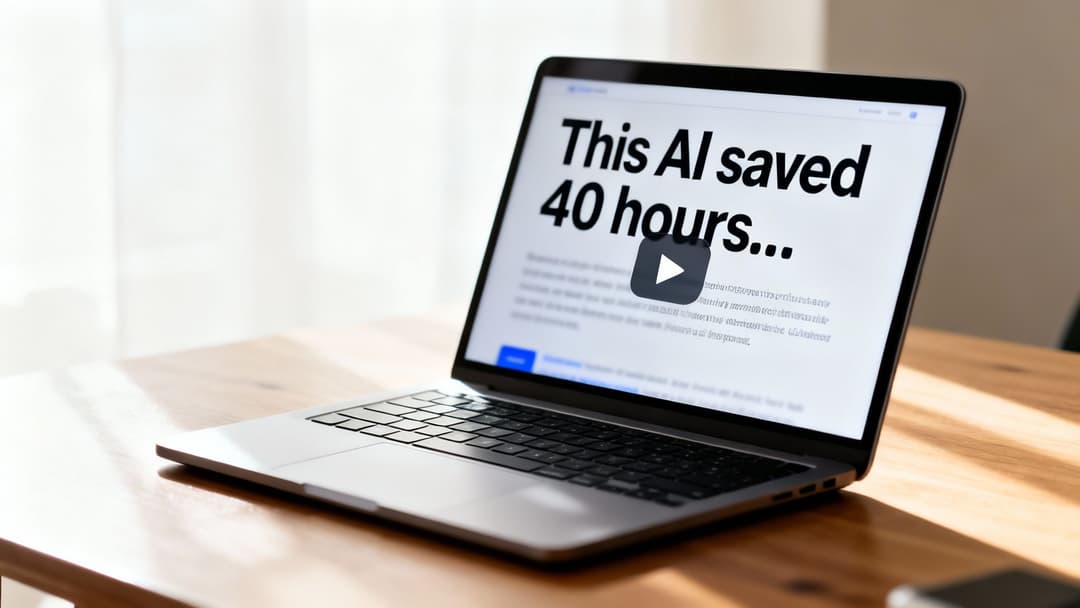
This framework excels in top-of-funnel campaigns where the primary goal is traffic and engagement. By teasing a surprising result, an unexpected finding, or a secret method, you motivate users to take action. It works especially well for promoting innovative product features, case studies with impressive results, or insightful blog content. The key is to make a bold claim that demands further explanation.
Why This Framework Works
- Headline: "We tested 500 ad creatives in 48 hours. Here's what happened."
- This opening creates immediate intrigue by presenting a massive undertaking and hinting at a surprising outcome. The audience wants to know the results of such a large-scale test.
- Body Copy: "Discover how AdStellar's bulk creation and AI analysis make it possible."
- This line connects the intriguing outcome directly to the product's capabilities, framing AdStellar as the tool that unlocks this impressive feat. It bridges the curiosity with the solution.
- Result: The user feels compelled to click to see the results of the test, and in doing so, they are introduced to the product's value proposition in a memorable way.
Actionable Tips & Takeaways
To use the Curiosity Gap effectively, your hook must be credible and your payoff immediate.
- Be Specific: Use numbers, percentages, or tangible outcomes. "This AI just saved our team 40 hours a month" is far more compelling than "This AI saves time." Specificity makes the claim believable, not clickbait.
- Satisfy the Curiosity Instantly: Your landing page must immediately answer the question posed in the ad. If a user clicks to find out "what happened," the answer should be in the hero section, not buried at the bottom.
- Pair with Revealing Creatives: Use this copy with carousel or video ads. A carousel can reveal the answer card by card, while a short video can build suspense before delivering the payoff, keeping users engaged directly on the platform.
For a deeper dive into driving clicks, explore our guide on how to improve your click-through rate.
4. The Before-After-Bridge (BAB) Copy Structure
The Before-After-Bridge (BAB) framework is a powerful narrative tool that paints a vivid picture of transformation for your audience. It hooks users by showing them a relatable "Before" state, a desirable "After" state, and presenting your product as the "Bridge" that makes the transformation possible. This is one of the most compelling Facebook ad copy examples for products that deliver a clear, tangible change.
The BAB structure excels at creating an emotional connection. It allows the audience to see themselves in the "Before" scenario and aspire to the "After" scenario. By positioning your offering as the simple, direct path between the two, you make the purchase decision feel like a logical next step toward their goal. This framework is highly effective for video, carousel, and collection ads where you can visually represent the transformation.
Why This Framework Works
- Before: "Guessing which of your 50 ad creatives will actually perform."
- This immediately highlights a specific, high-stakes problem familiar to any performance marketer. It establishes a sense of uncertainty and risk.
- After: "Confidently scaling your top 5 creatives based on real ROAS data."
- This presents a future state of clarity, confidence, and efficiency. It’s not just about a better outcome; it’s about a better, more strategic way of operating.
- Bridge: "AdStellar's AI ranks every creative against your true business goals, so you stop guessing and start scaling the winners."
- The bridge clearly and concisely explains how the transformation happens. It directly links AdStellar's core feature (AI-powered creative ranking) to the solution.
Actionable Tips & Takeaways
To master the BAB framework, focus on contrast and clarity.
- Quantify Both States: Make the "Before" and "After" as specific as possible. Instead of "wasting time," say "spending 15 hours a week on manual ad variations." Instead of "work faster," say "launch fully tested campaigns in 30 minutes."
- Use Visual Storytelling: This framework is perfect for visual ads. Use a split-screen video to show the chaotic "Before" workflow next to the streamlined "After" workflow. A carousel ad can dedicate the first card to the problem and the following cards to the solution.
- Make the Bridge the Hero: Your product or service is the essential link. Clearly state how it facilitates the change. Use phrases like "With [Your Product], you can..." or "[Your Feature] is the key to..." to make the connection explicit.
- Emphasize Speed: Add a timeline to make the transformation feel more achievable and immediate. Phrases like "In just one week..." or "Go from guesswork to confidence in minutes" create a powerful sense of urgency.
5. The Specific Benefit + Numbers Copy Formula
Leading with a specific, quantifiable benefit is a powerful way to cut through the noise on a crowded feed. The Specific Benefit + Numbers formula makes abstract value propositions concrete and instantly credible. By using hard numbers, you anchor your claims in reality, making this one of the most effective Facebook ad copy examples for a target audience of performance marketers who respond to measurable outcomes.
This formula is a top performer in consideration and conversion campaigns where the audience is already aware of their problem and is actively evaluating solutions. Vague promises like "improve your ads" are easily ignored, but a claim like "Double your ROAS" immediately captures attention and forces the user to consider the impact on their own business. It shifts the focus from what your product is to what it achieves.
Why This Formula Works
- Headline: "Save 40 hours a week on ad campaign setup."
- This is a bold, attention-grabbing claim. It immediately presents a highly desirable and specific outcome, appealing directly to overworked marketers.
- Body Copy: "Stop wasting time on manual uploads and repetitive adjustments. AdStellar automates your campaign creation, letting you launch 100+ ad variations in 15 minutes, not 15 days."
- The copy validates the headline's promise by explaining how it's possible. It contrasts the slow, manual process with the speed and efficiency of the solution, using more numbers to reinforce the value.
- Call to Action: "See how much time you can save. Start your free trial."
- The CTA logically follows the benefit-driven copy, inviting the user to experience the promised efficiency for themselves.
Actionable Tips & Takeaways
To leverage numbers effectively, ground them in credibility and relevance.
- Use Believable Numbers: Stick to figures that are impressive but realistic. "Save 8 hours/week" is often more credible than "Save 99.9 hours/week." Test conservative estimates against best-case scenarios to see what resonates.
- Test Different Benefit Angles: Your product likely offers multiple benefits. A/B test copy focused on time savings ("40 hours saved") versus revenue growth ("3x better ROAS") or cost reduction ("Cut CPL in half") to identify the most motivating angle for your audience.
- Provide Context: Numbers are more powerful with context. Instead of just "10x faster," use comparative language like "10x faster than manual setup." This helps users fully appreciate the scale of the benefit.
- Pair with Social Proof: Reinforce your numerical claims with testimonials or case studies. A quote saying "AdStellar saved our team 20 hours a week" makes your own claims more believable and trustworthy.
This approach is especially powerful when running complex ad tests. For more on this, check out our guide on what is multivariate testing.
6. The Question-Based Copy Hook
The Question-Based Copy Hook immediately engages users by posing a direct question that resonates with their challenges, desires, or curiosities. This technique is highly effective because questions naturally prompt an internal response, forcing the reader to pause their scroll and mentally answer. It transforms passive consumption into active engagement, making it one of the most reliable Facebook ad copy examples for grabbing attention in a crowded feed.
This framework is exceptionally versatile for awareness and consideration campaigns. It works by framing a problem or aspiration in a way that makes the audience feel personally addressed. Instead of telling them their problem, you ask them about it, which feels less intrusive and more conversational, sparking curiosity to discover the answer you provide in the ad.
Why This Framework Works
- Question: "Is your team spending more time on ad setup than strategy?"
- This opening line is a direct, pain-point-focused question that instantly qualifies the audience. Marketers who feel this pain will immediately think "yes" and want to learn more.
- Agitation (Implied): The question itself implies a significant problem: wasted time, inefficient workflows, and a lack of focus on high-impact strategic work. It agitates the reader by making them confront a frustrating reality.
- Solve: "With AdStellar's AI, you can launch hundreds of ad variations in minutes, not hours. Free up your team to focus on what really moves the needle: creative strategy and scaling winners."
- The solution is presented as the clear answer to the initial question. It directly addresses the pain of manual setup by offering speed, efficiency, and a shift back to strategic priorities.
Actionable Tips & Takeaways
To leverage the Question-Based Copy Hook, tailor your questions to your audience's stage in the funnel.
- Segment Your Questions: Use aspirational questions like "Ready to scale your winning ads?" for top-of-funnel audiences. For mid-funnel, use pain-based questions like "Tired of wasting budget on ads that don't work?" to address known frustrations.
- Avoid Simple Yes/No: While effective, vary your approach. Ask "how much" or "why" questions to provoke deeper thought. For example, "How much revenue is your team leaving on the table with poor creative testing?"
- Pair with a Strong Answer: Your ad's body copy must provide a compelling answer or solution to the question posed in the hook. The question creates the intrigue; the body copy delivers the value. Use a clear CTA like "Find Out How" or "Get the Answer" to bridge the two.
7. Action-Oriented Call-to-Action (CTA) Copy
Your Call-to-Action (CTA) is the single most important instruction in your ad. Action-oriented CTA copy goes beyond generic phrases like "Learn More," using strong, benefit-driven verbs to guide users toward a specific, valuable next step. This approach is one of the most critical Facebook ad copy examples to master because it directly impacts click-through rates and conversions by reducing friction and clarifying the value exchange.
This technique works by replacing passive, vague language with commands that promise a clear outcome. It's the final nudge that turns a viewer into a prospect. Instead of simply inviting users to learn, it compels them to act by highlighting what they will immediately gain, see, or achieve by clicking the button.
Why This Framework Works
This framework focuses on aligning the user's intent with a clear, low-friction action. It makes the decision to click feel both logical and urgent.
- Primary Benefit CTA: "Start Free Trial" or "See My Savings"
- This is direct and value-focused. It doesn't just ask for a click; it offers an immediate, tangible benefit like access to a product or a personalized calculation.
- Low-Friction CTA: "Watch Demo" or "See Examples"
- This works well for top-of-funnel audiences who aren't ready to commit. It lowers the barrier to entry by offering valuable information without demanding a sign-up or purchase.
- Urgency-Driven CTA: "Claim Beta Access" or "Secure Your Spot"
- This leverages scarcity and exclusivity to drive immediate action. It’s perfect for limited-time offers, webinars, or early-access programs where the fear of missing out is a powerful motivator.
Actionable Tips & Takeaways
To maximize your CTA's impact, align its language with the user's stage in the customer journey and the specific offer.
- Match CTA to Audience Stage: Use "Watch Demo" for awareness campaigns, "See Case Study" for consideration, and "Start Free Trial" for decision-stage audiences.
- Test Benefit-Driven Phrasing: Instead of "Sign Up," test "Join 5,000+ Marketers." The latter provides social proof and implies community value, making it more persuasive.
- Use First-Person Language: A/B test CTAs like "Show Me My Results" versus "See Your Results." The first-person perspective often creates a stronger sense of ownership and can increase engagement.
- Ensure Landing Page Congruence: The headline and content on your landing page must instantly mirror and expand upon the promise made in your CTA. If the ad says "Claim Your Free Ebook," the landing page should lead with that exact offer.
8. The Personalization + Segmentation Copy Strategy
The Personalization and Segmentation strategy moves beyond one-size-fits-all messaging by tailoring ad copy to specific audience segments. This approach uses dynamic copy that changes based on audience attributes like industry, job title, or past behavior. By speaking directly to a user's specific context, these Facebook ad copy examples achieve significantly higher relevance, engagement, and conversion rates.
This strategy is highly effective for businesses with diverse customer bases. Instead of showing the same generic ad to an e-commerce brand and a digital agency, you can highlight the unique benefits that matter most to each. This makes the audience feel seen and understood, immediately differentiating your brand from competitors using broad messaging.
Why This Framework Works
- For E-Commerce Teams: "E-commerce teams are launching campaigns 10x faster with AdStellar. See how Glossier doubled ROAS."
- This copy works by using industry-specific language ("ROAS") and a relatable customer example (Glossier), making the benefit tangible and credible for e-commerce professionals.
- For Digital Agencies: "Digital agencies manage 10+ client campaigns simultaneously with AdStellar. Automate setup, scale revenue."
- This version addresses a core pain point for agencies: managing multiple client accounts efficiently. The copy focuses on automation and scalability, which are key priorities for this segment.
- For B2B SaaS: "B2B growth teams reduce CAC by 35% with AdStellar's AI-guided targeting. Start your free trial."
- This example appeals directly to B2B marketers by using a crucial metric (Customer Acquisition Cost) and a specific, quantifiable result. It highlights a bottom-line impact that resonates with this data-driven audience.
Actionable Tips & Takeaways
To execute a personalization strategy, start with clear audience definitions and test segment-specific value propositions.
- Segment Your Audience: Create distinct audience segments in Meta Ads Manager based on industry, company size, customer lifecycle stage (e.g., prospect vs. existing customer), or even job title.
- Craft Segment-Specific Hooks: Develop 3-5 copy variations, each highlighting the single most compelling benefit for that segment. For agencies, emphasize efficiency; for DTC brands, focus on creative performance.
- Leverage Dynamic Creative: Use Meta's dynamic creative optimization to automatically test different copy-segment combinations. This allows the algorithm to find the most effective message for each audience group. Learn more about how to get started with what is dynamic creative optimization.
Facebook Ad Copy: 8-Point Comparison
| Strategy | Implementation Complexity | Resource Requirements | Expected Outcomes | Ideal Use Cases | Key Advantages |
|---|---|---|---|---|---|
| The Problem-Agitate-Solve (PAS) Copy Framework | Low–Medium — simple 3-part structure but needs audience insight | Low — copywriting and basic research/testing | High engagement and urgency; improved CTA response | Time-sensitive offers, pain-point driven SaaS/DTC ads | Emotional resonance, clear value proposition, versatile formats |
| Social Proof, Authority & FOMO Copy Combo | Medium — assemble proofs and manage scarcity claims | Medium–High — testimonials, case studies, permissions, frequent updates | Faster conversions, reduced perceived risk, spike during launches | Free trials, upgrades, launches, high-consideration purchases | Combines trust + urgency; strong credibility signal |
| The Curiosity Gap Copy Hook | Low — craft mysterious/incomplete headlines; needs landing alignment | Low — creative headlines; requires landing page to deliver | Very high CTR; variable downstream conversions if not fulfilled | CTR-driven campaigns, content promotion, surprising feature reveals | Drives clicks and attention; memorable “aha” moments |
| The Before-After-Bridge (BAB) Copy Structure | Medium — narrative requires sequencing and visual support | Medium — video/carousel assets and clear before/after visuals | Persuasive transformation messaging; strong for ROI demos | Product demos, workflow transformation, case-study style ads | Clear narrative arc; demonstrates causation and outcome |
| Specific Benefit + Numbers Copy Formula | Low — direct, number-led claims are simple to write | Low–Medium — requires credible data and verification | High clarity and credibility; attention-grabbing in feeds | Performance marketing, metric-focused audiences, landing pages | Quantifiable claims; easy to test and compare |
| The Question-Based Copy Hook | Low — write targeted, relevant questions | Low — multiple variations for audience testing | High engagement and mental activation; needs strong follow-up to convert | Awareness/consideration campaigns and audience segmentation | Invites internal response; easy to tailor to segments |
| Action-Oriented Call-to-Action (CTA) Copy | Low–Medium — needs alignment with offer and landing page | Low — copy variations and A/B testing | Improved conversion rates and reduced friction at decision point | All funnel stages, especially conversion/decision stage | Clear next step; benefit-driven and testable |
| Personalization + Segmentation Copy Strategy | High — requires audience segmentation and dynamic logic | High — data, multiple copy/creative variants, tooling/infrastructure | Higher relevance and conversion lift (often 20–40%) when executed | Multi-segment SaaS, agencies, e-commerce with varied audiences | Highly targeted messaging; reduces banner blindness and scales relevance |
Final Thoughts
We've journeyed through a comprehensive collection of powerful Facebook ad copy examples, dissecting the strategic frameworks and psychological triggers that turn passive scrollers into active customers. From the classic Problem-Agitate-Solve (PAS) formula that taps into pain points to the compelling allure of the Curiosity Gap hook, the underlying lesson is clear: effective ad copy is never accidental. It is a calculated blend of art and science, empathy and data.
The examples we analyzed weren't just random successes; they were demonstrations of core marketing principles in action. They showed us that the best copy doesn't just describe a product, it solves a problem, builds a connection, and creates a sense of urgency. It speaks directly to a specific audience segment, using their language and addressing their unique motivations.
Your Blueprint for High-Performing Ad Copy
As you move forward from this guide, remember that the goal isn't to perfectly replicate every example. Instead, your objective is to internalize the strategic thinking behind them. The true power lies in adapting these frameworks to your unique brand voice, offer, and audience.
Here are the most critical takeaways to carry into your next campaign build:
- Frameworks Are Your Foundation: Don't start with a blank page. Begin with a proven structure like PAS, BAB, or a simple Question Hook. These frameworks provide a reliable scaffold to build your message upon, ensuring you hit key psychological notes.
- Specificity Sells: Vague promises are forgettable. "Save money" is weak, but "Cut your monthly software spend by 35%" is compelling. Use numbers, data, and concrete outcomes to make your benefits tangible and believable.
- Emotion Drives Action: Logic justifies a purchase, but emotion often initiates it. Whether you're agitating a pain point, creating FOMO with social proof, or inspiring hope with a before-and-after story, tapping into your audience's feelings is paramount.
- Testing is Non-Negotiable: The most brilliant copywriter in the world cannot perfectly predict which hook or CTA will resonate most. The examples in this article should serve as your initial testing hypotheses. Systematically test different hooks, body copy angles, and calls to action to find your winning combination.
From Examples to Execution
Mastering the art of writing high-converting Facebook ad copy is a continuous process of learning, testing, and iterating. The difference between an ad that gets ignored and one that drives significant ROI often comes down to a few carefully chosen words. By applying the principles from these Facebook ad copy examples, you are no longer guessing what might work; you are operating from a strategic playbook.
You now have the templates and the analytical lens to deconstruct any ad you see in your own feed, understand why it works (or doesn't), and apply those insights to your own campaigns. This skill is a superpower in the world of performance marketing, enabling you to craft messages that not only capture attention but also drive meaningful business results. Use this knowledge to build campaigns that resonate, convert, and scale.
Ready to move from inspiration to automation? The principles we've discussed are exactly what powers AdStellar AI. Our platform helps you generate hundreds of high-performing, on-brand ad copy variations based on these proven frameworks in seconds, letting you test and scale your creative strategy faster than ever. See how it works at AdStellar AI.