Think of it this way: would you rather pay a salesperson just for showing up to work, or for the deals they actually close?
Performance marketing is the digital version of paying for closed deals. You only pay when someone takes a specific, measurable action—like making a sale, submitting a lead form, or clicking a link—not just for seeing your ad. It's a marketing philosophy built entirely on results, where every single dollar has a job to do.
What Is Performance Marketing?
At its heart, performance marketing represents a major shift from the old ways of advertising. Instead of sinking money into a campaign and just hoping it brings in customers, you invest in channels that have already proven their worth through a tangible action. This model takes a huge amount of the financial risk out of the equation, especially compared to brand awareness efforts where success can be fuzzy and hard to nail down.
A good analogy is the difference between a highway billboard and a unique coupon code.
Brand advertising is like that billboard. You know tons of people will see it (impressions), but you have no real way of knowing how many of them actually came to your store because of it.
Performance marketing, on the other hand, is like giving a partner website a special coupon code. You only pay them a commission when a customer uses that code to buy something. Simple, direct, and accountable.
This pay-for-results mindset has completely changed how companies think about their ad budgets. As more and more businesses demand a clear return on their ad spend, the industry is booming. Just look at affiliate marketing, a key piece of the performance puzzle. Spending in that area alone shot up from $9.1 billion in 2021 to an estimated $13.62 billion by the end of 2024—a massive 49.8% jump. The PMA's full industry analysis offers a deeper dive into this explosive growth.
Why It Matters For Growth
The real magic of performance marketing is its built-in accountability and efficiency. It creates an unbreakable link between your ad spend and your business outcomes, making it a non-negotiable for any team serious about sustainable growth.
You’re no longer just guessing what’s working. You're using real data to make every decision. This data-driven marketing approach is absolutely essential for optimizing campaigns and getting the most out of your budget.
For any business focused on real, tangible growth, this method brings a few huge advantages to the table:
- Measurable ROI: Every dollar is tied to a specific action. This makes calculating your Return on Ad Spend (ROAS) straightforward and crystal clear.
- Reduced Risk: Since you only pay for actions that matter, you drastically cut down on wasted spend from campaigns that just don't convert.
- Data-Backed Optimization: You get instant feedback on which ads, audiences, and offers are hitting the mark. This lets you make smart, rapid-fire improvements to your campaigns.
In short, performance marketing gets you out of the business of spending on potential and into the business of investing in proven results. It’s all about making every ad dollar work as hard as possible by tying it directly to the metrics that actually impact your bottom line.
Alright, let's get into the engine room of performance marketing. You've got the core idea down—you only pay for results. But what does that actually look like in practice?
Performance marketing isn’t some single, magical button you push. It's a whole ecosystem of channels and partners, all working together to turn your ad spend into measurable actions. Think of it less as a single marketing tactic and more as a framework for connecting your budget directly to your bottom line.
This is where it really separates itself from traditional brand marketing, which is more about building long-term visibility and awareness.
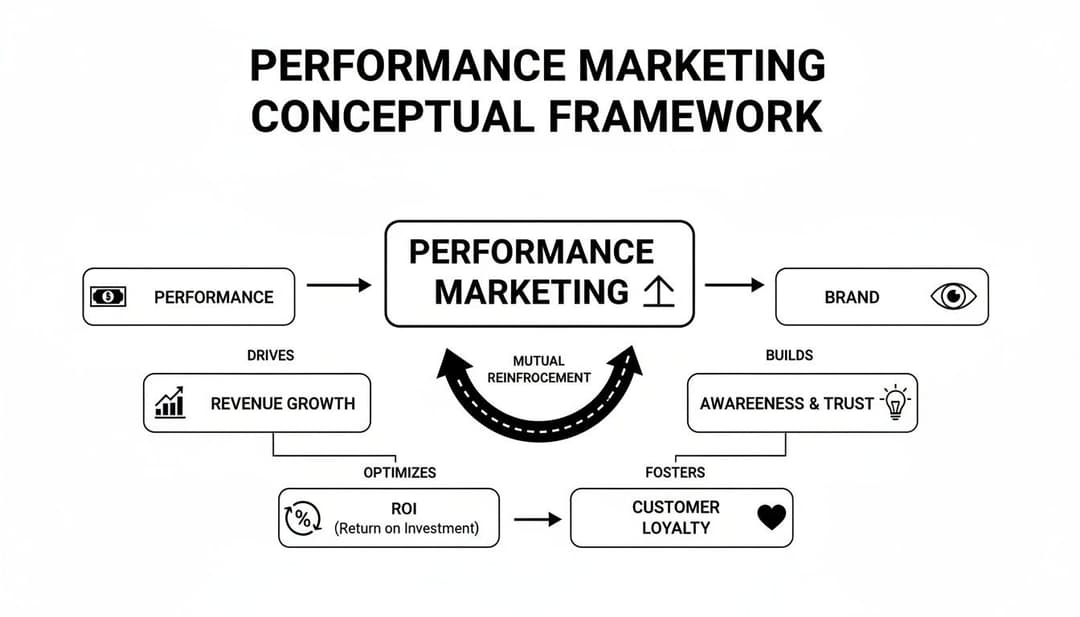
As you can see, the path is clear: performance marketing is laser-focused on converting attention into cold, hard revenue.
The Core Players in the Ecosystem
To navigate this world, you need to know who's who. The performance marketing space really boils down to three key players working in concert. Getting a handle on their roles is the first step to making the system work for you.
- Advertisers (or Merchants): That's you. You're the business with a product or service to sell, and you’re looking to drive specific outcomes like sales or sign-ups. You define the goals and put up the cash.
- Publishers (or Affiliates): These are the folks who own the digital real estate where your ads will live. This could be anyone from a high-traffic blogger, a social media influencer, a product review site, or even a massive search engine.
- Networks and Platforms: These are the essential middlemen connecting advertisers and publishers. They’re the ones providing the tracking technology, reporting dashboards, and payment systems that keep everything running. Think of platforms like Google Ads, Meta Ads, or specialized affiliate networks.
In this model, the risk and reward are beautifully aligned. Publishers only get paid when they send you traffic that actually converts. This creates a powerful, self-optimizing loop where everyone is gunning for the same thing: tangible results.
Common Channels and Pricing Models
Now for the fun part: picking your weapons. Different channels excel at different things, and they all operate on pricing models that define exactly what action you're paying for. The right mix depends entirely on what you’re trying to achieve.
Popular Performance Channels:
- Search Engine Marketing (SEM): This is about getting your ads in front of people actively searching for what you offer on platforms like Google. It’s the ultimate channel for capturing high-intent customers who are ready to buy.
- Paid Social Media: Here, you’re using platforms like Meta (Facebook and Instagram) or TikTok to target users based on their demographics, interests, and online behaviors. It’s fantastic for drumming up new demand and finding audiences who don't even know they need you yet.
- Affiliate Marketing: This involves partnering with content creators—like bloggers or reviewers—who promote your products to their dedicated audience. You pay them a commission for every sale they drive, making it a very low-risk channel.
- Native Advertising: These ads are designed to blend in with the look and feel of the publisher's site. They feel less like a disruptive ad and more like a helpful recommendation, which can lead to much higher engagement.
These channels are powered by specific pricing models. The most common ones you'll encounter are:
- Cost Per Click (CPC): Simple and direct. You pay every time someone clicks on your ad.
- Cost Per Lead (CPL): A step further down the funnel. You pay only when a user fills out a form or signs up, giving you a qualified lead.
- Cost Per Acquisition (CPA): This is the holy grail for many. You pay only when a click leads to a completed sale.
Combining these models with the right channels and tracking tools is what forms the backbone of any killer performance campaign. If you want to dive deeper into the tech that makes this all possible, check out our guide on the essential performance marketing software that helps you manage all these moving parts.
Measuring What Matters: Key Performance Marketing Metrics
In performance marketing, gut feelings don't pay the bills—hard numbers do. This is where we stop talking theory and start looking at tangible results. We need to focus on the key performance indicators (KPIs) that actually grow your business, not just vanity metrics like impressions or clicks.
Getting a grip on these core metrics is what separates the pros from the amateurs. It’s how you analyze campaign data, prove your marketing’s worth, and make decisions that are genuinely profitable. Let's break down the essential metrics that every performance marketer lives and breathes.
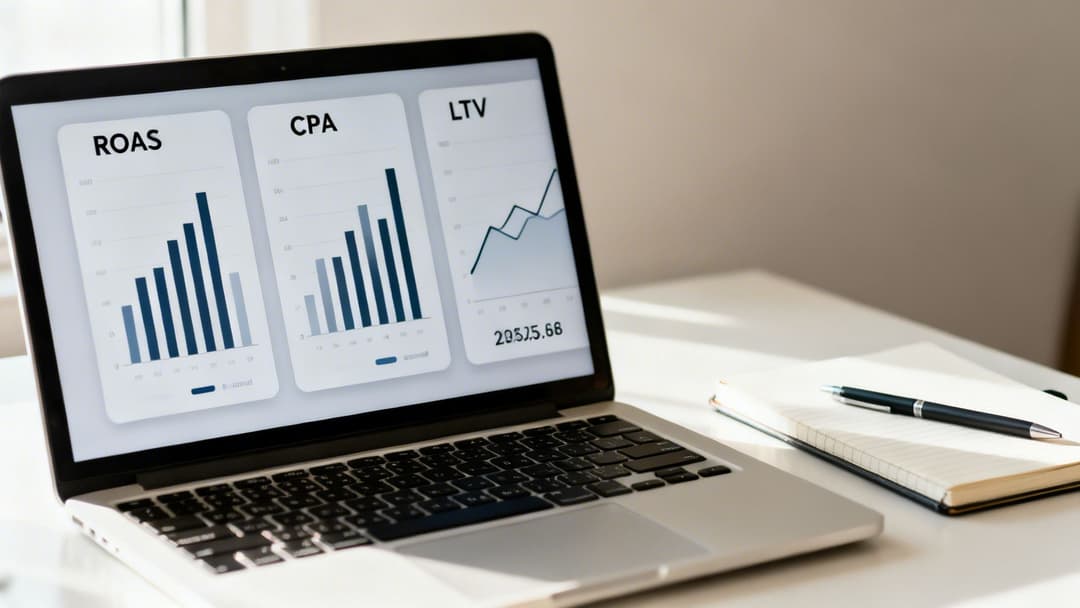
Return On Ad Spend
Return on Ad Spend (ROAS) is the North Star for most performance campaigns. It cuts right to the chase and answers the most important question: for every dollar I put into ads, how many dollars am I getting back in revenue? It’s a beautifully simple, yet powerful, measure of profitability.
The formula couldn’t be easier: ROAS = Total Revenue from Ads / Total Ad Spend
Let's say you spend $1,000 on a Meta Ads campaign and it brings in $4,000 in sales. Your ROAS is 4x, or 400%. That means you're earning $4 for every $1 you invest. A ROAS above 1x means you're in the black, while anything below signals you're losing money. Simple as that.
Cost Per Acquisition
While ROAS looks at revenue, Cost Per Acquisition (CPA)—also known as Cost Per Action—is all about efficiency. It tells you exactly how much it costs, on average, to land one new customer or hit a specific goal, like a sale or a completed sign-up.
The math is just as straightforward: CPA = Total Ad Spend / Total Number of Conversions
So, if you spend $1,000 on ads and get 50 new customers, your CPA is $20. This number is your best friend when it comes to budgeting. If you know your profit margin on a product is $50, a $20 CPA is a clear victory, leaving you with $30 in pure profit per sale.
Your target CPA is completely unique to your business. It all comes down to your product pricing, profit margins, and overall goals. There's no such thing as a universal "good" CPA—only what's profitable for you.
Customer Lifetime Value
Customer Lifetime Value (LTV) is the metric that takes your thinking from a single transaction to the entire customer journey. It’s the total profit you can realistically expect from a single customer over their entire relationship with your brand.
Understanding LTV is what separates good marketers from great ones. For example, a $40 CPA might seem a bit steep for a $50 product, netting you only $10 in profit. But what if that same customer comes back and makes three more purchases over the next year? Suddenly, their LTV makes that initial acquisition cost look incredibly smart and profitable.
To really get a handle on your numbers, you can explore a complete overview of the most important performance marketing metrics and build out your analytical toolkit.
For any business using performance marketing to gain subscribers, looking past the initial conversion is non-negotiable. You absolutely have to know how to track subscriptions and key metrics like MRR and churn rate to gauge the true return on your investment. Keeping an eye on these figures is the only way to understand the long-term health and profitability of your customer base.
How AI and Data Analytics Are Changing The Game
Performance marketing today isn’t just about paying for results; it's about using technology to get those results faster, smarter, and with a whole lot less guesswork. Artificial intelligence and data analytics have moved beyond buzzwords—they are now the core engines driving the most competitive campaigns, turning overwhelming spreadsheets into a clear strategic edge.
Think of it this way: a human marketer can manually test a handful of ad variations. An AI-powered platform can test thousands of combinations at once—different images, headlines, and audience segments. This is the new reality of what is performance marketing in a tech-first world.

From Manual Work to Predictive Power
The biggest shift is the move from reactive analysis to predictive optimization. Instead of just looking back at what worked yesterday, modern tools forecast what will work tomorrow. This is where machine learning truly shines, digging through historical data to spot patterns that are completely invisible to the human eye.
This means the system can automatically:
- Identify Winning Creatives: AI models can predict which ad image or video is most likely to convert before you even spend your first dollar.
- Discover Valuable Audiences: Algorithms can pinpoint niche audience segments that deliver the highest ROAS, so you can focus your budget where it really counts.
- Automate Budget Allocation: AI can shift your spending in real-time toward the best-performing ads and audiences, maximizing efficiency without needing constant manual tweaks.
This automated approach frees up your team from the tedious cycle of manual ad creation and monitoring. Instead, you can learn more about using AI for ads to focus on high-level strategy and creative brainstorming, letting the technology handle the heavy lifting of execution and optimization.
Turning Data Into Your Strategic Advantage
The performance marketing industry is in the middle of a massive shift toward AI-driven optimization. This isn't just about automating bids anymore; we're talking about predictive analytics and fully autonomous campaign management. This evolution highlights a huge opportunity, as 87% of marketers admit that data is the most underutilized asset in their organizations.
By leveraging AI, marketers are finally closing the gap between having data and actually using it. AI tools translate complex performance data into simple, actionable insights, answering critical questions like: "Which ad message resonates most with my top-performing audience?"
This capability changes everything. Instead of guessing, you can double down on winning strategies and cut the losers with confidence and speed. AI-powered platforms help you launch more tests, learn from results faster, and ultimately scale your campaigns far more profitably. It's the key to turning creative chaos into campaign clarity and unlocking more revenue from your ad spend.
Common Mistakes That Can Drain Your Budget
Knowing the rules of performance marketing is one thing. Actually putting them to work in the real world means learning how to sidestep costly pitfalls.
Even experienced marketers can fall into common traps that quietly bleed budgets and kill results. If you want to drive profitable growth, you have to know what these mistakes are and how to steer clear of them. It's about making sure every dollar you spend is actually pushing your business forward—not just getting lost in the noise.
Focusing On Vanity Metrics
This is one of the most common blunders in the book: chasing the wrong numbers. It’s so easy to get fixated on metrics like clicks, impressions, or a low Cost Per Click (CPC). Why? Because they’re easy to track and look impressive on a surface-level report.
But cheap clicks don’t pay the bills. Profitable sales do.
Imagine you're running two campaigns. Campaign A has a $0.50 CPC, but it costs you $80 to acquire each customer (CPA). Meanwhile, Campaign B has a much higher CPC of $2.00, but its CPA is only $30. If you were only looking at CPC, you’d think Campaign A was the winner. In reality, Campaign B is the one driving your business forward.
Always align your primary KPIs with your core business objective. If your goal is sales, your North Star metric should be Return on Ad Spend (ROAS) or CPA, not just clicks or impressions.
Ignoring Creative Fatigue
People get bored. It’s human nature. If you run the same ad for too long, your audience will start to tune it out. This is creative fatigue, and you'll see it in your metrics as a rising CPA and a sinking click-through rate (CTR).
To fight this, you need a system for refreshing your ads. This doesn't mean you have to start from scratch every single week. The trick is to continuously test new variations of your top-performing creative.
- Test new headlines and copy against your best images or videos.
- Introduce different visual hooks in the first three seconds of a video.
- Swap out static images for user-generated content (UGC) or carousels.
By keeping a steady stream of fresh creative in the pipeline, you keep your campaigns engaging and prevent performance from flatlining. Improving your ad spend optimization depends on this cycle of testing and refreshing.
Another critical error that directly drains your budget is overlooking invalid traffic. Every fraudulent click is money spent with zero chance of a return. Preventing Click Fraud is essential, because ignoring it allows bots and competitors to waste your ad spend, skew your data, and make accurate performance analysis impossible. This is a foundational step in protecting your investment and ensuring your metrics reflect genuine user interest.
Got Questions About Performance Marketing? We've Got Answers.
As you start digging into performance marketing, a few questions are bound to bubble up. It's a corner of the marketing world with its own lingo and rules, and it’s totally normal to feel a bit lost at first.
To help you get your bearings, we’ve put together some straight-shooting answers to the questions we hear all the time. Think of this as your personal cheat sheet to clear up any confusion and get you on the right track.
Isn't Performance Marketing Just Another Name For Digital Marketing?
This is easily the most common question, and the distinction is super important. Think of digital marketing as the entire universe of marketing online. It’s a massive umbrella that covers everything from SEO and content writing to social media and email newsletters.
Performance marketing, on the other hand, is a very specific slice of that universe. Its defining feature is the payment model: you only pay when a specific, measurable action occurs. A sale, a lead, a click—whatever you define as your goal.
So, all performance marketing is digital, but not all digital marketing is performance-based. A big brand awareness campaign on Instagram is digital marketing. But an Instagram campaign where you only pay a partner when someone actually buys your product? That's performance marketing.
What's a Realistic Budget to Get Started?
There’s no single magic number, but here’s the key: you need to budget enough to buy meaningful data. Your first dollars aren't just for making sales; you're paying for information. You're funding your own education on what actually works so you can scale up profitably later.
A solid rule of thumb for platforms like Meta Ads is to aim for 50-100 conversions per ad set each week. For most advertisers, this means starting with a budget around $50-$100 per day.
That initial spend gives the platform's algorithm enough fuel to get out of its "learning phase" and start finding your ideal customers. If you start too small, you'll just get inconclusive results and you'll never know if your campaign was a hidden gem or a total dud.
Can B2B Companies Actually Use Performance Marketing?
Absolutely. While it’s often tied to e-commerce, performance marketing is a powerhouse for B2B. The main difference is what "performance" you're measuring. Instead of a direct purchase, the goal usually shifts to a valuable action that feeds the sales pipeline.
Common B2B performance goals look like this:
- Demo Requests: Paying for each qualified person who signs up to see your software in action.
- Whitepaper Downloads: Offering a high-value resource in exchange for contact info to generate leads.
- Qualified Leads (CPL): Paying per lead that fits specific criteria, like company size or job title.
Channels like LinkedIn Ads and Google search ads targeting high-intent business keywords are perfect for B2B performance campaigns. The principle is the same: tying your ad spend directly to a tangible business result.
How Long Until I Actually See Results?
You'll see surface-level data like clicks and impressions almost instantly. But the results that matter—the ones that impact your bottom line—take a bit more patience. Most ad platforms have a "learning phase" that lasts about 5-7 days, where the algorithm is busy figuring things out.
You should plan for your first 2-4 weeks to be a period of intense learning and testing. This is when you’ll figure out which ads and audiences are your winners. True, scalable profit usually becomes clear after the first month of consistent, data-driven optimization.
Performance marketing is a marathon of continuous improvement, not a sprint. Patience and a willingness to follow the data are your greatest assets here.
Ready to stop the manual grind and start scaling your Meta ads? AdStellar AI is the AI-powered platform that lets you launch, test, and scale campaigns 10x faster. Generate hundreds of ad variations in minutes, let our AI identify the winners, and double down on what works to unlock more revenue with less spend. See how it works at https://www.adstellar.ai.