Performance marketing software is the engine that powers modern advertising. Gone are the days of paying for ad placements and just hoping for the best. With this technology, you pay only for measurable actions—think clicks, leads, or actual sales. It makes every single dollar you spend completely accountable.
From Disconnected Tasks to a Unified Strategy
Ever tried conducting an orchestra one instrument at a time? It would be chaotic and wildly inefficient. That’s pretty much what manual campaign management feels like for performance marketers today. You're constantly jumping between spreadsheets, different ad platforms, and analytics tools, trying to stitch together a coherent picture.
Performance marketing software steps in as the conductor, bringing every critical element into a single, harmonious workflow. Instead of managing campaigns piece by piece, these platforms provide a high-performance system designed for one core purpose: turning marketing from a series of disjointed tasks into an integrated, data-driven operation. It becomes the central hub where ad creation, audience targeting, bidding, attribution, and reporting all come together.
This shift isn’t just a niche trend; it’s a massive market movement. The performance marketing software market was valued at USD 15.2 billion in 2023 and is projected to climb to USD 30.9 billion by 2032, growing at a solid CAGR of 8.23%. This explosive growth is driven by the need for advanced features like predictive analytics and multi-channel campaign tools—essentials for scaling complex campaigns on platforms like Meta without all the manual grunt work.
So, What's the Real Value?
At its heart, performance marketing software tackles the fundamental challenge of campaign complexity head-on. It provides the structure needed to manage dozens or even hundreds of ad variations across multiple audience segments. By automating the tedious, repetitive tasks, it frees you up to focus on what actually moves the needle: strategy, creative insights, and growth.
For instance, a platform like AdStellar allows a marketing team to:
- Automate Bulk Ad Creation: Spin up hundreds of unique ad combinations from a set of images, headlines, and descriptions in minutes, not hours.
- Centralize Campaign Management: Launch, monitor, and optimize all your Meta campaigns from one place, saving you from navigating complex native ad managers.
- Get AI-Driven Insights: Instantly see which creative elements, audiences, and messages are driving the best results, cutting right through the noise of raw data.
The table below breaks down just how different the workflow looks when you move from a manual approach to using dedicated software.
Manual Campaign Management vs Performance Marketing Software
| Task | Manual Approach | Using Performance Marketing Software |
|---|---|---|
| Ad Creation | Creating ads one by one in the native ad manager. A slow, repetitive process. | Bulk-generating hundreds of ad variations from creative assets in minutes. |
| Audience Targeting | Manually setting up and testing individual audience segments. | Using AI to identify and target high-value audience segments automatically. |
| Campaign Monitoring | Constantly checking multiple dashboards and spreadsheets for performance updates. | Viewing all key metrics and performance data in a single, unified dashboard. |
| Optimization | Making educated guesses based on fragmented data to adjust bids and budgets. | Receiving AI-driven recommendations and automated rule-based optimizations. |
| Reporting | Spending hours pulling data from different sources to build reports. | Generating comprehensive, automated reports with a few clicks. |
As you can see, it's not just about saving time—it's about fundamentally changing how you approach campaign execution and strategy.
Bridging the Gap Between Action and Outcome
Ultimately, the goal of this software is to forge a clear, unbreakable link between your marketing actions and your business outcomes. It finally answers the critical questions every marketer has: Which ads are actually driving sales? Which audiences are our most profitable? Where should we put our next dollar of ad spend for maximum impact?
By providing precise tracking and attribution, this software ensures success is no longer a matter of guesswork. It makes performance visible, measurable, and—most importantly—repeatable. This is especially vital when you're testing different advertising channels. To see how this applies specifically to social, check out our guide on social media advertising software.
In essence, performance marketing software isn't just a tool for efficiency; it’s a strategic asset that empowers marketers to make smarter, faster, and more profitable decisions. It turns campaign chaos into a predictable system for growth.
Core Capabilities That Drive Campaign Success
To really get what performance marketing software brings to the table, we need to pop the hood and look at its core functions. These aren’t just a random list of features; they're interconnected systems built to wrangle the beautiful chaos of modern advertising. Think of the software as a highly efficient team with five distinct departments, each mastering a specific part of the campaign lifecycle.
This map shows how the three pillars of a great platform—Ad Creation, Targeting, and Analytics—work in harmony to manage a campaign from start to finish.
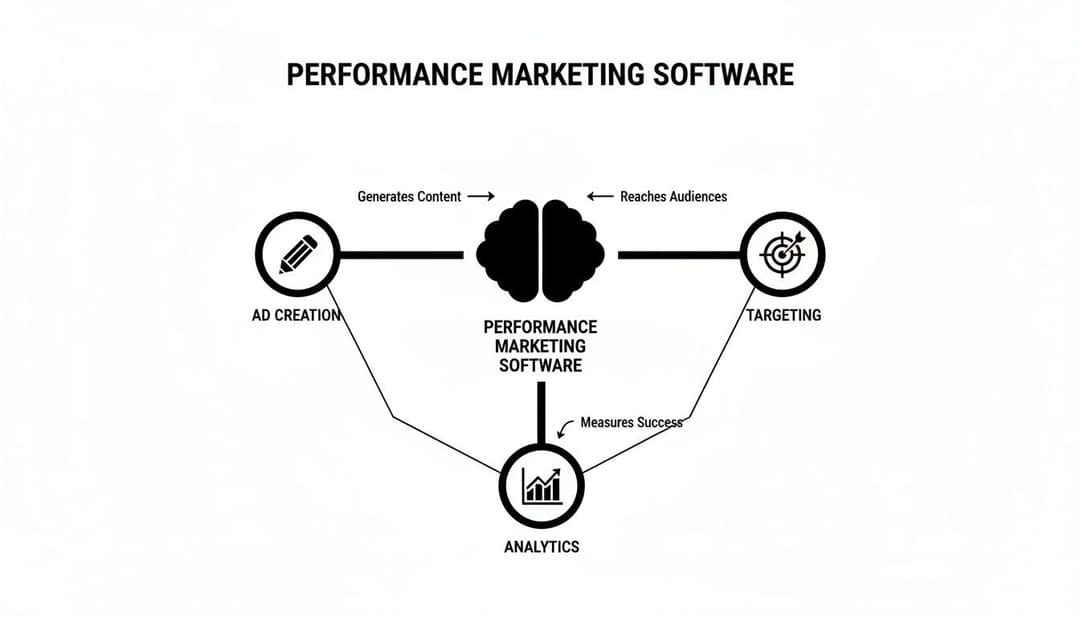
As you can see, a powerful platform breaks down the walls between creative production, audience selection, and performance measurement, pulling them into a single, intelligent workflow.
Campaign Orchestration: The Mission Control
At its heart, performance marketing software is the mission control for all your advertising. Instead of drowning in a sea of ad accounts and spreadsheets, you get one command center to launch, monitor, and tweak campaigns across every channel.
This unified view is a game-changer for maintaining control and consistency, especially when you’re running campaigns at a serious scale. It makes sure every ad set, budget, and bidding strategy is perfectly aligned with your main objectives. Without it, teams get bogged down in busywork and lose track of the bigger picture.
Campaign orchestration transforms marketing from a series of disconnected tactics into a cohesive, goal-driven strategy. It’s the difference between managing chaos and commanding a well-oiled machine.
Creative Automation: The Digital Assembly Line
Picture a digital assembly line for your ads. You feed it the raw materials—images, videos, headlines, and copy—and it instantly churns out hundreds of unique ad variations. That's the magic of creative automation.
This capability solves one of the biggest headaches in performance marketing: the soul-crushing, one-by-one process of building ads. For example, a bulk ad creation tool like AdStellar’s can take 5 images, 5 headlines, and 5 body texts and spin them into 125 distinct ads in minutes. This is how you run exhaustive tests at lightning speed to find the creative combinations your audience actually responds to.
Audience Management: The GPS System
Great advertising is all about getting the right message in front of the right person. Audience management is your sophisticated GPS, helping you pinpoint and engage your most valuable customer segments with laser precision. We're talking way beyond basic demographic targeting here.
Modern performance marketing software lets you:
- Segment Audiences: Carve out granular segments based on behavior, purchase history, or engagement.
- Build Lookalikes: Use your best customer data to find new, high-potential audiences on platforms like Meta.
- Manage Suppression Lists: Stop wasting money showing acquisition ads to people who are already customers.
By centralizing all your audience data, the software makes sure you’re consistently targeting the people who are most likely to convert, squeezing every last drop of efficiency from your ad spend.
Attribution and Tracking: The Detective
So, which ad click actually led to that sale? That’s where attribution and tracking come in—the detective work of performance marketing. This feature connects the dots between a user’s interaction with an ad and the final conversion, giving you a clear, honest picture of what’s driving results.
Without solid attribution, you’re just guessing. You might give credit to the wrong channel or kill the budget for a campaign that’s secretly a top performer. A robust performance marketing software platform uses advanced tracking pixels and server-to-server integrations to make sure every conversion is accurately tied back to its source. This delivers the trustworthy data you need to make smart optimization decisions.
Analytics and Reporting: The Actionable Dashboard
Finally, all the data gathered from orchestration, testing, and tracking flows into the analytics and reporting engine. This isn’t just a repository for raw numbers; it’s a dashboard designed to translate complex data into clear, actionable insights. The best platforms use AI to take it a step further, proactively flagging performance trends you might have missed.
For instance, AdStellar’s AI Insights module doesn't just show you which campaigns have the best ROAS. It digs deeper, breaking down performance by creative element, headline style, and audience segment to tell you why something is working. You might discover that user-generated content outperforms your slick studio shots by 30%—a powerful insight that can reshape your entire creative strategy. If you want to dive deeper into how this works, check out our guide on the top features of AI ad platforms.
How to Choose the Right Platform for Your Business
Picking the right performance marketing software isn't like comparing spec sheets for a new laptop. A long list of flashy features is useless if the platform doesn't fit your team's workflow, your business goals, and your existing tech. The right tool should feel like a natural extension of your marketing strategy—something that cuts through the complexity, not adds more of it.
Making a smart choice requires a practical framework. Think of it as a series of stress tests to see how a platform will actually hold up when you need it most. It's time to look past the sales demo and dig into the core pillars that support real, sustainable growth.
Assess Seamless and Secure Integrations
Your performance marketing software is about to become the central nervous system for your ad operations. Its ability to connect securely and reliably with everything else you use is completely non-negotiable. If the integrations are clumsy or weak, you're signing up for data gaps, security risks, and countless hours of manual workarounds.
When you’re looking at a platform, make integrations a top priority, especially with mission-critical ad networks like Meta.
- Look for Official API Connections: The platform absolutely must use secure, official APIs (like OAuth for Meta) instead of sketchy, unstable methods. This is the only way to guarantee your data connection is stable, compliant, and protects your sensitive ad account info.
- Evaluate Data Sync Speed: How fast does the platform pull in performance data? A big lag can delay your optimization decisions, and that means you’re burning money on ads that aren't working. Real-time or near-real-time data is the gold standard.
- Consider Your Full Tech Stack: Does it play nice with your analytics tools, CRM, or e-commerce platform? A truly integrated system gives you a complete picture of the customer journey, from first click to final sale.
Distinguish True Automation from Basic Scheduling
The word "automation" gets thrown around a lot, but not all automation is created equal. Plenty of tools offer basic scheduling or simple "if this, then that" rules. And while that's helpful, it’s not the kind of intelligent automation that actually transforms how you manage campaigns.
True automation, usually powered by AI, learns from your data to make smarter decisions all on its own. It’s the difference between a simple kitchen timer and a self-driving car. For example, an AI-powered platform can analyze thousands of data points to predict which ad creative will crush it and automatically shift more budget its way in real time. This proactive optimization is where advanced platforms leave the basic ones in the dust.
The goal of automation isn’t just to do tasks faster. It’s to make better decisions at a scale no human team could ever manage. It should free up your strategists to think about growth, not spend their day making manual tweaks.
Prioritize Proven Scalability and Performance
You’re building your business to grow, and your software has to be ready to grow with you. A platform that works great for ten campaigns might completely fall apart under the pressure of a hundred. Scalability isn't some far-off problem; it's a critical need for any ambitious marketing team.
This is a huge reason why the digital marketing software market is booming, with a valuation of USD 88.0 billion in 2024 expected to reach USD 281.6 billion by 2033. A major driver is the demand for scalable, cloud-based solutions that can handle massive amounts of data securely—a key concern for businesses dealing with regulations like CCPA. You can see more on this explosive growth in the full digital marketing software market report on imarcgroup.com.
Evaluate the User Experience and Onboarding
Even the most powerful software on the planet is worthless if your team can't figure out how to use it. A clean, intuitive user interface (UI) is absolutely essential for getting your team up and running quickly and keeping them efficient. A clunky or confusing platform just creates friction, slows down campaign launches, and can easily lead to expensive mistakes.
During your evaluation, insist on a trial or an extended demo and get your actual team members to test the workflow. Can they easily build a campaign? Can they find the reports they need? Can they make sense of the performance data without hours of training? A great user experience empowers your whole team, shrinks onboarding time, and ensures you start seeing a return on your investment much faster. For a deeper dive into this process, check out our guide on how to select the right ad platform for your needs.
The Strategic Advantage of AI in Performance Marketing

Most performance marketing software is reactive. It gives you the data, and you figure out what to do next. But AI-powered platforms are built differently—they’re designed to be predictive. This isn’t just a fancy way of saying "automation"; it’s a fundamental shift from looking backward at what happened to looking forward at what will happen.
Think of it this way: traditional optimization is like driving using only your rearview mirror. It shows you where you’ve been, but it doesn’t help you navigate the road ahead. AI is like a GPS with live traffic data, analyzing everything it knows to predict the fastest, most efficient route to your destination. It helps you sidestep the expensive guesswork that quietly drains ad budgets.
From Educated Guesses to Data-Driven Certainty
The real magic of AI in performance marketing software is its ability to spot subtle patterns that are nearly impossible for a human to see. It can sift through thousands of your past campaigns to pinpoint the exact mix of creative elements, audience segments, and messaging angles that consistently deliver results.
For example, an AI model might analyze your entire media library and discover that ads featuring lifestyle photos of people using your product outperform static product shots by 45%. Or it might find that headlines phrased as questions drive a higher click-through rate among audiences aged 25-34. These are the kinds of specific, actionable insights that elevate campaigns from good to unbeatable.
This level of intelligence is why the market is moving so quickly. Cloud adoption in marketing analytics, a core piece of this puzzle, shot up by 50% in 2024. More importantly, businesses that got in early on these AI tools saw lead conversion rates jump by an average of 35%, proving just how much value is on the table. You can dig deeper into the numbers by reviewing the latest marketing analytics software market insights on coherentmarketinsights.com.
Uncovering Hidden Opportunities with Predictive Modeling
One of the biggest wins with AI is its knack for finding your next best customer. Predictive audience modeling goes way beyond building simple lookalike audiences. It dissects the DNA of your highest-value customers to build sophisticated models that can identify entirely new, untapped segments with a high probability of converting.
This means the software might point you toward a niche audience you never even thought to target, opening up a fresh well of potential customers. It’s like having a dedicated scout who’s constantly exploring new territories and coming back with a list of high-potential leads.
Automated Budget Optimization in Real Time
AI is also a master at managing budgets with a speed and precision no human team can realistically match. Instead of someone manually checking performance dashboards and shifting spend every few hours, an AI-powered system does it continuously, 24/7.
Here’s what that looks like in practice:
- Real-Time Reallocation: The system automatically moves budget away from underperforming ads and channels it toward the winners as the data comes in.
- Pacing and Efficiency: It makes sure your budget is spent smartly throughout the day or campaign flight, so you don’t blow your entire daily spend by noon.
- Prevents Over-Correction: It makes decisions based on statistical significance, avoiding the classic mistake of killing a great ad just because it got off to a slow start.
An AI-powered system doesn't just manage your budget; it actively maximizes its impact. It ensures every dollar is working as hard as possible to achieve your campaign goals, whether that's a lower CPL or a higher ROAS.
This is exactly where a platform like AdStellar shines. Its AI Insights feature doesn’t just show you data; it ranks every single creative, audience, and message against your specific goals. Then, its AI Launch feature takes that intelligence and builds entirely new campaigns using your proven winning components. For a deeper look at how this all works, check out our guide on what AI advertising technology is and how it works. It's a closed loop that turns historical data into decisive, forward-looking action.
Implementing Software and Measuring Your Success
Adopting a new performance marketing platform isn’t like flipping a switch. It’s a process, one that’s designed to prove its own value right from the start. Think of it less as buying a tool and more as building a new engine for profitable growth. To do it right, you need a clear, phased approach that takes you from a secure setup to measurable, scalable wins.
The whole game hinges on creating a solid feedback loop where data drives every single decision. Instead of going all-in on massive, high-risk campaigns right away, the smart move is to build a strong foundation, lock in your benchmarks, and then methodically test your way to the big wins. This is the playbook for building an undeniable business case for your investment.
Secure Onboarding and Initial Setup
First things first, and this is the step you can't afford to rush: getting your data connected securely and your first few campaigns structured for learning. A sloppy setup leads to bad data and flawed insights, so nailing this part is critical.
Your onboarding checklist should have a few non-negotiables:
- Connect Data Sources Securely: Always use official, secure connections like OAuth for platforms like Meta. This keeps your account safe and ensures a stable data flow without ever exposing your passwords.
- Organize Your Media Library: Get your existing creative assets—all the images, videos, and copy variations—uploaded and organized. A clean library is the bedrock of fast, automated ad creation down the road.
- Structure Your First Campaigns: Build a handful of initial campaigns with simple, clear objectives. The goal here isn't to hit a home run immediately, but to create a clean testing ground for gathering baseline performance data.
Establishing Your Performance Baselines
Before you can truly see the lift from advanced automation and AI, you need to know exactly where you're starting from. Running your initial campaigns without all the fancy automation features turned on is a crucial step. It gives you a clear benchmark to measure all future improvements against.
It’s like getting a fitness assessment before starting a new training program. You have to know what you can do today to accurately track your progress tomorrow. These first campaigns will give you the baseline metrics for your most important KPIs, whether that's Cost Per Lead (CPL) or Return On Ad Spend (ROAS).
Establishing a baseline isn't just a technical step; it's a strategic one. It provides the "before" picture that makes the "after" so compelling when you report on the software's impact to stakeholders.
The Test and Scale Process
Once you've got your baselines, it’s time to let the software do its thing. The test and scale process is where the magic happens. It’s a systematic way to use automation to rapidly figure out which creative and audience combinations are your winners, and then strategically pour fuel on the fire. This is where the platform really starts to drive serious ROI.
It’s a simple but powerful loop:
- Hypothesize: Come up with clear ideas to test based on your baseline data. For instance, "Will user-generated content beat our studio photos for this audience?" or "Does a headline phrased as a question get more clicks than a statement?"
- Test at Scale: Use the software’s bulk creation tools to build hundreds of ad variations that put your hypotheses to the test across different audiences. Launch them with a controlled budget.
- Analyze and Identify Winners: Let the platform's analytics engine do the heavy lifting, pinpointing the top-performing ads, creative elements, and audience segments based on real-time data.
- Scale the Winners: Shift more of your budget to the proven combinations, turning those small-scale test wins into large-scale, profitable campaigns.
Measuring True Return on Investment
Finally, you need to calculate the software's true ROI, and it goes way beyond just one metric. A full analysis takes into account the time you're saving, the ad spend you're no longer wasting, and the direct lift in performance. When you quantify all these benefits, you build an airtight business case for your investment in performance marketing software.
To get the full picture, factor in these three key areas:
- Time Saved: Tally up the hours your team is no longer spending on manual work like building ads and pulling reports. Then, put a dollar value on that time.
- Reduced Ad Spend Waste: Measure how much less you're spending on underperforming ads now that you can spot them and shut them down faster.
- Uplift in Conversion Rates: Compare your baseline KPIs to your new, optimized results. This shows the direct lift in conversions or ROAS. For more ideas on what to track, check out our in-depth guide to essential performance marketing metrics.
Turning Campaign Chaos into Profitable Growth

It all comes down to this: performance marketing software isn't a "nice-to-have" anymore. In today's crowded market, it's the core engine for any brand that wants to compete and grow. The real goal has moved far beyond just automating a few tasks. It’s about smart automation that finally frees you and your team from the grind of execution, letting you put 100% of your focus back on strategy.
Forget getting stuck in the weeds, manually building ads and pulling reports day after day. You can now command a system built from the ground up for speed, scale, and precision. This is what connects your big creative ideas to tangible results, making every single dollar you spend completely accountable.
From Manual Effort to Strategic Partnership
The right platform doesn’t feel like another piece of software; it feels like a strategic partner. It gives you the framework to test new ideas fast, pinpoint what’s working, and pour fuel on your winners with total confidence. This is exactly where AI-driven platforms like AdStellar AI shine, helping teams get campaigns live, analyze them, and find the next growth lever faster than ever before.
With this approach, you can finally turn the daily creative scramble into a repeatable, data-backed system for driving revenue.
This shift allows marketing teams to move from being reactive campaign managers to proactive growth architects, using data to build predictable success instead of just hoping for it.
At this point, the question isn’t if you should adopt this technology, but how quickly you can get it working to drive more profitable growth. Ready to see how an AI-powered platform can change the game for your advertising and unlock your team’s true potential?
Explore how AdStellar AI helps you launch, test, and scale campaigns at a speed you never thought possible. This is your chance to turn complexity into clarity and ad spend into real, measurable ROI.
Frequently Asked Questions
When you start digging into performance marketing software, a few questions always pop up. Let's tackle some of the most common ones to give you a better sense of how these platforms work, who they're for, and what it's really like to get started.
How Does This Software Integrate With Platforms Like Meta Ads?
Solid, secure integrations are the absolute foundation of any performance marketing platform worth its salt. The best software doesn't use sketchy workarounds; it connects to ad networks like Meta through official, secure APIs, almost always using a process called OAuth.
Think of OAuth as a secure digital valet key. Instead of handing over your account's master keys (your username and password), you grant the software specific, limited permissions to access your ad account. It’s a system designed for trust and has a few major benefits:
- Serious Security: Your actual login credentials are never shared, which dramatically cuts down the risk of someone getting unauthorized access to your ad accounts.
- Rock-Solid Data: Official API connections mean the flow of performance data is stable and accurate. You avoid the glitches and missing information that plague unofficial methods.
- Staying Compliant: Using the approved integration methods keeps you in good standing with big platforms like Meta, protecting your ad account from being flagged or suspended.
This secure handshake is what allows the software to reliably pull in performance data and push out campaign changes without putting your account's safety on the line.
Is This Software Suitable For Small Businesses?
Absolutely. It’s a common misconception that this kind of software is only for huge companies with massive ad budgets. The reality is, its impact on small businesses and startups can be even more profound. The trick is finding a platform that scales with you.
For a small, scrappy team, performance marketing software is a massive competitive lever. It automates the tedious, manual work that can easily swamp a small crew, letting them punch way above their weight class. A single marketer, for instance, could use the platform to launch and test hundreds of ad variations in the same amount of time it would take them to manually build just a handful.
The right platform completely levels the playing field. It gives growing businesses the same powerful optimization tools that used to be reserved for companies with giant teams and budgets. It's an investment in pure efficiency that pays off at every single stage of growth.
What Is The Typical Learning Curve For a New Platform?
The learning curve can definitely vary, but the good news is that modern platforms are built with the user experience front and center. The best ones focus on intuitive design and simple workflows, all designed to get you from zero to launch with as little friction as possible.
Typically, you'll find a clean, central dashboard that brings all your important campaign info into one place. Onboarding is often a guided process with clear, simple steps for connecting your ad accounts, uploading your creative assets, and building out that very first campaign. A great platform should make you feel empowered, not intimidated, allowing you to get a structured test campaign live within your first session. While you'll naturally spend more time mastering the advanced features, the core functions should feel accessible right from day one.
Ready to transform your campaign management? AdStellar AI is an AI-powered platform built to launch, test, and scale your Meta ad campaigns 10× faster. Discover how AdStellar AI can help you turn creative chaos into profitable growth.