You open a placement breakdown in Ads Manager and see one line eating the report: Audience Network Rewarded Video. Views look strong. Costs look cheap. Delivery is concentrated there. Then a critical question arises: is this a hidden source of scale, or are you buying metrics that won't survive contact with revenue?
That tension is why this placement keeps showing up in account audits. It can be useful. It can also mislead teams that judge success by the wrong KPI. The difference usually isn't the placement itself. It's the campaign goal, the optimization event, and whether anyone bothered to isolate it before making a decision.
Understanding Audience Network Rewarded Video
The simplest way to understand Audience Network rewarded video is to stop thinking like a media buyer for a minute and think like the app user.
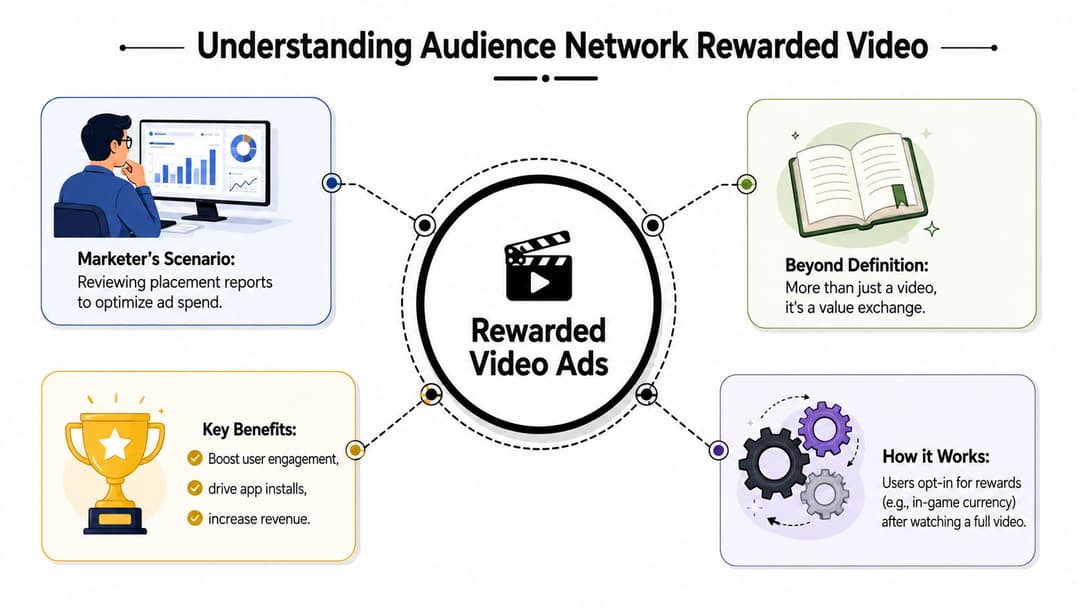
A person is inside a third-party mobile app or game. They want something immediately valuable inside that experience, like in-app currency, an extra life, or a feature. The app gives them a choice: watch a full-screen video, get the reward. That choice is the defining feature of the format.
What the placement actually is
Audience Network is Meta's inventory beyond Facebook and Instagram, delivered across third-party apps and other external environments. Rewarded video is one format inside that ecosystem, and it behaves differently from feed inventory because the user has explicitly agreed to the exchange.
Industry coverage describes rewarded video as a voluntary, opt-in format inside third-party apps and games where users watch a full-screen video in exchange for value such as in-app currency, extra lives, or feature access. That same coverage notes that rewarded video is often monetized at a premium, citing roughly $10 to $50 eCPM per 1,000 impressions, with reported averages of $10.16 on Android and $16.33 on iOS in one 2026 industry guide (Business of Apps on rewarded video advertising).
That matters for two reasons. First, publishers like it because the format can monetize well. Second, advertisers need to remember they're buying attention in a context where the reward, not the brand, is often the immediate motivation.
Why marketers misread it
The confusion usually starts in reporting. A buyer sees low-cost engagement and assumes intent. But rewarded video is not passive browsing. It's an exchange. That can create strong completion behavior without creating the same depth of commercial interest you'd expect from someone browsing a product feed or clicking a search result.
Practical rule: Treat Audience Network rewarded video as a separate behavioral environment, not just another line item under placements.
If you're managing this inside a broader Meta setup, it helps to understand how the wider network works before judging the format. This overview of Audience Network in Facebook advertising is a useful refresher if you haven't looked at these placements closely in a while.
For teams that need a grounded view of execution across the platform, strong Meta advertising services can also help clarify when placement expansion supports performance and when it muddies it.
How the Rewarded Video Placement Auction and Delivery Function
Rewarded video feels unique on the user side, but on the buying side it still runs through the same Meta machinery as other placements. You aren't negotiating a fixed rate for this inventory. You're entering an auction.
Meta uses the same auction-based buying model across Audience Network, so rewarded video delivery is governed by CPM, CPC, and oCPM competition rather than fixed pricing. Independent guidance also notes that Audience Network CPM and CPC can be 20–30% lower than Meta in-feed placements, which is why many buyers use it as a scaling lever when cost efficiency matters (Bir.ch on Facebook Audience Network).
Same auction, different user context
That price gap is where many mistakes begin. Lower costs can be good. Lower costs can also mean you're buying inventory in a context where user intent is radically different from feed behavior.
A person in Facebook Feed is browsing content. A person in rewarded video has interrupted an app flow to claim a reward. Same targeting logic. Very different mindset.
If you want a clean primer on the mechanics behind this kind of auctioned media environment, this explanation of how programmatic advertising works is worth revisiting. It helps frame why inventory supply, context, and competition shape cost so heavily.
What drives delivery quality
Three variables matter more than is generally acknowledged:
- Bid competitiveness: If your bid strategy is too restrictive, Meta may struggle to find enough inventory that matches your target and event.
- Targeting quality: Broad or narrow audiences can both work, but rewarded inventory still needs a coherent audience signal.
- Inventory fit: Some offers make sense in app-heavy environments. Others don't.
A useful way to think about it is this:
| Factor | What it affects | Why it matters in rewarded video |
|---|---|---|
| Audience signal | Matching | Meta still uses your targeting inputs, but the external context changes behavior |
| Optimization event | Delivery bias | The system chases the cheapest path to the selected outcome |
| Creative fit | Attention quality | The user didn't ask for your brand, they asked for a reward |
Campaign structure matters too. If you need a sharper process for separating weak delivery from weak setup, this guide to Meta ads campaign optimization is useful because it forces the right question: was the issue the placement, the event, or the build?
Cheap inventory isn't automatically low quality. But it does need a stricter standard of proof.
When to Use and When to Avoid Rewarded Video Placements
Most blanket advice about Audience Network rewarded video is lazy. “Always remove it” is too simple. “Always trust automatic placements” is too simple too.
The answer depends on what you're asking Meta to optimize for.
When it makes sense
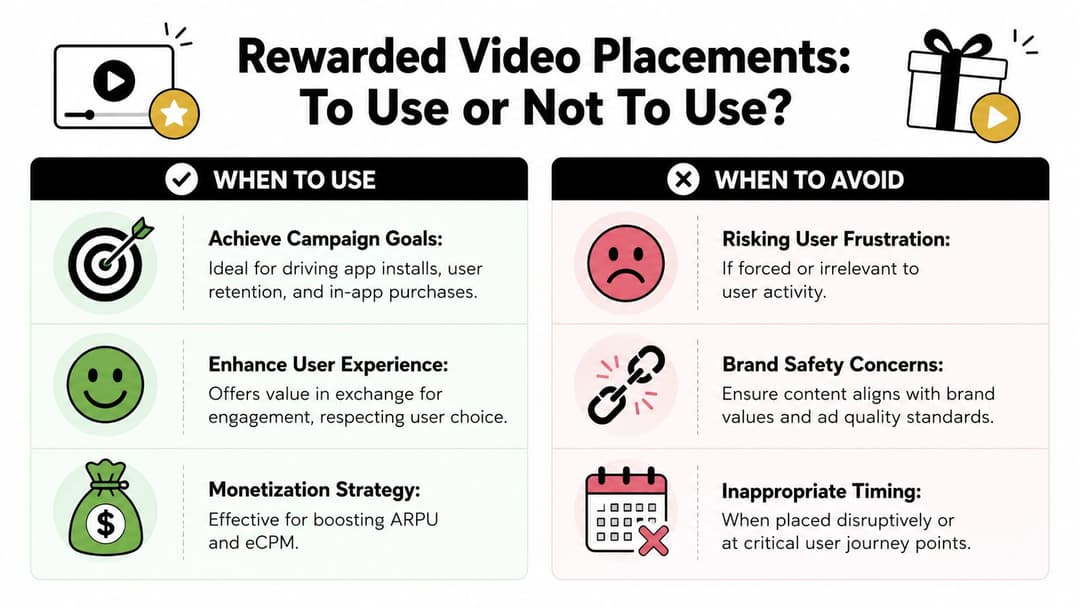
A nuanced industry view is that rewarded video mainly becomes problematic when the campaign is optimized for the same outcome the placement can cheaply manufacture, such as ThruPlay or video views. For conversion-focused campaigns, its impact is often minimal because it's used far less or not at all (Jon Loomer on placements to remove).
That means rewarded video can make sense in cases like these:
- Mobile app growth: Especially when the product already lives in an app-first world and the user journey doesn't depend on desktop research or long consideration cycles.
- Controlled reach expansion: If your goal is to find lower-cost inventory without assuming every impression should convert immediately.
- Video consumption objectives: If you intentionally want completed views and understand exactly what those views do and don't mean.
When it usually backfires
Here's where I'd be cautious.
If you run a B2B lead gen campaign and optimize for a view metric because it's cheap, rewarded video can make the account look healthier than it is. You'll see engagement. You may not see qualified pipeline. The placement isn't cheating. It's just doing the job you asked it to do.
For high-consideration ecommerce, SaaS demo requests, or lead forms where downstream quality matters, this placement often creates more noise than clarity unless the account is optimized tightly around true business outcomes.
A simple decision filter
Use this quick framework before leaving it on:
- Ask what success means. If the answer is views, watch time, or another engagement proxy, be careful.
- Check how close your optimization event is to revenue or qualified leads. The farther away it is, the more risky rewarded video becomes.
- Review the offer context. App-native offers usually fit better than high-friction, high-consideration offers.
- Decide whether you can measure quality after the click. If you can't, don't trust cheap top-line results.
For a broader look at how this fits across campaign types, this breakdown of types of Facebook ads can help map placement choices back to objective and offer.
A placement isn't bad because it's cheap. It's bad when it wins on a metric that doesn't matter.
A Practical Setup Checklist for Your Campaigns
Once you know whether rewarded video belongs in the test, setup should be deliberate. This isn't a placement to leave unexamined just because Advantage+ placements made it easy to include.
What to check in Ads Manager
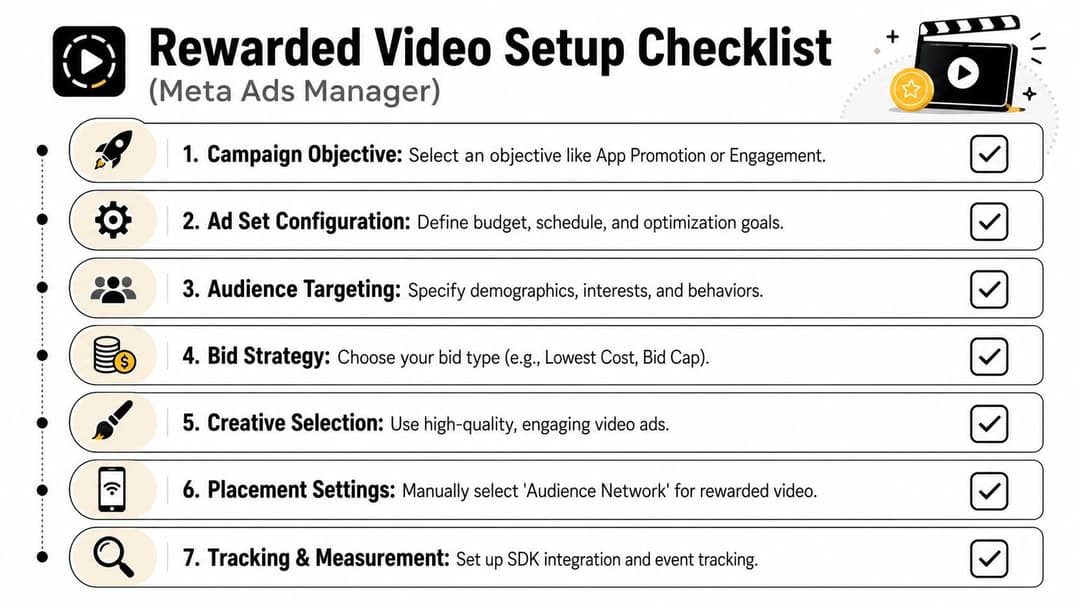
At the ad set level, review placement controls before launch. If you're testing rewarded video, document that decision. If you're excluding it, make that explicit too.
Use this checklist:
- Choose the right objective: Pick an objective that matches a real business outcome. Don't use a cheap engagement objective and then complain that the traffic lacked intent.
- Review placement settings manually: If you're using manual placements, inspect Audience Network options closely. Confirm whether rewarded video is selected or removed.
- Match creative to placement eligibility: Some assets technically deliver across placements but fit poorly in a reward-based environment.
- Separate tests when needed: If you have strong suspicions about the placement, split it into a dedicated ad set or campaign test so the data stays readable.
When to trust automation and when not to
Automatic placements can work well when the account has strong conversion data and the optimization event is close to revenue or qualified leads. In that setup, Meta has better feedback loops and less reason to overvalue shallow engagement.
Manual intervention makes more sense when:
- Your KPI is soft: View metrics, landing page visits, and top-funnel engagement need more scrutiny.
- You're auditing quality problems: If reported success isn't translating into sales outcomes, isolate the placement.
- The client or stakeholder needs proof: Placement-level testing is often the fastest way to stop opinion-driven debates.
A practical setup habit is to keep a pre-launch note for every campaign that includes three lines: placement choice, reason for including or excluding rewarded video, and the KPI that will decide whether it stays.
Build for analysis, not just launch
The biggest setup mistake isn't selecting the wrong box. It's launching in a way that makes later diagnosis impossible.
That's why strong event tracking matters before you worry about scaling. If your reporting can't tell you whether post-click behavior or conversion quality changed, you'll end up arguing about CPMs instead of outcomes.
Creative and Bidding Best Practices for Rewarded Video
Rewarded video demands a different creative mindset than feed video. You're not interrupting a scroll. You're entering a value exchange that the user consciously chose.
The format is full-screen, user-initiated, typically 15–30 seconds, non-skippable, and ends with a reward exchange, which is why it's usually treated as a higher-engagement format rather than a passive impression unit (Typito's Facebook video ad specifications guide).
Creative that fits the environment
That structure changes what good creative looks like.
A feed ad can rely on curiosity and thumb-stop visuals. Rewarded video needs immediate clarity. The user already knows they must watch to get the reward. Your job is to make the brand message memorable and the next action obvious.
Here's what tends to help:
- Front-load the brand and message: Don't hide the point until the last seconds. If the ad completes but your message lands too late, you've paid for attention you can't use.
- Design for full-screen mobile viewing: Small text, cluttered layouts, and weak contrast get punished fast in this format.
- Use a clear end card: The reward belongs to the app, not your brand. Your end card has to redirect attention toward your CTA.
- Keep the ask simple: One action. One idea. One reason to care.
Bidding and optimization choices
Bidding strategy should follow the same principle as placement strategy. Optimize for something the business values.
If you include rewarded video in a mixed-placement campaign, avoid reading success through cheap engagement alone. A low-cost result can still be the wrong result. That's why many strong accounts tie optimization to deeper events and let Meta decide whether this placement deserves spend.
If you do test it intentionally, compare setups like this:
| Campaign setup | Likely effect |
|---|---|
| View-focused optimization | Rewarded video may attract more delivery because it can satisfy the event efficiently |
| Conversion-focused optimization | Delivery often shifts toward placements more likely to drive the selected action |
| Mixed creative with no placement fit review | Good assets can underperform because the environment wasn't considered |
Your creative has to survive two filters: the user's tolerance for a non-skippable ad, and your own standard for downstream performance.
One practical habit helps a lot here: write the CTA first, then build the video backward from it. That forces discipline. If the CTA feels weak or disconnected, the rest of the asset probably is too.
Measuring True Performance and Troubleshooting Common Issues
Teams at this point either achieve clarity or engage in self-deception.
A documented Meta Ads Manager example showed that more than 98% of the results came from the Audience Network Rewarded Video placement, which shows how heavily a campaign can concentrate delivery there when it isn't isolated or excluded (Jon Loomer on rewarded video placement concentration).
That kind of concentration can make the placement look dominant. Sometimes it is. Sometimes it's only dominant because the optimization event was easy for it to win.
What to look for first
Open your placement breakdown and compare rewarded video against feed, stories, reels, and other active inventory. Don't stop at top-line volume.
Check for patterns like these:
- High view counts with weak business outcomes: That's the classic warning sign.
- Sudden delivery concentration: If one placement captures most results, ask why the system favored it.
- Mismatch between engagement and conversion quality: Strong front-end metrics with weak back-end behavior usually means the KPI is too soft.
A troubleshooting workflow that actually helps
Use a simple investigation sequence:
- Break down by placement in Ads Manager.
- Compare the metric you optimized for against the metric the business cares about.
- Inspect post-click quality using your analytics stack, CRM, or server-side tracking.
- Run an isolation test if the blended campaign data is too messy.
- Decide based on contribution, not on whether the placement generated cheap results.
If your account still relies too heavily on browser-side tracking, quality analysis gets harder fast. Better signal collection improves placement decisions, especially when cheap attention muddies attribution. Consequently, a setup like Conversion API Gateway proves relevant, as cleaner event transmission makes placement-level evaluation less guessy.
Common interpretation mistakes
Teams often make three avoidable errors:
- They confuse completion with intent.
- They evaluate placements only on blended CPA or CPM.
- They disable the placement globally without checking whether the campaign goal made the problem worse.
Rewarded video doesn't need to be judged by whether it looks efficient. It needs to be judged by whether it helps the account hit the KPI that matters after the click.
A good placement report should answer one question clearly: if this line item disappeared tomorrow, would qualified leads, purchases, or revenue change in a meaningful way? If you can't answer that, you don't have enough segmentation yet.
Streamline Rewarded Video Analysis with AdStellar AI
Manual placement analysis is where experienced buyers spend a lot of wasted time. You export breakdowns, compare ad sets, chase post-click quality in separate tools, then try to explain to a stakeholder why cheap ThruPlays didn't become profitable customers.
That's manageable in one account. It gets ugly across multiple brands, multiple offers, and constant creative testing.

Where the workflow usually breaks
The hard part isn't finding the placement breakdown. Ads Manager can do that. The hard part is turning that breakdown into a repeatable decision system.
Media teams need answers like:
- Which placements support ROAS, CPL, or CPA goals?
- Which creatives hold up inside lower-intent inventory?
- Which campaigns should keep rewarded video active, and which should cut it fast?
When those answers live across spreadsheets, screenshots, and account notes, reaction time slows down. By the time the team has certainty, the budget has already moved.
What an automated layer changes
An AI layer is useful when it ranks performance against business KPIs instead of engagement noise. That's the key distinction. Rewarded video often looks good at the surface. Its genuine value comes from systems that compare it against placements using the outcomes the account cares about.
That's where AI optimization for Meta campaigns becomes practical, not theoretical. Instead of manually checking whether rewarded video is helping, the platform can surface winning and losing combinations faster, including placement-level patterns tied to your real conversion goals.
The payoff isn't just saved time. It's cleaner decision-making.
If rewarded video is a genuine source of efficient scale, the account should show that through conversion quality and business outcomes. If it's mostly inflating vanity metrics, you want that exposed early, before it distorts creative judgments, audience strategy, and budget allocation.
A strong analysis workflow does one thing well: it stops buyers from arguing about placements in the abstract. It forces the account to answer with data.
If you want a faster way to test, rank, and scale Meta campaigns without digging through placement reports by hand, AdStellar AI gives growth teams a cleaner operating system for creative testing, KPI-based optimization, and decision-making around tricky inventory like Audience Network rewarded video.