You launch a Meta campaign with strong creative, a clean landing page, and enough budget to learn fast. A few days later, the dashboard looks active. Clicks are coming in. Engagement looks decent. Sales barely move.
That usually isn't a creative problem first. It isn't even a budget problem first. It's an objective problem.
Meta will optimize toward the instruction you give it. If you tell the platform to find clicks, it will find people who click. If you tell it to find purchases, it will look for people who behave like buyers. The objective of a campaign is the control lever that shapes delivery, bidding behavior, reporting, and what counts as a win.
Most underperforming accounts aren't broken because marketers forgot tactics. They're underperforming because the campaign goal stayed fuzzy all the way into launch. "Get more traffic" feels reasonable, but it gives the algorithm too much room to chase cheap activity that doesn't improve revenue. The result is motion without progress.
The fix is simple in theory and disciplined in practice. Start with the business outcome. Translate that into a measurable campaign objective. Then map that objective to the correct Meta setting, KPI, and optimization cycle.
Why Your Campaign Objective Is Your Most Important Decision
A common pattern shows up in paid social accounts. A team spends weeks on creatives, audience ideas, and copy angles. Launch day arrives, spend ramps, and the campaign generates a lot of top-of-funnel activity. Everyone feels productive until the finance view shows the truth: the campaign didn't create profitable behavior.
That happens because the platform followed instructions exactly.
If the objective of a campaign is vague, every downstream choice becomes loose. Audience selection gets broader than it should. Bidding chases the wrong action. Reporting celebrates the metrics that are easiest to inflate. Teams end up debating click-through rate while ignoring whether the campaign improved customer acquisition efficiency.
A campaign objective isn't a label in Ads Manager. It's the operating instruction for Meta's delivery system.
This matters most when the budget is meaningful. A weak objective can waste spend faster than a weak ad. The creative may still attract attention, but the system won't prioritize the users most likely to complete the action that matters to the business. That's why launch discipline matters before the first impression goes live. A practical campaign launch checklist for Meta ads helps catch the mismatch between strategy and setup before money starts leaking.
What a bad objective looks like
Bad objectives usually sound harmless:
- More traffic: Useful only if traffic quality has a defined role in the funnel.
- More engagement: Fine for content distribution, weak for direct response if revenue is the target.
- More visibility: Not enough on its own unless the account has a clear awareness mandate.
Those aren't business instructions. They're activity requests.
What a strong objective changes
A strong objective sharpens four things immediately:
- Optimization path: Meta knows what event or behavior to prioritize.
- Success criteria: The team knows which KPI decides whether to scale or cut.
- Creative direction: Messaging can match the intended stage of the funnel.
- Budget efficiency: Spend moves toward users who fit the desired action, not just cheap inventory.
When marketers treat the objective of a campaign as the first strategic decision instead of a dropdown selection, the rest of the account gets easier to manage.
Defining a Truly Effective Campaign Objective
A goal says where you want to go. An objective tells the platform exactly where to drive.
That's why the SMART framework matters. Marketing objectives need to be Specific, Measurable, Achievable, Relevant, and Time-bound, with quantifiable metrics tied to business growth. Guidance on SMART planning also notes that a significant gap between planned and actual outcomes usually points to unrealistic planning or execution issues, which is why regular comparison matters during the campaign, not just after it ends, according to this breakdown of marketing objectives and SMART planning.
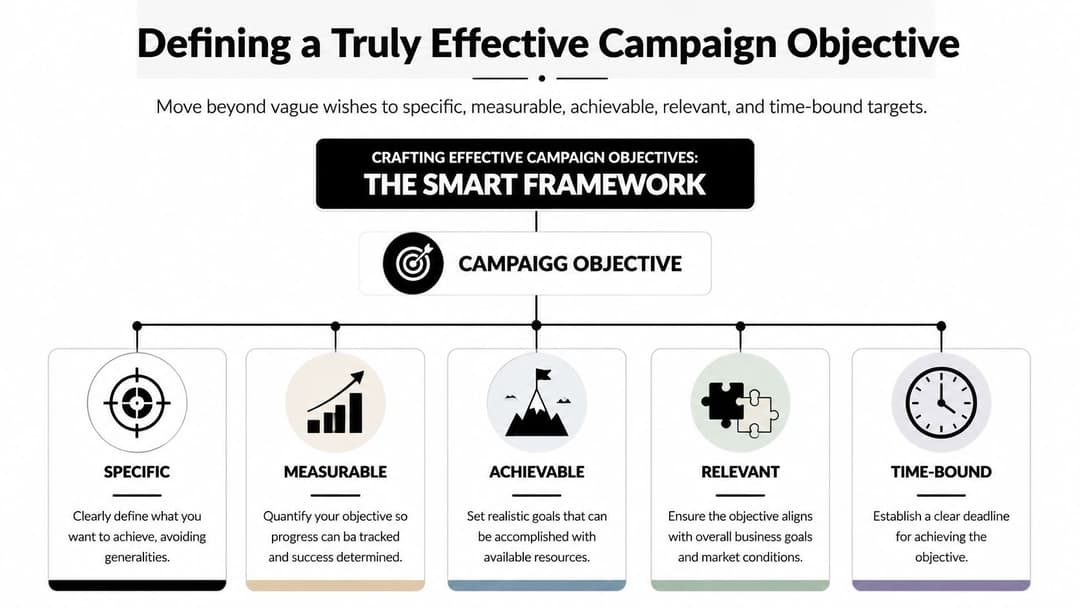
Turn a goal into an objective
"Increase sales" is a goal. It's directionally useful, but it won't guide campaign construction.
A usable objective sounds more like this: increase purchases from a defined audience segment, measured by a specific efficiency metric, within a fixed period. That version tells you what to optimize for, how to judge performance, and when to review it.
If your planning process is loose, use a structured worksheet before touching Ads Manager. This proven campaign planning template is useful because it forces the connection between offer, audience, channel, and measurement.
The five checks I use before launch
- Specific: Define the action. Purchase, lead, booked demo, add to cart, or qualified visit.
- Measurable: Tie the campaign to a KPI you can monitor in platform and in your source of truth.
- Achievable: Set a target grounded in account history, sales cycle, and funnel reality.
- Relevant: Make sure the campaign serves a real business priority, not a vanity metric.
- Time-bound: Put a review window on it so the team knows when to keep testing, scale, or stop.
Practical rule: If two people on your team could describe the campaign's success differently, the objective still isn't clear enough.
Why marketers skip this step and pay for it later
Teams often rush from business ambition to ad execution. They know revenue matters, but they don't define the intermediate outcome clearly enough. That creates confusion in reporting. One person looks at CTR. Another looks at landing page views. Someone else reports blended ROAS. No one agrees on what the campaign was supposed to do in the first place.
A clear objective fixes that. It also makes media planning easier across channels. If your paid social goals need to align with broader channel strategy, this guide to building a paid media strategy is a useful companion because it frames campaign objectives within a larger acquisition system.
The Three Core Objective Categories Explained
Most campaign objectives fall into three practical categories: Awareness, Consideration, and Conversion. They map to different stages of buyer intent, and they should not be judged by the same standard.
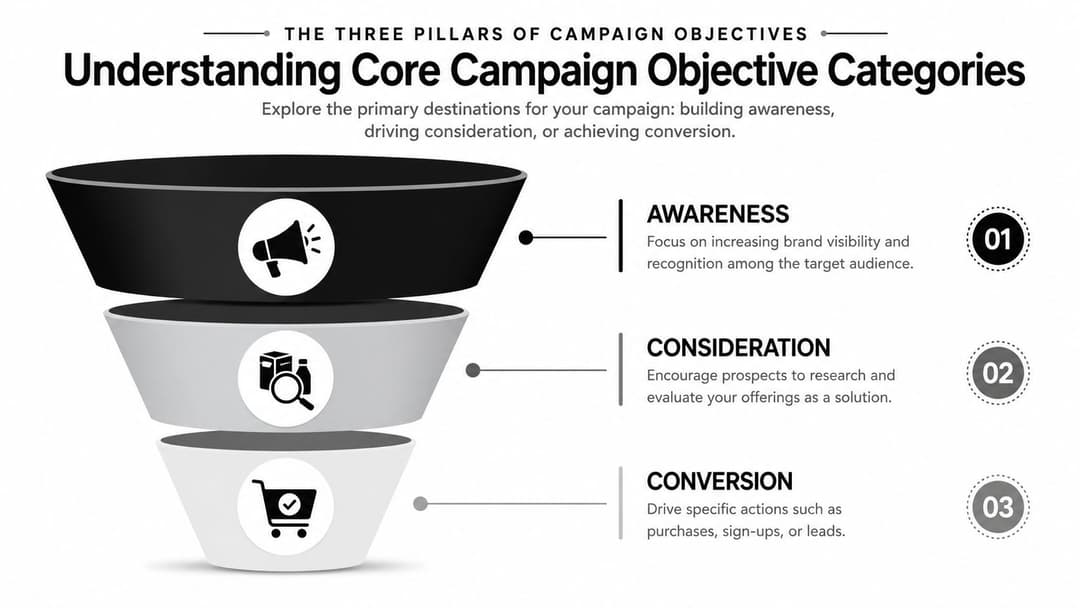
Awareness
Awareness is the right choice when the market doesn't know you yet, or when you're introducing a new product, offer, or category angle. The job here is exposure and recognition.
Before awareness work, a cold audience may scroll past your brand with no context. After a good awareness campaign, more of that audience recognizes the brand, remembers the core promise, and is more likely to respond when asked to take a deeper action later.
Many brands often get impatient at this stage. They expect awareness campaigns to produce direct response economics on day one. That's usually the wrong test. The objective of a campaign at this stage is to create qualified familiarity, not to force immediate purchase intent from people who haven't built trust yet.
Consideration
Consideration sits in the middle. The audience knows you exist, but they need a reason to care enough to evaluate. This stage commonly involves traffic, content consumption, product exploration, and lead capture.
Before a consideration campaign, a prospect may have seen your ad but not visited your site or explored your offer. After it works, that same prospect is reading product pages, comparing options, watching demos, or joining an email flow.
A lot of content strategy belongs here. If you're trying to understand how this middle stage connects to broader growth thinking, this article on understanding the AARRR growth framework is useful because it shows how acquisition and activation depend on the right intermediate steps, not just top-of-funnel reach or bottom-funnel sales.
Conversion
Conversion is where the campaign asks for a high-value action: purchase, qualified lead, trial signup, or another tracked business event. This is the most direct path to measurable financial outcome, but it only works well when the setup is strong enough to support it.
Before a conversion campaign, interested users may browse, click, or even add products to a cart without completing the action. After it works, the campaign turns existing intent into tracked outcomes.
The mistake isn't using conversion objectives. It's using them without enough signal quality, tracking integrity, or offer clarity to help the algorithm learn.
The key trade-off
These categories are connected, but they are not interchangeable. Awareness builds future demand. Consideration shapes and qualifies that demand. Conversion captures it.
When marketers confuse the stages, they usually overvalue cheap metrics and undervalue profitable behavior. The objective of a campaign should reflect the audience's temperature and the business problem you're trying to solve right now.
Mapping Objectives to Meta Ads and KPIs
Inside Meta Ads Manager, objective selection is where strategy becomes machine instruction. This is also where many campaigns drift off course, because teams choose one setting and judge it with the wrong KPI.
When Meta campaign objectives are set to Conversions, the platform's deep learning models identify users with a high probability of converting, which can lead to 20 to 30 percent lower CPA compared to traffic-optimized campaigns because the system filters out non-converting segments, according to this analysis of conversion-focused campaign objectives. That's the core reason objective selection affects efficiency so much. You're not only choosing a report view. You're choosing what the algorithm hunts for.
The practical mapping
| Objective Category | When to Use It | Meta Ads Objective | Primary KPIs |
|---|---|---|---|
| Awareness | New brand launch, new market entry, broad product introduction | Awareness | Reach, impressions, brand lift signals, frequency trends |
| Consideration | Content distribution, product education, list building, site exploration | Traffic, Engagement, App Promotion, Leads | Landing page views, cost per landing page view, engaged sessions, lead quality |
| Conversion | Purchases, booked calls, completed forms, trial starts, retargeting | Sales, Leads | CPA, ROAS, cost per qualified lead, conversion rate |
Match the KPI to the job
If you choose Sales in Meta, don't let the team celebrate low CPC as the main win. That's a supporting metric at best. The campaign should live or die on the conversion KPI tied to the business objective.
If you choose Traffic, don't complain that purchases are weak as if the platform ignored you. It didn't. You asked for visits, and it delivered visits.
For cleaner reporting, teams should align dashboard views with the objective selected in platform. This reference on Facebook ad performance metrics explained is useful because it helps separate diagnostic metrics from decision metrics.
A simple decision filter
Use this quick filter before launch:
- Choose Awareness when the audience needs familiarity before action.
- Choose Consideration when the audience needs education, comparison, or a softer conversion step.
- Choose Conversion when your tracking is reliable and the business needs direct outcomes.
If the KPI you care about isn't the KPI Meta is optimizing for, don't expect efficient delivery.
That one mismatch explains a large share of disappointing campaign performance.
Common Mistakes and Successful Campaign Examples
The most expensive campaign mistakes usually look reasonable at setup. That's why they survive so long.
A typical one is using a traffic objective for a product launch because the team wants site visits quickly. The campaign performs well on paper. Sessions rise. Cost per click stays low. Sales remain flat because the system found habitual clickers, not buyers.
Another common issue is conflicting goals across the funnel. Research cited in this discussion of campaign objective selection notes that 68 percent of marketers report campaign objectives clashing across funnel stages, leading to diluted ROAS. That friction is easy to spot in real accounts. Prospecting is judged on immediate sales. Retargeting gets overloaded with awareness messaging. Creative and budget rules start pulling in opposite directions.
A DTC shoe brand done the wrong way
Take a fictional shoe brand launching a new everyday sneaker.
The team starts with one broad campaign. They choose Traffic because they want people on the site. Their ads mention comfort, style, and free shipping. Everyone from cold audiences to cart abandoners gets pushed into roughly the same structure.
The result is predictable. The campaign attracts curious visitors and low-intent browsers. Product page views rise. Conversion efficiency stays weak because the account never separated discovery from purchase intent.
The same brand with aligned objectives
A better build looks different.
For launch week, the brand runs an Awareness campaign focused on introducing the sneaker and the brand angle. The creative does one job: make the product memorable.
Next, it uses a Consideration campaign to drive readers to a product story page and care-content around fit, materials, and daily wear. That gives interested users a reason to spend more time with the offer.
Then the brand deploys a Conversion campaign for retargeting. That campaign speaks to users who viewed products, engaged with content, or showed shopping behavior. The message shifts from introduction to action.
Here's the practical sequence:
- Top funnel: Broad message, low pressure, clear product narrative.
- Mid funnel: Education, comparison, objection handling.
- Bottom funnel: Strong offer framing, urgency, and direct conversion ask.
If you're training a team on how these flows look in practice, reviewing a few annotated campaign ad examples for Meta can speed up the learning curve.
What works and what doesn't
What works is objective separation. Each campaign gets one job, one core KPI, and creative built for that stage.
What doesn't work is trying to make one campaign handle awareness, education, and revenue capture at the same time. That usually creates messy reporting and weak optimization.
How to Implement and Measure Campaign Objectives
Picking the objective is only half the job. The rest is implementation quality.
Start with tracking integrity
If you're optimizing for leads or sales, Meta needs reliable event data. That means your pixel setup, event prioritization, and server-side tracking have to reflect the core business action you care about. For many teams, the first upgrade is implementing the Facebook Conversion API setup approach so web events are more resilient and campaign feedback loops are cleaner.
Without clean tracking, even the right objective can underperform because the system is learning from partial or delayed data.
Build a measurement routine that respects signal quality
Campaign measurement shouldn't stop at "did the number move?" The better question is whether the movement was strong enough to separate signal from noise.
A campaign is only statistically effective when results exceed the standard deviation by at least 1.7 times, helping show that the change came from the campaign rather than random fluctuation, according to Optimove's explanation of statistical significance in marketing. That standard matters because paid media data is noisy. Short windows, limited volume, and creative rotation can all create false confidence.
Don't call a campaign successful because one metric blipped upward. Look for evidence that the result stands above normal variation.
A practical review routine includes:
- Tracking check: Confirm the campaign is recording the intended action accurately.
- Objective check: Make sure the KPI under review matches the optimization event.
- Variation check: Compare results against normal account fluctuation before scaling.
- Decision check: Know in advance what triggers more spend, more testing, or a pause.
Where automation actually helps
Manual campaign management gets strained when you test many audiences, offers, and creatives at once. That's where automation becomes useful, not because it replaces strategy, but because it applies the strategy at scale.
One option is AdStellar AI, which connects to Meta Ads Manager, uses the selected campaign objective as a core input, and helps teams launch and test many creative and audience combinations against KPIs like ROAS, CPL, or CPA. That makes it easier to keep the objective fixed while the system explores execution variables.
For a quick look at how objective-driven automation fits into a modern Meta workflow, this walkthrough is worth watching.
Frequently Asked Questions About Campaign Objectives
Should I optimize for short-term ROAS or long-term brand growth
Treat that as a sequencing problem, not an either-or debate. Short-term ROAS matters when the business needs direct efficiency. Brand-building matters when the account needs stronger future demand and lower resistance from cold audiences. The mistake is trying to make one campaign do both jobs equally well.
A reported 2025 Gartner study found that 72 percent of growth teams struggle to quantify how awareness-focused objectives affect future conversion rates, and the same source notes Meta's updated algorithmic weighting can create attribution lag of 3 to 7 days, which makes static objective setting less reliable, as referenced in this article discussing awareness campaign goals. In practice, that means you should separate campaign roles and review them with enough time for delayed conversions to appear.
Can one Meta campaign handle awareness and conversion together
Usually, no. Not well.
A campaign can contain mixed creative angles, but once you ask Meta to optimize toward one primary action, that's the behavior it prioritizes. If you need reach and purchases, split the work into distinct campaigns or at least distinct structures with different expectations.
How long should I wait before judging performance
Long enough for the campaign to gather stable data and for delayed attribution to settle. The exact window depends on volume and sales cycle, but the operating principle is simple: don't make hard optimization calls from immature data.
What if my planned target and actual results are far apart
That usually means one of two things. The target was unrealistic, or execution didn't match the plan. When that happens, don't patch the dashboard narrative. Revisit the objective, the offer, the audience temperature, and whether the Meta setting matched the intended outcome.
What's the fastest way to improve the objective of a campaign
Write the objective in one sentence before launch. Include the audience, the action, the KPI, and the review window. If that sentence feels vague, the campaign isn't ready.
If your team is launching Meta campaigns with too many variables and not enough control, AdStellar AI can help turn campaign objectives into structured execution. It gives media buyers a way to build, test, and scale large numbers of creative and audience combinations around the KPI that matters, so objective setting doesn't stay static after launch.