You can be active on Meta, Google, LinkedIn, TikTok, and still have no reliable answer to a simple question: which spend is generating revenue?
That's the situation a lot of teams are in right now. Campaign dashboards look busy. Clicks come in. Leads show up in the CRM. But budget decisions still get made on fragments. One platform says the campaign worked. Sales says lead quality is weak. Finance asks for payback clarity. The problem usually isn't effort. It's that execution has outpaced strategy.
A strong paid media strategy fixes that. It turns channel activity into an operating system for growth, where targeting, creative, budget, and attribution all point to business outcomes instead of isolated ad metrics.
What Is a Paid Media Strategy
A paid media strategy is a documented plan for how a business will use advertising to reach specific audiences, drive a defined action, and measure business impact. It's not the same as running ads. It's the logic behind why you're running those ads, where you're running them, what success looks like, and what you'll change when performance shifts.

Without that plan, teams tend to default to reactive behavior. They boost posts that get attention, add budget to a channel that had a good week, or pause campaigns the moment cost rises. That isn't strategy. That's improvisation with paid spend.
Strategy versus tactics
A tactic is launching a retargeting campaign. A strategy is deciding how retargeting fits into the full customer journey, what audience should see it, what message they need at that stage, and how that campaign should be judged against revenue or pipeline.
A tactic is testing a new ad format. A strategy decides whether that test supports your broader mix, your margin structure, and your conversion path.
Practical rule: If you can't explain how a campaign connects to pipeline, revenue, or customer acquisition efficiency, you don't have a paid media strategy. You have platform activity.
What a good strategy does in practice
A usable strategy gives your team a few things immediately:
- Clear priorities: Everyone knows whether the goal is purchases, demos, qualified leads, or market coverage.
- Channel discipline: Budget goes to platforms because they fit the buying journey, not because someone on the team likes using them.
- Measurement rules: Success is defined before launch, not rewritten after results come in.
- Optimization boundaries: Teams know what to test, what to keep stable, and when to cut spend.
That's also why paid media teams increasingly need tighter links between execution and ad infrastructure. If you're evaluating how campaign systems shape speed and control, this guide to an ad tech platform is a useful companion read.
The Core Paid Media Strategy Framework
Most underperforming accounts don't fail because of one catastrophic mistake. They fail because the pieces don't connect. The audience is broad, the creative is generic, the KPI is weak, and attribution stops at the platform level.
A repeatable paid media strategy needs a loop, not a checklist.
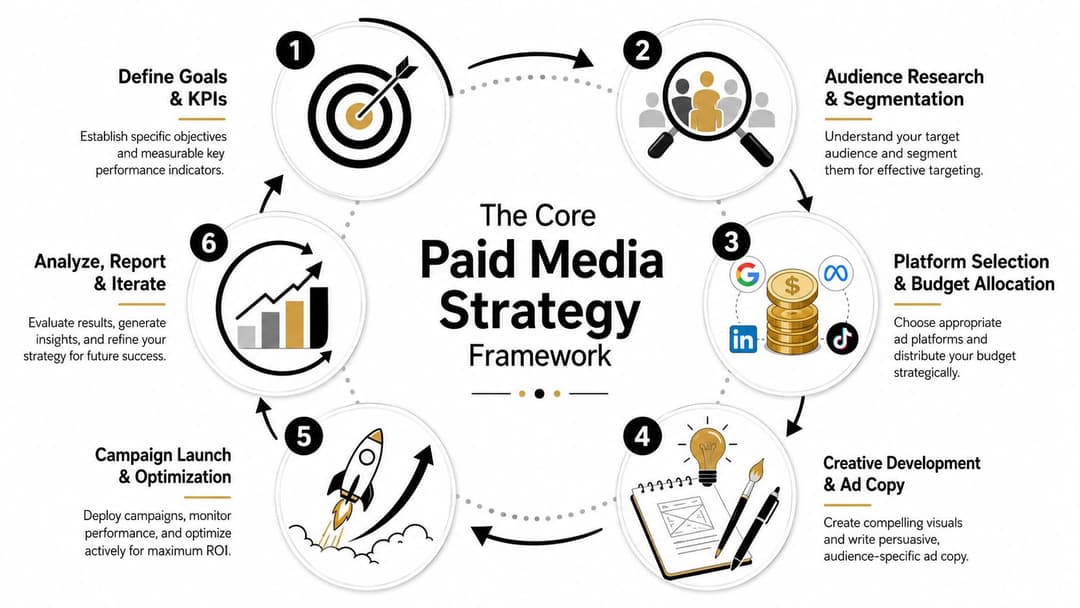
Step 1 Define goals and business constraints
Start with the business model, not the ad platform. An e-commerce brand can usually work backward from purchase value and margin. A B2B team has to account for sales cycle, qualification, and payback. A local service business has to care about booked jobs, not cheap leads.
This step sounds obvious, but teams skip it constantly. They launch with vague goals like “scale traffic” or “increase awareness” and then act surprised when the account produces low-intent results.
Set goals that can survive contact with finance and sales. That usually means metrics tied to revenue efficiency, pipeline quality, or customer acquisition cost, not just front-end engagement.
Step 2 Build audience segments from buying signals
Audience work is where most paid media strategy either gets sharp or stays expensive.
Don't build one audience called “prospects” and call it done. Split by intent and buying stage. Existing customers need different creative than returning site visitors. Product-aware users need a different message than problem-aware users. B2B buyers on LinkedIn often need role-based qualification. Meta audiences often need exclusion logic to remove users who consistently click but don't convert.
Here's the mistake I see often: teams widen targeting before they've tightened qualification. That creates volume, but it also invites noise.
A useful audience map usually includes:
- High-intent groups: Retargeting pools, cart viewers, pricing-page visitors, demo-page traffic.
- Problem-aware groups: Interest or behavior-based audiences aligned to the pain point.
- Qualified lookalikes or seed expansions: Built from actual customers, not just leads.
- Exclusions: Existing customers, low-fit users, poor lead sources, irrelevant regions, and low-quality engagement segments.
Step 3 Choose channels based on buying behavior
Good channel mix isn't about being everywhere. It's about matching platform behavior to the action you want.
Search works when users know what they need. Paid social works when you need to create demand, shape consideration, or retarget at scale. LinkedIn can fit when job title and company context matter more than cheap traffic. Product-led commerce brands should also pay attention to social checkout behavior. In a 2026 projection from HubSpot, 26% of marketers plan to explore selling directly on social platforms, which matters because channel choice is shifting from “drive the click to site” toward in-platform conversion paths in some categories (HubSpot marketing statistics).
If you're working through that shift on social commerce, this breakdown of TikTok Shop paid ad strategy is worth reviewing.
A channel is only “cheap” if it produces efficient customers. Low CPC with poor qualification is just affordable waste.
Step 4 Create messaging by audience, not by brand preference
Most creative fatigue starts earlier than people think. It starts when every audience gets the same promise.
Creative has a job beyond getting attention. It should pre-qualify. That means the ad should help the right person self-identify and help the wrong person move on. If your offer is premium, say so. If your product is for teams of a certain size, show that. If your service only works in specific use cases, make that visible.
That's where social advertisers can borrow from paid search thinking. Search marketers use negative keywords to block irrelevant intent. Paid social teams should use equivalent filtering logic through exclusions, offer framing, and creative that narrows who responds.
Step 5 Define measurement before launch
At this point, strategy becomes operational. Every campaign needs a measurement plan before budget goes live.
At minimum, set up:
- Primary KPI: The one metric that decides whether the campaign is commercially viable.
- Secondary diagnostic metrics: The numbers that explain why performance is moving.
- Attribution path: How traffic source, campaign, and downstream revenue will be connected.
- Decision windows: When you'll evaluate, what level of data is enough, and what counts as a meaningful pattern.
If this step is weak, you'll end up optimizing Meta for Meta metrics, Google for Google metrics, and never see how channels work together to create pipeline.
Step 6 Run an optimization loop
Optimization isn't random change. It's structured learning.
Use a loop like this:
- Hold one variable steady: Don't rewrite the whole campaign every time CPA rises.
- Test one meaningful difference: Offer, angle, audience, landing page, or format.
- Read outcomes at the business level: A lower CPL that creates weak sales conversations is not a win.
- Feed findings back into the next build: Winning messages should influence new ad sets, landing pages, and exclusions.
The strongest teams treat paid media like product development. Every campaign is a version. Every result is feedback. Every budget increase has to be earned.
How to Set and Measure Paid Media KPIs
Most KPI problems start with picking metrics that are easy to see instead of metrics that are useful to run the business.
A healthy paid media strategy uses different primary KPIs for different models. E-commerce can usually anchor on purchase efficiency. B2B often needs to move further down the funnel and judge channels on pipeline and payback. Home services usually need a clean line from inquiry to booked work.
Use KPIs that match your economics
A broad rule matters here. A sustainable benchmark requires ROAS of at least 3:1, and a 1% increase in conversion rate can reduce CAC by 10–28%, which is why landing page and audience quality often matter more than increasing bids (paid ads benchmarks for 2026 by industry).
That changes how you should read performance. If ROAS is weak, the fix isn't automatically “spend less” or “raise targeting.” Sometimes the biggest gain comes from improving message match, offer clarity, or landing page friction.
For teams refining that part of the funnel, this roundup of top CRO tools can help identify testing and conversion workflow options.
A practical KPI table
Use a table like this to align metrics to business goal rather than platform habit.
| Metric | E-commerce Benchmark | B2B Lead Gen Benchmark | Home Services Benchmark |
|---|---|---|---|
| ROAS | At least 3:1 | Use revenue efficiency carefully, often secondary to payback and pipeline quality | 4:1+ can be achieved in high-performing sectors |
| CVR impact | A 1% increase in CVR can reduce CAC by 10–28% | Same principle applies when lead-to-opportunity friction is reduced | Same principle applies when booking flow improves |
| CAC Payback Period | Useful but often not primary | Sustainable channel is six months or less | Useful when repeat value matters |
| LTV:CAC | Important where repeat purchase exists | 3:1 to 5:1 benchmark | Useful if service contracts or repeat jobs exist |
Don't stop at channel metrics
CTR, CPC, and CPL are useful. They are not enough.
A paid social lead campaign can look efficient in-platform and still fail the business if those leads don't create qualified meetings or revenue. The same goes for branded search campaigns that harvest demand created elsewhere and then claim the conversion credit.
The question isn't “Which channel converted?” It's “Which combination of touches created a customer we'd want again?”
That's why attribution has to move beyond siloed reporting. Every paid campaign should carry UTM tracking, and the CRM should capture source, pipeline value, and outcome. If you're working on that layer, this guide to measuring true ad attribution is a practical next step.
A working KPI template
Use three levels:
- Primary business KPI: ROAS, CAC payback, or pipeline revenue.
- Mid-funnel quality KPI: Qualified demo rate, sales acceptance, purchase conversion rate.
- Platform diagnostics: CTR, CPC, CPM, frequency, landing page engagement.
That stack keeps you from celebrating cheap clicks that don't become profitable customers.
Paid Media Strategy Examples for E-commerce and B2B
The framework stays the same. The way you apply it changes fast once the business model changes.
E-commerce brand launching a new product line
A DTC brand introducing a new product line usually needs two things at once: demand creation and efficient conversion. That means the account can't rely only on retargeting, and it can't judge success only by top-line purchase volume.
The team starts with a purchase goal tied to margin. Audiences are split into existing customer groups, site visitors, and prospecting segments built from customer data and product interest. Creative isn't one generic brand reel. It's a set of angles. One ad focuses on the product problem it solves, another on use case, another on objections, and another on social proof or product detail.
Channel mix typically includes Meta for discovery and retargeting, with shopping or search placements handling higher-intent demand capture. Landing pages need to match the ad angle closely. If the ad leads with a specific use case, the page should open with that same use case instead of resetting to broad brand copy.
For teams focused on this model, these examples of Facebook ads for e-commerce are useful because they show how offer structure and creative framing affect downstream purchase quality.
B2B SaaS company driving demos
B2B SaaS needs more restraint. A cheap lead isn't helpful if sales can't close it. The first filter is channel viability. According to Brighter Click, a sustainable paid media channel for B2B SaaS is defined by a CAC Payback Period of six months or less, and if it goes beyond that, the channel needs a strategic review (SaaS paid media strategy).
That changes campaign design immediately.
The team should start with qualification in the ad and on the page. Job role, company fit, problem context, and expected use case all matter. LinkedIn might make sense for precise role targeting. Search might capture active demand for category and competitor terms. Meta can still help, but usually as part of a broader mix where awareness and retargeting support later-stage conversion.
A common mistake is optimizing to booked demos alone. Better practice is to separate raw demo volume from sales-qualified pipeline. If a campaign drives form fills from low-fit companies, it can look productive while damaging sales efficiency.
In B2B, volume is easy to buy. Qualified pipeline is harder. Judge the channel by what survives sales review.
Same framework, different emphasis
Both examples use the same six-step logic. The difference is where pressure sits.
- E-commerce: Creative-message match and on-site conversion matter most.
- B2B SaaS: Qualification, attribution, and payback discipline matter most.
- Both: Channel-level reporting has to connect to actual business outcomes or the team will optimize the wrong thing.
Troubleshooting Your Paid Media Performance
When performance drops, teams often change too much at once. They edit bids, refresh creatives, widen targeting, and swap landing pages in the same week. Then they can't tell what fixed the problem.
A better approach is to diagnose by symptom.
If CPA is too high
High CPA usually comes from one of four issues: weak audience fit, poor message match, low conversion rate after the click, or traffic that never should have entered the funnel.
Start by checking where the inefficiency begins.
- If CTR is weak: Your audience-message pairing is probably off.
- If CTR is fine but conversion rate is weak: The landing page or offer likely breaks the promise of the ad.
- If leads convert poorly downstream: You're attracting the wrong users.
Qualification filtering matters. In search, negative keyword strategy can reduce wasteful spend by 15–20% according to PR Newswire's 2025 guidance on paid media strategy (paid media strategy trends and benchmarks). On paid social, apply the same logic differently. Exclude existing customers. Exclude low-fit geographies. Build creative that names who the offer is for and who it isn't for. Use forms and landing pages to screen out weak intent before sales sees it.
If ROAS is below target
Low ROAS doesn't always mean the channel is bad. It may mean you're scaling before the account has earned scale.
Try this sequence:
- Freeze expansion: Don't add new audiences while baseline units are underperforming.
- Review offer clarity: Discount, bundle, free trial, consultation framing, and urgency all affect response.
- Audit post-click flow: Checkout friction or unclear pages can erase strong ad performance.
- Run structured tests: Continuous A/B testing can improve ROAS by 30–50% in optimized campaigns, but only if the tests are deliberate and measurable within your account structure, as noted in the same PR Newswire resource.
If your Meta account keeps drifting after short bursts of success, this guide on why Meta ads stop working covers the common failure patterns.
If you're getting junk leads
This is usually a qualification issue, not a volume issue.
Tighten the system in three places:
- In the ad: State the use case, buyer type, or pricing position more clearly.
- In the audience: Exclude low-fit segments and poor historical sources.
- In the conversion path: Add friction where it improves quality, such as better form questions or stronger page copy.
A lot of teams fear adding friction because they think lower volume is failure. It isn't. Lower volume with better sales outcomes is usually the healthier account.
How AdStellar AI Amplifies Your Paid Media Strategy
Manual campaign management breaks down when the number of variables gets too high. Once you're testing multiple audiences, several offers, and a large creative set, execution speed becomes a real constraint. Good strategy can still lose if the team can't launch enough tests or read the results quickly enough.
That's where tooling matters. Platforms like Meta Ads Manager, analytics stacks, creative testing workflows, and automation layers all have a role. One option in that workflow is AdStellar AI, which is built to generate bulk Meta ad variations, rank creative and audience performance against goals like ROAS, CPL, or CPA, and help teams launch new combinations from existing winners. Its AI media buyer page shows how that workflow is structured.
Where automation helps most
The strongest use case for automation is not “replace strategy.” It's accelerate the parts that humans do too slowly.
- Creative testing: Faster production of multiple angles, formats, and messages.
- Audience combinations: Easier setup for segmented testing instead of broad, blended ad sets.
- Performance review: Quicker identification of winning creatives and weak pairings.
- Iteration: Faster rebuilds based on actual account data instead of guesswork.
Automation is useful when it increases the number of valid tests you can run without lowering measurement discipline.
If your team already knows what good looks like, speed compounds that advantage.
Paid Media Strategy FAQs
How much should I budget for paid media
Start from target economics, not a fixed percentage. Work backward from your acceptable CAC, payback expectations, or ROAS target. A budget only makes sense once you know what a sustainable acquired customer is worth.
How long does it take to see results
You'll usually see early signal before you see stable truth. The first phase is data gathering. The second is optimization. Don't confuse initial activity with validated performance, and don't scale from a tiny sample just because a dashboard looks promising.
Should I start with one channel or several
Start with one primary channel and one supporting channel if you can measure both clearly. A common pitfall is spreading budget too thin when launching everywhere at once. Win one repeatable motion first, then expand the mix.
If your team needs to launch more tests, connect Meta execution to real business goals, and scale winning combinations without adding manual campaign overhead, AdStellar AI is built for that workflow.