You're probably living this already. One tab has Meta Ads Manager open. Another has a spreadsheet for naming conventions. A third holds creative files. A fourth shows analytics that don't quite match platform reporting. A fifth is where someone dropped audience notes in Slack or Notion and now nobody remembers which version is current.
That's the daily reality behind a lot of paid media work. The campaigns may be live, but the system around them is messy.
An ad tech platform is supposed to reduce that mess. At its simplest, it's the set of software and infrastructure that helps advertisers buy, deliver, track, and optimize ads. But that definition is too abstract to be useful. For a performance marketer, the better question is this: does your stack help you launch faster, learn faster, and move budget toward what's working before the opportunity passes?
If the answer is no, the issue often isn't one bad tool. It's the handoff problem between many tools.
The Hidden Costs of a Disconnected Ad Strategy
A fragmented setup rarely fails in a dramatic way. It leaks value in small, repeated moments.
You build audiences in one system, traffic creative approvals in another, buy media in a third, and check attribution in a fourth. Nothing looks broken on its own. But each handoff adds delay, and delay matters when you're trying to improve ROAS.
Where teams lose time
A junior buyer usually notices fragmentation first during launch. The ad copy is ready, but the audience list hasn't synced. The tracking team is waiting on event validation. Reporting comes from a separate dashboard, so nobody wants to scale budget until the numbers reconcile.
That friction adds up. A 2024 McKinsey analysis found that fragmented stacks increase campaign setup time by 30 to 40% and reduce media budget efficiency by up to 12% because of mismatched data graphs and delayed insights, as noted in the verified analysis above.
Practical rule: If your team has to manually re-enter the same campaign logic into multiple systems, your stack is already taxing performance.
The hidden cost isn't just labor. It's missed timing. If a creative angle starts working on Tuesday but the reporting lag keeps you from reacting until Thursday, the platform didn't just slow you down. It changed the result.
What consolidation actually solves
People sometimes hear “consolidation” and think “buy one giant platform for everything.” That's not the point. The primary goal is to create a central operating layer where data, creative decisions, and campaign changes move together.
A strong ad tech platform helps with three operational jobs:
- Coordination: It keeps campaign setup, asset management, audience logic, and reporting connected.
- Speed: It shortens the gap between launch, feedback, and optimization.
- Clarity: It gives the team one trusted view of what happened and why.
Think of it as the nervous system for paid media. Your channels still do different jobs. Your creative tools still matter. Your analytics stack still matters. But when the systems can't talk to each other, your team ends up doing the translation by hand.
That's expensive, even before you factor in ad spend.
The Core Components of the Ad Tech Ecosystem
A lot of ad tech confusion comes from the labels, not the jobs.
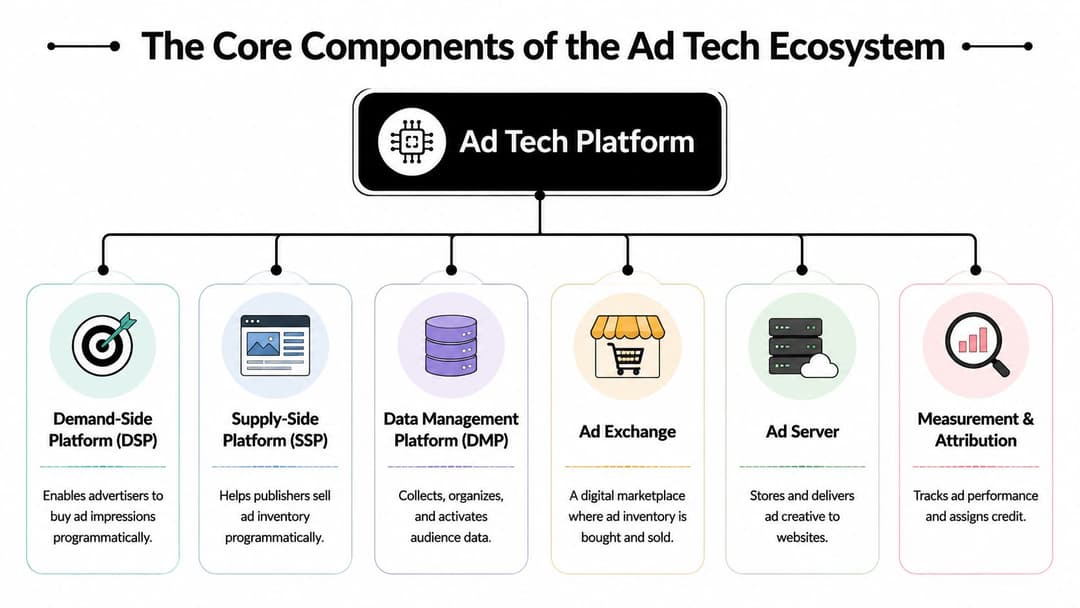
If you strip away the acronyms, the ecosystem is a coordination system for four practical tasks. Buying media. Selling inventory. Applying audience data. Tracking delivery and results. Once those roles are clear, it becomes easier to see where fragmented tools slow teams down and where consolidation improves speed.
A good mental model is a stock market with logistics attached. Buyers place bids. Sellers offer inventory. A marketplace clears the transaction. Data helps price the opportunity. A delivery system makes sure the right creative shows up and gets recorded correctly.
The buy side and sell side
DSPs, or Demand-Side Platforms, are the tools advertisers use to buy ad inventory programmatically. For a marketer, the DSP works like a trading desk. Instead of logging into dozens of publisher systems one by one, you use one platform to evaluate opportunities, set bidding rules, apply audience targeting, and manage spend across exchanges.
That matters for more than convenience. A DSP affects campaign velocity. If your bidding logic, audience inputs, and reporting are scattered across separate tools, each optimization takes longer to ship. If those pieces sit closer together, your team can adjust faster and protect ROAS when performance shifts.
SSPs, or Supply-Side Platforms, serve the publisher side. A publisher uses an SSP to package available inventory, set pricing controls, and send those impressions into auctions so buyers can compete for them.
Ad exchanges sit between the two. They run the marketplace itself by passing bid requests between SSPs and DSPs and determining which ad wins the auction.
Here is the cleanest way to separate those roles:
| Component | Who uses it | Main job |
|---|---|---|
| DSP | Advertisers and agencies | Buys impressions |
| SSP | Publishers | Sells impressions |
| Ad exchange | Both sides indirectly | Runs the marketplace |
For marketers who work across social and programmatic media, the interfaces differ but the operating logic often stays similar. Audience selection, bid control, creative delivery, and measurement still need to stay connected. If you want a channel-specific example, this overview of a Meta advertising technology stack shows how those same operational ideas appear inside social buying environments.
The data and delivery layer
DMPs and CDPs create a lot of confusion because both deal with audiences, but they solve different problems.
A DMP, or Data Management Platform, is built for advertising use. It organizes audience segments, often from cookies or other campaign-oriented signals, so those segments can be activated in buying platforms.
A CDP, or Customer Data Platform, is built around first-party customer records. It pulls together data from site behavior, CRM activity, purchases, email engagement, and other touchpoints to create a more persistent customer view.
The simplest way to remember the difference is this. A DMP helps you group audiences for media buying. A CDP helps you unify customer knowledge so media decisions can use better inputs.
In practice, many teams care less about the acronym and more about the handoff. Where does audience intelligence live? How quickly can it reach the buying platform? If that handoff requires exports, manual mapping, or delayed syncing, your stack is not just messy. It is slowing down optimizations that should happen within the same working session.
Ad servers handle another job entirely. They store creative assets, deliver the ad into the placement, and record what happened after delivery. That includes impression logging, click tracking, and in many setups, conversion measurement.
The ad server often becomes the operational ledger for paid media. If the DSP is where you make buying decisions, the ad server is where you verify what was delivered.
That distinction matters. Teams often blame channel performance when the actual issue is measurement drift between buying, delivery, and attribution systems. A connected stack reduces that drift. A disconnected stack creates version-control problems for media, audiences, and reporting, which slows decision-making and makes ROAS harder to improve with confidence.
When these components work together, the ecosystem feels less like a pile of acronyms and more like an operating system for paid growth.
How It All Works The Journey of an Ad Impression
Your team launches a campaign in the morning. By lunch, spend is pacing, impressions are coming in, and someone asks the practical question that trips up a lot of marketers: what happened between a person opening a page and our ad showing up there?
Following one impression end to end clears up a lot of ad tech confusion. It also shows where fragmented systems create hidden drag. Every handoff between buying, delivery, data, and measurement affects how fast you can adjust bids, swap creative, and protect ROAS.
Step by step through the auction
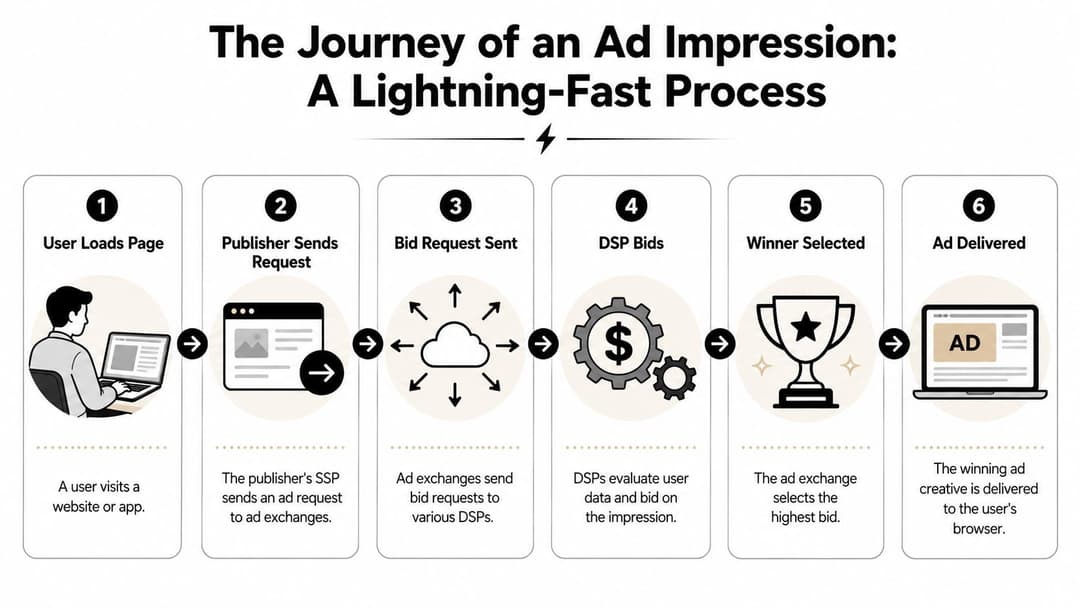
Start on the publisher side. A user opens a webpage or app, and the publisher sees an open ad slot that needs to be filled. That opportunity gets passed into the sell-side system, which packages the available impression and sends it to an ad exchange.
The exchange works like a stock market for attention. It broadcasts a bid request to eligible DSPs, and that request includes the details buyers need to judge the opportunity, such as ad size, page context, device type, location signals, and sometimes audience information.
The DSP then makes a very fast decision.
It checks whether that impression matches the advertiser's goals, budget rules, and conversion model. If the opportunity looks promising, the DSP submits a bid and points to the creative it wants to show. If not, it skips the auction and waits for the next impression. This all happens while the page is still loading, which is why programmatic buying depends on automation rather than manual media review.
What decides the winner
The winner is not only the advertiser willing to spend the most in every case. Publishers and exchanges also apply rules about deal priority, ad quality, brand safety, technical compatibility, and floor prices. From the advertiser side, though, the core question is simple: is this impression likely to produce value at a cost that still supports our target economics?
A DSP is usually weighing a few variables at once:
- User fit: Does this person resemble past converters or high-value customers?
- Context fit: Does the page or app environment support the campaign goal?
- Price fit: Can we win at a cost that still leaves room for efficient CPA or ROAS?
- Creative fit: Which version of the ad is best for this format, audience, and moment?
That last point gets underestimated. Winning the auction is only half the job. The creative also has to render correctly, load fast, and match the placement. If you want a practical view of what users see after the bid clears, this guide to digital ad display formats and delivery is a useful companion.
Where measurement enters the loop
Once the exchange selects a winner, the ad is served into the placement and measurement begins. The ad server records the impression. If the user clicks, that gets logged too. If the user later purchases, signs up, or completes another tracked action, attribution systems try to connect that conversion back to the impression or click.
Stack design starts to affect performance in a very operational way. A connected setup passes those events back into bidding and reporting systems quickly. A fragmented setup often adds delays through pixels, exports, mismatched IDs, or manual reconciliation between platforms.
Those delays are expensive.
If conversion data reaches the DSP late, the platform keeps bidding based on stale assumptions. Budget can continue flowing to weak placements, weak audiences, or weak creative combinations long after the market has shifted. If feedback arrives quickly and in a format the buying system can use, optimization happens while the signal still matters.
That is the journey of an ad impression. It is not just an auction. It is a chain of decisions and data handoffs, and every extra layer in that chain can slow campaign velocity, reduce efficiency, and make ROAS harder to improve.
Unlocking Performance Why Ad Tech Matters for Growth
Many marketers don't need to become ad tech specialists. They do need to understand enough of the machinery to make better operating decisions.
That matters because performance isn't just about targeting or creative quality. It's also about how quickly your system can turn raw signals into action.
Better control at larger scale
Manual campaign management works until volume rises. One campaign becomes ten. One audience test becomes dozens of combinations across placements, creatives, and goals. At that point, human judgment is still important, but human execution becomes the bottleneck.
An ad tech platform helps teams scale without losing control by centralizing setup, delivery rules, reporting, and optimization logic. You can manage frequency, creative rotation, audience exclusions, and channel coordination from a more structured system instead of rebuilding those choices in every interface.
That's one reason paid teams lean into automation. Not because strategy stops mattering, but because repetitive execution shouldn't consume the time needed for strategy.
Smarter optimization, less wasted spend
The biggest growth advantage in ad tech is not “more data.” It's usable feedback.
When audience signals, delivery data, and conversion outcomes stay connected, the team can make sharper calls on where to push spend and where to pull back. That improves ROAS in a practical way. It reduces the amount of budget spent learning the same lesson twice.
For teams using machine learning and decision support inside paid media workflows, this broader shift is similar to what's happening in AI for performance marketing. The useful part isn't the automation itself. It's the compression of the launch-test-learn cycle.
The strongest growth teams don't just buy impressions efficiently. They learn faster than competitors buying the same inventory.
That's why understanding the stack matters. If your campaigns underperform, the issue may not be the offer or the copy alone. The issue may be that your stack is too slow, too fragmented, or too opaque to surface what's happening.
Ad Tech Platforms in Action Real World Use Cases
Theory gets easier when you watch the stack solve a real campaign problem.
Use case one e-commerce retargeting
An e-commerce brand wants to re-engage shoppers who added products to cart but didn't check out.
The audience signal starts in the customer data layer. The team identifies cart abandoners and sends that audience to the buying platform. The DSP then bids more aggressively when those users appear across available inventory because the predicted conversion value is higher than for a cold prospect.
The creative decision matters too. Instead of running one generic ad, the brand can serve product-aware creative or category-aware messaging. The ad server delivers the selected creative and records which version was shown, clicked, and later converted.
In that setup, each part of the ad tech platform does a distinct job:
- Audience layer: Identifies the user group worth pursuing
- DSP: Decides when and how much to bid
- Ad server: Delivers the creative and tracks outcomes
- Measurement layer: Tells the team which audience-creative combinations deserve more budget
That's the ideal version. In a fragmented setup, those same steps often sit in separate tools with manual exports between them. The campaign still runs, but the team reacts slower and trusts the data less.
Use case two Meta workflow execution
Meta has its own ad delivery system, so the mechanics aren't identical to open-web programmatic. But the operational pain points are familiar. Creative volume increases. Naming conventions drift. Testing becomes inconsistent. Reporting fragments across ad level, audience level, and message angle.
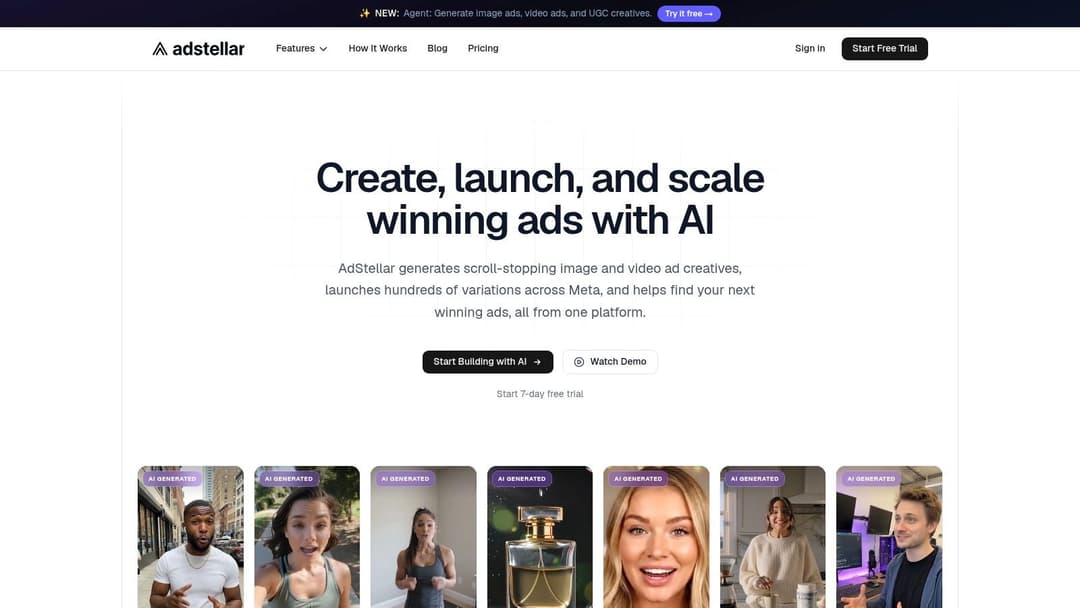
A specialized execution layer offers valuable support. One example is AdStellar AI, which connects to Meta Ads Manager, automates bulk ad creation, centralizes workflows for campaigns, creatives, audiences, and performance breakdowns, and uses historical results to rank combinations against goals like ROAS, CPL, or CPA.
That matters most for teams running high-variation testing. Instead of manually building every ad set and creative permutation, the system reduces setup work and keeps learning tied to execution.
Here's the practical difference between the two workflows:
| Workflow | Fragmented process | Connected process |
|---|---|---|
| Creative testing | Built manually across many screens | Built from a central workflow |
| Performance review | Spread across platform reports and spreadsheets | Grouped into one operating view |
| Iteration speed | Slower because setup and analysis are separate | Faster because results feed the next launch cycle |
The lesson across both examples is the same. An ad tech platform isn't valuable because it sounds advanced. It's valuable when it shortens the path from signal to action.
How to Choose the Right Ad Tech Platform
Vendors love feature grids. Buyers need operating criteria.
The right ad tech platform is the one that removes the bottleneck hurting your team most right now. For one team, that's launch speed. For another, it's reporting trust. For another, it's audience activation across disconnected systems.
Start with the business problem
Before you compare vendors, write down the specific friction you're trying to remove.
A simple shortlist might look like this:
- Launch bottleneck: Campaign builds take too long and require too many manual steps.
- Data mismatch: Platform reports and analytics disagree often enough to slow decisions.
- Testing paralysis: The team can't efficiently produce and evaluate enough variants.
- Workflow sprawl: Creative, buying, and reporting live in separate places with weak handoffs.
If a vendor can't clearly show how it addresses your main bottleneck, the rest of the demo doesn't matter much.
Use a practical evaluation checklist
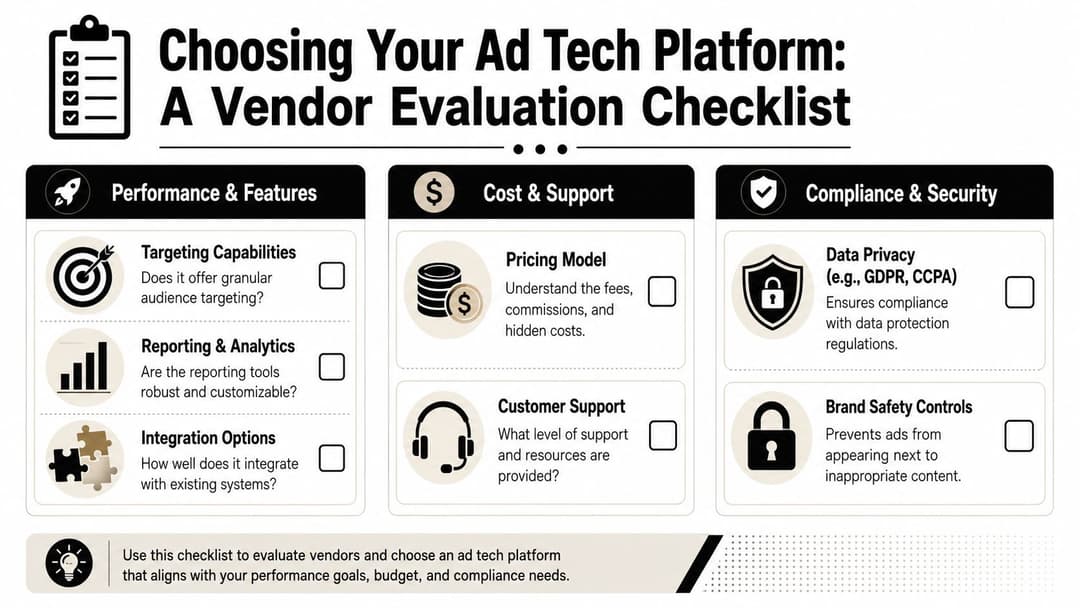
When you evaluate options, focus on operational fit more than glossy claims.
Performance and feature fit
- Integration depth: Does it connect cleanly with your existing media, analytics, and creative systems?
- Targeting usability: Can the team activate the audience logic it cares about?
- Reporting clarity: Can buyers and stakeholders see performance at the level needed for decisions?
- Workflow support: Does the platform reduce manual setup or just move it around?
A side-by-side review of categories in an AI ad platform comparison can help frame what to look for beyond marketing language.
Cost and implementation reality
- Pricing model: Understand platform fees, service costs, and whether value scales with usage.
- Support model: Ask who handles onboarding, troubleshooting, and migration help.
- Time to usefulness: A platform that promises everything but takes months to operationalize may extend the problem you're trying to solve.
Ask vendors to walk through a real campaign workflow, not just a dashboard tour. You want to see where work disappears.
Explainability and trust
This one is getting more important, not less. A 2025 Gartner survey of 500 marketing leaders found that 68% distrust AI-driven insights because platforms don't provide explainability reports, according to the verified data provided in the brief.
That should change your evaluation process. If a platform says its AI found the winning audience or creative, ask what evidence it surfaces. Can the team see whether the result came from message angle, audience composition, placement bias, or simple spend concentration?
Black-box recommendations are hard to defend to stakeholders. They're also hard to learn from.
Measuring Success KPIs for Your Ad Tech Stack
A stack is only useful if it changes business outcomes or operating speed. That means your KPI set should mix media efficiency metrics with workflow metrics.
The KPIs that matter most
Track the outcome metrics your team already uses to judge paid media performance:
- ROAS: Are you generating stronger return from the spend already in market?
- CPA: Are acquisition costs becoming more efficient as the system learns?
- CPL or other objective-specific metrics: For lead gen teams, this may matter more than purchase efficiency alone.
- Customer lifetime value context: A platform that finds slightly more expensive customers may still be better if those customers are more valuable later.
Then add stack-level operational measures:
- Time to launch: How long does it take from approved brief to live campaign?
- Time to insight: How quickly can the team identify a winner or loser?
- Iteration rate: How often can you ship meaningful tests without burning the team out?
- Reporting trust: Can finance, media, and growth teams work from the same numbers?
If your attribution view is muddy, this guide to measuring true ad attribution is a useful companion for tightening how you judge platform impact.
The strongest signal that your ad tech platform is working isn't just cleaner reporting. It's that your team launches faster, learns faster, and makes fewer expensive guesses.
If your team runs Meta campaigns and the bottleneck is campaign production, fragmented testing, or slow learning loops, AdStellar AI is one option to evaluate. It connects to Meta Ads Manager, automates bulk campaign building, and organizes creative, audience, and performance workflows in one place so buyers can spend less time on manual setup and more time improving ROAS.