You can have a Meta ad that looks polished, reads clean, and still burns budget. The creative gets approval, the offer looks sensible, the audience targeting feels tight, and the first week even gives you enough clicks to stay hopeful. Then the dashboard settles in, ROAS is soft, CPL is climbing, and the uncomfortable truth shows up, one or more elements of an ad are working against each other instead of compounding.
That's the part many teams miss. Ads don't fail because one pixel is ugly or one headline is slightly off. They fail when the message, offer, audience signal, placement, and landing page don't point in the same direction. Even the old marketing mix helps explain this, because advertising sits inside the four Ps, with Promotion most directly tied to how you reach and persuade people, while Product, Price, and Place shape the frame around the ad itself (Advertising overview).
A useful way to think about this is through the lens of performance, not aesthetics. The strongest campaigns don't just earn attention, they move people through the funnel and show it in impressions, click-through rate, conversion rate, and return on ad spend. If you've ever launched something that looked great in review meetings but fell apart in live delivery, this is the resource that usually helps, especially if you're also comparing account structure against practical references like Amazon ad insights from OBG.
Why Ads Look Good But Fail to Perform
The most frustrating campaigns are the ones that pass every visual check and still underdeliver. The image looks premium, the copy sounds strategic, the offer isn't obviously broken, and the account team can point to every element with confidence. Then the spend runs, the clicks arrive, and the numbers don't justify the creative approval meeting that came before it.
The problem is usually alignment, not polish
A strong ad can still fail if the promise in the headline doesn't match the offer, if the CTA asks for too much too soon, or if the audience sees a message that doesn't fit their stage of awareness. That's why treating the ad as one creative asset is a mistake. It's really a chain, and the weakest link decides whether the rest of the work matters.
Practical rule: If the ad wins attention but loses intent, fix the offer or the page before you touch the visual again.
Performance marketers get stuck because they chase the visible part of the problem. They swap thumbnails, rewrite one line of copy, and leave the surrounding structure untouched. In practice, the underperformance often comes from a mismatch between what the ad implies and what the user experiences after the click.
A better way to read bad results
Start by asking what the ad was trying to do, then map each element to the metric it should influence. Attention belongs to the hook and visual, click quality belongs to the offer and CTA, and conversion quality belongs to landing page alignment and measurement. If one element is pulling the wrong way, the entire campaign can look weaker than it really is.
That mindset matters even more in Meta accounts where creative iteration is fast and temptation is high. If you want a direct performance lens on copy decisions, the guide at Ad copy best practices is a useful companion because it keeps the focus on outcomes rather than style.
The Five Essential Elements of an Ad
Advertising has always been framed through the four Ps, but modern performance work needs a more operational view. The ad is not just the promotion layer, it's a coordinated set of choices that connect business intent to campaign delivery. The moment one part stops matching the others, the numbers usually tell on you.
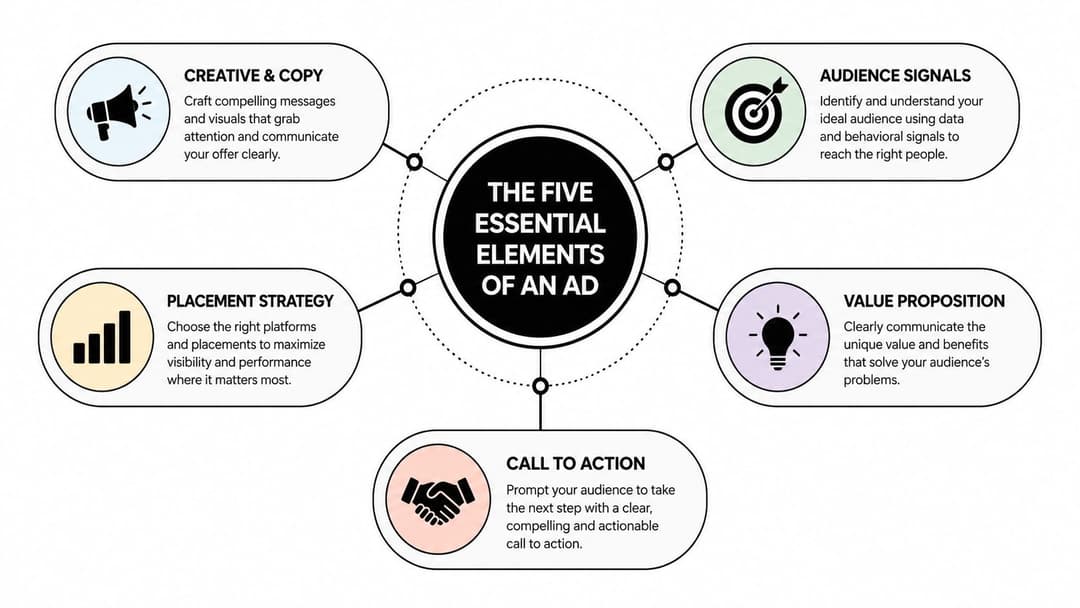
Creative, audience, value, placement, and CTA
The five pieces I look at first are creative and copy, audience signals, value proposition, placement strategy, and call to action. Creative and copy earn attention. Audience signals decide who gets the message. Value tells the user why they should care, placement shapes how the ad appears, and the CTA tells them what to do next.
Those five elements map cleanly onto metrics. If impressions are fine but click-through rate is weak, the creative or value proposition is probably losing the first judgment. If clicks are good but conversion rate is poor, the page or offer is likely out of sync. If both are decent but ROAS is soft, the issue may sit deeper in audience quality, placement fit, or tracking integrity.
Why the chain matters more than the checklist
The mistake is treating each element as independent. A sharp hook can't rescue a weak offer. A strong CTA can't fix the wrong placement. A highly relevant audience can still ignore a creative that's cropped badly or visually cluttered in feed.
That's why the old “make the ad look good” instinct often falls short in paid social. The better instinct is “make the system coherent.” When the ad's parts work as a set, performance becomes easier to diagnose and scale. When they don't, you end up optimizing one piece while the leak stays hidden.
The fastest way to improve an ad isn't to make every part louder. It's to make every part say the same thing.
Creative and Copy That Drives Attention
Creative quality is where the biggest performance swings usually start. One widely cited meta-study of nearly 450 CPG campaigns found that creative quality contributed 49% of incremental sales lift, ahead of reach at 14%, brand at 21%, targeting at 11%, and recency at 5% (creative performance statistics). Other industry research has also reported that strong creative can account for up to 89% of sales lift. That does not mean media is secondary. It means the message often decides whether media spend pays back.

What actually moves the first click
On Meta, the headline, primary text, and image do different jobs. The headline sets the frame, the visual earns the pause, and the body copy closes the relevance gap. If all three try to do the same job, the ad usually feels busy instead of persuasive.
The strongest creative tests isolate one question at a time. Test a direct-benefit headline against a problem-led headline while holding the image constant. Or keep the copy stable and test whether the visual needs more context, less clutter, or a more obvious product cue. That is how you learn which element is doing the heavy lifting.
Copy testing works best when the hypothesis is narrow
A lot of teams say they're testing creative, but what they're really doing is changing five things at once and hoping the platform sorts it out. That approach makes learning slow. It also hides whether the lift came from the message, the design, or the audience reaction to both.
If you are building a repeatable copy process, anchor it to the metric you care about. For ROAS, test messaging that shifts purchase intent. For CPL, test wording that filters for stronger lead fit. For CPA, watch whether the copy matches the level of urgency the audience is ready for.
Format matters as much as phrasing
A clean sentence can still fail in the wrong format. A static visual may work in one placement and collapse in another because the user reads it differently. That is why high-performing teams do more than write better copy, they build copy systems that can survive multiple contexts.
For a deeper treatment of framing, sequence, and CTA language, the internal guide on Ad copy best practices is a useful reference because it keeps the discussion on what the text is doing, not just how it sounds.
Crafting the Offer and Call to Action
A strong creative can get the click, but the offer decides whether the click feels worth it. The offer is the concrete value proposition, the thing the user believes they'll get by responding. The CTA is the behavioral instruction that turns that belief into action.
Match the offer to the level of intent
A discount offer and a consultation offer are not the same kind of persuasion. A discount is transactional and immediate. A consultation is slower, more trust-based, and usually better suited to users who need reassurance before they commit.
That's why the CTA should not be treated like a cosmetic button choice. Learn More, Shop Now, Sign Up, and Contact Us each signal a different level of friction, and each one fits a different funnel stage. A direct commerce CTA may attract fewer but hotter clicks. A softer CTA may widen the top of the funnel but bring in weaker intent.
The offer should do one job
The worst offers are the ones that try to be clever and vague at the same time. Users do not need brand poetry when they're deciding whether to click. They need a clear reason, a clear payoff, and a clear next step.
Rule of thumb: If the offer can't be explained in one breath, it's probably too complicated for paid social.
That's where alignment matters again. A strong CTA attached to a weak offer only increases the speed at which people leave. A strong offer paired with a muddled CTA creates hesitation. Both need to point in the same direction.
For practical positioning work, the internal guide on what is unique selling proposition is worth reading because it helps separate the actual value from the decorative language around it.
Test the offer before you blame the CTA
If an ad underperforms, many teams rewrite the CTA first. That's often backwards. The CTA is usually the final expression of offer strength, not the root issue. If the offer is soft, the CTA can't save it.
The better test sequence is to compare offers first, then refine the CTA language once the promise is strong. That keeps the learning clean and helps you see whether people are rejecting the value itself or just the way the action is framed.
Audience Signals and Placement Strategy
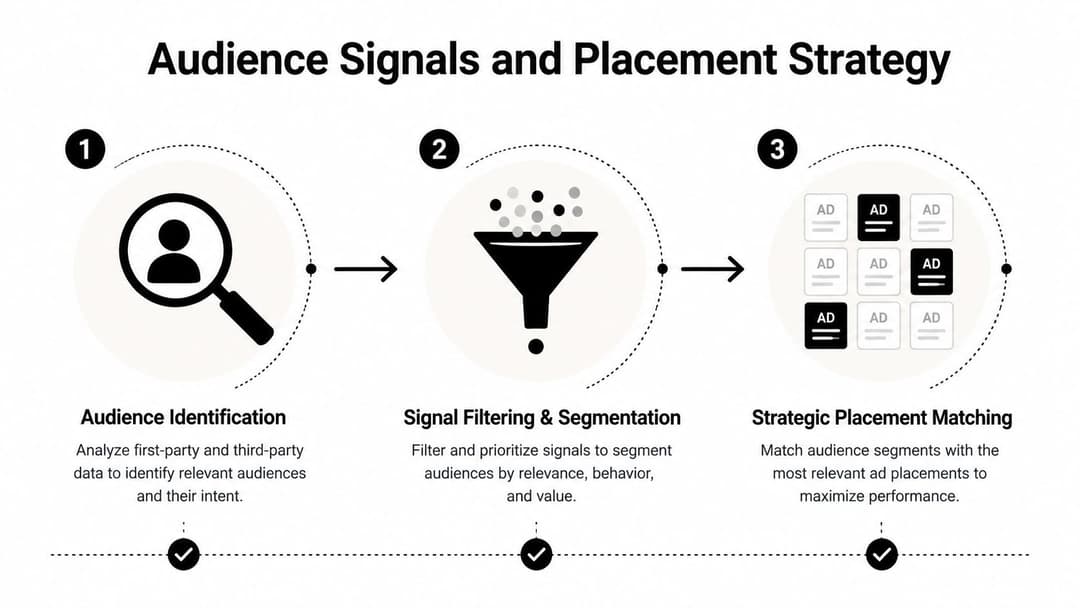
The best ad in the account can still fail if it reaches the wrong people or shows up in the wrong format. Audience signals decide who enters the auction, and placement strategy decides how the message is delivered. Those two choices affect whether the ad feels native, interruptive, or out of place.
Audience quality is more than a targeting label
On Meta, audience signals can come from custom audiences, lookalike modeling, interest targeting, and behavioral patterns. Those inputs don't just define reach, they influence the quality of the people who see the ad. A broad audience with a great creative can outperform a narrow audience with a weak signal, but only if the creative can self-select the right buyer.
Placement is the other half of the equation. Feed, Stories, Reels, and Audience Network all create different viewing conditions. A message that feels native in one placement can feel cramped or rushed in another, especially when the frame, pacing, or text density isn't built for it.
Build for the placement, not just the message
A lot of wasted spend comes from format mismatch. The same ad can look polished in one environment and broken in another because the composition doesn't survive the crop. That's why platforms like Google specify square 1:1 and horizontal 1.91:1 image assets, with supported image files commonly capped at 5120 KB, and why broader industry guidance stresses creating multiple ratios to cover feed, story, and desktop placements without layout degradation (Google ad specs, multi-ratio ad specs). Even when the platform differs, the lesson is the same, format mismatch can sink performance before the message gets a fair read.
Why a ratio matrix beats one hero asset
The smartest teams build a ratio matrix upfront. That means the core concept is adapted for each placement before launch, not rescued afterward. It preserves composition, protects text legibility, and keeps the brand recognizable across formats.
For deeper audience mechanics, the internal guide on interest based targeting is a useful companion because it keeps the focus on signal quality, not just audience size.
Landing Page Alignment and Measurement Setup
The click is not the finish line. If the landing page doesn't match the ad's promise, the user feels the disconnect immediately and leaves before the conversion happens. That kind of mismatch is expensive because it wastes the intent you already paid for.
Message match is non-negotiable
If the ad says 20% off and the landing page opens on a generic homepage with no visible offer, the page is doing the opposite of what the ad promised. The same problem shows up when the ad sells a specific outcome, but the page buries that promise under generic branding. Users don't need to be convinced twice. They need continuity.
The page also has to load cleanly and present the core offer early. If the value is hidden below the fold or the layout makes the next step unclear, the page adds friction right where the ad worked hardest to remove it. That's how strong upstream creative still ends up with weak downstream conversion.
Measurement has to tell the truth
A lot of bad decisions start with incomplete tracking. If you're not mapping the right events, you can't tell whether the ad is producing quality conversions or just cheap clicks. You also can't tell whether your CPA or ROAS numbers are distorted by missing events, duplicate events, or the wrong attribution window.
That's why measurement setup belongs in the ad architecture, not in a post-launch cleanup list. Pixel events, custom conversions, and attribution logic all shape what you think is working. If the data is messy, you'll optimize the wrong element and scale the wrong lesson.
If the page and the tracking are wrong, the creative gets blamed for problems it didn't create.
For teams that want a structured way to observe what happens after the click, the internal guide on website visitor tracking is useful because it reinforces the connection between behavior, attribution, and optimization.
Read the numbers in context
Not every strong click should become a scaling signal. A low-cost lead can still be a poor fit if the landing page attracts the wrong intent. A high-intent page visit can still look underwhelming if your tracking window is too narrow.
The point is simple. You can't improve what you can't see, and you can't trust what your measurement setup distorts. The cleaner the data, the more confidently you can tie performance back to the element that moved it.
A/B Testing Framework for Ad Elements
Testing ad elements without a framework is just organized guessing. You can learn something from almost any test, but you only learn something useful when the variable you changed is the one you meant to study. Otherwise, the winning ad is just the one that happened to fit the audience, not the one that explains why it won.

Test the angle before the micro-variation
A useful distinction gets ignored all the time. The creative angle is not the same thing as the headline, the hook, or the visual. The angle is the underlying frame, while hook variations sit underneath it. That matters because teams often spend weeks testing tiny copy edits while never checking whether the narrative itself is wrong.
A cleaner method is to group ads into angle clusters and test three to five distinct angles first, then read performance at the angle level before drilling into line-level tweaks (creative angle framework). If one narrative consistently loses, no amount of punctuation polishing will save it.
Match the test to the goal
For ROAS campaigns, compare offer depth and CTA alignment. For CPL campaigns, compare headline hooks and landing page friction. For CPA campaigns, compare audience signal precision and placement mix. Those are different questions, and they deserve different test designs.
The goal isn't to prove that one ad is “better” in a vague sense. The goal is to identify whether the value proposition, the friction level, or the audience match is the primary driver. Once you know that, the next round of creative gets smarter instead of just newer.
Don't confuse movement with significance
A lot of ad accounts chase fast-looking winners that disappear as soon as spend rises. That's why result interpretation matters as much as setup. If you want a disciplined way to think about whether a result is worth acting on, the internal guide on what is statistical significance gives a more stable lens than gut feel.
Putting It All Together
The elements of an ad are not a launch checklist. They're a system. Creative, offer, CTA, audience signal, placement fit, landing page alignment, and measurement setup all affect the same outcome, which is whether the campaign earns efficient action at scale.
The best performance marketers treat each campaign like a learning loop. They launch with a hypothesis, isolate one meaningful variable, read the data against the right KPI, and feed the result into the next iteration. That's how small wins become repeatable process instead of one-off luck.
Tools can speed that process up when they're used with discipline. AdStellar AI is one option for teams that want to generate ad copy, structure campaign and ad set elements, and use historical performance to rank creatives and audiences against goals like ROAS, CPL, or CPA. The platform fits the exact problem this article is about, turning element-level decisions into a repeatable testing system rather than a guess-heavy workflow.
If you're ready to tighten your ad structure and test faster, visit AdStellar AI to see how it helps teams build, launch, and learn from Meta campaigns with less manual work. The right system won't replace judgment, but it will make every test more useful, and every winning element easier to scale.