A unique selling proposition is a specific, defensible benefit that a competitor can't easily copy. If you're spending paid media dollars against lookalike audiences, that difference is what keeps your ad from blending into every other offer in the feed.
You've probably seen it already. Two ads sell nearly the same product, the prices are close, the targeting is similar, and yet one account keeps getting cheaper clicks or stronger downstream results. The split usually comes down to the message, not the mechanics.
What Is a Unique Selling Proposition in Plain Language
A unique selling proposition, or USP, is the reason someone should choose your offer instead of a competing one. In plain English, it answers a buyer's simplest question, “Why you, and not the other brand?” A strong USP makes a clear promise about a benefit people can feel, verify, or see in use, and it gives the audience a reason to care before they click. Mailchimp's definition of a unique selling proposition points to that same core idea.
For performance marketers, this matters because paid social ads are judged fast. If the message sounds like every other offer in the feed, the platform and the audience both have little reason to pause. If the message names a specific benefit, like faster setup, less manual work, or a solution to one clear pain point, it gives people something concrete to process in seconds.
A USP also works like a testable creative hypothesis. You are not just writing a nice line for the homepage, you are choosing one claim that can be validated or rejected in paid social through creative testing, landing page response, and downstream conversion signals. That is why teams using AI-powered bulk creative generation and ranked performance insights can move faster, because they can produce many USP variations, then see which one earns attention and action.
Why the distinction matters in paid social
A slogan can sound polished and still tell the buyer nothing useful. A USP should be strong enough to defend in a sales call, on a landing page, and in a creative review. The older version of the idea, shaped by Rosser Reeves, was built around one clear claim that set an offer apart in a crowded market, and that logic still holds today. The historical summary of USP's origins shows how the concept moved from mid-20th-century advertising into a repeatable way to position an offer.
In paid social, the practical version is straightforward. Your USP is the single strongest reason your audience should stop scrolling and believe your offer is worth a click. If you cannot say it clearly, the ad usually will not say it clearly either.
Practical rule: If a junior teammate cannot explain the offer in one sentence without extra context, the USP is not ready yet.
A useful benchmark is simple. Your USP should name the audience, the problem, and the unique answer in customer language. Ad copy best practices help here because the same clarity that strengthens ads also sharpens the proposition behind them.
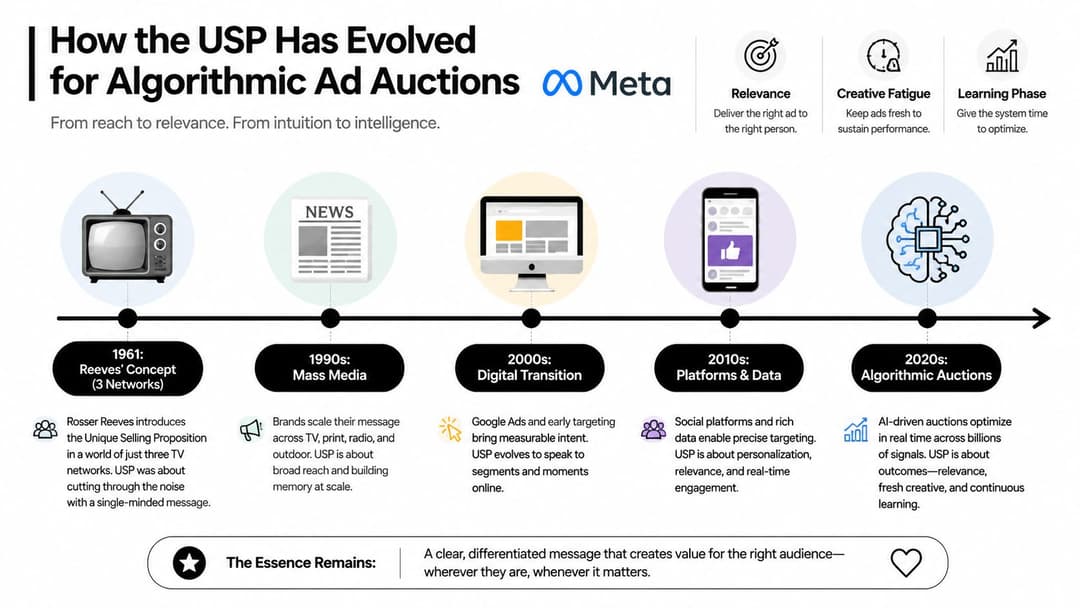
How the USP Has Evolved for Algorithmic Ad Auctions
Rosser Reeves built the USP for a broadcast world where attention was scarce and media choices were limited. The core logic still holds, one clear claim, one clear audience, one clear reason to believe. The historical record shows the idea was never about style for its own sake, it was about distinctiveness you can defend.
Why the old rule still works
The buying environment changed. In algorithmic ad auctions, the platform keeps sorting creative by signals like relevance, fatigue, and how people react to the ad. A fuzzy USP gets rejected faster than it did in the TV era because the system sees weak response quickly. A broad message can lose to a sharper claim even when the products are almost identical.
That is why modern guidance still returns to the same three questions. Who is this for? What need does it solve? What makes it different from the alternatives? Mailchimp's USP guidance and Salesforce's approach to building a USP both use that structure. The difference now is execution. The claim has to survive creative testing, not just a brand review.
What changes under algorithmic optimization
The old definition breaks when teams treat uniqueness as a one-time slogan instead of a live hypothesis. Paid social teams cannot assume a claim will keep working, because audiences change, competitors copy fast, and platforms reward ads that keep earning attention. A USP now behaves more like a testable message than a finished brand line.
A useful way to frame it is simple. Your USP is the first creative hypothesis the platform helps you validate or reject.
That matters even more in AI-heavy workflows. Machine learning in advertising helps teams surface which angle, frame, or proof point wins, then carry those learnings into the next round of creative. AI-powered bulk creative generation makes that process faster, because teams can launch many USP variations at once, then use ranked performance insights to see which promise earns clicks, attention, and action. In practice, the USP still starts as one clear claim, but it now lives inside a faster feedback loop.
The Three Components Every Strong USP Must Have
A strong USP rests on three load-bearing parts. If one is missing, the message starts to wobble. A quick way to check a draft is to ask whether it clearly names who it's for, what problem it solves, and what makes it defensible.
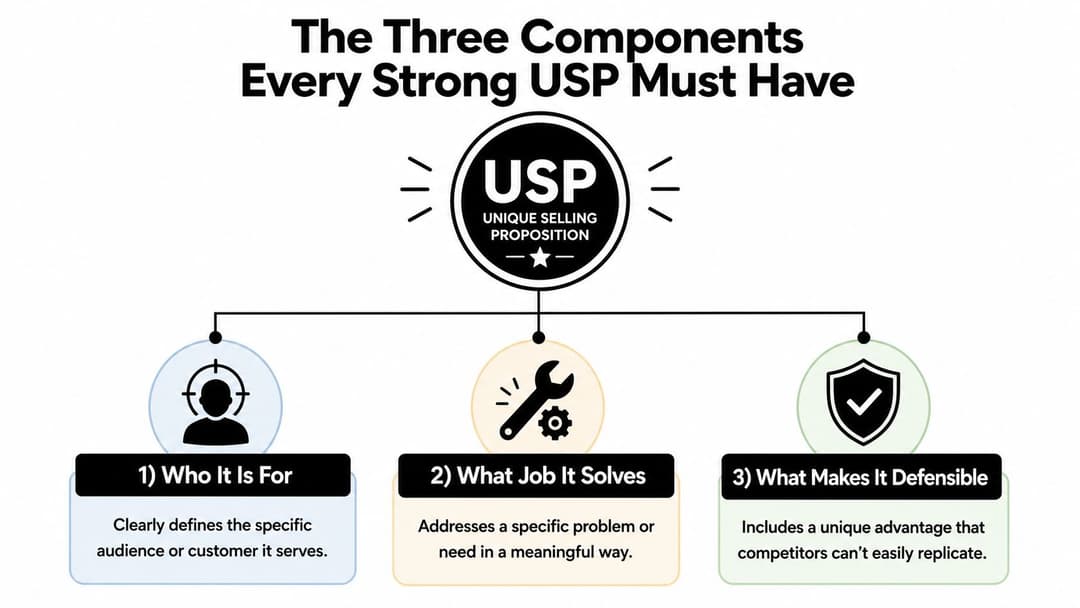
Who it is for
A USP gets sharper when it rules out the wrong people. “For busy paid media teams managing multiple client accounts” is more useful than “for marketers” because it gives the audience context and makes the message feel specific. Salesforce's USP framework starts with who you serve for that reason.
If this part is vague, the ad turns generic. The hook may sound polished, but nobody can tell whether it is meant for a startup founder, an agency buyer, or a solo operator.
What job it solves
The second part is the pain point or job-to-be-done. A lot of teams drift into feature language here and forget the buyer's pressure. If your offer helps people launch faster, reduce manual setup, or improve creative testing, name the job in the customer's terms, not your internal product terms.
A paid-social headline should read like a real outcome, not a product tour. That is why ad copy best practices keep pushing teams back toward clarity, specificity, and the buyer's actual task.
What makes it defensible
The third part is the difference competitors cannot easily copy. That can be a workflow, a timing advantage, a specialized audience focus, or a proof-based claim. The older USP idea still matters because it forces the claim to rest on a real distinction, not a broad promise that any rival could reuse.
Good test: If a competitor could say the same line without changing their product, your USP is too loose.
A clean template helps. Try this, For [audience] who [pain], we offer [benefit] unlike [alternative] because [proof]. Use it as a creative brief, not only as a copy exercise. It gives AI-powered bulk creative generation a clear starting point, so the team can produce multiple USP variants and then compare which promise earns clicks, attention, and action.
Real USP Examples Across DTC, SaaS, and Agencies
Theory is cheap. A working USP has to survive contact with a real market, real objections, and real creative. That's why the best way to understand the concept is to look at how it changes by category.
DTC skincare
A skincare brand selling to sensitive-skin buyers might position itself around dermatologist-developed formulas that are designed for people who react to common ingredients. The pain is obvious, shoppers want fewer breakouts, less irritation, and fewer trial-and-error purchases. The headline that carries the USP could be something like, “Built for sensitive skin without the ingredient guesswork.” That line works because it points to a very specific buyer and a very specific promise.
B2B SaaS
A billing platform can make a more operational promise. If its real difference is helping finance teams close month-end faster, then the USP needs to sound like a workflow win, not a generic software claim. A headline such as “Close month-end without the spreadsheet scramble” makes the pain concrete and keeps the benefit tied to the task the buyer wants to finish.
Agency services
For an agency, the USP may live in the operating model. If the team replaces manual ad ops with an AI launch system that can produce large batches of creative variants quickly, the core message is speed plus scale plus less busywork. The headline should carry that operational advantage, not hide it behind abstract agency language. Meta advertising examples are useful here because they show how the same offer can be framed differently depending on the audience and proof.
| Category | USP statement | Main pain | Ad headline style |
|---|---|---|---|
| DTC skincare | Sensitive-skin formulas built around dermatologist logic | Irritation and ingredient confusion | Benefit-first, simple, human |
| B2B SaaS | Billing that compresses month-end work | Manual reconciliation and reporting drag | Workflow-first, outcome-driven |
| Agency | AI-led launch system for rapid creative production | Slow ops and bottlenecked testing | Speed-first, operational proof |
One useful shortcut is to look for the part of the offer that a rival would struggle to replicate quickly. That is usually where the strongest ad angle lives.
A Step-by-Step Framework for Writing Your Own USP
A strong USP usually starts as a testable hypothesis. If you write the headline first, you often end up with a neat sentence that sounds good and teaches nobody anything. Start with the customer evidence, then turn that evidence into a claim you can prove or disprove in paid social.
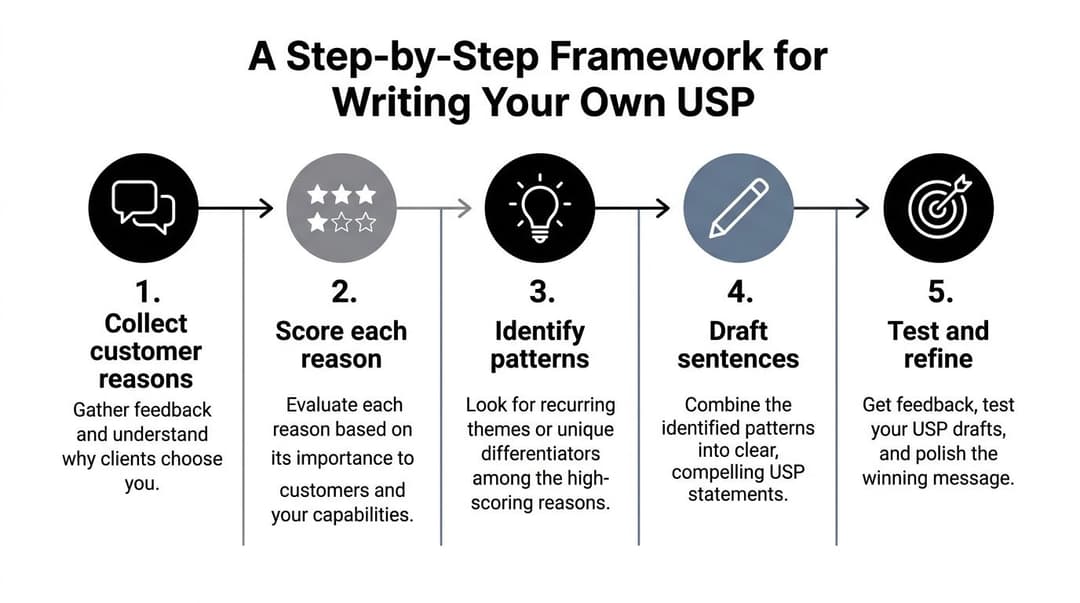
1. Collect the real reasons customers buy
Use support tickets, sales calls, reviews, and onboarding notes. The goal is to find the exact phrases buyers use when they explain why they chose you, not the words you prefer for the brand deck. If the same benefit keeps showing up across different conversations, that is a signal worth testing.
Template, Customers choose us because [reason].
2. Score each reason against competitors
Take the strongest reasons and compare them with two named competitors. If a rival can make the same claim with equal credibility, the point is not distinctive enough to carry a paid-social angle. This check keeps the USP honest, which matters because ads are where vague claims get exposed fast.
Template, We do [benefit] differently from [competitor] because [difference].
3. Identify the pattern that matters most
Look for the overlap between the buyer's pain and your clearest advantage. Sometimes the strongest pattern is a feature. Sometimes it is speed, onboarding, workflow simplicity, or proof quality. Salesforce's framework for defining the three guiding questions helps here because it keeps the work centered on who you serve, what you do, and why it matters.
4. Draft the sentence in customer language
Write the USP the way you would say it on a sales call. Keep it short. Keep it plain. Keep it believable. If it sounds like a slogan, cut more words until it sounds like something a buyer would repeat back to a colleague.
Template, For [audience], we help [job] with [unique benefit].
5. Pressure-test it in a one-line ad
Turn the USP into a headline or hook, then check whether it still makes sense without a long explanation beside it. If the idea falls apart once it leaves the brief, it was too dependent on context. Use this guide to finding winning Facebook ad creatives to connect the USP to creative testing, and pair that with Saaspa.ge product launch resource so the launch logic stays organized when you are moving from idea to execution.
Useful rule: If the sentence cannot survive as ad copy, it probably was not a real USP yet.
A good USP should also hold up in the brief, the landing page, and the media plan. If those pieces point in different directions, the message leaks and the test gets harder to read.
Testing and Scaling USPs in Paid Social Creative
A USP that has not been tested is still a hypothesis. Paid social lets you stress-test that hypothesis quickly, because the same core claim can be turned into several creative angles and each one can be judged by what it does in market.
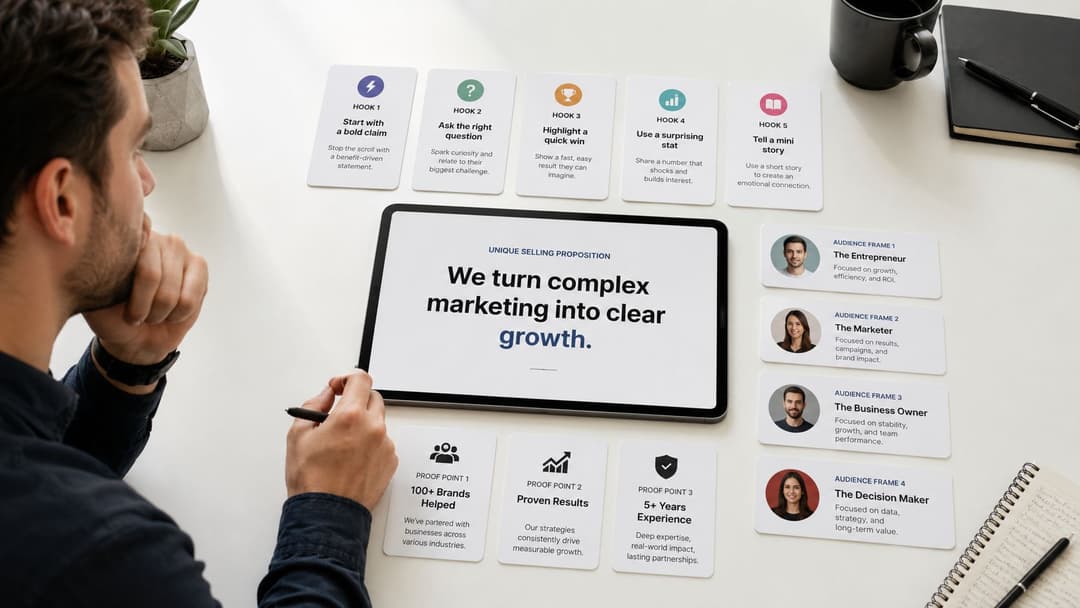
Start by separating the USP into working parts. The hook can name the pain, the visual can show proof, the body copy can add context, and the CTA can restate the promised outcome. That gives you a clean way to generate multiple variants from one proposition without changing what the brand is claiming.
Then test those variants against the metric that matters. For one campaign that might be ROAS, for another CPL or CPA. The goal is to rank the concepts by business outcome, not by whoever likes the copy most. Manual testing can work, but it slows down once the volume grows. AI workflows can speed that up. Platforms like AdStellar AI can read historical performance, generate many creative combinations, and rank them against the chosen goal so the learning loop becomes faster and less subjective.
A practical launch checklist helps keep the rollout organized, and the Saaspa.ge product launch resource can sit alongside that process as you move from idea to execution. The point is not the tool itself. The point is to treat the USP as something you can validate, reject, or refine, not something you only announce in a strategy deck.
After the first round, keep the winners and remove the weak versions. Then remix the strongest hooks, proof points, and audience frames into the next set of ads. That is how a USP becomes a living creative system instead of a fixed sentence.
Common Misconceptions That Kill Great USPs
The first myth is that a USP is just a tagline. It isn't. The tagline is the wrapper, while the USP is the underlying claim that gives the wrapper meaning. A line like “Just do it” can be memorable, but memorability alone doesn't make a USP.
The second myth is that a USP is permanent. That's rarely true in paid social. Competitors respond, audience expectations shift, and what felt distinctive last quarter can look ordinary after enough repetition. A USP needs periodic review, especially when market conditions or customer behavior change.
The third myth is that a USP must always be a feature. Sometimes the strongest edge is an operating model, a learning loop, or a faster turnaround. If your team can launch more creative variations, learn from the data faster, and redeploy winners sooner, that can be the differentiator, especially in crowded ad-tech categories.
If competitors can copy your claim by changing a headline, the claim is probably not strong enough to hold up in-market.
A quick way to spot a weak draft is to ask whether it sounds like a boast, a frozen brand line, or a feature dump. A real USP sounds specific, believable, and useful to the buyer.
Putting It All Together and What to Do Next
A strong USP is a clear, defensible buying reason. In paid social, it should start as a three-part statement, turn into creative hypotheses, and get validated through testing, ranking, and iteration. In the next 48 hours, lock the audience, pain, and unique benefit, generate a set of variations, and launch them into a system that can rank by outcome.
AdStellar AI helps teams turn one USP into many testable creative variations, then learn from the results instead of guessing. If you want to build, launch, and rank paid social concepts faster, visit AdStellar AI and see how the workflow fits your next campaign.