You're probably already using machine learning in advertising, even if you've never opened a notebook, trained a model, or talked to a data scientist.
If you run paid social or programmatic campaigns, your day likely looks familiar. You launch a batch of creatives, watch CTR spike on a few ads, shift budget manually, pause the obvious losers, then wake up the next day to find performance has changed again. One audience suddenly stops converting. One creative burns out faster than expected. One campaign that looked healthy at blended ROAS starts falling apart when spend increases.
That's the point where manual optimization starts to break. There are too many signals, too many combinations, and too many decisions happening too fast.
Machine learning fixes that problem by turning campaign management from a series of reactive edits into an ongoing prediction system. Instead of asking, “What should I change today?” the platform keeps asking, “Given everything we've seen so far, what is most likely to work on the next impression?”
The End of Guesswork in Digital Advertising
A lot of performance marketers still think of machine learning as a layer added on top of advertising. In practice, it has become part of the operating system.
A media buyer running Meta, display, and retargeting campaigns used to rely on broad audience assumptions and regular check-ins. They'd review yesterday's numbers, spot a weak ad set, tweak bids or budgets, then hope the next reporting window confirmed the change helped. That process wasn't stupid. It was the best available method when planning happened in chunks and optimization happened on a schedule.
Now the market moves too quickly for that rhythm.
According to Salesforce data cited by Aerospike, 75% of marketing organizations have already implemented or are actively experimenting with AI in their operations. That matters because it reflects a deeper shift from manual media planning to algorithm-driven campaign management.
What changed in practical terms
The old workflow asked humans to do pattern recognition by hand. You looked at age bands, placements, devices, and time windows, then tried to infer what mattered.
Machine learning flips that. It processes far more inputs than a person can reasonably track, then uses those patterns to influence bidding, delivery, targeting, and budget movement at the impression level.
For a performance marketer, that means:
- Less blunt targeting: Campaigns don't have to depend only on broad demographic buckets.
- Faster budget decisions: Spend can move toward stronger combinations without waiting for a weekly review.
- More relevant delivery: The system can prioritize the users, contexts, and creatives most likely to produce the action you care about.
Practical rule: If your campaign has more moving parts than you can review confidently in one sitting, you've already crossed into machine-learning territory.
Why this matters for ROAS
ROAS improves when your budget goes to the right opportunity at the right price with the right message. That sounds obvious, but it's hard to do manually at scale.
Machine learning in advertising helps by reducing wasted impressions and by improving decision quality under uncertainty. It doesn't eliminate strategy. It makes strategy executable at a speed humans can't match.
That's why understanding it is no longer a nice-to-have for media teams. It's not about becoming technical. It's about knowing what the system is optimizing for, where it helps, and where you still need to step in.
How Machine Learning Actually Works in Ads
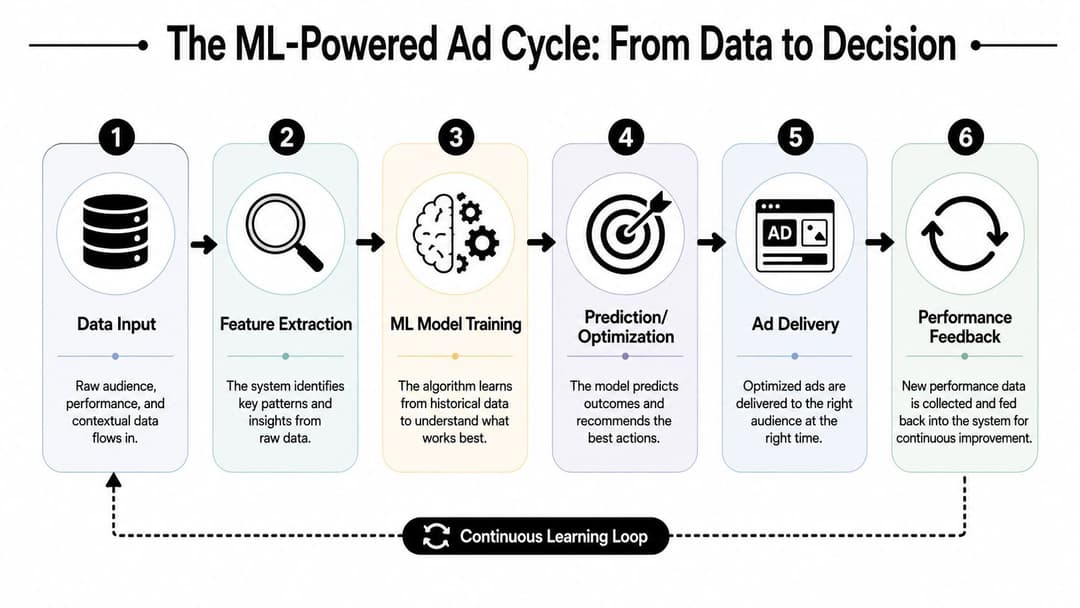
Most confusion around machine learning comes from the label, not the mechanics. You don't need the math to understand the workflow. Think of it as a cycle: collect signals, find patterns, make a prediction, take an action, observe the result, then update the next decision.
Supervised learning as training a new hire
Supervised learning is the easiest place to start. Imagine onboarding a junior buyer by showing them past ads labeled as strong or weak. You give examples of users who converted and users who didn't. Over time, they learn what patterns tend to lead to a sale.
That's what a supervised model does. It learns from historical labeled data. In advertising, those labels might be clicks, purchases, sign-ups, or churn events. The model studies the conditions around those outcomes and estimates what future users or impressions are most likely to do.
That's the logic behind a lot of predictive modeling in marketing workflows. The machine isn't “thinking.” It's spotting recurring relationships between inputs and outcomes.
Unsupervised learning as pattern discovery
Unsupervised learning works differently. No one tells the system which users are “good” or “bad.” It explores the data and groups similar patterns on its own.
In a campaign setting, that often helps with audience segmentation. The model may find clusters of users who behave similarly even if they don't fit your original targeting logic. One group may browse repeatedly before buying. Another may respond to short-form video but ignore static images. Another may only convert after interacting with product detail pages.
This is useful because real customer behavior is messier than the audience labels we build in Ads Manager.
Reinforcement learning as machine-speed media buying
Reinforcement learning is the most intuitive model for bidding and budget allocation. It treats advertising as a running sequence of choices. The system takes an action, sees the reward, then updates its future behavior.
According to Gourmet Ads' explanation of reinforcement learning in advertising, these algorithms treat ad buying as a sequential decision problem where the system sets bids, allocates budgets, or selects creatives, observes rewards like conversions or ROAS, and updates its strategy to maximize cumulative outcomes over time.
The simplest way to think about reinforcement learning is this: the platform is running thousands of tiny experiments continuously, then leaning harder into what pays back.
What the platform is actually doing
Behind the scenes, the cycle usually looks like this:
- Collect signals: Audience behavior, placement context, device data, creative interactions, and conversion events come in.
- Turn signals into usable features: The system extracts patterns from raw inputs.
- Train or update the model: It learns which combinations tend to correlate with the desired action.
- Make a prediction: The platform estimates the likelihood of a click, conversion, or higher-value outcome.
- Act on that prediction: It adjusts bids, prioritizes delivery, or changes budget allocation.
- Learn from results: New performance data feeds back into the next round.
For non-technical marketers, the key idea is simple. Machine learning in advertising is not a black box you either trust or reject. It's a feedback loop. Your job is to feed it clear goals, good inputs, and the right constraints.
Five Key Ways ML Is Reshaping Ad Campaigns
The broad promise of machine learning sounds abstract until you look at campaign mechanics. Where it becomes useful is in the daily decisions that affect spend efficiency, creative survival, and scale.
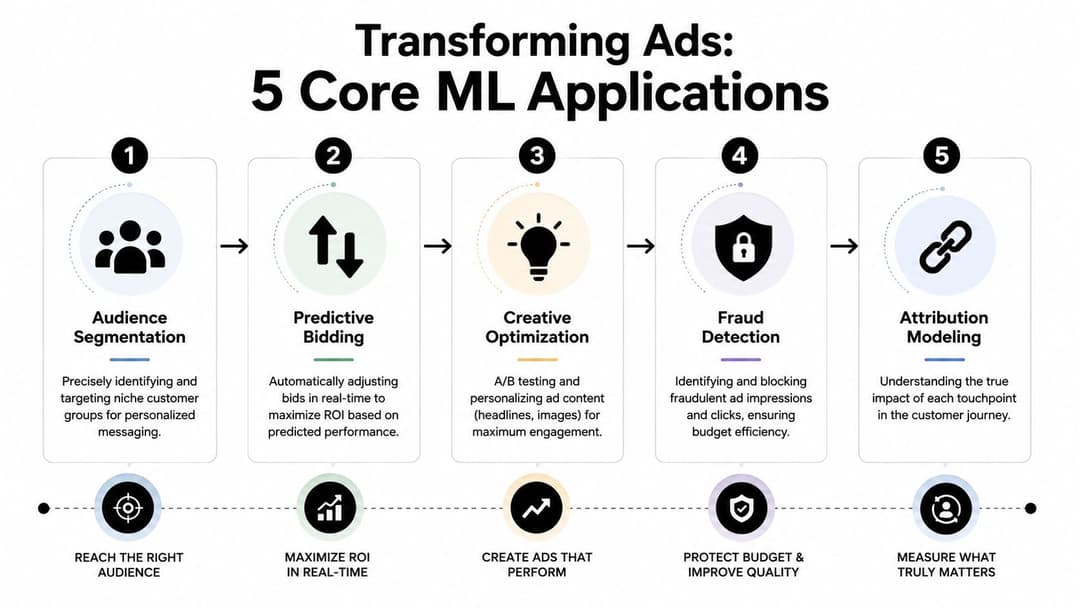
Predictive targeting goes past demographics
A skincare brand launches a new prospecting campaign. In the old setup, the buyer might target women in a certain age range with beauty interests and a few lookalikes layered in.
A machine learning system takes a different route. It looks for patterns in behavior and context that resemble previous converters, not just demographic fit. That can include site activity, engagement patterns, product interest, and signals that suggest intent.
Demographic targeting often indicates who a person is. ML is more useful when it estimates what a person is likely to do.
Dynamic creative optimization changes the testing process
Now take the same account with dozens of headlines, hooks, product angles, and formats. Testing those combinations manually gets messy fast.
ML helps assemble and prioritize combinations based on how different audiences respond. Instead of one static ad trying to do everything, the system can learn which message angle works better with colder traffic, which visual style gets stronger thumb-stop behavior, and which format keeps converting after the first burst of engagement.
That doesn't mean the algorithm writes your strategy for you. It means it can sort through creative combinations far faster than a human team.
Watch for this: Good machine learning can improve creative selection. It can't rescue weak positioning, unclear offers, or repetitive ad concepts.
Automated bidding prices each impression separately
This is one of the most direct ways ML affects ROAS. Platforms no longer need a buyer to set one generalized bid rule and hope it holds.
As explained in this overview of ML-driven bid decisions, ML models assess multiple factors, including the likelihood of a user clicking or converting, before making an informed bid decision, effectively predicting outcomes such as the probability of purchase or churn to prioritize higher-value opportunities.
That means one impression can be worth far more than another, even inside the same audience.
A useful way to consider it:
| Situation | Manual thinking | ML-driven thinking |
|---|---|---|
| Broad audience | “This segment usually performs well” | “This specific impression has a stronger probability of converting” |
| Budget pacing | “Spend evenly through the day” | “Spend more where predicted value is higher” |
| Bid logic | “Use one rule for the set” | “Adjust bid based on expected outcome” |
A lot of AI in performance marketing comes down to this shift from segment-level assumptions to impression-level probability.
Hyper-personalization works when the offer changes with intent
Think about a shopper who viewed a product category but didn't add anything to cart. Compare that with another shopper who viewed the same category, returned twice, and spent time on shipping information.
Those are not the same people, even if they sit in the same retargeting pool.
ML helps distinguish those intent levels and serve different messages accordingly. One person may need a benefit-led hook. Another may need urgency. Another may need proof. Hyper-personalization isn't just dropping a first name into a message. It's aligning the ad with likely intent and readiness.
Attribution gets closer to the real journey
One of the hardest parts of media buying is deciding what caused the result. Last-click reporting often overstates the role of retargeting and understates the role of earlier touchpoints.
Machine learning can help model contribution across channels and moments. It won't produce perfect truth, but it gives a better directional view of how display, paid social, video, and remarketing interact.
That changes budgeting decisions. Instead of starving upper-funnel activity because it doesn't “close,” you can evaluate which touchpoints consistently move people toward conversion and which ones merely collect the credit at the end.
A Practical Workflow for ML-Powered Advertising
Teams often don't need to “adopt machine learning” as a giant initiative. They need a reliable operating rhythm for using ML tools without losing strategic control.
Start with the workflow, not the software.
Phase one starts with one clear business outcome
A lot of ML projects disappoint because the team asks the system to optimize for everything at once.
Pick one primary outcome for the pilot. That might be purchase volume, qualified leads, lower CPA, stronger retention, or more efficient budget scaling. The clearer the objective, the cleaner the learning loop.
If you tell the system to chase clicks while your business needs margin-safe purchases, it will do exactly what you asked and still disappoint you.
Phase two is data readiness, not data perfection
You don't need a perfect warehouse to benefit from machine learning in advertising. You do need usable inputs.
That means making sure your conversion events are mapped sensibly, your naming conventions aren't chaos, your creative assets are organized, and your historical performance can be reviewed without detective work.
A simple readiness checklist helps:
- Conversion clarity: Confirm the platform can distinguish soft signals from the event that matters.
- Creative labeling: Tag hooks, formats, offers, and angles so you can learn from patterns, not just ad IDs.
- Audience hygiene: Separate prospecting, retargeting, and customer pools cleanly enough to avoid muddy interpretation.
- Feedback discipline: Review results on a schedule that matches your sales cycle, not your anxiety.
If your inputs are messy, machine learning won't become smarter than your process. It will scale your confusion.
Phase three is choosing where automation should live
Some teams can get meaningful gains using only platform-native automation inside Meta or a DSP. Others need a layer that helps with bulk testing, creative organization, and repeatable launch workflows.
One option is AdStellar AI's setup workflow, which focuses on connecting Meta performance data, organizing campaign inputs, and helping teams launch and compare large volumes of ad combinations more systematically.
The selection question isn't “Which AI tool is smartest?” It's “Where are we currently losing time or missing signals?”
Use a simple decision lens:
| Need | Better fit |
|---|---|
| Bidding and delivery optimization | Platform-native ML |
| Bulk creative testing and launch speed | Workflow layer |
| Cross-campaign pattern analysis | Reporting and insight layer |
| Team consistency across accounts | Structured operating system |
Phase four is a controlled pilot
Don't roll machine learning across every campaign on day one. Pick one account, one funnel stage, and one test window.
For example, you might use ML-assisted creative testing on one Meta prospecting campaign while keeping your existing control process in place elsewhere. That gives you something to compare operationally, even when performance data has noise.
A useful pilot usually defines:
- The optimization target
- The campaign scope
- The creative input set
- The review cadence
- The decision rule for scaling or stopping
After you've set that foundation, it helps to watch a practical walkthrough of how campaign automation tools fit into the day-to-day workflow:
Phase five is scaling what proved useful
When the pilot works, don't just increase spend. Standardize the process that made it work.
That might mean creating creative taxonomies, building repeatable testing templates, tightening your event hierarchy, or documenting when a human buyer should override automation.
The goal is not full autopilot. The goal is a system where humans decide direction and machine learning handles the repetitive, high-speed optimization work.
Measuring Success Beyond Clicks and Conversions
Most dashboards still push marketers toward surface metrics. CTR, CPM, CPC, and even headline CPA can be useful, but they don't tell you enough about whether machine learning is making your spend more efficient.
That's because ML often creates value in places that basic reporting hides.
Blended ROAS can hide bad decisions
A campaign can look fine at blended ROAS while getting weaker at the margin. Consequently, many teams get misled during scale.
Blended ROAS asks, “What did all our spend produce together?” That's a helpful finance view. It's a poor optimization view once you start increasing budget.
Marginal ROAS asks a sharper question: what is the return on the next dollar spent?
If the next increment of budget is going into lower-quality impressions, fatigued creatives, or weaker inventory, your blended number may still look acceptable while your efficiency is already sliding.
The metrics that matter more in ML-driven buying
Use this as a more useful scorecard:
- Marginal ROAS: Shows whether added spend is still productive.
- Incrementality or uplift: Helps answer whether the ad caused the outcome or merely captured existing demand.
- Creative decay: Reveals when an ad is losing effectiveness even before it fully collapses.
- Win-rate by concept: Compares message angles, not just individual ad IDs.
- Time-to-learning: Measures how quickly your testing process identifies usable winners.
Here's the key distinction:
| Basic KPI | Better question |
|---|---|
| CTR | Did attention lead to qualified downstream action? |
| CPA | Is the next unit of spend still efficient? |
| ROAS | Which spend increment is driving the strongest return? |
| Conversion count | Which message and context caused the lift? |
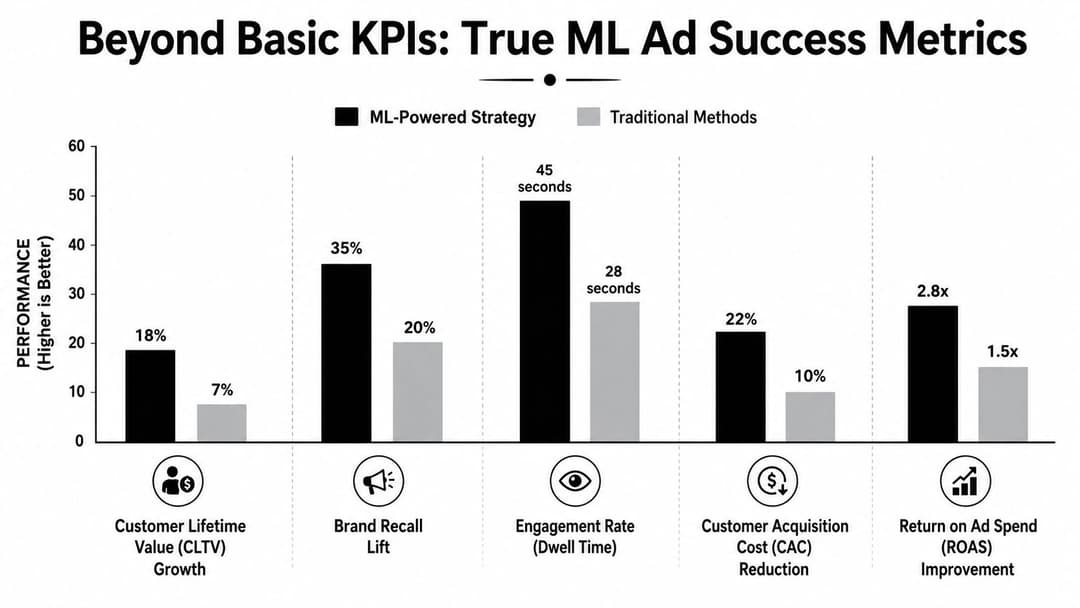
The chart above is best treated as a visual illustration, not as a source for decision-making. In practice, your own account data should determine what “better” looks like.
Attribution should support budget moves, not just reporting
A good attribution model doesn't need to be philosophically perfect. It needs to help you decide where to spend next.
That's why many advanced teams pair platform reporting with approaches like media mix modeling for budget planning. The point is not to replace in-platform metrics entirely. It's to avoid over-crediting the final click while underinvesting in the channels and creatives that shape demand earlier in the journey.
Better measurement doesn't always give you certainty. It gives you better odds of moving budget in the right direction.
Creative fatigue deserves its own reporting lane
One common blind spot in machine learning in advertising is assuming strong early performance means a concept is scalable.
It might not be. Some ads attract fast clicks and cheap engagement but wear out quickly. Others start slower and hold their efficiency longer. If you only watch top-line averages, those differences disappear.
The practical fix is simple. Track creative performance over time by concept, audience context, and spend level. That helps you separate true winners from short-lived spikes.
Navigating Privacy Changes and Ethical Lines
Privacy changes didn't kill machine learning in advertising. They changed what the models can rely on.
That distinction matters. A lot of marketers interpreted signal loss as proof that automation had become less useful. The better interpretation is that weak historical data forces platforms and buyers to lean on different signals and different workflows.
According to Appen's discussion of signal loss and targeting accuracy, 60% of marketers report diminished ML accuracy in audience targeting since 2024, pushing more teams toward creative-first testing rather than audience-first automation.
Why audience-first logic got shakier
When tracking becomes less complete, models have a harder time connecting exposure to outcome at the individual level. That weakens the value of audience definitions built from historical patterns that are no longer fully visible.
If your old process depended on precision targeting built from dense user-level data, privacy updates make that process less stable. The model may still optimize, but the training signal is less reliable.
That's why many teams now put more pressure on:
- Creative strength: The ad has to do more of the persuasion work.
- Contextual relevance: Placement and page context become more important.
- First-party data quality: Owned customer data becomes more valuable.
- Conversion modeling: Platforms estimate missing outcomes instead of observing all of them directly.
A useful primer on this shift is AdStellar's guide to first-party data, especially if your current account structure still leans heavily on rented audience intelligence.
Contextual targeting is more important than many buyers assume
Contextual advertising often gets framed as a fallback. It's better understood as a different kind of relevance.
Instead of asking, “Who is this person based on their past behavior across the web?” contextual systems ask, “What is this person engaging with right now?” Machine learning can scan page content, infer topics, and align ads with the surrounding environment without relying on personally identifiable information.
That approach won't recreate every old targeting advantage. It can still be effective because intent often shows up in context.
Ethics is not a side topic
The same systems that improve efficiency can also make opaque decisions at scale. That creates responsibility for the marketing team.
Use machine learning to improve relevance and reduce waste. Don't use it as an excuse to hide poor data practices, muddy consent standards, or manipulative messaging.
The ethical test is simple. If a customer understood how the targeting and message worked, would your team still be comfortable defending it?
In practical terms, ethical use means setting clear conversion goals, limiting unnecessary data collection, reviewing model outputs for bias or odd behavior, and making sure automation does not inadvertently optimize toward low-quality outcomes just because they're easy to measure.
Common Pitfalls and Your Path Forward
Most failures with machine learning in advertising don't come from the algorithm. They come from how teams frame the problem.
The good news is that the common mistakes are fixable.
Mistake one is feeding the model weak signals
If your conversion setup is muddled, your event priorities are inconsistent, or your campaign taxonomy is chaotic, the model has no clean foundation.
The better approach is boring and effective. Clean up naming. Separate meaningful events from vanity actions. Make sure the optimization goal reflects business value, not just reporting convenience.
Mistake two is handing over too much control
Some marketers swing from manual overwork to blind trust in automation. Neither extreme works well.
Machine learning is excellent at high-speed optimization inside a defined objective. It is not responsible for your positioning, offer strategy, audience exclusions, or creative direction. Humans still need to decide what “good” means.
A useful operating split looks like this:
| Human owns | Machine owns |
|---|---|
| Offer strategy | Real-time bid adjustments |
| Creative angles | Pattern detection at scale |
| Measurement framework | Delivery optimization |
| Budget guardrails | Ongoing probability-based decisions |
Mistake three is thinking personalization alone will save performance
At this point, a lot of generic AI content loses the plot. Personalization matters, but it isn't the whole story.
According to The Weather Company's note on ML personalization usage, 41% of advertisers use ML for personalization at scale, yet that still leaves a major operational gap: many teams don't account for the way ML can over-optimize for short-term clicks and speed up creative burnout across large volumes of ad variations.
That's especially relevant on Meta when you're launching many creatives at once. The system may quickly favor the ads that win early attention, then hammer those assets so hard that they fatigue faster than your team can refresh them.
Mistake four is confusing fast winners with durable winners
An ad that wins in the first wave of delivery is not automatically the one you should scale hardest.
The better approach is to judge creatives on durability, not just launch-day momentum. Ask which concepts hold conversion efficiency as spend increases, which messages continue to work across audience pockets, and which formats survive beyond the initial novelty window.
Mistake five is treating ML as a replacement for a testing culture
Machine learning helps you test faster. It doesn't replace disciplined testing.
Strong teams still form hypotheses. They still document why a creative angle should work. They still compare concepts, not just assets. They still review outcomes with context.
That mindset is the path forward:
- Start smaller than you want to
- Choose one high-value optimization goal
- Structure your data before you scale your tools
- Use automation where speed matters most
- Keep human judgment on strategy and creative quality
Machine learning won't make advertising easy. It does make complexity more manageable. And for performance teams under pressure to scale without wasting budget, that's the real advantage.
If your team is trying to launch more Meta ad variations, learn faster from creative tests, and reduce manual setup work, AdStellar AI is one option to evaluate. It's built to help teams organize, launch, and analyze large volumes of campaign combinations while using performance data to guide what gets scaled next.