First-party data is the information your company collects directly from its audience and customers with consent, and 55.1% of marketers worldwide say it's much more important today than it was two years ago. It matters because direct data gives Meta better signals to optimize on, and that matters more as cookies disappear and privacy rules tighten.
If you're running paid social right now, you've probably felt the shift already. Prospecting looks less stable. Retargeting pools don't feel as dependable. CPA rises, then falls, then rises again, and the old answer of “add more data” doesn't work if that data is weak, fragmented, or impossible to trust.
That's why the question “what is first-party data” isn't academic anymore. It's operational. First-party data is information a company collects directly from its audience through owned channels, with consent. That makes it the most accurate and valuable data asset most marketing teams have in a privacy-focused environment. For Meta advertisers, it's also the difference between feeding the platform clean signal and asking its algorithm to guess.
The End of an Era for Old Data Strategies
A familiar scenario plays out inside ad accounts every week. A team has years of campaign history, decent creative, and a healthy budget. Then performance starts slipping. Website traffic still comes in, but attribution gets murkier. Audience building gets noisier. A segment that used to convert predictably now swings from strong to weak with no clear reason.
That usually isn't a creative problem first. It's a data problem.
According to EMARKETER coverage from Insider Intelligence, 55.1% of marketers worldwide report that first-party data is much more important today than it was two years ago. That shift tracks with what performance teams see in practice. Third-party cookies have lost their reliability, privacy rules have become stricter, and platforms like Meta need better direct inputs if you want the machine to optimize with confidence.
What broke in the old model
The older model leaned heavily on rented signal. You could buy, infer, or borrow audience intelligence and still get acceptable results. That model is weakening fast.
What usually fails first:
- Audience trust: Third-party segments can look broad and useful, but they often miss the nuances that predict purchase intent.
- Measurement consistency: Cookie loss creates gaps between ad exposure, site behavior, and downstream conversion reporting.
- Optimization quality: Meta can only learn from the signals you send back. If those signals are partial, delayed, or disconnected, the platform learns slowly or badly.
Practical rule: When campaign performance becomes less predictable, check your data plumbing before you rewrite every ad.
A lot of teams also underestimate the integration side. Collecting emails, purchases, and site events is one thing. Making those sources work together is another. If you want a grounded walkthrough of that problem, Samuel Woods' data integration guide is a useful companion read because it focuses on the mechanics of combining systems, not just collecting more records.
On the Meta side, this is also why server-to-platform event transfer matters. Browser-only tracking leaves too much on the floor. A setup like the Facebook Conversion API helps preserve signal quality when browser tracking gets blocked or stripped.
Defining First-Party Data and Its Sources
The simplest way to answer what is first-party data is this: it's data you get from direct interaction with your audience, not from a broker and not from a platform guessing on your behalf.
Picture it as a conversation. First-party data is what a customer says to you directly, or what you observe while they interact with your store, site, app, or support team. Third-party data is closer to overheard gossip. It might contain something useful, but you can't treat it with the same confidence.
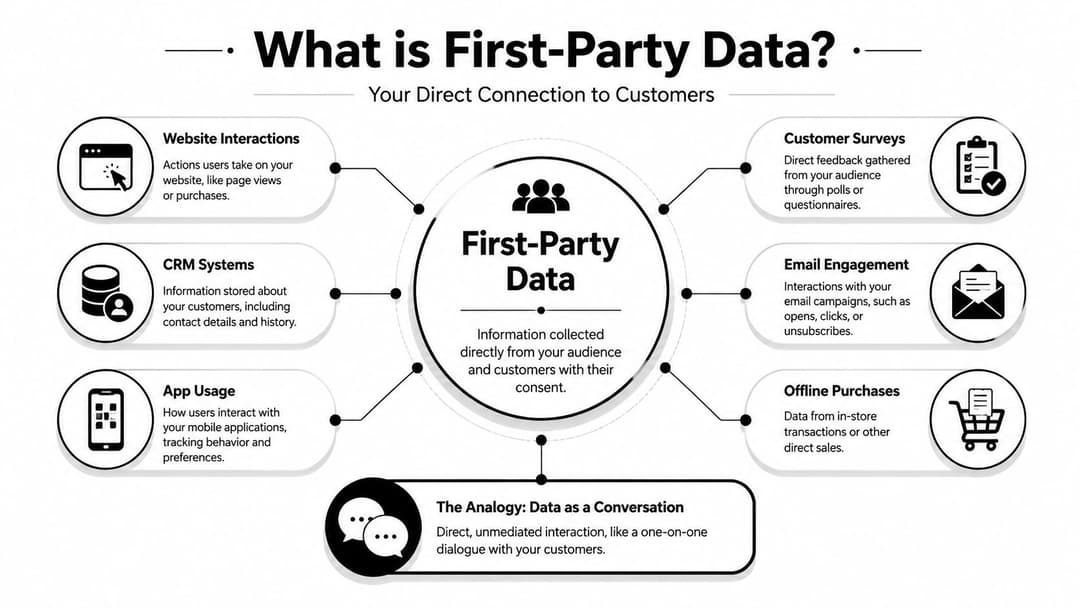
A key reason this works is the value exchange. A Jack Morton study referenced via Statista found that 48% of customers are comfortable sharing personal data when it leads to a better experience. People will share when the benefit is clear. Better recommendations, easier checkout, more relevant offers, loyalty rewards, and fewer wasted messages all count.
Where first-party data comes from
In day-to-day marketing operations, first-party data usually shows up in six buckets.
- Website interactions: Page views, product views, clicks, time on site, content consumption, lead form submissions, and on-site search behavior.
- App usage: In-app events, feature engagement, session behavior, and actions tied to known users.
- Transactional records: Purchases, repeat orders, cart abandonment, returns, subscription status, and average order value.
- CRM and service history: Contact details, sales notes, lifecycle stage, support tickets, and communication history.
- Email engagement: Opens, clicks, replies, unsubscribes, and content preferences.
- Declared input: Surveys, quizzes, review text, preference centers, and self-reported needs.
What these sources tell you
Not all sources answer the same question.
| Source | Best use |
|---|---|
| Website behavior | Shows interest and browsing intent |
| Purchase history | Shows buyer quality and commercial value |
| CRM records | Shows relationship stage and sales context |
| Surveys and forms | Show explicit preferences and intent |
| Email engagement | Shows message fit and audience responsiveness |
| Offline purchases | Show customer value beyond digital touchpoints |
A lot of teams struggle because they collect all of this but treat every record the same. They shouldn't. A product view is not as strong as an add-to-cart. An email open is not as strong as a repeat purchase. A support conversation can be more useful than a click if it reveals urgency or friction.
That's also why setup matters. Even a basic Meta Pixel implementation becomes more valuable when you know which events deserve the most attention and how they connect to the rest of your customer record.
If your funnel depends on lead quality rather than immediate purchases, it also helps to separate early interest from sales-ready intent. A practical guide to lead and prospect qualification is useful here because a lot of “bad data” is really just good data from the wrong stage of the funnel.
First-Party vs Second-Party and Third-Party Data
Defining first-party data isn't where marketers get stuck. The difficulty lies in the comparison: Which data can you trust, what risk comes with it, and what can scale without creating compliance and performance problems?
Here's the working distinction.
- First-party data comes from your direct relationship with your audience.
- Second-party data is another company's first-party data shared through a direct partnership.
- Third-party data is aggregated data acquired from outside sources that didn't collect it through a direct relationship with your business.
Data types compared
| Attribute | First-Party Data | Second-Party Data | Third-Party Data |
|---|---|---|---|
| Source | Your owned channels and direct customer interactions | A partner's owned channels and customer interactions | Aggregated external sources |
| Accuracy | Usually highest because it reflects direct behavior with your brand | Can be useful, but depends on partner quality and fit | Often less precise for purchase prediction |
| Consent and privacy risk | Lower when collected with clear consent and governance | Depends on partner permissions and transfer terms | Highest risk because consent lineage is harder to verify |
| Cost | Built through your own infrastructure and programs | Often requires partnership or commercial agreement | Usually rented or purchased |
| Uniqueness | High, competitors can't copy your exact customer history | Shared value, but not exclusive in the same way | Low differentiation if many buyers use similar segments |
| Meta usefulness | Strong for matching, retargeting, suppression, and modeling | Situational, depends on compatibility | Less durable in a privacy-first ad environment |
The practical trade-offs
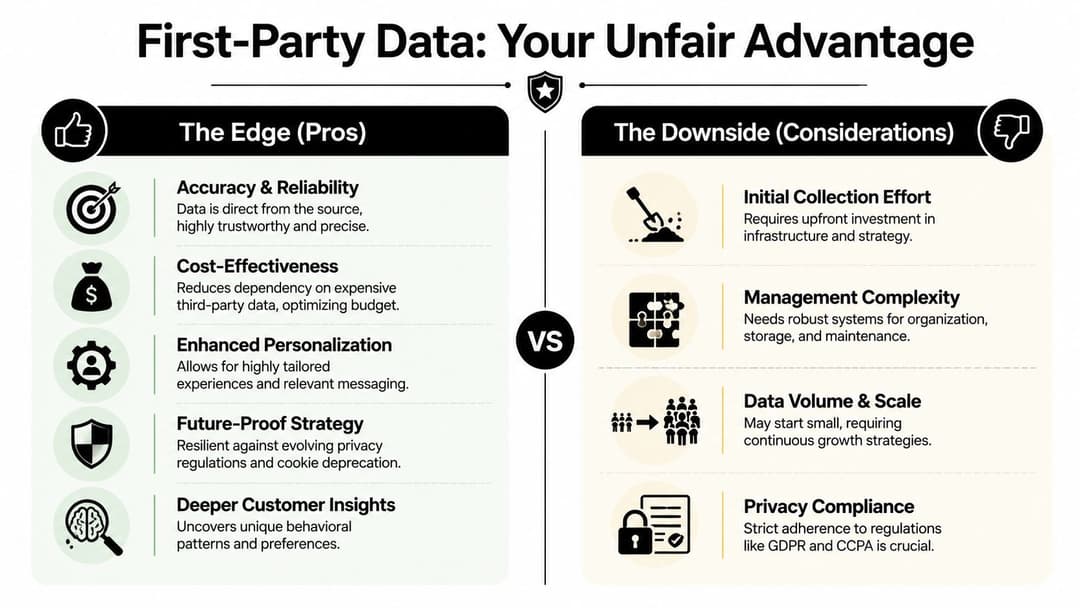
First-party data takes more effort upfront. You need tracking, consent, normalization, and identity resolution. But the payoff is that the signal is yours. Nobody else has your exact pattern of product views, repeat purchase cycles, support interactions, and email engagement.
Second-party data can still be valuable in narrow cases. Retail partnerships, publisher alliances, and co-marketing relationships can expand reach with better quality than cold third-party segments. The trade-off is dependency. You're relying on another company's collection standards and data sharing terms.
Third-party data still gets discussed because it feels scalable. It promises fast audience expansion. The problem is that broad scale doesn't guarantee useful signal. In performance marketing, relevance beats volume when the goal is efficient conversion.
Strong Meta performance doesn't come from the biggest audience file. It comes from the cleanest and most behavior-rich signal set you can activate.
This matters for audience expansion too. A high-quality first-party seed typically gives you a better base for modeled audiences than vague external targeting. If you use Meta Lookalike Audiences, the quality of the seed matters more than marketers often admit.
Why First-Party Data Is Your New Competitive Edge
First-party data isn't just a compliance-safe replacement for older targeting methods. It's a strategic advantage because it's difficult for competitors to replicate.
One brand can copy another brand's ad format, offer framing, or landing page layout. It can't copy the exact history of customer interactions sitting inside that brand's website analytics, CRM, app events, purchase records, and service conversations. That history becomes a moat when you use it well.
Why the edge is real
The biggest gain is signal quality. When someone browses your pricing page, abandons a cart, downloads a buying guide, or places a repeat order, that behavior reflects real intent with your business. It's not inferred from someone else's network. It's observed directly.
That improves three things quickly:
- Audience building: You can segment around actual behaviors instead of generic assumptions.
- Message fit: Creative and offers can match where people are in the journey.
- Suppression: You stop paying to show acquisition ads to existing customers or low-fit users.
Why infrastructure matters
The edge disappears if collection is weak. Browser-side tracking alone is fragile. Ad blockers, browser restrictions, and cookie limitations all reduce event quality.
According to AI Ark's explanation of first-, second-, and third-party data, server-side data collection is superior to client-side methods because it avoids browser restrictions and ad blockers, providing more persistent and reliable data tied to durable identifiers like email addresses rather than ephemeral cookies, ensuring higher accuracy and compliance under GDPR and CCPA.
That sentence sounds technical, but the business implication is simple. Server-side collection helps you keep a more stable memory of customer behavior. Meta performs better when your business sends durable, trusted conversion signals instead of relying on brittle browser events alone.
A short primer helps clarify the shift in thinking:
The trade-offs are real
First-party data is not effortless.
- You have to earn it: Customers share more when the exchange is obvious.
- You have to manage it: Bad naming conventions, duplicate records, and disconnected tools kill usefulness.
- You have to govern it: Consent status and data access rules need to be clean.
Field note: Most companies don't have a collection problem. They have a usable-data problem.
That's why the winning teams treat first-party data like infrastructure, not a campaign add-on.
A Framework for Collecting and Organizing Your Data
Most first-party data strategies fail in the middle. Collection starts well enough. A pixel gets installed, forms go live, CRM records accumulate, and email events stream in. Then everything lands in separate systems with different naming, different timestamps, and different IDs.
That's where the ROI gets lost.
A practical operating model
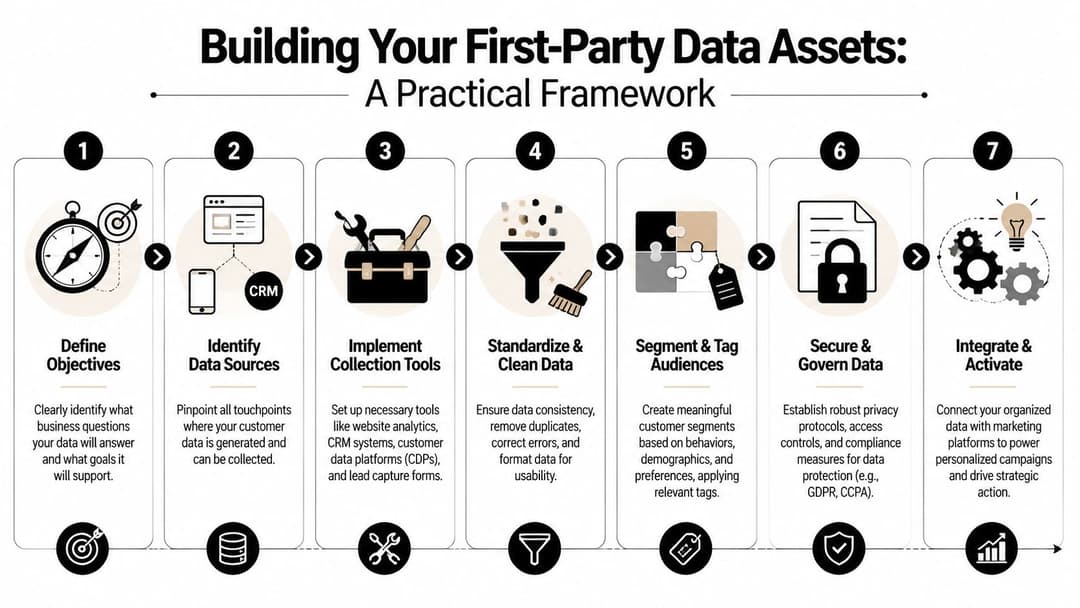
A usable setup usually follows seven moves.
Define objectives
Start with decisions, not tools. Are you trying to improve prospecting, retention, lead scoring, suppression, or creative personalization?Map collection points
Website forms, checkout flows, app events, CRM updates, email clicks, loyalty programs, surveys, and offline sales all belong on the map.Implement collection tools
Use analytics, event tracking, SDKs, CRM workflows, form capture, and commerce tracking that can tie activity back to a user or account where consent allows.Standardize names and values
“Lead,” “MQL,” and “qualified_contact” shouldn't mean the same thing in three different systems. Pick a taxonomy and stick to it.Resolve identity
Connect anonymous behavior to known profiles when possible through logins, email capture, purchases, or CRM syncs.Apply governance
Consent status, data retention, access controls, and regional privacy requirements need to be part of the operating model, not an afterthought.Activate into platforms
Push clean segments and events into Meta and other channels in formats they can use reliably.
What usually goes wrong
The biggest mistake is thinking collection equals readiness. It doesn't.
A team might have:
- website events in one analytics tool,
- customer records in a CRM,
- purchase history in Shopify or another commerce platform,
- support history in a help desk tool,
- email engagement in an ESP.
If those systems don't connect, no one has a real customer view. Meta doesn't get complete signal. Segmentation stays shallow. Reporting turns into reconciliation instead of analysis.
The role of unification
A CDP or a well-built warehouse model becomes important. The goal isn't to buy software for its own sake. The goal is to create one profile that reflects browsing, conversion, retention, and service behavior in a way the marketing team can effectively use.
Unified data is what turns isolated events into decision-making signal.
That also means your consent management setup needs to be tied to the same operating logic. If consent is collected in one place but ignored downstream, your data quality and compliance posture both degrade. Clean organization is what makes activation possible.
Activating Data for High-Performance Meta Campaigns
Here, first-party data stops being theory and starts affecting spend.
Meta's system performs best when it receives clear signals about who engages, who converts, what actions matter, and which users should be excluded. If your first-party data is unified, you can build audiences with intent behind them. If it's fragmented, Meta sees pieces instead of patterns.
What activation looks like in practice
Good activation usually happens in four layers.
- Customer suppression: Exclude recent buyers, active subscribers, or already-qualified leads from acquisition campaigns.
- Retargeting by behavior: Separate product viewers from cart abandoners, content readers from pricing-page visitors, and trial users from sales-ready users.
- Value-based audience building: Use purchase history or high-quality lead signals to create better seed audiences.
- Creative alignment: Match messages to the stage reflected in the data, not just to broad demographic assumptions.
These are not advanced because they sound impressive. They're advanced because they depend on data being stitched together cleanly.
The overlooked gap between collection and performance
A lot of teams say they “have first-party data” when what they really have is scattered first-party records. That distinction matters.
According to StackAdapt's first-party data strategy article, 78% of marketers collect first-party data, but only 22% successfully unify it across sales, marketing, and service systems to drive actionable insights. That gap is the key bottleneck. Meta can't optimize against a customer view that your own systems haven't assembled.
This is also why broad guidance like “upload customer lists” is incomplete. A stale email list isn't a strategy. A live, unified stream of customer interactions is.
If you want a more tactical view of campaign design around this principle, this guide to building data-driven Facebook campaigns connects segmentation and signal quality back to execution choices inside the ad account.
AI needs enough signal to work
There's another issue most guides miss. Even clean data can underperform if there isn't enough of it per segment.
Fullstory's 2025 first-party data strategy research reports that Meta's AI advertising models require a minimum of 1,200 first-party data points per audience segment to generate stable ROAS predictions. The same research says 43% of e-commerce brands fall below this threshold, leading to 30% higher CPA and inconsistent creative optimization.
That finding has real implications for account structure.
If you split audiences too narrowly, your segments may become conceptually smart but statistically weak. If you create dozens of micro-audiences without enough first-party depth, Meta's learning system has less stable input. The result is often noisy delivery, volatile CPA, and creative decisions based on thin evidence.
What works better
A better approach is to unify first, then segment with discipline.
Use first-party data to create:
- broader but behavior-rich seed groups,
- cleaner exclusion pools,
- high-intent retargeting windows,
- stronger value-based inputs,
- and better feedback loops from conversion events back into Meta.
That's how first-party data improves ROI. Not because “owned data” sounds strategic, but because Meta's automation gets better when your business sends complete, recent, and meaningful customer signal.
Measuring Success with First-Party Data KPIs
If you can't measure data quality, you can't explain why activation is working or failing. Many organizations track spend, CPA, and ROAS. Fewer track whether the underlying first-party data is healthy enough to support those outcomes.
That's a mistake.
The KPIs that matter most
According to the CDP.com glossary entry on first-party data, enterprise benchmarks for data health include an 80 to 90% deterministic identity match rate, a 60 to 75% audience coverage rate, and profile freshness under 7 days for active customers.
Those metrics tell you different things:
- Deterministic identity match rate: How often you can reliably connect events and touchpoints to a known person.
- Audience coverage rate: How much of your addressable audience exists in a resolved, usable profile.
- Profile freshness: How recently active customer records have been updated.
How to interpret them
A weak identity match rate usually means your systems can't connect browser activity, CRM records, and conversion events well enough. A weak coverage rate often means you're collecting data in pockets. Stale profiles usually mean sync delays, broken pipelines, or event feeds that don't reflect current behavior.
There's one more KPI worth treating as operational, not optional: activation rate. The benchmark in the same source recommends that over 40% of collected data be actively used in campaigns within 90 days. If your data warehouse is full but your live campaigns still depend on shallow segments, your problem isn't collection. It's activation discipline.
Measure the distance between data captured and data used. That gap is where marketing efficiency disappears.
When reporting performance upstream, tie these health metrics to business outcomes. If match rate improves and campaign stability improves, that's not a coincidence. If profile freshness drops and retargeting weakens, that's usually not a creative mystery either. For teams trying to connect these dots more accurately, measuring true ad attribution becomes much easier when the underlying first-party data is current and connected.
If your team wants to turn messy Meta workflows into a faster, more data-backed operating system, AdStellar AI is built for that job. It helps marketers launch, test, and scale Meta campaigns faster by organizing creative, audience, and performance signals into a system that can learn from results instead of just reporting on them.