Split testing is a controlled comparison of two or more ad variants to see which one wins on a chosen metric, and about 77% of organizations run A/B tests on their websites. Because 71% of those organizations run two to three tests per month, split testing has become a routine decision-making tool rather than a one-off tactic. (A/B testing overview)
Your Meta campaign is live. One video has a stronger click-through rate, another appears to produce cheaper leads, and a third has collected just enough purchases to look promising. The team is already arguing about which creative to scale, but nobody can tell whether the difference reflects a real advantage or ordinary delivery noise.
That's the problem split testing solves. It gives you a controlled way to compare creative, copy, audiences, landing pages, or offers against a defined outcome. The method won't remove uncertainty completely, but it will stop your team from treating every early dashboard fluctuation as a strategic insight.
By the end, you'll know how to frame a useful hypothesis, choose between a fast directional test and a stricter experiment, set up a Meta test without contaminating the comparison, and decide what to do after a variant appears to win. You'll also have a practical way to connect creative learning with the wider process of creative benchmarking.
The Moment Every Marketer Stops Guessing
A campaign manager launches two ads in the same ad set. The first uses a founder-led video with a direct product demonstration. The second uses a polished lifestyle image and a shorter headline. Meta delivers more impressions to one of them, the click-through rate moves around, and the cost per result looks different from one day to the next.
Someone says the video is clearly better. Someone else points out that the image ad has generated the only meaningful downstream action. A third person asks whether the audience saw the ads in the same conditions. At that point, the team isn't optimizing. It's interpreting an uncontrolled comparison.
Split testing introduces discipline. You define the question first, isolate the factor you want to examine, expose comparable audience groups to each version, and measure a primary outcome such as conversion rate, revenue, or ROAS. The same logic applies whether you're comparing two Meta hooks, two landing-page headlines, or two audience definitions.
The decisions split testing improves
A useful test can answer focused questions such as:
- Creative: Does a product demonstration outperform a testimonial-led video?
- Message: Does a benefit-focused headline generate better-quality traffic than a feature-focused one?
- Audience: Does a broad prospecting audience produce stronger results than a tightly defined interest group?
- Destination: Does the current landing page convert better than a shorter page with the same offer?
The important word is focused. If you change the video, headline, audience, and landing page together, you may get a different result, but you won't know which change caused it.
A split test also creates a record of what your team learned. A losing variant isn't wasted if it rules out a weak assumption or reveals that a message attracts clicks without producing valuable actions. The objective isn't to manufacture a winner in every launch. Real testing data shows that many experiments are inconclusive, which makes clean design and patient interpretation more valuable than confident opinions.
What Split Testing Is
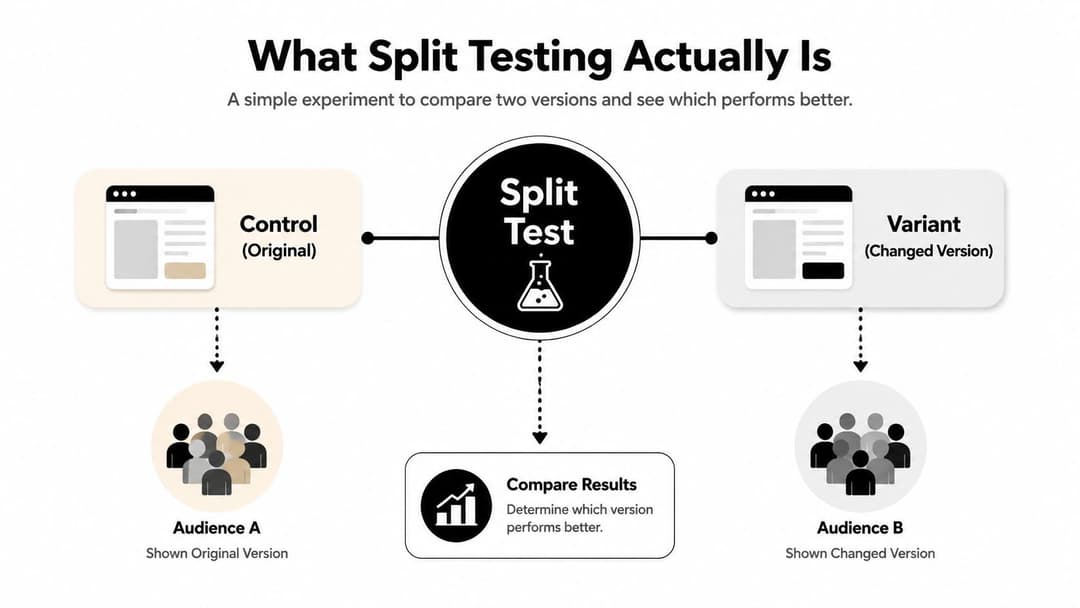
A Meta marketer has two promising video hooks and limited budget. Running both ads in the same ad set may reveal which one receives more delivery, but it does not guarantee a fair comparison. Split testing, also called A/B testing, is a controlled experiment that compares versions of an asset with similar audience groups and measures a defined outcome. Version A is the existing ad, known as the control. Version B is the changed ad, known as the variant.
Suppose both ads use the same primary text, audience, budget structure, landing page, and call to action. The opening hook in the video is the only difference. If the variant produces a better result on the selected metric, you have evidence about that hook. You do not automatically have evidence that the entire creative strategy, audience, or offer is better.
The main testing approaches
The terms below describe different ways to distribute changes and traffic:
- A/B testing: Compare one control with one changed version. It is the clearest starting point when you need to understand one variable.
- A/B/n testing: Compare a control with several challengers built around the same question. This can explore multiple creative options, but every added version spreads the available evidence more thinly.
- Multivariate testing: Change several variables at once and evaluate the combinations. It can expose interactions, such as one headline working only with one image, but it requires more traffic and careful analysis.
- Multi-armed bandit testing: Shift delivery toward versions that appear stronger while the experiment runs. This can support quicker allocation decisions, though the changing distribution makes the final comparison harder to interpret than a fixed allocation.
Meta creative exploration often resembles an A/B test without meeting the standard for a controlled experiment. Put several ads in one ad set and Meta may give them different delivery opportunities as its system optimizes. That approach can find promising creative quickly, especially with limited traffic, but it is directional evidence rather than a clean test.
The one-variable discipline
The practical rule is hold one meaningful variable constant, change one element, and measure one primary outcome. You might test a hook, headline, body copy, call to action, audience, or landing page. Choose the variable that matches the business question.
With high traffic, a fixed, isolated experiment supports a more rigorous comparison. With low traffic, a rapid directional test may be more useful, provided you label the result as a signal rather than proof. Either way, define what “better” means before spending.
Keep secondary metrics visible, but do not let them replace the primary metric after launch. A video may win on clicks yet lose on qualified leads. A lower cost per lead may hide weaker lead quality. Use supporting metrics to explain the result, while judging the test against the outcome that matters to the campaign.
The Statistics That Decide Your Winner
A dashboard can show a leader without proving that the leader has a repeatable advantage. Statistical testing helps you separate a likely signal from random variation, especially when the expected improvement is modest.
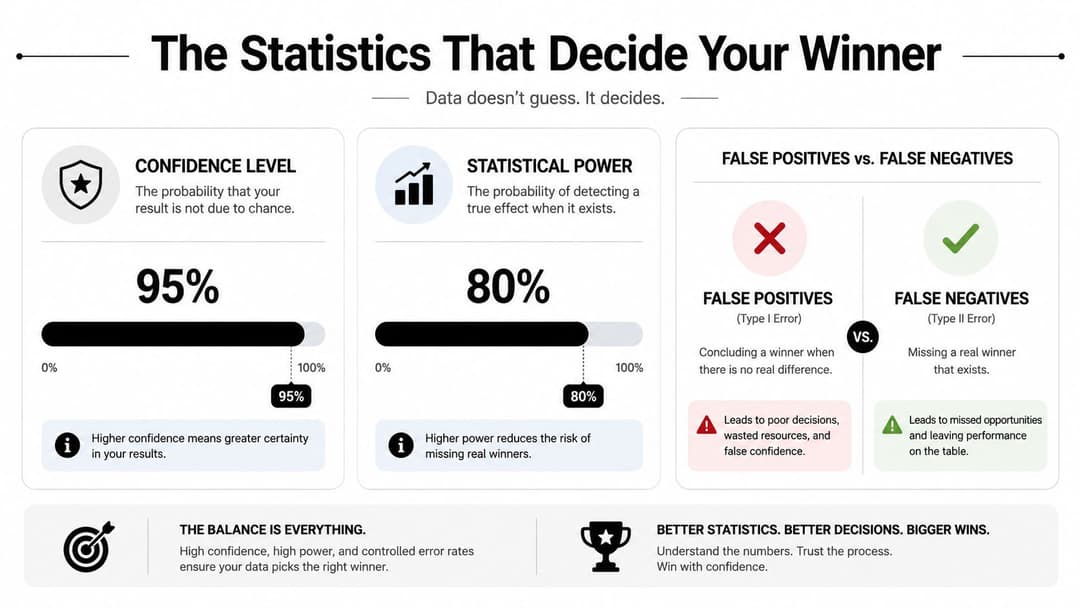
A standard well-powered design commonly uses 95% confidence and 80% power. That means the design accepts a 5% false-positive risk and a 20% false-negative risk. (Sample-size guidance for A/B tests)
- Confidence level: How much protection the test provides against incorrectly calling a difference real.
- Power: How capable the test is of detecting a genuine effect of the size you care about.
- False positive: You declare a winner even though the apparent difference is noise.
- False negative: The test fails to identify a real difference.
Sample size comes before launch
You need an expected baseline, a minimum effect worth detecting, the number of variants, and the chosen confidence and power settings before the test starts. Those inputs determine whether the experiment can answer the question at all.
A small sample can show a dramatic-looking gap that disappears with more data. A larger sample improves sensitivity to smaller effects, but it also costs time and spend. If your campaign doesn't generate enough conversions or meaningful events, the correct conclusion may be that the test couldn't distinguish the variants, not that both versions are equally effective.
The available benchmark data makes this caution concrete. Convert's analysis found that 36.3% of A/B tests produced a statistically significant winner at 95% confidence, while 22.1% produced a significant loser and 41.6% were inconclusive. Among winning tests, the median conversion-rate uplift was 1.88%, which illustrates why testing usually produces incremental gains rather than spectacular transformations. (Convert testing benchmarks)
Practical rule: Decide the sample size before the test starts, then let the experiment run according to that plan.
Don't repeatedly check the dashboard and stop as soon as the preferred version moves ahead. Early stopping can inflate false positives, particularly when the result is based on a small number of observations. If you need speed, choose a testing method designed for speed rather than changing the rules halfway through.
For high-volume campaigns, sequential testing can shorten time to decision because it doesn't fix the sample size in advance. Guidance suggests it fits situations where each variant has roughly 500 or more unique users and the priority is detecting major degradation quickly. Fixed-horizon testing remains preferable when strict control over Type I error matters. (Sequential and fixed-horizon testing)
For a deeper explanation of the language teams use around confidence and significance, see this guide to statistical significance.
A B, Multivariate, and Multi-Armed Bandit Compared
The best test type depends on three constraints: how much traffic you have, how quickly you need a decision, and how clean the interpretation must be. A strict A/B experiment isn't automatically the right choice for every Meta launch, and a fast directional test shouldn't be presented as definitive proof.
| Test Type | Traffic Needed | Decision Speed | Best for Meta When |
|---|---|---|---|
| A/B test | Enough traffic and conversions to compare two controlled variants | Deliberate and relatively slower | You need a defensible decision about one variable |
| Multivariate test | High traffic because several combinations divide the sample | Slower to interpret | You have a mature program and want to study interactions between creative elements |
| Multi-armed bandit | High-volume delivery that can support ongoing allocation changes | Faster directional allocation | You want to reduce exposure to clear underperformers while the campaign runs |
A/B testing is the default for clean learning
Use a controlled A/B test when the decision carries meaningful budget or strategic consequences. Meta's native experiment tools are suited to high-stakes comparisons because they can create a more deliberate test environment. The tradeoff is that you may wait longer for a reliable read.
A manual split can be useful for exploratory creative work. For example, you might compare several hooks to identify which ideas deserve formal testing. Treat the result as directional unless the audience, allocation, timing, and sample support a stronger conclusion.
Multivariate testing needs room
Multivariate testing changes more than one component and evaluates combinations. That makes it powerful for interaction questions, but it spreads traffic across many possible experiences. If your campaign has limited conversions, the test can become too thin to support useful conclusions.
Don't choose MVT because it sounds more advanced. Choose it when you have a specific interaction hypothesis, enough volume to support the combinations, and a decision that can't be answered through sequential A/B tests. Teams evaluating software for this workflow can compare ad variant testing software, but the tool won't solve an underpowered design.
Bandits optimize delivery differently
A bandit approach is closer to allocation optimization than a clean end-of-test comparison. The system can send more traffic to a promising variant, which may reduce wasted exposure, but the groups no longer receive the same fixed opportunity. That can make causal interpretation less straightforward.
The practical choice is often two-stage. Use rapid directional exploration to narrow the creative field, then use a stricter experiment for a high-stakes scaling decision. That approach respects both Meta's need for fresh creative and the analyst's need for credible evidence.
Setting Up a Split Test for Meta Ads Step by Step
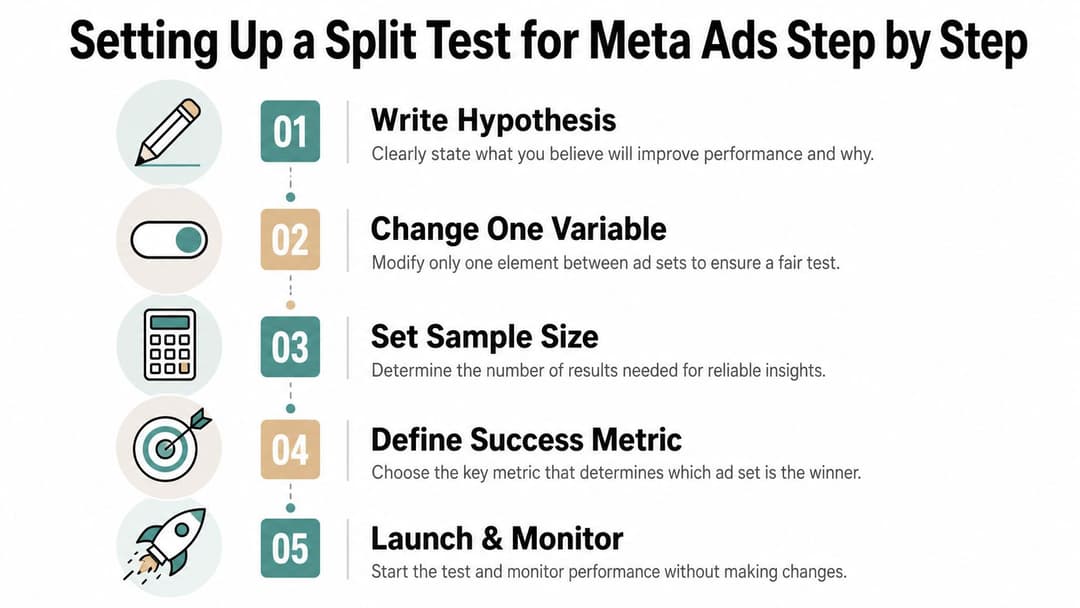
A strong Meta test starts before you open Ads Manager. Write down the decision, the variable, the audience, the primary metric, and the stopping rule while the outcome is still unknown.
Start with a falsifiable hypothesis
A weak hypothesis says, “This ad looks better.” A useful one says, “If we replace the product-first opening with a problem-first hook, the ad will produce more qualified leads while the audience, offer, destination, and optimization event remain unchanged.”
Your hypothesis should identify:
- The baseline: What the current control does.
- The change: The single variable you'll alter.
- The expected behavior: Why the audience might respond differently.
- The primary metric: The outcome that decides the test.
- The decision rule: What you'll do with a winner, loser, or inconclusive result.
Build a clean comparison
Use Meta's native Experiments tool for a high-stakes test when you need the cleanest possible separation. For fast creative exploration, a manual structure may be practical, but make sure the setup doesn't allow audience overlap or delivery dynamics to create a misleading comparison.
Keep the following fixed wherever possible:
- Audience: Use comparable and mutually exclusive groups.
- Budget logic: Avoid a setup that gives one variant an uncontrolled advantage.
- Optimization event: Don't change the event between versions.
- Destination: Keep the landing page constant unless the page itself is the test.
- Timing: Launch versions together and account for major external changes.
Use a pre-launch gate
| Check | Question to answer |
|---|---|
| Hypothesis | What specific behavior should change? |
| Variable | Have we changed only one meaningful element? |
| Sample | Can the available traffic support the intended decision? |
| Metric | Which outcome is primary, and which metrics are diagnostic? |
| Duration | What condition ends the test? |
| Action | What will we do if the result is positive, negative, or inconclusive? |
The test isn't ready if the team can't answer the last question. Pre-commitment prevents a strong early result from becoming an excuse to stop before the design has done its job.
For a practical walkthrough of creative setup, use this guide to A/B test Facebook ad creatives.
A visual checklist can help junior buyers follow the same process consistently. The video below adds operational context after the planning framework.
After the test ends, examine the primary metric first, then check downstream quality and segment behavior. A winner that only works for one narrow audience may be useful, but it shouldn't automatically become the new default for every campaign.
Pitfalls That Invalidate Your Results
Most failed tests don't fail because the creative idea was foolish. They fail because the experiment couldn't isolate the answer. The most common problems are operational, and teams often create them while trying to move faster.
Stopping at the first attractive result
Peeking feels responsible because you want to protect budget. In practice, repeated checks create more opportunities to mistake a temporary fluctuation for a durable difference. The remedy is simple: set the sample and duration before launch, then use a planned analysis rule.
Underpowered tests create the opposite problem. They divide limited traffic across variants that can't collect enough evidence, then force the team to choose between a noisy leader and an inconclusive result. Limited traffic was identified as the top challenge for statistically significant results by 51% of respondents, ahead of lack of resources at 47% and time-consuming execution at 38%. (Ascend2 marketing research report)
Contamination and novelty
Audience overlap can expose people to multiple variants, especially when teams build separate manual campaigns without a clear exclusion strategy. If the same person enters both groups, the response may reflect accumulated exposure rather than the tested variable.
Novelty can also inflate a new creative's early performance. A fresh hook may attract attention initially, then settle once the audience has seen it repeatedly. A second validation phase with a holdout group or extended tracking can help assess whether the apparent gain persists. Recent controlled-experiment guidance highlights premature stopping, cross-contamination, and multiple-comparison false positives as recurring failure modes. (Controlled-experiment pitfalls)
Too many variants for the budget
Testing several hooks, images, headlines, audiences, and destinations at once produces a large decision tree. Each branch receives less evidence, and the final result becomes difficult to explain. If the question is which hook works, don't add three headline styles to the same test.
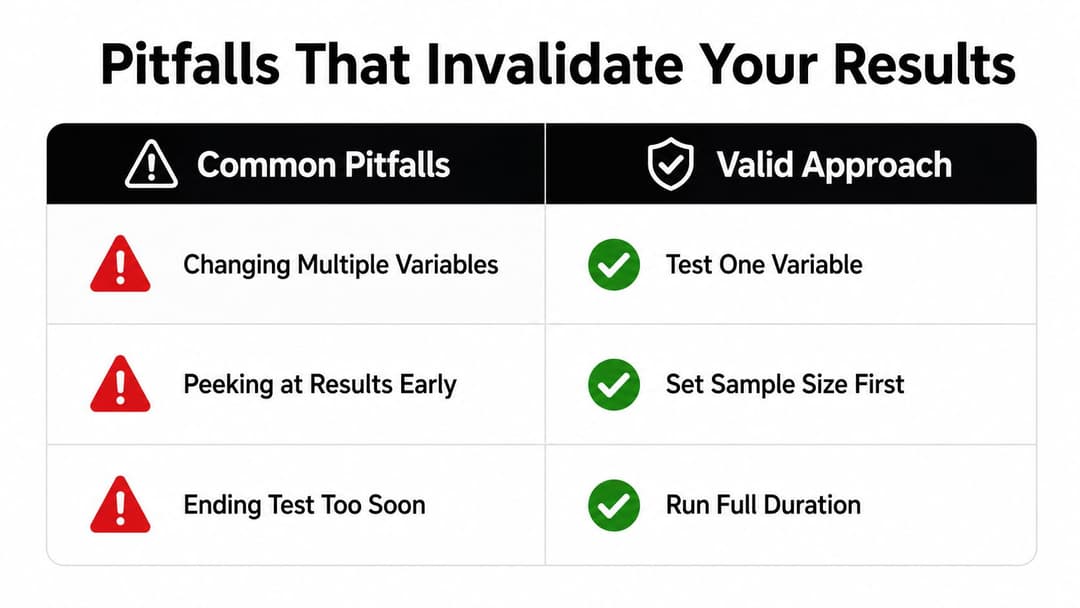
Defend the experiment with a short audit:
- One variable: Can you name the exact change?
- Exclusive exposure: Could a person have entered more than one group?
- Pre-commitment: Did the team define the stopping rule in advance?
- Multiple comparisons: Did you adjust your interpretation for the number of variants?
- Persistence: Has the result survived beyond the initial novelty period?
If the answer to several of these is no, label the result directional, not conclusive. That distinction protects future budgets and keeps your learning database honest.
How Automation and AI Speed Up the Testing Loop
A Meta team can lose days building ad variations before learning which idea deserves more traffic. Automation shortens that production loop by generating combinations of creative concepts, copy, headlines, and audiences, then organizing performance data around the business goal. See this guide to automated A/B testing workflows for a related process.
The practical gains fall into four areas:
- Production: Create multiple versions from a defined creative brief.
- Deployment: Prepare campaign structures and reduce repetitive setup work.
- Analysis: Rank combinations against ROAS, CPL, CPA, or CTR.
- Iteration: Carry promising patterns into the next hypothesis round.
That speed does not make an experiment valid. Software cannot fix audience contamination, compensate for too little traffic, or explain a result that shifts as the audience matures. The marketer still defines the question, isolates the variable, chooses the primary metric, and decides whether the result is a quick directional signal or evidence strong enough to support scaling.
AdStellar AI is one platform built for this workflow. It can generate and launch Meta creative, copy, and audience combinations, use historical performance, and surface combinations against goals such as ROAS, CPL, and CPA.
Use automation for repetitive production and monitoring. Keep the hypothesis, test design, interpretation, and scaling decision with the performance marketer.
Quick Wins and Common Questions
Use this seven-day operating plan:
- Day 1: Choose one hypothesis and one variable.
- Day 2: Set the primary metric, sample requirement, and decision rule.
- Days 3 to 5: Launch the test and resist unplanned changes.
- Day 6: Read the result against the pre-committed rule.
- Day 7: Validate persistence, document the learning, and scale carefully.
How long should a Meta test run? Long enough to collect the sample required by your design. Traffic volume, conversion rate, effect size, and the number of variants all affect duration, so there isn't one universal calendar answer.
What should you do when a test is inconclusive? Don't force a winner. Record the result, check implementation and contamination, then decide whether to gather more evidence, simplify the comparison, or test a stronger hypothesis.
Can you trust a winner from a small sample? Treat it as a directional signal. A small sample can justify a follow-up experiment, but it shouldn't support a major scaling decision without validation.
When does multivariate testing beat A/B testing? Use it when you have enough traffic for the combinations and a real interaction question. If you only need to compare two hooks, a controlled A/B test is easier to interpret.
AdStellar AI helps performance teams turn split-testing ideas into organized Meta experiments by generating variants, launching combinations, and ranking results against goals such as ROAS, CPL, and CPA. Visit AdStellar AI to see how the platform can reduce manual setup and keep your creative testing loop moving.