You're in the middle of a Meta Ads week where nothing feels current. One tab shows yesterday's creative performance, another has half-finished duplicate campaigns, and your spreadsheet already disagrees with Ads Manager because someone updated the wrong cell after lunch. That's the point where automated A/B testing stops sounding abstract and starts feeling like a way out of operational drag.
The shift isn't just that software can run more tests. It's that the system can carry some of the repetitive work you've been doing by hand, variant setup, traffic assignment, and result tracking, while you keep the strategic part. Done well, that changes experimentation from a slow reporting exercise into a live decision system, which is why teams looking at omnichannel execution keep circling back to practical resources like omnichannel retail A/B testing insights when they compare channels and measurement habits.
It also changes the kinds of mistakes people make. A faster experiment engine can surface winners sooner, but it can also make bad logic look polished. If you want a cleaner operating model around the output, a useful companion is automated client reporting, because the reporting layer is often where bad assumptions become visible first.
From Spreadsheet Chaos to Automated Experimentation
The manual version of experimentation usually starts with good intent and ends in copy-paste fatigue. A performance marketer has five campaigns open, three ad sets in motion, and a pile of creative variations that were supposed to answer one question but now answer five different ones badly. The numbers are copied into a spreadsheet, the spreadsheet is already stale, and the team is left arguing about whether the spike came from the creative, the audience, or the day of week.
That's the hidden tax of manual testing, not just slow execution, but weak learning loops. If the hypothesis is vague, the measurement is inconsistent, and the result gets declared before the data has settled, you don't really have an experiment. You have a guess with formatting.
Practical rule: if a test can't survive a busy week without someone babysitting it, the process is too fragile.
Automated experimentation exists to reduce that fragility. In practice, it helps teams create variants faster, keep assignment logic consistent, and capture results in a way that's easier to trust. That matters even more in ad environments where creative fatigue hits quickly and the team can't afford to rebuild every variant manually. A platform view of the same pattern shows up in A/B testing terms explained, which is useful when you're trying to separate experimentation vocabulary from actual operating behavior.
The market has also moved far enough that this isn't a niche workflow anymore. Industry estimates place the global A/B testing tools market at USD 850.2 million in 2024, with a projected CAGR of 14.00% from 2024 to 2031 (VWO statistics). Convert's 2026 analysis also shows how dominant structured experimentation still is, with 67.6% of experiments being A/B tests, while split URL tests account for 16.9% and multivariate testing stays below 1% (Convert analysis). That same dataset shows that 70% of CRO teams run tests to 95%+ statistical confidence, which tells you how much the field still values rigor over speed.
The point isn't that automation replaces judgment. It's that it gives judgment a better operating surface.
What Automated A/B Testing Means
Automated A/B testing is one label for a few different mechanisms, and that is where much of the confusion starts. Some tools automate variant generation. Some automate traffic allocation. Some automate analysis. A few handle all three, but none of them remove the need for a clear hypothesis or a decision rule that tells you when to act.
Manual testing follows a familiar rhythm. A person defines the idea, splits traffic, waits for significance, and writes up the result. Automated systems keep that same basic frame, then compress the work around it by suggesting variants, adjusting allocation, and flagging a likely winner while the campaign is still running.
The structure behind it matters. One research line describes automated experimentation with two layers, a design-time layer that declaratively defines what can vary, and a runtime layer that repeatedly generates, executes, and evaluates variants in a closed loop (Politecnico di Milano paper). That split helps separate planning from execution. You set the space of possibilities first, then the runtime system keeps working inside that space.
The cleanest way to think about it
Manual testing resembles driving with a paper map. You choose the route, stop to check the road, and make adjustments when traffic changes. Automated testing works more like a navigation system that can reroute while staying inside the destination you set.
The system is not smarter than you. It is better at repeated observation and response. In a Meta Ads workflow, that can mean generating ad creative variants, sending traffic to them, and evaluating which arm improves the metric you care about. It can also mean the system stays consistent when human operators are tired, because it does not forget which rule was set at launch.
A useful boundary to keep in mind, multi-armed bandits are a traffic-allocation strategy, not a substitute for experimental discipline. They can shift attention toward promising arms, but they do not remove the need to define the goal, guardrails, and stopping logic.
For terminology, A/B testing terms explained is a helpful companion if you are translating between platform language and experimentation language. And if you want a closer look at the inferential side, statistical significance guidance keeps “looks better” from becoming “is better” too early.
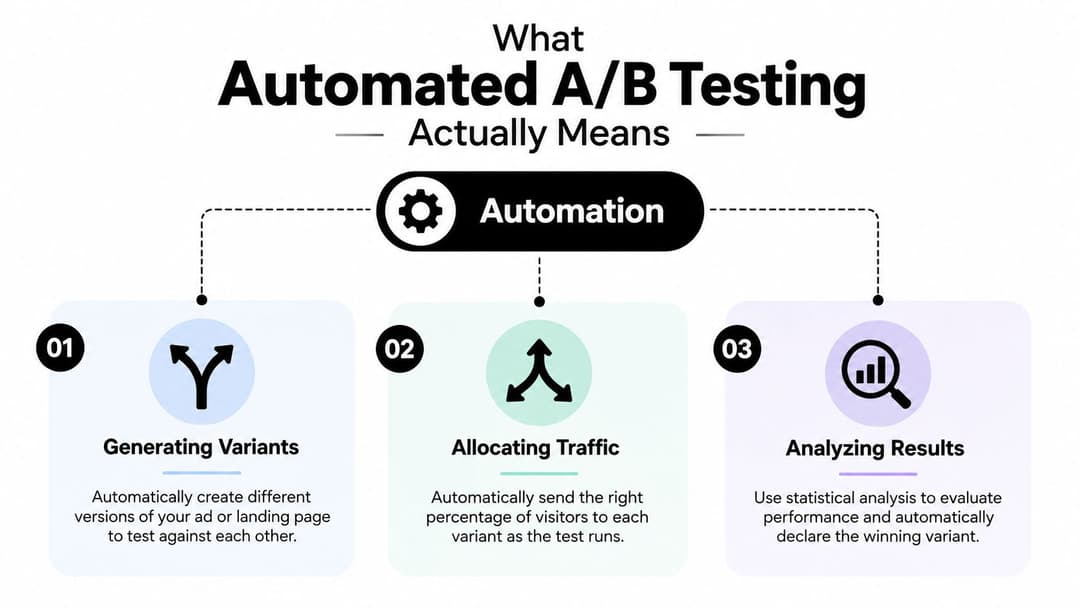
The Four Building Blocks of a Trustworthy Automated Testing System
Most bad automation doesn't fail loudly. It fails by giving you a confident dashboard that rests on shaky mechanics. If the same user can drift into different variants, if the ad or product experience doesn't respect the assignment, or if raw observations never make it into analysis cleanly, then the final “winner” is just a prettier version of a bad test.
Deterministic randomization
The first layer is deterministic randomization, usually implemented with hash-based bucketing so the same user lands in the same variant across sessions. That consistency matters because experimentation is about isolating cause, not chasing moving targets. If the assignment changes every time someone refreshes, you're not measuring a variant, you're measuring noise.
Assignment enforcement and the data path
The second layer is assignment enforcement, which makes sure the mapped variant is the one the person sees in the product or ad experience. The third is the data path, which records raw observations instead of only summary metrics, because summaries hide edge cases and make debugging much harder. A trustworthy system also keeps those services separate, so one failure doesn't contaminate the others (architecture guide).
The fourth layer is the decision engine. That's where statistical testing and business rules meet. One side checks whether the signal is real, the other side checks whether it's safe to act on. A campaign can be statistically interesting and still be a bad rollout if it hurts a guardrail metric or narrows performance in a way the business can't absorb.
A practical evaluation checklist for any automated testing vendor should ask four questions.
- Can it keep assignment stable? If a user is bucketed once, the system should respect that decision consistently.
- Can it prove exposure? The platform should know not just who was assigned, but who saw the variant.
- Can it expose raw data? Aggregates are fine for dashboards, but raw events are what let analysts debug anomalies.
- Can it separate significance from business judgment? A real decision engine needs both.
That's why automation without good plumbing is riskier than a manual test. It can make broken logic look more legitimate, because the interface is clean and the results arrive faster.
Wiring Automation Into a Meta Ads Workflow
A Meta Ads workflow gets clearer if you split it into two layers. The first layer handles the setup, which includes the hypothesis, the variables, and the guardrails. The second layer handles the running test, where the system creates combinations, reads performance, and keeps score while the campaign is live.
A solid workflow starts before any creative is generated. The marketer writes a hypothesis tied to a business goal, then defines which parts of the ad can vary, such as headline, primary text, image, CTA, or audience. That design step is where a lot of teams get lazy, because they want the tool to suggest the strategy for them. It won't.
A workable flow usually looks like this.
- Connect the account and historical data. The system needs prior performance context before it can suggest meaningful combinations.
- Define the test design. That means naming the variable, the success metric, and the guardrails before launch.
- Generate and launch variants in bulk. The automation pays for itself here, because the platform can create many combinations without manual duplication.
- Let the runtime system read performance. The engine can rank variants against the KPI and update learning as new data comes in.
For Meta teams, the gain comes from cutting down the handoffs. A secure account connection lets the platform ingest prior performance, then the launch layer can push creative combinations live without someone rebuilding every ad by hand. Media buying becomes a chain of repeated decisions, and media buying workflow automation helps reduce the friction in that chain.
What good automation does inside the workflow
It helps with bulk creative generation, while the marketer still owns the business objective. It can surface top creative patterns, but it should not override a brand constraint, such as avoiding a misleading CTA. It also keeps learning as data arrives, which matters more in a live campaign mix than in a frozen test environment.
AdStellar AI fits that pattern as one option for Meta teams, because it connects to Meta Ads Manager through secure OAuth, ingests historical performance, and uses AI Insights to rank creatives and audiences against goals like ROAS, CPL, or CPA. The value lies in shortening the distance between launch and learning.
Metrics That Matter and How Automation Surfaces Them
Automation is only useful if it points attention at the right metric. A team chasing the highest click-through rate can still ship weak economics, because clicks don't pay the bill by themselves. The clean way to handle this is to split metrics into three jobs, what decides the winner, what explains the winner, and what blocks a bad rollout.
Primary, secondary, and guardrail metrics
Primary metrics are the business outcome. In paid social, that often means revenue, CPA, or ROAS. Secondary metrics help explain why the primary moved, such as CTR or engagement depth. Guardrail metrics stop a variant from scaling when it damages another part of the funnel, like bounce rate or unsubscribe behavior.
| Metric Type | Purpose | Example Metrics | How Automation Helps |
|---|---|---|---|
| Primary | Decide the winner | ROAS, CPA, revenue | Surfaces the main decision signal and ranks variants against it |
| Secondary | Explain performance | CTR, engagement depth | Shows whether a lift came from attention, clicks, or downstream conversion |
| Guardrail | Prevent harmful rollouts | Bounce rate, unsubscribe rate, average order value | Blocks promotion when a variant helps one metric but hurts the business elsewhere |
The point of automation is not to collapse all of these into one score. It's to track them in parallel so the dashboard doesn't reward a shallow win. That's especially important when a creative arm gets early attention but starts to underperform once the novelty fades.
A well-built system also keeps the statistical engine in the background. In real programs, that means confidence thresholds, sample-size reasoning, and continuous updates to the readout rather than a single raw snapshot. Convert's 2026 data shows that the most common sample-size band is 10K to 50K visitors per test and that nearly half of CRO teams reach 99%+ confidence (Convert analysis). That's a strong signal that teams still want automation wrapped around rigor, not the other way around.
For teams choosing a platform, campaign performance metrics is a useful way to align vocabulary before anyone argues about dashboard color instead of test design.
Where Automation Breaks and What to Watch Out For
A Meta Ads account can look healthy on paper and still be producing bad decisions. Automation makes that risk easier to hide, because it can sort variants, reallocate budget, and surface a clean-looking winner before the test has earned a real signal.
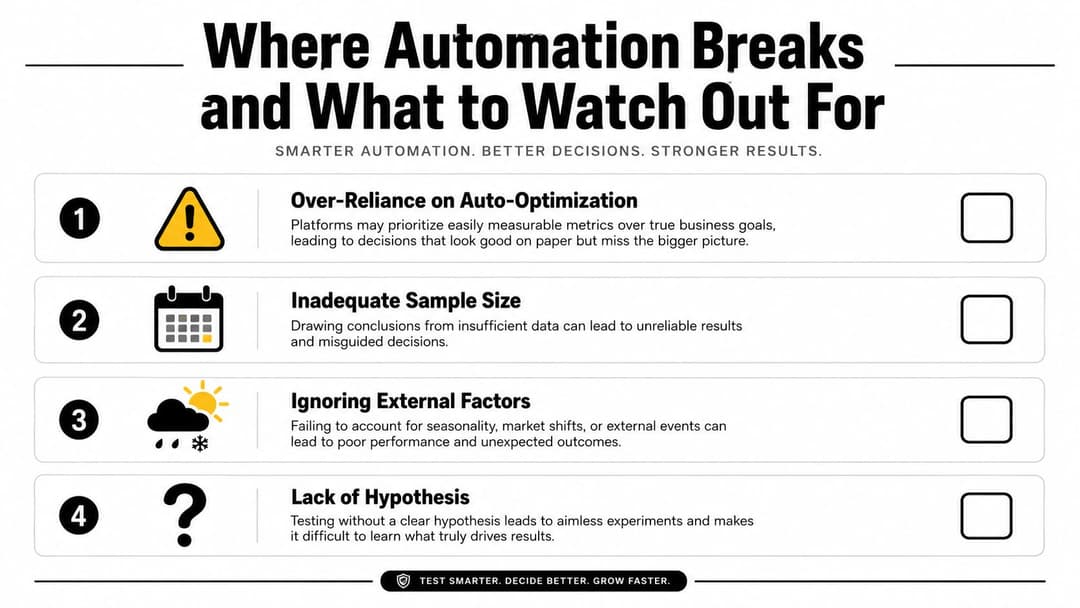
The failure modes that matter most
- Over-reliance on auto-optimization. Platforms often favor the metric they can observe most easily, even if that metric says little about revenue quality.
- Inadequate sample size. A test with too little data can still flash a convincing lift when the line happens to jump early.
- Ignoring external factors. Seasonality, promotions, and shifts in demand can make a weak variant look strong for reasons that have nothing to do with the test.
- Lack of hypothesis. Without a clear reason for running the test, automation only collects outcomes. It does not create learning.
The problem gets worse when teams treat AI as a substitute for experimental thinking. Tools can suggest variants, flag underpowered tests, or surface patterns faster than a spreadsheet workflow, but they do not fix the logic of the experiment itself. Crazy Egg guidance still comes back to the same basics, a clear hypothesis, primary and guardrail metrics, and a test duration that reflects sample size instead of impatience (Crazy Egg guidance).
Guardrails worth insisting on
A mature team sets limits before launch. Stop a test only when the decision rule says it is ready, not because the chart looks tidy. Keep a variant from graduating if it lifts one channel metric while hurting downstream quality. Require an assignment method you can explain to someone who was not in the room when the test was built.
The same discipline shows up in a concrete campaign ad example, where the workflow matters as much as the creative itself.
If the experiment cannot answer “why did this win?” it is too early to call it a learning system.
Automation helps teams move faster, but judgment still defines the boundary between a useful result and a false winner. The system can rank what happened. It cannot decide whether the result deserves trust without the guardrails around it.
Real-World Examples of Automated A/B Testing in Action
A DTC brand with enough Meta spend can use automation to test creative breadth quickly. The usual setup is a large batch of creative combinations, then a system that scores early performance and shifts more delivery toward the variants that show promise. The useful guardrail is simple. The team keeps the primary metric fixed, so early click activity cannot override evidence tied to revenue.
A B2B SaaS team uses the same machinery with a different threshold for success. Traffic is smaller, intent is higher, and a demo request only matters if the lead quality holds up after the form fill. Guardrails matter more than raw sign-up volume, so the team has to resist calling a winner just because one landing page produces more submissions. The decision rule is usually slower here, because the account cannot afford a false positive.
A concrete campaign build helps make that workflow easier to picture, and this campaign ad example shows how the pieces can be assembled in practice.
The pattern across both cases is the same. Automation helps generate and route variants, but the team defines the stopping rule, the primary metric, and the guardrails before launch. In Convert's analysis, many experiments still sit in the 10K to 50K visitor range (Convert analysis), which fits the reality that teams still need enough traffic to separate signal from luck.
Adopting Automated A/B Testing Without Burning Trust
Adopt automation only if your team already respects test hygiene. If the hypothesis is weak, tracking is sloppy, or people stop tests whenever the dashboard flatters them, automation will just produce confident noise faster. If the process is disciplined, it becomes a force multiplier.
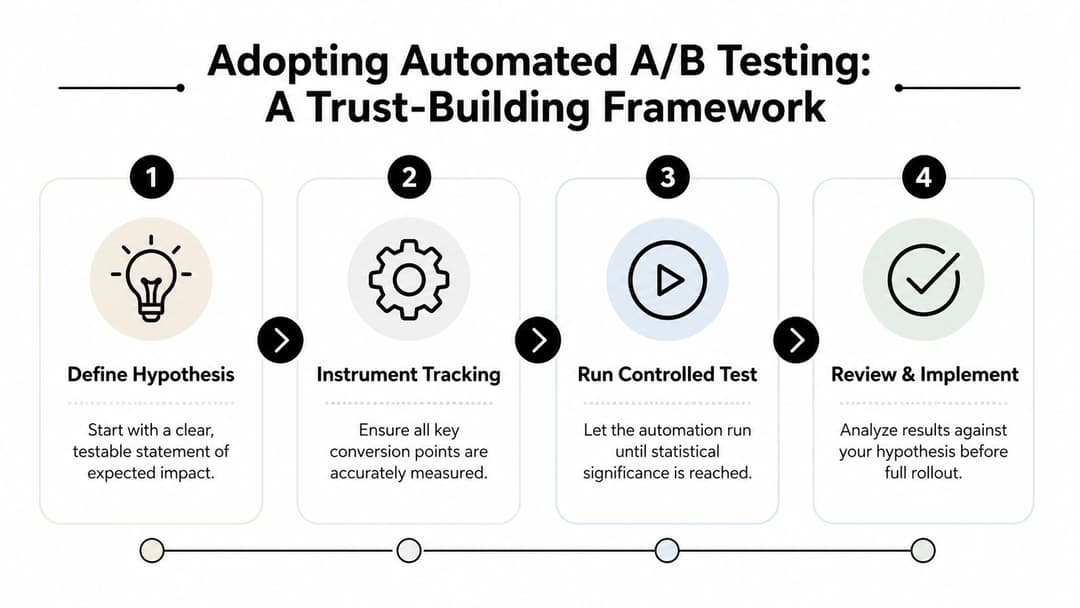
The adoption checklist is simple. Define the hypothesis first. Instrument the primary and guardrail metrics before launch. Run the experiment until the evidence is strong enough to support the call. Review the result against the original question, not against whichever chart looks nicest.
The future is moving toward more rigorous automation, not less. That includes simulation-based experimentation and more advanced automated methods, but the direction of travel is clear, better validity, not just faster output (Crazy Egg guidance). Teams that stay honest about guardrails will move faster with less waste. Teams that skip the discipline will just learn the wrong lesson sooner.
If you're ready to run Meta experiments with more structure and less manual duplication, AdStellar AI gives you a way to launch bulk creative variations, read performance back into the system, and rank winners against the metrics that matter. Visit AdStellar AI to see how automated testing can fit into a real media buying workflow without turning your team loose on guesswork.