Your team has strong campaign ideas, but the work gets swallowed by production. Someone resizes the same concept for Feed, Stories, and Reels. Another person creates copy variations, a designer handles revisions, and a media buyer rebuilds the campaign in Ads Manager. By the time approvals are complete, the next test is already overdue.
A Facebook ad creative tool can remove very different bottlenecks. Some generate image, video, copy, and UGC variations. Others personalize catalog ads from product feeds, score creative before launch, enforce brand rules, or connect production directly to Meta publishing and optimization. Choosing the wrong category can leave you with more assets but no better testing process.
This list compares 10 Facebook ad creative tool options for 2026 by the workflow problem they solve, production model, scale, pricing transparency, strengths, limitations, and relationship with Meta Ads Manager. It also considers creative volume, feed requirements, analytics depth, governance, publishing permissions, and human review. If your team is also exploring AI-generated advertorial formats, generating advertorials with Landra is a related production workflow worth separating from campaign management.
1. AdStellar AI for fast, data-backed Meta execution
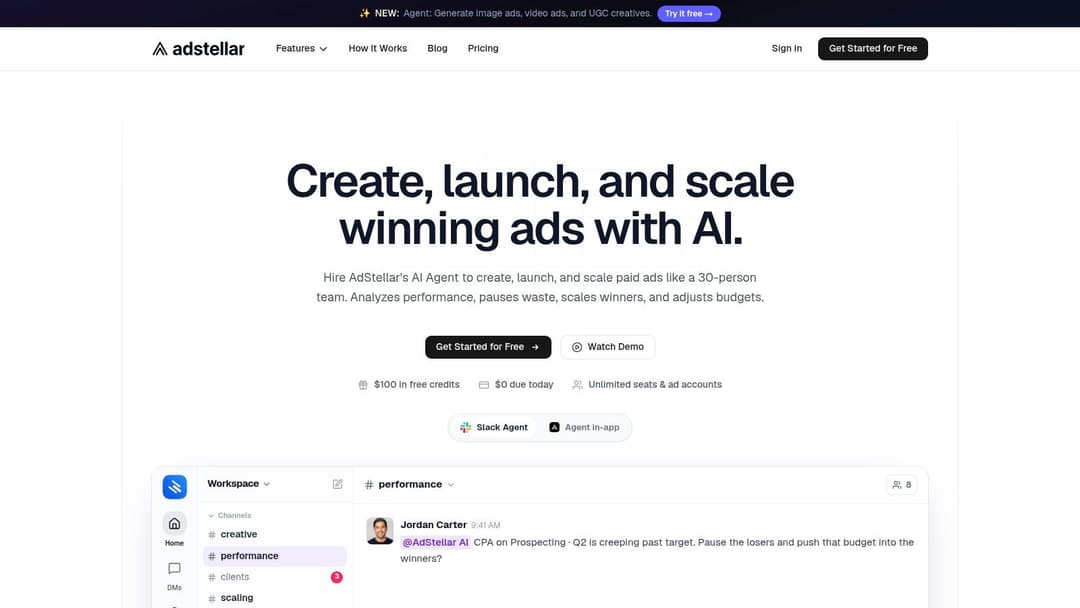
AdStellar AI is built for teams that don't want creative generation, campaign setup, and performance analysis scattered across separate tools. It connects with Meta Ads Manager through secure OAuth, brings historical performance into the workflow, and helps generate large batches of creative, copy, and audience combinations for testing.
That makes it a strong fit for performance marketers, agencies, e-commerce teams, scaleups, and B2B SaaS teams that already know what they want to test but lose time assembling campaigns manually. The platform's AI Insights can rank creatives, audiences, and messages against business metrics such as ROAS, CPL, and CPA, while AI Launch can use proven winners as inputs for new campaign builds.
Where it fits best
AdStellar's advantage is workflow continuity. A media buyer can work across campaigns, creatives, audiences, the media library, and performance breakdowns without exporting every decision into another system. The platform can generate image ads, video ads, and UGC-style avatar creatives, then move selected combinations toward bulk launch in Meta.
The AdStellar AI features are most useful when the team has enough historical data to guide prioritization. A new account with little conversion history may still benefit from faster production, but its rankings should be treated as directional rather than final judgment. Human review remains necessary for claims, brand voice, visual quality, landing-page alignment, and policy risk.
Practical rule: Use AdStellar to expand and organize your testing pipeline, not to replace the strategy behind the test.
The trade-off is focus. AdStellar is designed specifically for Meta, including Facebook and Instagram placements, so it isn't a broad cross-channel buying platform. Pricing, customer testimonials, and third-party certifications aren't publicly listed on the supplied product information, so teams should request a demo and confirm permissions, account connections, usage limits, and reporting requirements before committing.
2. AdCreative.ai for rapid concept generation
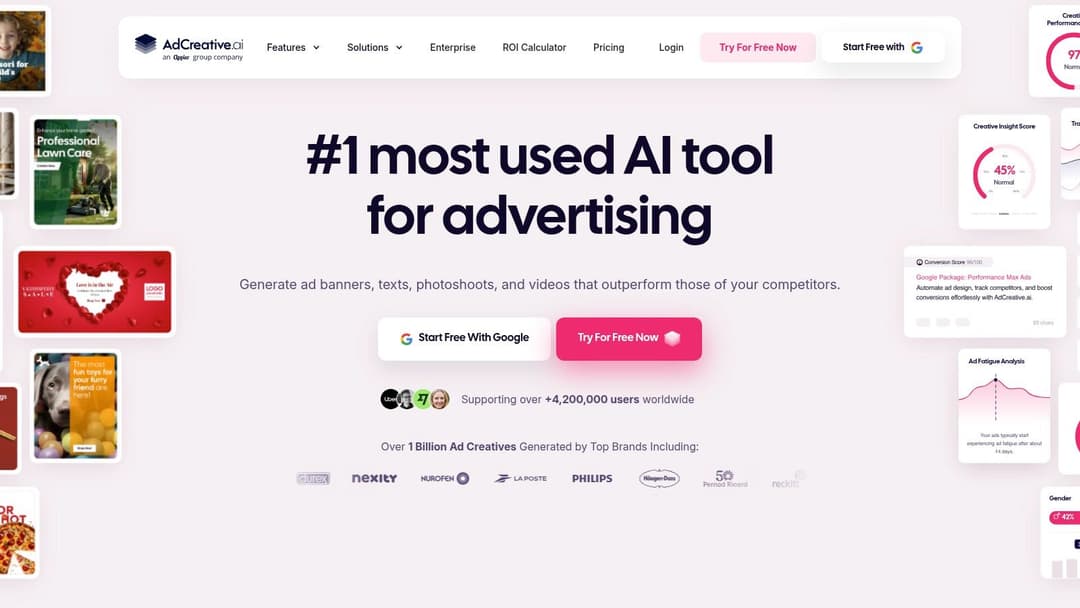
AdCreative.ai suits teams that need a steady stream of static ads, video concepts, and copy without building every variation from scratch. Its workflow combines AI generation, templates, stock assets, Meta integrations, and pre-launch creative insights, giving smaller performance teams a faster starting point for iterative production.
The platform is particularly useful when the bottleneck is the first draft. A marketer can provide a product, offer, or brand direction, then develop multiple visual and messaging routes before selecting assets for refinement. Its coverage of common Meta formats helps reduce the need to manually prepare every size.
The volume trade-off
AdCreative.ai's generation model is attractive for teams that want to explore many directions quickly. Plans offer AI generations with credit-based downloads, and selected plans include bundled stock access through iStock. The platform also provides creative insight scoring before launch, which can help a team reject obviously weak candidates before paying to distribute them.
However, teams should distinguish between generation volume and usable production volume. AI can produce a large set of starting points, but brand-specific language, offer details, product accuracy, and visual polish still need review. Credit and download mechanics can also become more important as production volume grows.
For a solo marketer or small in-house team, that trade-off may be acceptable because the tool reduces blank-page work. For a mature creative department, the main question is whether its outputs fit existing approval and asset-management systems. Teams comparing platforms can also review this AdCreative.ai alternative for Meta workflows when direct campaign execution matters as much as asset generation.
Visit AdCreative.ai to confirm current plan limits, integrations, and how its insight scoring fits your review process.
3. Smartly.io for enterprise feed-driven production
Smartly.io is designed for organizations that need to create, personalize, publish, and optimize large paid-social programs across markets and channels. Its strongest use case isn't producing one clever ad. It's operating a structured system of templates, product feeds, market adaptations, dynamic product ads, and campaign automation.
For a global e-commerce brand, the platform can connect creative templates to feeds or spreadsheets, then produce variations based on product information, market, language, or placement. That approach reduces repetitive production when the campaign needs many combinations that follow consistent design rules.
A production system for large teams
Smartly.io also brings media buying and creative operations closer together. Teams can manage automated ads, dynamic creative optimization, and cross-channel creative insights in one environment rather than handing every adaptation between design, media, and operations. Its predictive creative capabilities can help prioritize assets, but the value depends on how well the organization has defined its data and governance model.
The limitation is complexity. Smaller teams may find the breadth of the platform difficult to justify if they only need occasional Meta creative generation. Pricing isn't publicly listed, and the buying process is typically enterprise-led, so the evaluation should cover onboarding, feed maintenance, user roles, approvals, and implementation support rather than just template features.
Smartly.io works best when creative variation is an operational requirement, not an occasional request from a media buyer.
A brand running multiple markets, product categories, and formats may accept the heavier setup because manual adaptation creates more risk. Teams with a narrower remit should compare the platform against a simpler Meta workflow in this Smartly.io alternative for small teams discussion. Learn more at Smartly.io.
4. Madgicx for an all-in-one Meta workflow
Madgicx combines creative generation, performance insights, analytics, automation, and campaign management around Meta advertising. It suits teams that want to move from creative idea to launch and optimization without switching between a design tool, reporting layer, and Ads Manager for every task.
Its Creative Insights capability analyzes performance through creative attributes, helping marketers connect outcomes with elements such as format, message, or visual treatment. The AI Ad Hub then provides a route from inspiration to creation, testing, and launch. Custom automation can also support targeting, bidding, rotation, and optimization decisions.
That concentration is useful for a small growth team where the same people produce ads, monitor results, and adjust campaigns. Instead of exporting reports and manually translating observations into new tasks, the team can work inside a shared Meta-focused interface.
Where the all-in-one model can slow you down
The same consolidation can feel restrictive to specialists who prefer native Ads Manager workflows. A media buyer with established naming conventions, custom reporting, and carefully controlled campaign structures may not want another layer deciding how production and optimization should connect. Some capabilities also depend on connecting multiple ad or data accounts, so access requirements deserve attention before rollout.
Madgicx offers a free trial and spend-aware plan selection, but teams should still assess the complete cost of connected accounts, users, automation rules, and reporting needs. Its strength is convenience and concentration. Its weakness is that the platform may ask a mature team to adapt its process around the product.
Read the Madgicx pricing comparison alongside current plan details, then explore Madgicx if your priority is Meta-centered execution rather than a standalone design workspace.
5. Hunch for product-feed personalization
Hunch is a strong choice when the creative problem begins with a catalog, not a blank canvas. It creates and publishes personalized image and video ads from feeds, with support for dynamic product advertising, travel, retail, localization, and market-specific messaging across Meta and other social platforms.
Its template-based studio can use dynamic layers and AI resizing to adapt a controlled design system to products, languages, markets, and other feed values. That makes it more suitable for a retailer or agency managing many product groups than for a SaaS company promoting one central offer.
The feed is the real product requirement
A feed-driven platform can only be as reliable as the information it receives. Product names, prices, availability, images, destinations, and localized copy need to arrive in a form the templates can use. If the feed is incomplete or changes without clear ownership, creative errors can move into campaigns quickly.
Hunch's direct publishing workflows can reduce handoffs for agencies and multi-market brands. Hyper-localization is another practical advantage when each market needs its own language, offer, or dynamic element while retaining a shared visual system. The platform isn't the obvious choice for a team that mainly needs AI ideation without catalog logic.
Sales-led demos and private pricing mean buyers should ask to see the exact feed, localization, approval, and publishing workflow they plan to use. Review the Hunch Ads alternative if your team needs broader AI campaign construction, then assess Hunch for catalog-heavy programs.
6. Celtra for governed global creative operations
Celtra targets enterprise teams that need to generate, adapt, and distribute static, HTML5, video, and rich-media advertising across channels. For Meta advertisers, its value appears when a creative operation must support many markets, languages, formats, and catalog-driven variants while preserving central controls.
AI-assisted generation and preset prompts can help teams develop assets with campaign context. Automation can then scale creative across sizes, markets, and languages. Celtra also supports DPA and DCO workflows, with optional ad serving and packaging based on platform, scale, serving, and add-ons.
Governance before convenience
Celtra's strongest differentiator is control. Large organizations often need more than a generator. They need approved templates, clear ownership, regional permissions, repeatable packaging, and a record of how assets reached each channel. A centralized system can reduce the number of off-brand or technically unsuitable files that reach paid media teams.
That enterprise depth can be excessive for a Meta-only advertiser with a small creative library. Rich-media and ad-serving capabilities may add scope without solving the team's immediate bottleneck. Custom pricing also makes a direct comparison harder, particularly when the buyer only needs image and video adaptation for Facebook and Instagram.
Use Celtra when governance, global distribution, and format complexity justify a formal creative operating system. Don't choose it because it can generate more versions. Explore Celtra and ask for a proposal that separates core creative automation from optional serving and rich-media features.
7. VidMob for creative scoring and production guidance
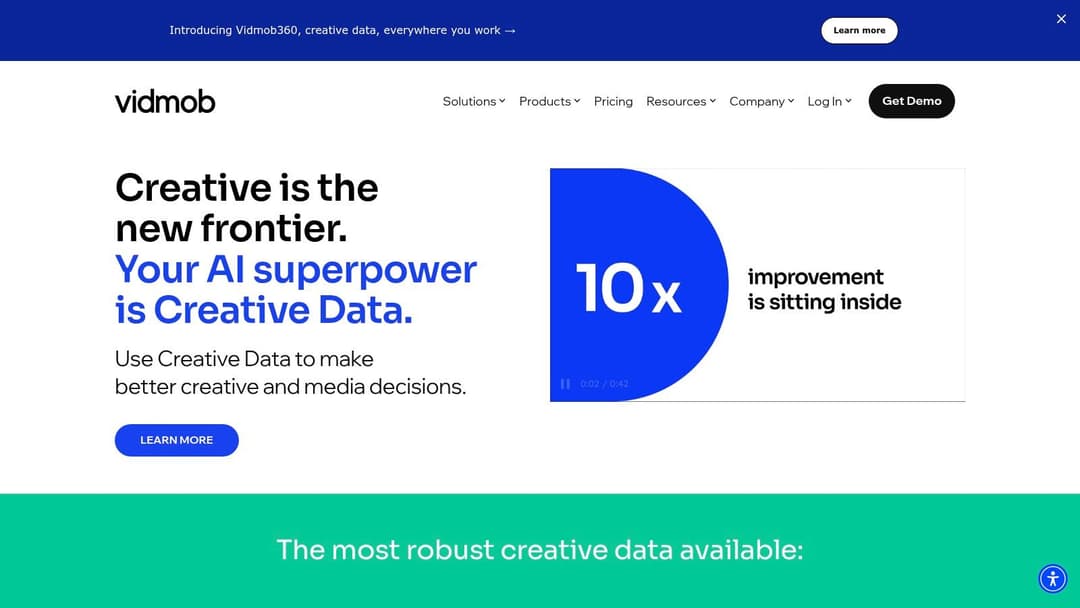
VidMob is built around the question many teams ask after launch: what should change in the next asset? Its platform combines AI creative analytics and scoring with a connected creative studio and managed creator or production network. That makes it a fit for advertisers that need actionable guidance, not just a larger folder of generated files.
The platform can score pre-launch and in-flight Meta creative against configurable guidelines, report with impression weighting, and connect recommendations to media outcomes. APIs can also bring scoring into existing workflows. A team might use those capabilities to check whether a new video follows its creative standards before spending behind it, then compare the in-market result with the original diagnosis.
Scoring only helps when someone acts on it
A score isn't a substitute for a creative decision. Teams need a clear path from recommendation to revision, approval, launch, and learning. VidMob can support that loop through its studio and managed network, but advertisers that already have strong production resources may use it primarily for diagnostics and governance.
The platform's subscription or project pricing is custom, so it may not suit very small budgets. It also emphasizes insight and scoring more than self-serve creation. Buyers should clarify whether they need software access, production support, creator sourcing, API integration, or a combination.
For brands with multiple teams or agencies, that distinction matters. A scoring layer can standardize judgment across contributors, while a production network can fill capacity when internal teams are overloaded. Learn about AI video production for fashion brands as a related production example, then evaluate VidMob against your existing creative review process.
8. CreativeX for brand and platform governance
CreativeX solves a different problem from AI generators. It helps large advertisers determine whether their creative meets brand and platform standards before and during distribution. Its Creative Quality Score and Creative Salience capabilities can assess the presence and consistency of cues such as logos, colors, and sounds across a large library.
That is valuable when a brand works with multiple agencies, markets, and internal teams. A central quality layer can identify assets that technically exist but fail to show the brand clearly, use the wrong treatment, or fall outside an approved framework. The result is better control over what reaches Meta campaigns.
A quality layer, not a design editor
CreativeX doesn't replace the people who develop concepts, edit video, write copy, or build templates. It works best alongside an existing production stack. The platform can evaluate and monitor creative, but the team still needs a designer, editor, or agency to fix the issue it identifies.
This separation is useful. It prevents governance software from pretending to solve production, while allowing brand leaders to define standards that media teams can apply consistently. It also helps organizations distinguish between a creative that is compliant and one that is strategically strong. Passing a brand check doesn't guarantee performance.
CreativeX is enterprise-oriented, with sales-led pricing that isn't publicly listed. Smaller teams may find a lighter approval process sufficient. Large organizations should assess global visibility, agency access, pre-flight evaluation, in-flight monitoring, reporting, and how the Creative Quality Score maps to internal standards. Visit CreativeX when governance is the primary workflow problem.
9. Pencil for accessible end-to-end experimentation
Pencil combines generative AI for text, image, and video ads with campaign activation, tracking, predictive insights, and bulk feed workflows. It occupies a middle ground between a lightweight creative generator and an enterprise production system, making it relevant to solo marketers, small teams, agencies, and organizations that want room to scale.
Its AI agents can generate ads and resize them for common ratios. Teams can launch and track campaigns on Facebook, Instagram, and other channels, then use performance insights and scoring to inform the next batch. Feed-based production adds a route to higher-volume catalog work without requiring every variant to be built by hand.
A useful entry point with real limits
Pencil's low-entry pricing makes it easier for a small team to test an end-to-end workflow before pursuing enterprise controls. Larger accounts can add features such as bulk feeds, SSO, and governance. That progression is useful when the organization expects its process to become more structured over time.
The trade-off is quota management. Lower tiers apply generation limits, so a team producing many concepts or repeated refreshes should model usage rather than judge the tool from a small pilot. Advanced creative still benefits from designer oversight, especially for regulated claims, product demonstrations, UGC-style assets, and detailed brand systems.
Pencil is a sensible option when you want ideation, production, activation, and measurement in one place but don't need the heavier governance model of a global enterprise platform. Review Pencil with a test that includes your actual formats, approval steps, and Meta publishing permissions.
10. Bannerwise for practical social dynamic ads
Bannerwise focuses on scalable design and feed-driven personalization rather than acting as a general-purpose AI generator. Its social dynamic ad support lets brands and agencies build Facebook and Instagram product-feed creatives from templates, then scale variants while retaining control over the visual system.
That makes it a good fit for retailers, travel companies, agencies, and catalog advertisers that need product-level personalization without building a custom engineering workflow. A team can define the design once, map feed values to dynamic elements, and distribute variations across supported networks.
When control beats generative range
Bannerwise is useful when the team knows what the ad should look like and needs the system to produce consistent versions. It can help preserve brand presentation across personalized ads, especially when product images, names, prices, or other catalog values change frequently. The platform's broad ad-network compatibility also helps agencies that manage more than Meta.
It won't replace an AI creative ideation tool for teams seeking new visual concepts, narrative directions, or generated video. Creative analytics are lighter than those of dedicated scoring platforms, so performance diagnosis may need to happen in Meta Ads Manager or another intelligence layer.
Public pricing tiers that include social dynamic ads make Bannerwise easier to evaluate than many enterprise alternatives. The right pilot should use a representative feed, real product imagery, and the exact personalization rules the campaign needs. Compare Bannerwise with the cost of manual catalog adaptation and the operational risk of inconsistent templates.
Top 10 Facebook Ad Creative Tools Comparison
| Product | Key features | Target audience | Unique selling points | Ease of use | Pricing |
|---|---|---|---|---|---|
| AdStellar AI (Recommended) | Bulk AI creative/copy/audience generation; historical Meta ingestion; AI Insights & auto-launch | Performance marketers, growth teams, e‑commerce/DTC, agencies, B2B SaaS | One-click publishing of 100s of variants; AI ranking + auto-scaling winners; centralized workflows | Fast setup via Meta OAuth; best with historical data & oversight | Sales/demo required; pricing not public |
| AdCreative.ai | AI static & video creative + copy; pre-launch scoring; ad platform integrations; stock assets | Small teams to agencies needing fast creative iterations | High-volume generation; pre-launch insights; bundled stock access | Easy to ramp; credit/download model at scale | Tiered plans; credit/download limits (public) |
| Smartly.io | Template-driven creative automation; DPA/DCO; feed-powered personalization; cross-channel | Enterprise & large agencies running multi-market social at scale | Proven for large-scale feed-driven programs; combines production + buying | Powerful but steeper onboarding for smaller teams | Enterprise sales-led pricing (custom) |
| Madgicx | Creative insights; AI Ad Hub; automation for targeting/bidding; consolidated analytics | Meta-first advertisers wanting all-in-one ad management | Tight integration of creative intelligence + optimization; consolidated UI | Moderate learning curve; offers free trial | Spend-aware tiers; trial available |
| Hunch | Template studio with dynamic layers; feed-fueled dynamic ads; hyper-localization | Agencies and brands running multi-market/product-feed campaigns | Strong localization & market-specific variants; direct publishing | Sales-led demo; built for feed-structured ops | Sales-led pricing (not public) |
| Celtra | Enterprise creative automation for static/HTML5/video; governance; optional ad serving | Global enterprises and large creative ops teams | Robust governance, packaging, and ad-serving options for large rollouts | Feature-rich; can be complex for small teams | Custom enterprise pricing |
| VidMob | Creative scoring & analytics; pre-/in-flight checks; studio + managed creator network | Brands wanting data-driven creative improvements and production support | Actionable guidance tied to media outcomes; scoring + production services | Enterprise workflow; integrates with teams or uses in-house studio | Subscription/project-based custom pricing |
| CreativeX | Centralized creative governance; pre-flight checks; Creative Quality Score (CQS) | Large advertisers, multi-market brands, agency ecosystems | Enforces brand cues at scale to reduce off-spec spend | Lightweight to integrate with existing stacks (not an editor) | Enterprise sales-led pricing |
| Pencil | GenAI ad generation (text/image/video); bulk feed workflows; campaign launch & tracking | Solos, small teams, and scaling enterprises | Low-entry pricing; end-to-end ideation → activation; bulk scaling | Easy to start; generation quotas on lower tiers | Transparent low-entry tiers; enterprise options |
| Bannerwise | Creative management for social-dynamic & feed ads; template personalization | Brands & agencies running DPA/personalized Facebook/Instagram ads | Practical DPA tool without heavy engineering; on-brand scaling | User-friendly for feed-driven creatives; not AI generator | Public pricing tiers available |
Build a Testing System, Not Just a Bigger Asset Library
The best tool depends on where your workflow breaks. Choose an AI-generation platform when your team has strong concepts but can't create enough image, video, copy, or UGC variations. Choose a feed-driven platform when catalog products, localization, or market-specific personalization drive the workload. Choose scoring and governance tools when the main risk is off-brand, off-spec, or poorly adapted creative reaching paid media.
An end-to-end Meta platform makes more sense when production, publishing, campaign setup, and optimization need to operate together. AdStellar AI is relevant in that category for Meta-focused teams that want bulk generation, historical-performance insights, one-click publishing, and continuous learning in one workflow. Its Meta-only focus is a limitation for teams that need one cross-channel operating system, and the quality of its prioritization depends on usable data and human oversight.
Before signing a contract, ask practical questions rather than comparing feature counts:
- Data readiness: Can the platform connect to the right Meta accounts, historical results, catalogs, and conversion signals?
- Creative responsibility: Who reviews claims, branding, accessibility, product accuracy, and policy risk before publishing?
- Publishing permissions: Can the tool publish directly, and can your team control account access, approvals, naming, and rollback?
- Feed maintenance: Who owns product feeds, localization fields, image quality, price updates, and error handling?
- Reporting depth: Can the platform separate creative performance from audience, placement, offer, and campaign effects?
- Pricing structure: Are costs based on users, generations, downloads, media spend, impressions, feeds, serving, or custom enterprise scope?
Testing also needs discipline. Independent benchmark-style guidance recommends at least 400 to 500 impressions per creative for CTR assessment, 15 or more lead events per creative for CPL analysis, and a 7 to 14 day test window to reduce noise from learning effects and day-of-week variation, as described in the Meta creative testing framework. Those are practical thresholds, not guarantees. A low-volume campaign may need a longer learning period, while a high-volume campaign may reach a useful directional signal sooner.
Meta's creative tooling has moved from simple asset rotation toward guided, AI-assisted production. Meta says Ads Creative Studio can analyze assets across ad sets, group images or videos into creative styles, generate new media assets, and identify performance trends and recommendations. Meta also reported that 9 million small businesses were using at least one AI ad creative tool, with those tools associated with an 8.3% increase in ad clicks and a 15.7% uplift in Facebook conversions in its Q2 2026 earnings coverage, as summarized in Meta's creative tools documentation. Treat those figures as Meta-reported platform data, not a promise for your account.
The practical workflow is straightforward. Define the campaign objective and primary success metric. Produce controlled variations that change a meaningful lever, such as the hook, offer, format, visual treatment, or audience message. Review every asset for brand and platform fit. Launch a focused test, evaluate performance against the chosen metric, document what changed, and feed the learning into the next creative cycle.
Meta's placement direction makes that last step more important. Its newer workflow supports placement customization and multiple media, while updates emphasize AI video generation, video expansion, AI-generated stickers for calls to action, and trend-aware placement tools. Independent coverage reports that 86% of surveyed DTC advertisers planned to increase AI use for research and ideation in 2025, 79% planned to expand AI in creative production, and 71% planned to increase investment in Meta ads, according to the Meta creative workflow reference. The operational question is no longer just how to make one Facebook ad. It's how to create enough placement-native variants without losing brand consistency or wasting budget on formats that don't suit the surface.
AdStellar AI is a practical option when the answer requires bulk creative production connected to Meta launch and performance feedback. Start with a controlled pilot, verify account permissions and data quality, assign human review, and judge the platform by whether it helps your team produce better next tests, not merely more files.
AdStellar AI helps Meta-focused teams generate creative, copy, and audience combinations, use historical results to prioritize campaigns, and move selected winners toward bulk publishing and continuous optimization. If that matches your production bottleneck, visit AdStellar AI to explore a workflow built around faster variation, clearer performance insight, and repeatable Meta execution.