You publish a campaign, watch the first impressions arrive, and wonder who's really making the decisions. You chose the objective, uploaded the creative, defined the audience, and set the budget. After that, Meta decides which person sees the ad, where the impression appears, which variation runs, and how much of the available opportunity your campaign receives.
That handoff is the practical meaning of Meta AI ads. Meta's system doesn't replace your marketing strategy. It interprets the signals you provide, predicts which impression is most likely to produce the selected action, and continuously reallocates delivery inside its auction. The strongest results come from understanding that boundary, then giving the system useful inputs and clear guardrails.
The Moment Your Ad Enters Meta's AI Auction
At the exact moment you click Publish in Ads Manager, your campaign object moves from a set of human choices into Meta's delivery system. The platform checks eligibility, considers available placements and users, and begins predicting where your ad has the best chance of producing the outcome tied to your campaign objective.
Meta's AI receives several categories of input:
- The objective, such as sales, leads, traffic, or engagement.
- Audience signals, including customer lists, lookalike inputs, location settings, age controls, and any permitted exclusions.
- Creative assets, including images, video, text, format, destination, and variations.
- Budget and bid instructions, which establish how aggressively the campaign can compete.
- Conversion signals, supplied through your pixel, Conversions API implementation, app events, or other measurement choices.
- Quality and predicted action signals, which help Meta estimate whether a person is likely to respond positively and complete the desired action.
The model then evaluates eligible opportunities across Meta's surfaces. This process is not a single campaign-level decision. It's a continuous sequence of impression-level predictions, and the ranking logic is described in practical terms in this guide to how ads ranking works.
Practical rule: Automation can distribute a strong input efficiently, but it can't rescue a vague offer, a broken event, or a creative portfolio that gives people no reason to act.
Your role doesn't end at launch. You establish the business goal, define acceptable constraints, supply the creative and conversion evidence, and decide what counts as a qualified result. Meta's AI handles much of the moment-to-moment distribution. The quality of that handoff depends on how clearly you've defined the inputs.
Three building blocks explain most of the advertiser-facing automation: Advantage+ Campaign, Advantage+ Audience, and Advantage+ Creative. Together, they show where human judgment stops and machine-led delivery begins.
The Three Building Blocks of Meta AI Ads
Meta's AI features can look like a long list of toggles, but three controls explain the core workflow. Each one automates a different part of the campaign, while leaving the advertiser responsible for the raw material and the business rules.
Advantage+ Campaign
Advantage+ Campaign is the broadest automation layer. It can select placements, work with audience signals, and combine creative options across up to 150 creative variants per ad set, as described in Meta advertising guidance and discussed in resources covering the elements of an ad.
Suppose an online retailer has product videos, lifestyle images, customer-focused copy, and several product feeds. The marketer supplies those assets, chooses a sales objective, sets the conversion event, and defines budget boundaries. Meta then tests combinations across eligible placements instead of requiring the marketer to build a separate ad for every possible pairing.
Advantage+ Audience
Advantage+ Audience treats detailed targeting as a starting signal rather than a permanent wall for many performance objectives. You might provide a customer list, a lookalike source, location rules, or a set of interests. Meta can then expand or contract delivery when its predictions indicate that another person may be more likely to convert.
For example, a subscription brand could upload its customer list and provide a broad prospecting audience. The seed helps the system understand the intended customer profile, but the delivery model can search beyond the marketer's initial assumptions. The marketer still controls exclusions, geography, sensitive-category restrictions, and the conversion event.
Advantage+ Creative
Advantage+ Creative adapts approved assets for different placements. Depending on the available options, Meta can adjust aspect ratios, brightness, text overlays, or music so that an asset fits a feed, Story, or video environment more naturally.
A local education provider might submit a vertical video, a square image, and several headlines. Meta can create placement-specific presentations from those approved inputs. It doesn't invent a new positioning strategy for the business. It works within the assets and settings the advertiser makes available.
| Building Block | What Meta AI Controls | What Marketer Still Owns |
|---|---|---|
| Advantage+ Campaign | Placement selection, delivery distribution, and combinations across campaign inputs | Objective, budget, offer, conversion event, creative assets, and exclusions |
| Advantage+ Audience | Expansion and contraction of the delivery pool based on predicted action | Seed signals, locations, exclusions, customer data, and business constraints |
| Advantage+ Creative | Placement adjustments and approved creative variations | Brand voice, claims, source assets, formats, and approval standards |
The operating principle is simple: you own the inputs and constraints, Meta owns much of the distribution. Treating those as separate responsibilities prevents the common mistake of blaming the algorithm for a weak offer or treating a promising automated result as proof that every underlying input is sound.
How Meta's AI Ranks and Prices Every Impression
Every available impression creates a competition among eligible ads. Meta's system estimates how likely each person is to take the action associated with each ad, then combines that prediction with the advertiser's bid and the ad's quality signals.
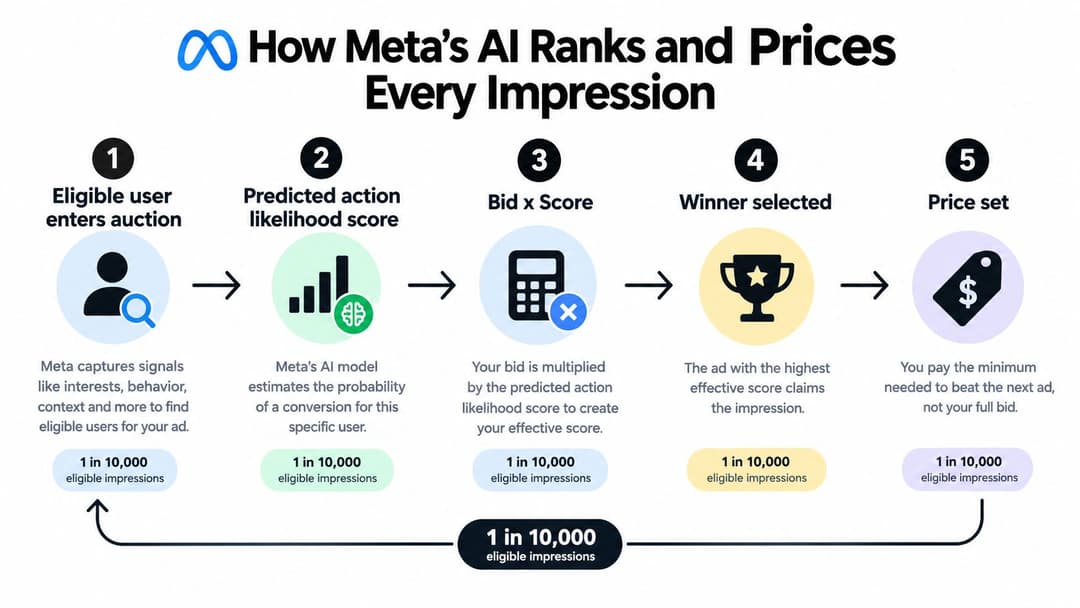
A useful simplified model looks like this:
- Meta identifies an eligible user and an available placement.
- The system predicts the likelihood of the selected action for that user.
- It combines the predicted action rate with the bid.
- It weighs quality and relevance signals.
- The highest effective result wins, while the final price reflects the competitive auction rather than automatically consuming the full bid.
The exact implementation is more complex than this shorthand, but the advertiser-facing lesson is reliable: a higher bid alone doesn't guarantee the impression. An ad with a stronger predicted action rate and better quality can compete effectively without offering only the most money.
Your controllable inputs shape those predictions. A purchase event that fires inconsistently gives the model a blurred view of success. A Conversions API setup can provide additional server-side evidence, while the pixel and other event sources help connect impressions to later actions. The practical distinction between browser and server-side signals is covered in Conversions API versus Meta Pixel.
Creative diversity also matters because the system needs legitimate alternatives to test. Several distinct hooks, formats, and visual treatments give Meta more opportunities to match an ad with a person and placement. Repeating near-identical versions may create the appearance of volume without adding much useful information.
Budget and bidding aren't only financial controls. They also determine how many opportunities the system can explore and which kinds of users it can reach. Exclusions, event prioritization, landing-page quality, and post-click behavior further affect whether the model receives evidence that its predictions were useful.
The auction rewards the quality of the signal, not just the size of the budget.
For a practical treatment of auction economics and advertiser costs, see this explanation of Facebook ad CPM. Use auction metrics as diagnostics, not as a substitute for business measurement. A cheaper impression can still be poor value if it produces unqualified leads, low-intent traffic, or no incremental demand.
Where Meta's AI Ads Work Best in Practice
The right automation feature depends on the job your campaign needs to perform. A prospecting campaign needs discovery. A retargeting campaign needs sensible expansion without losing commercial relevance. A lead campaign needs both a compelling creative path and a reliable definition of lead quality.
E-commerce prospecting
For a retailer seeking new customers, Advantage+ Shopping Campaigns can pair broad delivery with product feeds and varied creative. The marketer supplies product information, conversion events, pricing, offers, and approved assets. Meta searches for likely buyers across cold inventory rather than forcing the team to predict every useful interest category in advance.
The main performance question is usually incremental reach and profitable first purchase, not whether the campaign stayed inside a carefully constructed interest stack. Product availability, margin, landing-page experience, and creative freshness still belong to the retailer.
DTC retargeting
A direct-to-consumer brand can use Advantage+ Audience with custom audiences and lookalike signals to recover shoppers who viewed products, added items, or engaged without purchasing. Expansion can help when the original pool is too narrow, but the account still needs sensible exclusions for recent purchasers, unavailable products, and unsuitable customer states.
The useful KPI is often ROAS stability, assessed alongside new-customer contribution and margin. A retargeting campaign can look efficient while merely harvesting demand that would have returned anyway, so platform reporting shouldn't be the only evidence.
Lead generation
Financial and education advertisers can combine Advantage+ Creative with lead-form optimization. Multiple hooks, visuals, and form introductions give the system room to test the path from attention to submission. Human review remains essential because claims, qualification language, consent, and follow-up expectations can't be delegated safely to a delivery model.
The central KPI is cost per qualified lead, not just cost per completed form. Connect downstream sales or qualification outcomes wherever possible, so Meta learns from business value rather than treating every submission as equally useful.
| Use Case | Best Meta AI Feature | Primary KPI |
|---|---|---|
| E-commerce prospecting | Advantage+ Shopping Campaigns | Incremental reach and profitable customer acquisition |
| DTC retargeting | Advantage+ Audience with custom and lookalike signals | ROAS stability and new-customer contribution |
| Lead generation | Advantage+ Creative with lead-form optimization | Cost per qualified lead |
Which of these situations resembles your account most closely? That answer should determine the first automation layer you test, not the popularity of a feature in Ads Manager.
What AdStellar Adds on Top of Meta's Native AI
A marketer supplies the inputs, Meta's system makes the impression-level choice, and another layer can organize what happens next. Meta's native AI ranks opportunities in the auction, distributes delivery, adapts approved creative, and expands audiences according to its predictions. It does not, by itself, provide a complete operating system for tracking creative fatigue, comparing accounts, standardizing reporting, or coordinating budget decisions across campaigns.
External orchestration handles that surrounding work. It can monitor patterns, organize tests, compare creative performance, and flag changes that may be difficult to spot when a team reviews one Ads Manager account at a time. The distinction is practical: Meta's AI optimizes delivery, while orchestration manages the sequence of decisions around delivery.
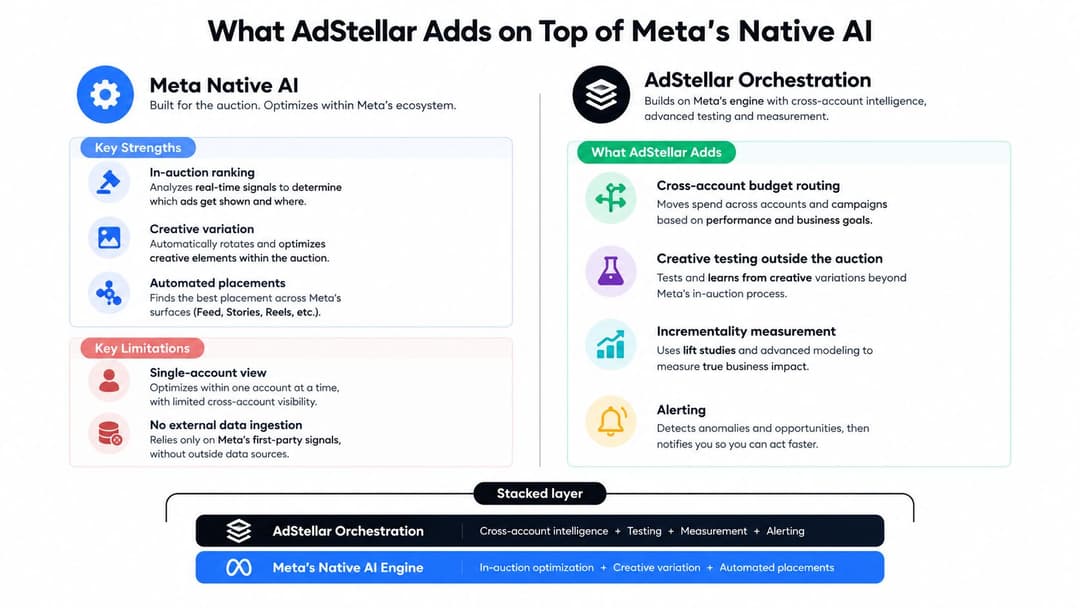
| Responsibility | Meta Native AI | External Orchestration |
|---|---|---|
| Impression ranking | Predicts action likelihood and selects delivery opportunities | Flags creative fatigue when ROAS drops 20% over 7 days and suggests budget reallocation to the top 2 ad sets |
| Creative variation | Adjusts and distributes approved assets within the platform | Organizes broader testing, refreshes, and comparisons |
| Budget movement | Optimizes within campaign rules | Helps identify when budget should move between campaign structures |
| Account perspective | Primarily operates within the connected ad account | Supports cross-account reporting and operating workflows |
| Measurement | Reports platform outcomes and available attribution views | Adds external comparisons, alerts, and testing workflows |
AdStellar AI illustrates this type of platform. It connects with Meta Ads Manager, uses historical campaign information, supports bulk creative and campaign workflows, and breaks down metrics such as ROAS, CPL, and CPA. It does not replace Meta's auction model. It gives the marketing team a separate layer for planning, production, monitoring, and iteration.
For a demonstration of an orchestration workflow above native delivery, watch the following video:
The benefit is operational. Campaign managers spend less time assembling repetitive structures and more time evaluating positioning, offer quality, lead qualification, and business impact. An external tool can speed up that rhythm, while marketers still decide whether the product promise is credible and whether the resulting customers are valuable.
When Meta AI Ads Quietly Underperform
Automation isn't equally useful for every account. Meta's AI needs enough reliable feedback to distinguish a high-value action from a cheap substitute, and some advertisers don't generate that evidence quickly or consistently enough.
The risk is greatest in accounts with sub-$1,000 daily budgets, where conversion data can arrive too slowly to support confident optimization. The same problem affects B2B campaigns with long sales cycles, offline closes, and sparse qualified events. A campaign may collect clicks and form submissions while receiving little information about pipeline quality.
Niche products can create another mismatch. If the relevant audience is small, broad delivery may spend against people who resemble the target superficially but have little buying intent. Creative portfolios with fewer than five variations per ad set can also leave the system with limited material to test, especially when one concept fatigues.
Diagnose the failure before changing the setting
Look at the gap between the event Meta optimizes and the outcome your business values:
- Cheap clicks, weak pipeline: The account may be teaching the system that traffic is sufficient, even when sales quality matters more.
- Many forms, few qualified leads: The form or event hierarchy may reward completion without passing useful qualification data back.
- High frequency, falling response: The creative system may be distributing variations that are technically different but strategically repetitive.
- Broad delivery, poor relevance: The audience seed, offer, or exclusions may not give the model a useful boundary.
Manual bidding, tighter audience seeds, and human approval can outperform full automation in these conditions. That doesn't mean manual control is always superior. It means the account needs stronger constraints until its data becomes more informative.
Diagnostic question: If the model receives only clicks, what reason would it have to optimize for revenue?
Meta AI ads act as a force multiplier when signal quality is strong. With weak events, thin creative, or a long gap between ad interaction and business outcome, automation can amplify the wrong proxy.
Privacy, Targeting, and Brand Safety in 2026
Privacy changes have altered how advertisers collect, pass, and interpret signals. Reduced browser-level tracking, consent requirements, platform aggregation, and regulatory scrutiny all make it harder to treat a single reported conversion as a complete account of customer behavior.
The practical response is to improve the quality of data you're allowed to use. First-party information from a CRM can support custom audiences when collected with appropriate permission. Conversions API can help send server-side events, while consent-aware implementation determines whether those events can be used lawfully. Aggregation and modeled reporting still mean that platform results may not expose every path at user level.
Targeting needs boundaries, not just expansion
Meta's AI can explore beyond the audience inputs you provide, but advertisers still need to define unacceptable delivery. Use location controls, customer exclusions, sensitive-category restrictions, and suppression lists where applicable. For financial services, health products, and family-oriented brands, review placements and surrounding content instead of assuming that engagement optimization equals adjacency safety.
Brand safety also depends on the creative itself. A model can distribute a claim efficiently, but it can't take responsibility for whether that claim is substantiated, appropriately qualified, or consistent with the brand's standards. Human approval should cover imagery, testimonials, pricing language, disclaimers, and the destination page.
Run this compliance check before scaling:
- Audit event coverage: Confirm that browser and server-side events reflect the actions you value.
- Validate consent flow: Check that collection, sharing, and audience use follow the permissions applicable to your market.
- Review exclusions: Maintain current customer, product, category, and placement exclusions.
- Document claims: Record the evidence and approval path for statements made in every creative variant.
Brand-safety principle: Meta's AI can optimize engagement and predicted action. It doesn't replace your legal review, suitability rules, or reputation judgment.
Performance and privacy aren't opposing objectives. Strong first-party governance gives the delivery system more dependable inputs while protecting the people represented in those inputs.
A Practical Playbook for Marketers
Start by separating decisions that require business judgment from decisions that benefit from machine-scale testing.
The marketer owns the offer, positioning, brand voice, conversion definition, budget guardrails, creative approvals, audience seeds, exclusions, and the distinction between a nominal lead and a qualified opportunity. Meta's AI can own much of the bid behavior, placement selection, delivery timing, and audience expansion when the account has enough trustworthy signal.
Use this rollout sequence:
- Audit campaign readiness. Identify broken events, duplicated structures, stale creative, weak exclusions, and campaigns optimizing to proxy actions.
- Consolidate conversion events. Choose the event that best represents commercial value, then ensure it fires consistently across the customer journey.
- Move suitable prospecting into Advantage+ structures. Start where broad discovery and automated delivery match the account's objective.
- Add meaningful creative variety. Vary the hook, proof, format, demonstration, and offer angle, rather than producing cosmetic edits.
- Strengthen first-party measurement. Connect CRM outcomes and server-side signals where consent and technical implementation allow.
- Compare against a control. Use holdout groups, conversion lift studies, or matched-market testing when you need to distinguish incremental demand from attributed demand.
Review the account weekly for spend anomalies, event quality, delivery concentration, and creative fatigue. Refresh rapidly when a concept is clearly exhausted, but don't replace every asset on a fixed schedule without evidence. For stable evergreen campaigns, a less frequent review may be sufficient. Override automated bidding when the objective requires a hard efficiency boundary, the conversion signal is unreliable, or the model is pursuing volume at the expense of qualification.
Teams managing several brands should also document permissions, account ownership, audience access, and approval responsibilities. A resource on SMS Activate multi account management can help frame the operational challenges around managing multiple accounts, although it doesn't replace Meta's access and compliance requirements.
Use a 30/60/90-day review window as a decision framework rather than a promise of a particular result. The first review should confirm tracking and delivery behavior. The second should compare creative and audience patterns against business outcomes. The third should assess incrementality, profitability, and whether the automation layer deserves broader control. Guidance on scaling successful ad campaigns is most useful when paired with this discipline, because scaling a noisy signal only makes the diagnosis harder.
AdStellar AI helps performance teams create and launch Meta campaigns, organize creative variations, connect historical performance data, and review outcomes such as ROAS, CPL, and CPA in one workflow. Visit AdStellar AI to see how its campaign-building and insight tools can support a clearer handoff between your marketing decisions and Meta's delivery automation.