A marketer can have a strong offer, a polished creative, and a clear landing page, then still hesitate over the headline. Should it lead with the benefit, create curiosity, show proof, or tell the reader exactly what to do? In a crowded Facebook feed, those choices aren't interchangeable. Curiosity can earn attention from an unfamiliar audience, while a direct benefit, credible proof point, or urgent call to action may fit better when people already understand the problem.
This guide gives you 11 practical headline patterns for Facebook ads, organized by campaign role: awareness, conversion, and retention. Each pattern includes a swap-ready formula, a realistic example, a testing angle, and a caution for launch. Use the examples as starting points, then replace every promise, number, and proof point with information you can verify for your own business.
1. Curiosity Gap Headlines
Curiosity headlines withhold the answer while making the question feel relevant. They work best when the reader recognizes the problem but doesn't yet know the solution. A performance marketing team might use “The Creative Signal Most Teams Miss” to attract marketers who want better campaign decisions without giving away the insight in the headline.
The strongest version creates an open loop with a clear subject. “This One Metric Increased Our ROAS by 340%” sounds specific, but unless the claim is real and documented, it shouldn't run. Safer alternatives include “The Metric That Changes How You Read Creative Data” or “What Your Best Ads Reveal Before You Scale Them.”
Practical rule: Curiosity should delay the answer, not hide the offer.
Use this pattern mainly for awareness and early consideration. The primary text or landing page must resolve the promise quickly. If the ad suggests a useful insight and the destination opens with unrelated product copy, the gap becomes a trust problem rather than a reason to continue.
Swap-ready formula:The [ overlooked detail ] behind [ desired outcome ]
Testing angle: Compare a highly specific curiosity hook with a more explicit benefit. Test “The Creative Signal Everyone Misses” against “Find Better Creative Signals Before You Scale.”
Implementation caution: Don't use mystery without relevance. “You Won't Believe What Happened Next” gives the audience no reason to care and can make a legitimate brand look like clickbait.

2. Number-Based Headlines
Numbers make an ad easier to scan and give the reader a defined promise. A list headline such as “7 Ways to Improve Creative Testing” tells the audience what kind of content they'll receive. A scale headline such as “Generate Hundreds of Ad Combinations” communicates product breadth without requiring a long explanation.
A large-scale analysis of 752,626 Facebook ads found a median headline length of 5 words, while average headline length increased from 14 words in 2015 to 19 words in 2018. The same research found that 48.1% of ads included a number in the headline, description, or text. Those findings support a practical approach: keep the headline compact, and use a number only when it adds genuine specificity. (The analysis of successful Facebook ads)
Swap-ready formula:[ Number ] ways to [ achieve benefit ]
or[ Number ] [ deliverables ] for [ audience or use case ]
Testing angle: Test a list format against a quantity format. For example, compare “7 Ways to Improve Creative Testing” with “Hundreds of Creative Combinations, One Workflow.”
For more inspiration, review these Facebook ad headline examples, then rewrite each concept around a deliverable your campaign provides.
Implementation caution: Never inflate a count or invent an outcome. A number attracts attention, but an unverifiable number weakens the entire ad.

3. Benefit-Driven and Pain-Point Headlines
A benefit headline tells the audience what improves. A pain-point headline names the frustration they already experience. Both can work well in conversion campaigns because they reduce interpretation. The reader doesn't need to decode a clever phrase to understand the commercial value.
For a SaaS audience, “Stop Building Every Ad Variation by Hand” identifies the problem. “Launch More Tested Campaign Ideas With Less Manual Setup” presents the desired outcome. The best choice depends on the audience's awareness. A team that feels buried in production work may respond to the pain, while a team actively comparing tools may want a clearer result.
Swap-ready formula:Stop [ costly or frustrating task ]. [ Achieve desired result ]
or[ Verb ] [ benefit ] without [ objection or trade-off ]
Use concrete benefits when you can substantiate them, but don't borrow unsupported performance claims. “Reduce Repetitive Setup” is defensible as a workflow promise. “Cut Production Time by 90%” requires evidence from your own product and campaign context.
A practical guide to Facebook ad copy best practices can help align the headline with the primary text and landing page rather than treating it as an isolated line.
Testing angle: Test pain against benefit. “Stop Wasting Time on Manual Setup” and “Spend More Time Improving Campaigns” may attract different segments.
Implementation caution: Don't lead with a feature when the audience cares about a business problem. “Multi-Asset Campaign Management” is less immediate than “Keep Campaign Production Moving.”
4. Question-Based Headlines
Questions invite self-identification. A marketer who reads “Still Building Every Facebook Ad Variation Manually?” can answer internally before deciding whether to continue. That moment of recognition makes the format useful for audiences that know the problem but haven't committed to a solution.
The question must reflect a real situation, not manufacture anxiety. “Are Your Competitors Scaling Faster Than You?” may feel aggressive if the ad offers no evidence or practical response. “What Would You Test If Setup Took Less Time?” creates a more constructive opening for a product that supports campaign experimentation.
Swap-ready formula:Still [ frustrating task ]?
orWhat would happen if you could [ desired action ] without [ obstacle ]?
For awareness, use a broad question that helps the reader name the challenge. For conversion, make it closer to the buying decision, such as “Ready to Compare More Creative Combinations?” For retention, connect it to an action the customer has already taken.
Testing angle: Compare a problem question with an aspirational question. “Still Rebuilding Campaigns Manually?” and “What Could You Launch With More Testing Capacity?” frame the same product differently.
Implementation caution: Answer the question immediately in the primary text. A question that leads to generic brand copy feels evasive, especially when the audience has already shown purchase intent.
A question can also qualify the audience. People who don't experience the problem may scroll past, while relevant prospects receive a message that matches their current workflow.
5. Emotional Connection and Aspiration Headlines
Functional benefits explain what a product does. Aspirational headlines explain who the customer can become with better tools and decisions. For a growth marketer, “Lead Campaign Decisions With Confidence” may feel more motivating than “Review Creative Performance Faster,” even though both point toward a similar capability.
This pattern fits awareness and consideration, where the audience is forming an opinion about the kind of solution they want. Connect the emotional outcome to a practical mechanism. “Become the Growth Leader Your Team Trusts” needs supporting copy about clearer insights, faster iteration, or more disciplined execution. Without that support, the line becomes an empty identity claim.
Swap-ready formula:Become the [ desired professional identity ] who [ meaningful outcome ]
orSpend less time on [ low-value work ]. More time on [ valued contribution ]
The emotional angle should match the buyer. An agency may care about making confident recommendations across client accounts. A DTC team may care about control, speed, and the ability to scale what works. A B2B SaaS marketer may care about turning campaign data into a repeatable acquisition process.
See these emotional marketing examples for ways to connect identity with a credible functional benefit.
Testing angle: Pair an aspiration headline with a direct benefit headline and keep the creative, audience, and offer consistent.
Implementation caution: Don't imply that software alone creates leadership or mastery. Position the product as an enabler of better work, then prove the workflow value underneath.
6. Social Proof and Authority Headlines
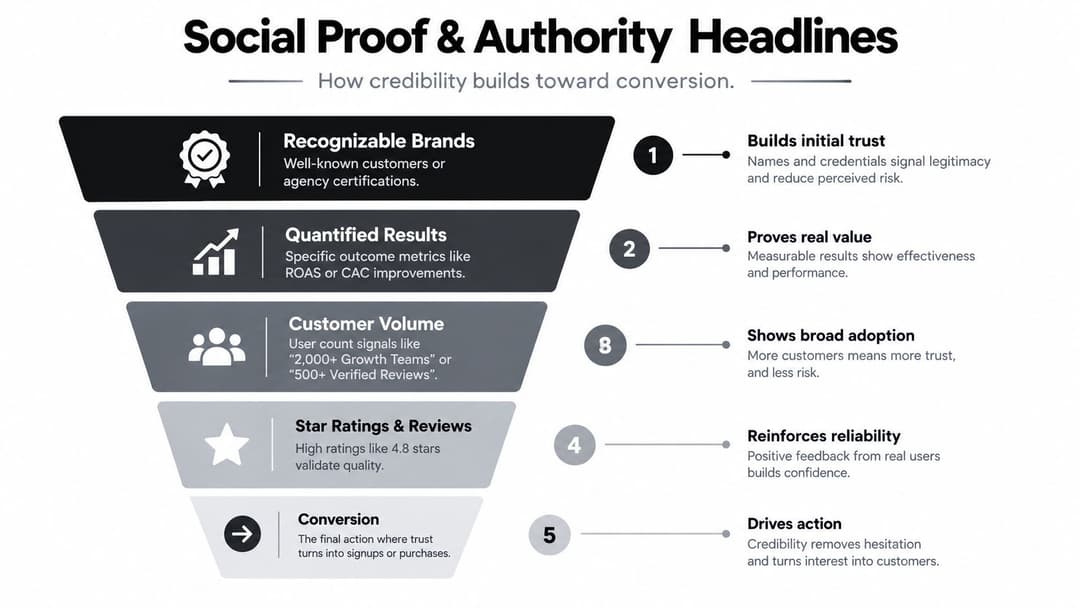
Social proof reduces uncertainty by showing that other relevant people have chosen, reviewed, or validated the offer. It works particularly well in conversion campaigns when the audience understands the problem but worries about making the wrong decision.
Use proof that you can verify. A customer count, rating, certification, named customer, or testimonial can all support a headline, but each needs internal documentation and current context. “Trusted by Growth Teams” is safer than a fabricated customer number, though it may be less persuasive because it lacks detail.
Swap-ready formula:Used by [ relevant audience ] to [ verified use case ]
orSee why [ customer segment ] choose [ product or solution ]
A headline can reference authority without making a performance claim. “Built for Performance Marketing Teams” positions the product around a clear audience. “Read How Customers Use Automated Creative Testing” invites proof without promising that every customer gets the same result.
Use testimonial ad examples to structure customer-led creative, but keep the headline consistent with the exact testimonial and its approved wording.
Testing angle: Compare audience relevance with outcome relevance. “Used by DTC Growth Teams” emphasizes similarity, while “See How Teams Organize Creative Testing” emphasizes use.
Implementation caution: Don't use logos, ratings, certifications, or customer language without permission and verification. Social proof only builds trust when the audience can believe it.
7. Comparison and Transformation Headlines
A transformation headline puts the current workflow beside the desired one. That contrast helps the audience understand the value gap quickly. “From Manual Ad Setup to Repeatable Campaign Launches” is broad enough for awareness, while “From One-Off Tests to Structured Creative Iteration” speaks to a more mature performance team.
The before state should sound familiar, not insulting. “From Guesswork to Clearer Creative Decisions” acknowledges a common challenge without implying that the marketer lacks skill. The after state should describe a process the product can support, rather than guaranteeing a business outcome.
Swap-ready formula:From [ current state ] to [ desired state ]
orInstead of [ old workflow ], [ new workflow ]
A visual can reinforce the contrast. Show a crowded manual process beside an organized campaign workspace, but make sure the image doesn't promise a result the landing page can't explain.
Testing angle: Test time-based transformation, workflow-based transformation, and decision-based transformation. For example, “From Repetitive Setup to Faster Launches” may appeal to operations-focused buyers, while “From Guesswork to Better Testing Decisions” may appeal to strategists.
Implementation caution: Avoid precise time or lift claims unless you have verified evidence for the exact audience and workflow. The research brief's examples include claims such as “40 hours to 1 hour,” but those are examples to adapt, not facts you can publish without proof.
A short explainer video can then show how the transition works in practice.
8. Command and Action-Driven Headlines
Command headlines remove hesitation by naming the next step. “Launch Your Next Creative Test” is direct and useful when the audience already understands the offer. “Discover a Better Way to Organize Ad Variations” is softer and better suited to consideration, where the reader may still be evaluating the problem.
Start with a verb that matches the actual action available after the click. Use “Explore” when the destination is educational, “Start” when a trial or setup flow follows, and “Claim” only when a real offer exists. The command should never promise an experience that the landing page delays or complicates.
Swap-ready formula:[ Action verb ] [ desired outcome ] with [ product or method ]
Examples include:
- Launch: Launch Your Next Creative Test
- Explore: Explore a Clearer Campaign Workflow
- Automate: Automate Repetitive Ad Setup
- Compare: Compare More Copy and Creative Combinations
Testing angle: Test a product action against a customer action. “Generate More Ad Variations” focuses on the tool, while “Test More Ideas Before You Scale” focuses on the marketer's goal.
Implementation caution: Commands work best when the friction after the click is low. If a visitor must read a long explanation before taking the promised action, replace an immediate command with a lower-pressure invitation such as “See How It Works.”
For lower-funnel audiences, action language can clarify intent. It can't rescue an unclear offer, weak proof, or mismatched landing page.
9. FOMO and Urgency Headlines
Urgency can move a decision forward when a deadline, limited-access offer, or expiring opportunity is genuine. “Early Access Ends Friday” is clear if the access window actually closes. “Apply Before the Current Enrollment Window Closes” creates pressure without pretending that availability is scarce when it isn't.
Use urgency as a secondary trigger. The headline still needs to communicate why the offer matters. “Early Access Ends Friday” may create action, but “Early Access to Automated Campaign Testing Ends Friday” gives the reader a reason to care.
Swap-ready formula:[ Relevant offer ] available until [ verified deadline ]
orJoin [ genuine limited-access opportunity ] before [ real closing event ]
Testing angle: Compare a deadline-led headline with a value-led headline. The deadline version may help people who are already convinced, while the value version may better educate people who need more context.
Implementation caution: Fake scarcity damages trust and can create policy or compliance problems. Don't claim limited seats, expiring pricing, or early access unless your business can prove the limit and honor the stated condition.
Urgency also needs repetition control. If the same “ends soon” message appears indefinitely, returning visitors learn that the deadline isn't meaningful. Retargeted audiences may need a more relevant next step rather than another generic countdown.
10. Contrast and Positioning Headlines
Positioning headlines explain why the offer differs from the familiar alternative. The safest contrast targets a workflow or category convention, not a named competitor. “Not Another Manual Ad-Building Workflow” is more defensible than an unsupported claim about a competitor's capabilities.
This pattern works when the audience already knows the category and needs a reason to reconsider how the problem is solved. A performance marketer may understand campaign setup tools but still view bulk creative production as tedious. “AI That Supports Your Team's Decisions” frames automation as assistance rather than replacement.
Swap-ready formula:Not [ familiar limitation ]. [ differentiated approach ]
orUnlike [ old method ], [ solution ] helps you [ defensible difference ]
Testing angle: Compare category contrast with outcome positioning. “Not Another Manual Ad-Building Workflow” challenges the status quo, while “Organize More Creative Tests in One Workflow” explains the benefit directly.
Implementation caution: Every contrast needs evidence below the headline. If you claim a distinctly different workflow, show the relevant interface, process, or customer path. Positioning should sharpen the choice, not rely on vague “better” language.
For a broader framework on researching market alternatives, see this guide to competitive marketing intelligence. Use competitor research to identify audience frustrations, then write a claim your own product can substantiate.
11. Retention and Re-Engagement Headlines
Retention headlines speak to people who already know the brand. A past visitor, trial user, or customer doesn't need the same introduction as a cold prospect. “Ready to Turn Your Best Campaign Insights Into the Next Launch?” assumes familiarity and invites a logical next step.
Match the headline to the person's prior action. Someone who viewed a product page may need a reminder of the core benefit. Someone who started a trial may need help completing setup. An existing customer may respond better to a workflow expansion, new capability, or campaign review prompt.
Swap-ready formula:Ready to [ next step ] with [ known benefit ]?
orTurn your [ previous action or asset ] into [ next outcome ]
Examples include “Ready to Scale What's Already Working?” and “Turn Your Best Creative Insights Into the Next Campaign.” These lines are stronger than repeating an acquisition headline because they acknowledge progress and reduce perceived effort.
Testing angle: Compare a continuity message with a new-angle message. “Keep Building With AdStellar” reinforces familiarity, while “Find Your Next Winning Creative Combination” introduces a fresh reason to return.
Implementation caution: Don't imply that the user completed an action they didn't take. Segment audiences by page view, trial status, engagement, or customer state, and align the headline with the actual relationship.
For practical audience segmentation ideas, use this guide on how to retarget website visitors. Retention messaging should feel like assistance, not surveillance.
Comparison of 11 Facebook Ad Headline Types
| Headline Type | Implementation Complexity | Resource Requirements | Expected Outcomes | Ideal Use Cases | Key Advantages |
|---|---|---|---|---|---|
| Curiosity Gap Headlines | Low–Medium (crafting intrigue balance) | Low (copy + A/B testing) | Higher CTRs and engagement, variable conversion | Upper-funnel, content promotion, retargeting | Drives clicks, memorability, shareability |
| Number-Based Headlines (Listicles & Specificity) | Low (templated format) | Low–Medium (accurate metrics, testing) | Improved scanability, perceived credibility, strong CTR | Listicles, scale/automation messaging, product feature highlights | Structure and specificity, measurable promise |
| Benefit-Driven / Pain-Point Headers | Medium (requires audience insight) | Medium (segmentation, research) | High conversion for qualified audiences | Bottom-funnel, performance marketing, demo signups | Immediate relevance, predictable CVR |
| Question-Based Headlines | Low–Medium (must match audience problems) | Low (copy tests) | Increased engagement, self-qualification | Awareness/consideration, thought leadership | Invites internal response, feels personalized |
| Emotional Connection & Aspiration Headlines | Medium–High (deep audience understanding + creative) | Medium–High (creative assets, consistent messaging) | Strong brand affinity and recall, variable direct conversions | Brand awareness, consideration, differentiation | Builds loyalty, memorable and shareable messaging |
| Social Proof & Authority Headlines | Low–Medium (gather verifiable proof) | Medium (case studies, testimonials) | Higher trust and conversion among skeptical buyers | B2B/enterprise consideration, comparison pages | Reduces perceived risk, boosts credibility |
| Comparison & Transformation Headlines | Medium–High (must substantiate claims) | Medium (before/after data, visuals) | Clear perceived value, persuasive for adoption | Product onboarding, ROI-focused offers, case studies | Demonstrates tangible change, highly persuasive |
| Command & Action-Driven Headlines | Low (directive writing) | Low (clear CTA, landing alignment) | High CTR and immediate actions with intent audiences | Demo signups, trials, bottom-funnel CTAs | Removes friction, explicit next step |
| FOMO & Urgency Headlines | Low (time-based wording) | Low (offer management, timing control) | Spike in immediate conversions, shortened decision cycles | Product launches, webinars, limited offers, retargeting | Drives fast action, increases immediacy |
| Contrast & Positioning Headlines (Market Differentiation) | Medium (requires defensible differentiation) | Medium (market research, proof) | Strong differentiation, attracts early adopters | Category creation, crowded markets, launch positioning | Memorable positioning, highlights uniqueness |
| Retention & Re-Engagement Headlines | Medium (segmentation and timing needed) | Medium (audience data, personalization) | Increased repeat engagement and higher LTV | Retargeting, churn prevention, reactivation campaigns | Leverages existing awareness, efficient re-engagement |
Turn Headline Ideas Into a Testing System
A list of headline patterns becomes useful only when it changes how you build campaigns. Start with the campaign goal. Awareness ads need a reason to stop and learn, conversion ads need a clear value proposition and a credible path to action, and retention ads need a relevant next step based on what the audience already knows.
Then choose one primary pattern for the first test. Don't combine curiosity, urgency, social proof, and a command in one crowded line. A headline such as “Early Access Ends Friday, Join Thousands, Boost Faster Campaigns Now” may contain several triggers, but it gives you no clear insight into which message influenced the result.
Adapt the formula to one audience problem. An agency managing multiple accounts may care about repeatable workflows. A DTC brand may care about finding and scaling effective creative. A B2B SaaS team may care about acquisition efficiency and better use of historical campaign data. The same product can require different headlines because the buyer's job is different.
Verify every proof point before launch. That includes customer counts, ratings, certifications, deadlines, feature descriptions, and performance claims. The research on Facebook ad headlines found a median headline length of 5 words, which supports concise testing, but brevity doesn't make an unsupported claim acceptable. (AdEspresso's summary of Facebook ad analysis)
Facebook headline space is also structurally limited. A neutral 2025 to 2026 benchmark cites roughly 25 characters for Feed headlines and up to 40 characters for Stories, while another analysis notes a 40-character maximum and mobile truncation at about 27 characters. Treat those figures as practical constraints from the cited benchmark, not as a substitute for checking the placements and previews in your own account. (Facebook ad headline length guidance)
Test meaningful differences, not cosmetic word swaps. Compare a pain-point headline with a benefit headline, or a proof-led headline with a direct-action headline. Keep the offer, audience, creative, and destination controlled closely enough that the result teaches you something.
Measure the outcome that matches the campaign goal. WordStream's 2025 Facebook Ads data reported average click-through rates of 1.71% for Traffic campaigns and 2.59% for Leads campaigns, with average CPCs of $0.70 and $1.92, respectively. Those benchmarks show why headline evaluation should account for objective and downstream performance rather than judging a line by clicks alone. (WordStream Facebook Ads benchmarks)
AdStellar can help teams create and compare combinations of copy, creatives, and audiences, but the platform doesn't replace judgment. Use campaign data to decide which message earns more budget, then keep testing as the audience, offer, and creative context change. If you need a separate naming workflow for short-form content, a title generator for Twitch clips can help with ideation, though Facebook ad headlines still need their own audience, placement, and conversion context.
AdStellar AI helps performance teams generate Meta ad copy packages, organize headline variations, and compare combinations across campaigns. Visit AdStellar AI to turn your next headline test into a structured workflow, then launch the strongest verified ideas with greater clarity.