You have a strong offer, a clear audience, and a campaign deadline that isn't moving. The problem is the copy queue. Your team needs enough headline variations to test different motivations, but not so many that production turns into another bottleneck.
The strongest ad headline examples do more than sound persuasive. They match the audience's awareness level, communicate one clear promise, and create a measurable hypothesis. A benefit headline tests outcome clarity. A curiosity headline tests intrigue. A pain-point headline tests problem recognition. Proof, urgency, promotional, novelty, testimonial, question, and educational angles test different reasons to act.
This guide organizes ten practical angles by campaign objective, then explains the reusable template behind each one, the audience fit, the proof required, and the next test to run. Use the examples as starting points, not copy to paste blindly. The same discipline applies when you're crafting tweets for real replies, writing Meta ads, or building landing-page variants.
AdStellar can help teams generate and manage combinations of headlines, primary text, creative, and audiences at scale. The strategic decision still belongs to the marketer: choose the hypothesis first, then use the platform to produce enough controlled variations to learn from it.
1. Benefit-Driven Headlines
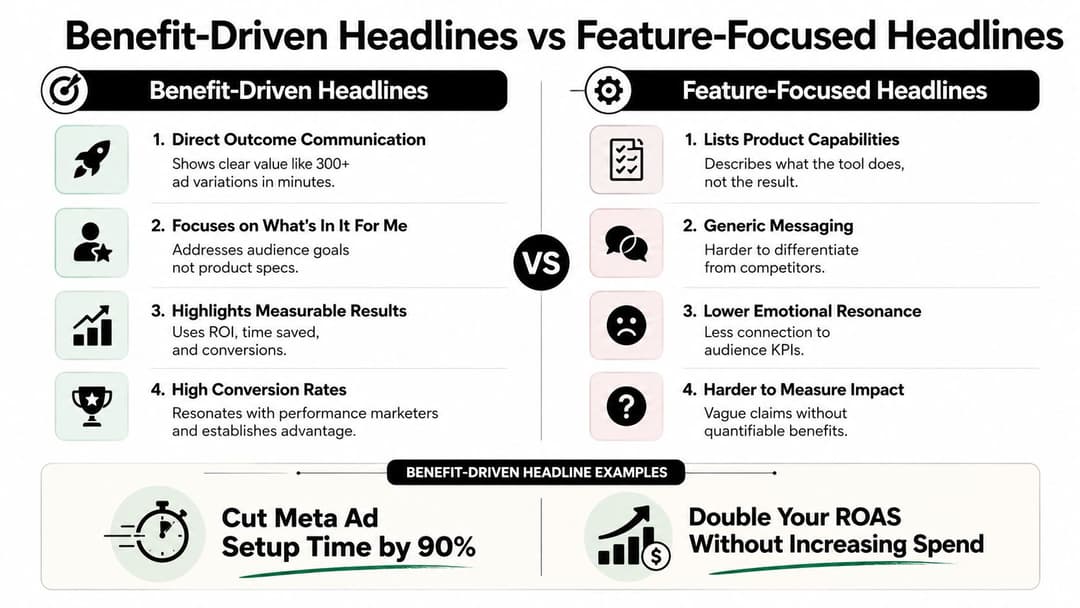
Benefit-driven headlines lead with the result the buyer wants. They fit audiences that understand the category and need a clear reason to choose one offer over familiar alternatives.
Useful starting points include:
- “Generate More Ad Variations in Less Time”
- “Build Meta Campaigns Without Manual Setup”
- “Turn Winning Creative Into New Campaigns Faster”
- “Spend More Time on Strategy, Less on Repetitive Work”
- “Create Campaign Combinations for Every Audience”
Use the template “Achieve [valuable outcome] without [costly obstacle].” Choose an outcome the audience can evaluate, such as production capacity, lead quality, campaign control, or testing speed. Keep one promise per headline. Combining faster creation, lower costs, stronger ROAS, and effortless scaling makes the claim harder to believe and harder to test.
Growth teams, agencies, and DTC operators are the clearest audience fit because manual campaign work already affects their output. New advertisers may need category education first. Experienced media buyers may respond quickly to a specific promise about faster iteration.
Match the benefit to the KPI
Proof must match the claim. A workflow benefit can be shown in a product walkthrough. A revenue or efficiency claim needs customer evidence, a defined measurement method, and a landing page that explains the conditions behind the result. For offer-level copy that supports a benefit headline, see this guide to writing FB ads that convert. Teams refining message alignment can also use these ad copy best practices.
Practical rule: Test one primary benefit against another. Keep the audience, offer, creative, and destination stable so the headline remains the main variable.
Headline wording can materially affect engagement. A large experimental analysis found statistically significant effects for 21 of 36 headline-related constructs, supporting headline tests as performance experiments rather than cosmetic edits. The analysis is documented in this headline experiment.
Build a speed variant, an efficiency variant, and a strategic-focus variant. Keep supporting copy and destination consistent, then compare click quality and downstream conversion. Scale the winning angle by testing wording changes within that angle, not by changing every campaign input at once.
2. Curiosity-Based Headlines
Curiosity headlines work by opening an information gap around a problem the buyer already recognizes. The gap must identify the category clearly. “The secret” creates weak intent if readers cannot tell whether it concerns campaign structure, creative production, targeting, or measurement.
Start with angles tied to a campaign objective:
- “Why Growth Teams Are Rethinking Manual Ad Building”
- “The Campaign Workflow Many Still Miss”
- “What Changes When Every Ad Variant Is Testable”
- “The Unexpected Bottleneck Behind Slow Campaign Launches”
- “We Compared Multiple Campaign Workflows. The Difference Was Clear.”
For a reusable version, use “Why [audience] is changing [familiar behavior]” when the goal is category education. Use “The overlooked [process or factor] behind [desired outcome]” when the audience already feels the problem and needs a reason to investigate. These templates preserve intrigue while indicating what the offer addresses.
Curiosity fits cold, higher-funnel audiences that recognize a category problem but are not yet comparing vendors. It can earn attention before a direct benefit claim does, though the trade-off is weaker qualification. Add a specific subheadline that names the audience, process, or outcome. The landing page must then show the hinted workflow near the top, explain who it serves, and provide a concrete next step. Otherwise, the click creates a message mismatch.
Test the gap and the resolution
Test a curiosity headline against a direct-benefit headline with the same creative, audience, offer, and destination. Measure click-through rate alongside qualified sessions, signup completion, and a meaningful activation event. Higher curiosity clicks with weaker downstream action indicate that the promise needs clearer qualification. Stronger activation suggests the angle has uncovered a motivation worth scaling.
For scaling, keep the winning psychological angle fixed and vary one element at a time, such as the audience, bottleneck, or implied outcome. Document the hypothesis, promised resolution, audience, and success metric with this message testing framework. That record helps separate a reusable curiosity pattern from a single headline that benefited from an isolated audience or creative combination.

3. Question-Based Headlines
A question headline earns attention by making the reader assess their own situation. Use it when the audience already recognizes a bottleneck and can answer quickly from experience. Generic prompts rarely create that recognition.
For agencies and growth teams, test angles such as:
- “Still Building Every Campaign Combination by Hand?”
- “Is Manual Ad Work Slowing Your Next Launch?”
- “How Many Strong Ideas Never Reach Testing?”
- “Could Your Team Test More Without Adding More Setup?”
- “Why Does Campaign Production Still Take So Long?”
The reusable pattern is “Are you [experiencing a specific problem]?” A constructive alternative is “What would change if you could [desired capability]?” Negative framing highlights friction and can prompt action. Positive framing helps the reader picture a better workflow without implying that the team has failed.
Match the question to the campaign objective. Use a pain-focused version for problem-aware prospects, a self-referencing version for audiences evaluating their own process, and a capability-focused version when the offer supports a workflow improvement. The landing page must answer the question near the top, show who the solution fits, and provide a clear next step.
Test the angle and the answer
Question headlines deserve a controlled test, not a blanket assumption that they perform better. Run one negative-framed question, one self-referencing question, and one direct-benefit control with the same creative, audience, offer, and destination. Measure click-through rate alongside qualified sessions, signup completion, and a meaningful activation event.
Keep the answer visible in the primary text or landing page. A high click rate with weak downstream action usually means the question created recognition without enough qualification or proof. For emotional framing, review this guide to emotional marketing, then choose whether empathy, urgency, or a direct operational answer fits the audience.
For scaling, hold the winning angle steady and vary one element at a time, such as the audience, bottleneck, or implied outcome. Confirm that each question matches evidence the landing page can support before expanding the variation set.
4. Urgency-Based Headlines
Urgency earns attention when the reason to act now is real. A campaign deadline, enrollment window, seasonal buying moment, or expiring commercial term gives the audience a concrete decision point. A repeated or invented countdown may lift short-term clicks, then weaken trust when the same deadline returns.
Use headline angles that match the campaign objective:
- “Prepare Your Next Campaign Before the Launch Window Closes”
- “Start Testing Before Your Seasonal Demand Peaks”
- “Build Your Next Ad Set While the Offer Is Available”
- “Your Next Campaign Window Is Open”
- “Act Before the Planning Cycle Ends”
A reusable template is “Act by [genuine deadline] to secure [specific benefit].” Replace the deadline with a verifiable event and name what the reader gains. Without a real cutoff, use immediacy instead: “Start building your next test today” creates momentum without claiming that access ends tonight.
Urgency usually fits bottom-funnel audiences and time-sensitive campaigns. It can also re-engage visitors who have already evaluated the product, if the message reflects their stage. Cold audiences may need proof and explanation before a deadline feels meaningful, so test urgency against a benefit-led angle rather than assuming pressure will improve performance.
Make the deadline verifiable
Keep the deadline and terms consistent across the ad, landing page, and checkout flow. If access or inventory is limited, specify what is limited. Use the campaign launch checklist to confirm that the operational details support the headline.
Test one urgency version against a calm, benefit-led control with the same audience, creative, offer, and destination. Review conversion quality, refund or cancellation behavior, and lead qualification alongside clicks. A genuine deadline can concentrate action, while artificial pressure may attract people who are not a good fit.
Name the object of the urgency. “Last chance” communicates pressure but leaves the value unclear. “Last chance to join the early-access campaign builder” identifies what the reader may lose and why it matters. For scaling, keep the deadline type fixed, then vary the benefit, audience stage, or level of proof one element at a time.
5. Social Proof Headlines
A paid-social agency comparing campaign tools looks for evidence from other agencies, not a generic popularity claim. Social proof reduces perceived risk when the example matches the buyer's team size, workflow, or campaign complexity.
Start with the audience, then connect it to a recognizable job:
- “Chosen by Teams Building More Than One Campaign at a Time”
- “See How Growth Marketers Organize High-Volume Ad Testing”
- “Built for Agencies Managing Multiple Client Campaigns”
- “Join Marketers Using Structured Creative Testing”
- “See the Workflow Teams Use to Turn Winners Into New Tests”
A reusable structure is “[Comparable audience] uses [product or method] to [relevant outcome].” Narrow descriptors make the claim easier to recognize and verify. “Used by agencies managing multiple paid-social accounts” gives a qualified buyer more information than “Trusted by everyone.”
Proof quality determines whether this angle can scale. Secure permission before naming customers or displaying logos, and substantiate any customer count or performance result. If the available evidence is qualitative, keep the headline qualitative. A product demonstration, named methodology, or clearly shown workflow can support an early-stage brand without implying broad adoption.
Customer-created material can reveal the language buyers use. Review the guidance on user-generated content ads before adapting that material into paid creative, and confirm that the customer's words support the headline's claim.
Match the proof to the campaign objective. For cold traffic, test a peer-group headline against a process-led version that shows how the product works. For retargeting, compare social proof with a direct benefit. Keep the audience and offer fixed, then vary one proof element at a time, such as peer type, workflow, logo usage, or customer language. Monitor qualified conversions, not clicks alone.
6. Promotional Offer Headlines
Offer headlines put the economic reason to act in front of the reader. They perform best when the product's value is already clear and the incentive removes a specific buying objection.
Start with the use case, then attach the offer:
- “Try Campaign Variation Workflows Before Your Next Launch”
- “Start With a Free Trial and Explore the Campaign Workflow”
- “Claim a Guided Campaign Audit With Your Signup”
- “Early Access Includes the Current Campaign-Building Features”
A reusable template is “Get [specific offer] when you [clear action].” It works for free access, guided services, feature access, or an added resource. The landing page should state eligibility, duration, exclusions, feature access, and usage limits. If availability is restricted, explain whether the restriction concerns time, seats, access, or a particular service.
This angle fits bottom-funnel and retargeting campaigns, where the visitor already understands the category. It is weaker when trust, capability, or strategic fit remains unresolved. A discount cannot clarify a vague value proposition.
Protect the economics
Use a focused comparison rather than testing every offer variable at once. Hold the audience, product, and landing page constant, then compare the promotion with a non-discounted bundle such as onboarding help, an audit, or access to a relevant resource. Track completed signups and activation, because offer clicks can include low-intent users who never reach the product's core value.
Keep commercial claims current and verifiable. Do not add unsupported prices, discounts, customer counts, or limits. Complicated terms can create uncertainty, so make the headline specific and let the landing page provide the conditions.
For scaling, test one angle at a time: direct incentive, use-case-led incentive, or service-based incentive. Match each variation to the audience's buying stage and require proof for any stated limitation or feature access. This structure makes it easier to identify whether performance comes from the offer itself or from clearer product relevance.
7. Pain-Point Headlines
A media buyer can have strong concepts ready while campaign setup, approvals, or repetitive production delays the launch. Pain-point headlines name that operational friction in language the audience recognizes, turning an abstract workflow problem into a specific reason to act.
Start with the problem, then connect it to the lost objective:
- “Still Rebuilding the Same Campaign Structure by Hand?”
- “Your Team Has Ideas. Setup Time Keeps Them Waiting.”
- “Manual Ad Production Limits How Many Tests You Can Run”
- “Long Campaign Launches Delay the Learning You Need”
- “Stop Letting Repetitive Setup Take Time From Strategy”
Reusable templates include “Stop [specific costly activity] from blocking [important objective]” and “[Operational problem] makes [business goal] harder.” Use concrete verbs and nouns rather than blaming the team. “Rebuilding ad sets,” “waiting on approvals,” and “losing testing time” identify friction more clearly than “inefficient workflow.”
This angle suits problem-aware media buyers and teams that already feel production, iteration, or account management slowing progress. It can work well in retargeting after visitors have recognized the cost of their current process. For audiences still evaluating the category, pair the pain with a clear capability, because a headline that only describes frustration may not establish strategic fit.
Source wording from customer conversations, reviews, support tickets, and sales-call notes. Those records can reveal the terms buyers already use, while campaign data helps determine which problem deserves headline space. Claims about a specific feature or workflow still need proof on the landing page, in the creative, or through a product demonstration.
Connect friction to a testable solution
The supporting copy should show the alternative quickly, such as bulk creation, organized testing, or a repeatable launch workflow. Test a pain-led headline against a benefit-led version while holding the offer, audience, creative format, and landing page constant. Judge qualified conversions and downstream activation, not attention alone.
If the pain version attracts clicks but converts poorly, narrow the problem, reduce the negative framing, or strengthen the connection to the solution. If it converts, create variations around the same friction and test one operational detail at a time.

8. Novelty Headlines
Novelty headlines earn attention by presenting a familiar task through a new method, capability, or workflow. They suit innovation-oriented buyers, but “new” must explain a meaningful difference. Without a mechanism, the headline creates interest without giving the reader a reason to continue.
Examples:
- “A New Way to Build and Organize Meta Ad Tests”
- “Turn Historical Performance Into Fresh Campaign Combinations”
- “AI-Assisted Campaign Building for High-Volume Testing”
- “Create New Ad Variations From the Patterns Already Working”
- “A More Repeatable Workflow for Scaling Creative Tests”
Use the template “A new [method or capability] for [specific audience task].” Reserve “first,” “only,” and “never before possible” for claims that have been verified and can be defended. A workflow can be novel without claiming superiority across the entire category.
The best audience is a team dissatisfied with legacy processes or actively evaluating new ways to test creative. The trade-off is proof. Novelty asks readers to believe the approach differs in a useful way, so supporting copy should show how inputs become outputs, where human review remains, and how performance informs the next iteration.
Test interest against usefulness
Run the novelty version against a direct outcome headline while holding audience, offer, creative, and landing page constant. Compare qualified conversions and activation, not clicks alone. If the novelty version wins attention but loses conversion quality, explain the practical benefit earlier or narrow the claim to one workflow.
For AdStellar, a credible angle could describe one environment that combines creative, copy, audience, and performance workflows. Keep the language focused on process unless outcome evidence supports more. Product demonstrations, early-user evidence, and transparent explanations can substantiate the difference.
A new feature may earn an initial click. A useful workflow gives the audience a reason to return.
9. Testimonial-Style Headlines
A quoted customer voice can reduce uncertainty around an unfamiliar product, especially when the buyer is comparing platforms. Its strength depends on three conditions: the wording is authentic, the customer permits its use, and the result can be supported.
Use examples such as:
- “We finally stopped rebuilding every campaign from scratch.”
- “Our team can spend more time on strategy.”
- “The workflow made high-volume testing easier to manage.”
- “We found a clearer way to organize creative variations.”
- “The campaign process is more repeatable now.”
The reusable template is “[Customer statement]”, [role or company context]. Keep each quote tied to one change. A workflow improvement often needs less qualification than a dramatic performance claim, which may require detailed evidence.
Match the speaker to the buyer
Testimonial headlines suit audiences seeking reassurance before adopting a platform. An agency owner may relate to an agency operator's experience, while a DTC marketer may need evidence from a comparable brand. Audience fit affects both click quality and the proof required on the landing page.
Do not create customer names, titles, companies, or results. Edit a quote only with permission and only when the meaning stays intact. If the customer wants anonymity, use a truthful role description and enough context to make the evidence useful.
Run an attributed version against an unattributed version only when both are legitimate. You can also compare the testimonial with a direct benefit headline while holding the audience, offer, creative, and landing page constant. Judge qualified conversions and completed actions, not clicks alone.
Every testimonial should lead to visible proof. Place the full story, methodology, or customer evidence near the conversion path. The headline earns attention. Supporting evidence earns belief.
10. How-To and Educational Headlines
A marketer searching for a repeatable process may click a guide before considering a product. How-to headlines fit cold acquisition, lead generation, content promotion, and campaigns where the audience must understand a workflow first.
Use examples such as:
- “How to Build a Repeatable Meta Ad Testing Workflow”
- “How to Turn Winning Creative Into New Campaign Ideas”
- “A Practical Framework for Organizing Ad Variations”
- “How Growth Teams Can Reduce Manual Campaign Work”
- “Learn a Structured Method for Scaling Creative Tests”
The reusable template is “How to [achieve a specific outcome] using [method or framework].” Add a step count only when the asset contains that many useful steps. Match the promise to the destination, whether it is a guide, checklist, webinar, audit, or demonstration. A sales page presented as education will weaken trust and reduce qualified follow-through.
Match the lesson to the campaign objective
Educational headlines work best for audiences with low or moderate product awareness. They also suit search and content campaigns, where learning intent may precede purchase intent. Set the success event accordingly, such as a qualified signup or completed resource, because these visitors may need more time before converting.
A useful asset can show how to define a testing hypothesis, create controlled headline variations, confirm message match, and evaluate downstream conversion quality. The embedded video below can add visual instruction when the workflow is easier to demonstrate than describe.
Test the educational angle against a direct product headline while holding the audience, destination, offer, creative, and follow-up path constant. Use “How to [outcome] using [method]” for process-led audiences, then vary the outcome and method separately. Scale the winning angle only after qualified conversions or completed actions improve, not merely after clicks increase.
10 Ad Headline Types: Side-by-Side Comparison
| Headline Type | Implementation Complexity | Resource Requirements | Expected Outcomes | Ideal Use Cases | Key Advantages |
|---|---|---|---|---|---|
| Benefit-Driven Headlines | Medium, needs validated, specific claims | Performance data, metrics, A/B testing | High conversions and measurable ROI uplift | Performance/ROI-focused campaigns, growth teams | Clear value proposition; easy to test; broad appeal |
| Curiosity-Based Headlines | Low–Medium, craft intrigue without misleading | Creative copy, strong landing content, testing | High CTR and engagement; conversion depends on follow‑through | Awareness-stage, social feeds, pattern-interruption ads | Attention-grabbing; memorable; stands out in feeds |
| Question-Based Headlines | Low, straightforward if specific | Audience insight, targeted messaging | High relevance and engagement; prequalifies readers | Problem-aware audiences, mid-funnel campaigns | Invites mental participation; resonates with pain points |
| Urgency-Based Headlines | Low–Medium, must be authentic and clear | Genuine offers, deadlines, monitoring | Increased CTR and fast conversions; short-term lift | Time-limited offers, seasonal or bottom-funnel pushes | Drives immediate action; shortens decision time |
| Social Proof Headlines | Medium, requires collecting credible proof | Testimonials, case studies, logos, up-to-date metrics | Higher trust and conversion; reduced perceived risk | New audiences, high-consideration B2B SaaS purchases | Builds credibility quickly; lowers buyer hesitation |
| Promotional Offer Headlines | Low, direct messaging but offer management needed | Discounts, trial setup, budget and onboarding plan | Rapid sign-ups and volume growth; potential lower LTV | User acquisition, product launches, trial-driven growth | Strong incentive to act; easy to measure ROI |
| Pain-Point Headlines | Medium, needs accurate customer research | Customer interviews, support/sales insights | Strong resonance with problem-aware users; high engagement | Competitive differentiation, sales-driven campaigns | Creates empathy; positions product as the explicit solution |
| Novelty Headlines | High, must substantiate "new" or "breakthrough" claims | Product proof, technical validation, PR/assets | Attention from early adopters; PR interest; differentiation | Emerging tech, early-adopter audiences, fundraise/launch moments | Differentiates in crowded markets; generates buzz |
| Testimonial-Style Headlines | Medium–High, legal/permission and production work | Customer quotes, attributions, photos/logos, approvals | Very high authenticity and trust; strong mid-funnel impact | Trust-building, case-study led campaigns, enterprise sales | Peer credibility; highly relatable and shareable |
| How-To / Educational Headlines | High, requires substantive, valuable content | Long-form guides, research, SEO and content production | High organic intent traffic; thought leadership; slower conversions | Content marketing, SEO, awareness and education funnels | Establishes authority; attracts qualified, research-stage leads |
Turn Strong Headlines Into a Testing System
A headline becomes valuable when it helps you learn something. Start with one audience and one campaign objective, then choose the angle that matches the buyer's awareness and motivation. A cold prospect may need education or a clear benefit. A frustrated media buyer may respond to a pain-point message. A warm visitor may need proof, a testimonial, or a genuine offer.
Write several variants, but change one meaningful element at a time. You might compare outcome versus process, positive versus negative framing, direct benefit versus curiosity, or peer proof versus educational guidance. If every version changes the headline, primary text, creative, landing page, and offer, you won't know which decision affected the result.
Headline research supports this testing discipline. One large engagement analysis found that headlines between 60 and 100 characters earned the highest click-through rates in that dataset, while performance declined below and above that range. The strongest measured range by words was 16 to 18 words, and the pattern varied by language, with French peaking around 13 to 15 words, Italian around 7 to 12 words, and Spanish continuing to improve into the longest tested range of 19 to 21 words. See the headline length analysis for the underlying findings. Treat this as a testing direction, not a universal character rule for every placement.
Evaluate attention and business value
A headline test needs more than a click metric. Track the immediate response, then examine the quality of the next action. A curiosity headline may generate attention. A benefit headline may clarify intent. A testimonial may reduce hesitation. The winner depends on the campaign objective and the cost of the traffic it attracts.
Controlled headline experiments have shown how widely outcomes can vary within the same page context. In one MarketingExperiments test, the strongest headline increased overall page conversion by 72.76%, while alternatives included results of -68.43% and -20.44%. The evidence appears in this headline conversion test. In another experiment, the winning headline outperformed the next-best variant by 34% in conversion, as reported in this headline and subject-line test.
Use a final review before launch:
- Clarity: Can the audience understand the offer without decoding the headline?
- Specificity: Does the line identify a real outcome, problem, method, or audience?
- Audience fit: Does the angle match what this segment already knows and cares about?
- Proof: Can you substantiate every result, customer statement, number, and scarcity claim?
- Message match: Does the primary text and landing page resolve the promise immediately?
- Genuine urgency: Is the deadline, availability, or incentive real and consistently presented?
- Test design: Are you changing one meaningful variable and defining success before launch?
AdStellar can help teams produce and manage large combinations of headlines, primary text, creatives, and audiences for structured Meta testing. The platform's value is strongest when marketers bring a clear hypothesis and use generated variations to expand the test without losing control. For more perspective on practical marketing execution, visit the Secta Labs blog.
AdStellar AI helps performance teams generate headline, primary-text, description, and CTA combinations for Meta campaigns, then organize those variations for testing. Visit AdStellar AI to explore a more structured way to turn headline ideas into launch-ready campaign experiments.