A recent benchmark puts median Meta ecommerce performance at 1.88 ROAS, with a $38.99 CPA, $15.06 CPM, and 1.53% conversion rate across advertising accounts, according to Triple Whale's 2026 Facebook ads benchmarks. Those figures make one point clear: the best Facebook ads rarely win because of one spectacular creative. They win through small, repeatable improvements in the match between audience, message, format, offer, and landing experience.
This list breaks down ten ad approaches that marketers can adapt across ecommerce, SaaS, services, and mobile-first campaigns. You'll find the performance signals worth watching, the creative decisions behind each format, and practical ways to use AI for faster testing without confusing production speed with marketing quality. For additional context on campaign planning, see this Facebook ads guide for car dealers.
1. Carousel Ads for Multi-Product Showcases
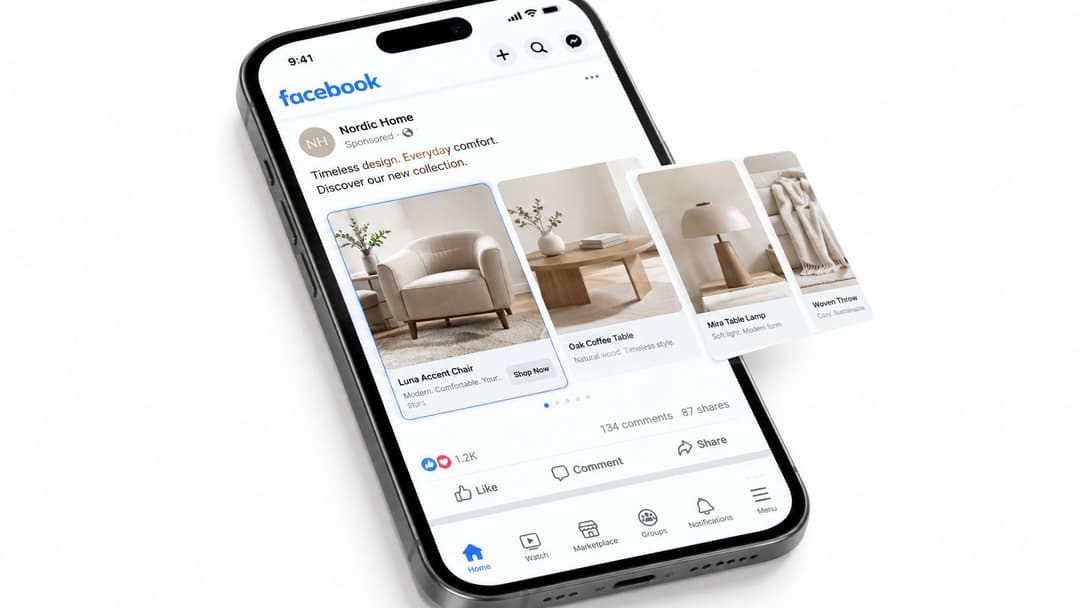
Carousel ads turn one placement into a sequence of product or message cards. Each card can carry its own image, headline, description, destination, and call to action, so the format works well when one product image can't answer every buyer question. A Shopify store can present a seasonal collection, while a brand such as Warby Parker can use successive cards to show different frame styles or use cases.
The strongest carousel usually starts with the card that has the clearest commercial role, not necessarily the most visually unusual image. Put the most relevant product or benefit first, then use later cards to resolve objections, introduce alternatives, or create a natural browsing path. A Nordic Home-style furniture carousel, for example, might open with a room scene, follow with individual pieces, and finish with a direct shopping prompt.
What to measure
Track card-level link clicks, outbound click quality, product views, and purchases rather than judging the carousel only by its overall click-through rate. If the first card attracts attention but later cards receive little interaction, the sequence may be too repetitive or the opening promise may not connect to the rest of the offer.
- Card order: Test whether a product-led opening beats a lifestyle-led opening.
- Visual consistency: Keep the design system coherent, but give each card a distinct job.
- CTA alignment: Match “Shop Now” to product cards and “Learn More” to educational cards.
A practical testing framework is to change one structural variable at a time, such as card order, first-card angle, or destination page. Carousel ad best practices can help teams turn those variations into a repeatable production workflow.
Practical rule: Treat the carousel as a guided buying path, not a folder of unrelated images.
2. Short-Form Video Ads That Stop the Scroll
The opening seconds determine whether a short-form ad earns attention. Dollar Shave Club-style razor demonstrations, Olaplex before-and-after footage, and Grammarly writing fixes work because they show the product, problem, or transformation before the viewer needs a detailed explanation. Motion makes the benefit observable.
Use the first scene to create a measurable hypothesis: demonstrate the problem, reveal a surprising contrast, show the result, or state a direct benefit. Captions must communicate the core idea without sound. Large, readable overlays support that job, while restrained text keeps the product visible. End with one clear action.
A reusable production system makes testing more informative. Keep the footage stable, then vary the hook, narrator, proof point, or CTA. Performance differences become easier to attribute to the concept, execution, or offer rather than to several changes at once.
Four angles provide a practical starting set:
- Demonstration angle: Show the product resolving one specific problem.
- POV angle: Place the viewer inside the use case.
- Testimonial angle: Let a customer describe the change in a relevant context.
- Comparison angle: Contrast the previous experience with the improved result.
The short-form video ads guide can help turn one concept into multiple mobile-first variants. AI can draft scripts, hooks, captions, and voiceovers, allowing teams to test more openings without treating generated copy as proof. Each version still needs a specific audience promise and footage that supports it.
A faster editing workflow cannot compensate for a vague opening. The first scene must explain why the viewer should continue.
3. Lead Generation Ads With Native Forms
Native lead forms shorten the path between interest and submission. A prospective HubSpot customer can request a consultation, a Zendesk prospect can ask for a demo, and an insurance shopper can seek a quote without leaving Facebook. The format reduces friction, so the ad must also set expectations about lead quality and follow-up.
Show the offer's fit before the form opens. Identify the intended audience, the information or service provided, and the next step after submission. “Get started” gives sales teams little context. A clearer promise names the consultation, audit, quote, or demo and explains what follows.
Build forms around sales decisions
Ask only questions that affect routing, qualification, or service delivery. Use the thank-you screen to direct the prospect toward a specific action, such as booking time, reviewing a relevant resource, or confirming contact preferences.
- Audience versioning: Create separate forms for enterprise buyers, smaller businesses, or distinct service needs.
- Qualification: Ask questions that change follow-up, rather than collecting information out of curiosity.
- Handoff: Send submissions into a response process quickly, while intent remains current.
Form volume is an incomplete performance signal. Meta's benchmark summary reported an 8.54% conversion rate and a $27.39 average CPL for lead-generation campaigns, as noted in the introduction benchmarks. Treat those figures as operating references, then compare campaigns by qualified leads, booked meetings, and downstream revenue.
AI can help scale this system by drafting audience-specific questions, thank-you messages, and follow-up variations. Review each version against the actual sales workflow. Use this guide to setting up Facebook lead-generation ads to align the form, campaign objective, and follow-up sequence.
4. Collection Ads for Mobile Shopping
Collection ads connect a hero image or video with selected products inside a mobile shopping experience. Their strength is continuity: the cover establishes a theme, and the catalog lets shoppers investigate items without losing that context. Fashion and beauty brands such as Urban Outfitters, Sephora, Kylie Cosmetics, and Everlane can use the format to turn a seasonal idea or product story into a browsable assortment.
Start with the shopping decision, then choose the cover. A styled scene can introduce a seasonal launch; a close product view can support replenishment or detail-focused consideration. The catalog must fulfill that promise. A cover showing a complete outfit followed by unrelated products creates a weak handoff and can reduce exploration.
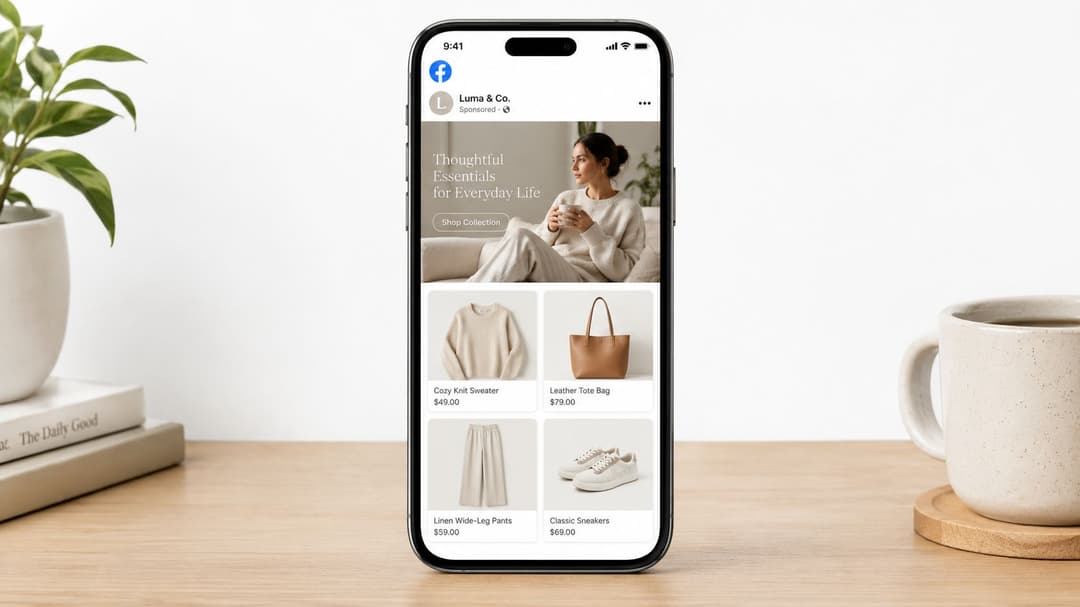
Product selection is a performance variable, not a filing task. Feature recognizable bestsellers or items that explain the collection quickly. Check product images, names, availability, and destination links before launch. Catalog automation can reduce manual updates, while feed maintenance protects the customer experience.
Use each cover variation to test a specific hypothesis:
- Lifestyle cover: Does context increase product exploration?
- Close-up cover: Does detail attract higher-intent shoppers?
- Offer cover: Does a promotion improve qualified action?
- Social proof cover: Does visible customer confidence change engagement?
A smaller, coherent assortment may outperform a broad catalog because it reduces choice friction. AI can help generate cover concepts and match products to themes, but marketers should judge versions by product views, selection depth, and completed actions. The Meta collection ads guide offers a reference for structuring the format.
5. Dynamic Ads for Product-Catalog Retargeting
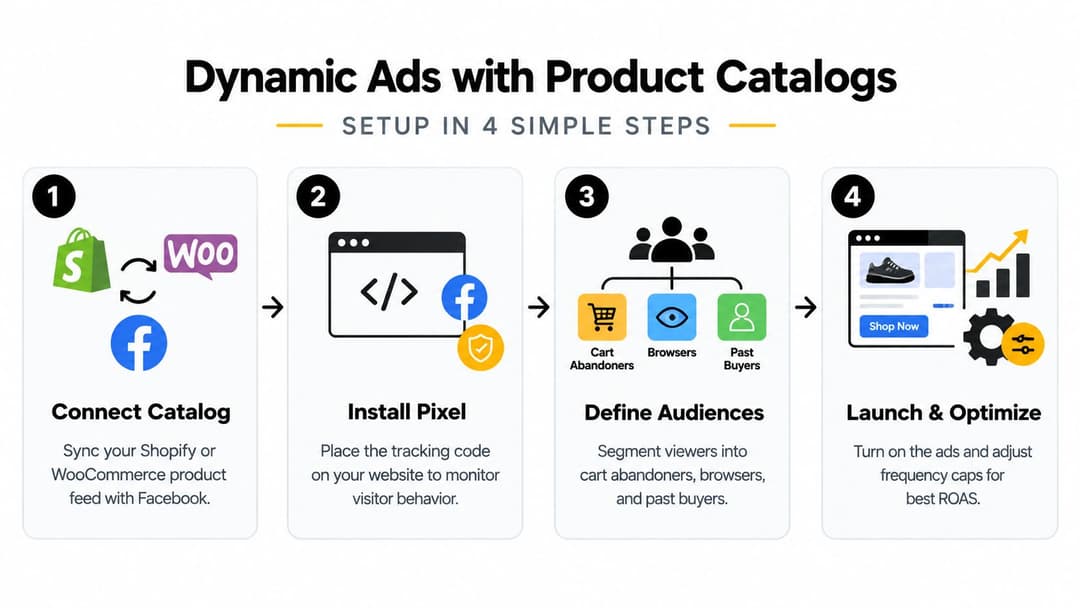
Dynamic ads turn catalog and behavioral signals into product-specific reminders. A visitor who viewed a Zappos shoe can see that item again or receive a related-style recommendation. A furniture shopper who examined a Wayfair or Article product can receive a category-relevant follow-up. Relevance works best when the message reflects intent without repeating the same exposure indefinitely.
Audience logic should follow the shopper's last meaningful action:
- Browsers: Provide education, reviews, and category benefits.
- Cart abandoners: Address uncertainty about shipping, fit, returns, or checkout.
- Past buyers: Recommend complementary products or replenishment rather than the original item.
- Feed health: Check broken images, missing prices, and unavailable products.
Read the signal before changing the creative
A lower conversion rate does not identify the cause by itself. Compare click-through and conversion movement. Falling clicks with stable conversion suggests a creative or audience issue. Healthy clicks with weaker conversion points toward the offer, price, product, landing page, or checkout experience.
Frequency adds another diagnostic layer. Repeated exposure can turn useful relevance into irritation when the product and message stay unchanged. Set exclusions, refresh product sets, and give each audience a distinct reason to return.
Catalog automation can reduce manual updates, while feed maintenance protects the path from ad to product page. The dynamic product ads automation guide outlines a more systematic workflow. AI can help group products by behavior, generate message variations, and flag feed inconsistencies. Marketers should compare those versions using product views, add-to-cart activity, and completed actions, then scale the combinations that improve downstream results rather than clicks alone.
6. Story Ads With Full-Screen Vertical Creative
Story ads work best when they feel native to quick, personal updates. Nike could use a rapid product reveal for a limited-edition release. ASOS or H&M could build anticipation through sequential frames for new arrivals. An app such as Uber, DoorDash, or Bumble could show the steps a user takes after opening the product.
The first frame carries the heaviest burden. Place the product, problem, or tension near the top, keep text clear of interface edges, and make the CTA understandable before the story advances. A three-frame sequence often communicates more clearly than one crowded image when each frame has a defined job: problem, proof, and action.
Sequence the creative deliberately
Treat each Story as a short testable narrative rather than a standalone poster. Build several routes, then compare where viewers drop, tap, and convert:
- Reveal sequence: Open with curiosity, then show the product and offer.
- Proof sequence: Present a customer outcome, demonstrate the product, then invite action.
- Launch sequence: Establish novelty or limited availability, introduce the collection, then direct viewers to shop.
- Utility sequence: Show a task, demonstrate the shortcut, then prompt an install or signup.
Meta reported 18% year-over-year ad-impression growth in Q4 2025, 12% for full-year 2025, and a 9% increase in average price per ad for 2025 in its 2025 results announcement. Rising competition increases the value of a distinctive opening, not just a larger volume of vertical assets. AI can generate controlled variations of hooks, frame order, captions, and CTAs. Keep the strongest versions only after comparing completion, tap-through, and downstream conversion signals.
7. Instant Experience Ads for Interactive Storytelling
Instant Experience ads keep a richer mobile destination inside Facebook, combining video, images, product details, and buttons. Porsche could use interactive configuration content, while IKEA could connect room inspiration with a relevant product set. The format suits products that need context before a decision.
Design the experience as a sequence of questions and answers. The opening block earns the next scroll, while each later block resolves a specific hesitation. A strong route might move from demonstration to proof, then comparison and action. This progression gives users a reason to continue without forcing every detail into the first view.
Make each block earn the next action
A crowded page delays decisions. Assign one dominant idea to each block, repeat the CTA when intent becomes clear, and remove decoration that competes with the product.
- Opening block: Present the product and its practical appeal.
- Evidence block: Show use, features, reviews, or relevant context.
- Decision block: Clarify price, availability, fit, or eligibility.
- Action block: Direct the user to the most relevant next step.
The embedded example illustrates immersive product storytelling that can inform an opening sequence.
Judge performance beyond the initial tap. Compare scroll depth, product interactions, outbound clicks, and final conversions. High exploration with weak progression indicates that the experience captures attention but leaves the commercial decision unclear. AI can produce alternate block orders, headlines, product pairings, and CTA wording. Test those variants against downstream conversion signals, not engagement alone.
8. Messenger Ads for Conversational Conversion
Messenger ads suit decisions that improve through dialogue. Sephora can help shoppers narrow product choices, Domino's can support order-related interactions, and Booking.com can answer travel questions or direct users to relevant offers. Their shared strength is clear intent: the ad gives people a practical reason to start a conversation instead of repeating a feed message.
The opening reply should deliver value quickly through a promotion, recommendation, appointment route, or personalized answer. Keep the path short enough to feel like assistance rather than a form disguised as chat. A cold audience may need one question to identify interest, while a recent buyer may need support or a complementary recommendation.
Audience context should shape the flow. Qualified prospects can receive a direct route to sales, whereas existing customers may benefit from product guidance or service help. The best sequence collects only information that improves the recommendation or handoff.
- Opening prompt: State what the user receives by replying.
- Choice architecture: Present a small set of relevant options.
- Qualification: Ask questions that change the next recommendation.
- Exit path: Offer a clear route to a person, booking page, or product page.
MasterClass-style enrollment reminders and personalized lesson prompts show how Messenger can support retention as well as acquisition. Performance analysis should connect reply rate with completed bookings, purchases, support resolutions, or qualified handoffs. High engagement with weak completion suggests that the conversation creates interest without resolving the decision. AI can generate audience-specific prompts, branching options, and follow-up variants, but teams should review accuracy, escalation rules, and staffing capacity before scaling. Response speed and reliable product information are part of the ad experience.
9. Testimonial and User-Generated Content Ads
Specific customer evidence makes UGC ads persuasive. A Glossier tutorial can show product use, an Allbirds review can address fit or comfort, and a Birchbox unboxing can reveal the experience of receiving the product. These formats work when the setting, problem, and outcome are clear. A customer video alone does not guarantee credibility.
Start with the buyer's unanswered question: what changed, for whom, and under which conditions? Use image reviews when the product is easy to assess visually. Choose video when prospects need to see a process, reaction, or demonstration. Preserve the creator's natural voice, then edit for a clear commercial point without making the testimonial sound scripted.
The asset should support a claim the customer can reasonably verify. Secure permission for paid distribution, show the product in the relevant context, and avoid turning one experience into a promise for every buyer.
A practical testing matrix can separate the variables that often get mixed together:
- Proof type: Compare demonstrations, reviews, unboxings, and product comparisons.
- Story angle: Test outcome-led, process-led, and objection-led openings.
- Distribution: Compare creator-led partnership ads with standard brand creative.
- Asset rotation: Refresh opening scenes and formats while retaining themes that produce qualified action.
- Rights control: Document usage permission before increasing spend on a creator asset.
Mosh provides a measurable example. In the Meta's Mosh case study, Meta reported that combining creator-led partnership ads with the company's usual creative produced a 53% lower cost per lead than using the usual creative alone. The useful lesson is methodological: evaluate creator participation in distribution separately from creator participation in the content. AI can help generate edits, hooks, and audience-specific variants, while human review should protect accuracy, consent, and the credibility of the customer's story.
10. Lookalike Audience Ads for Data-Driven Scaling
A lookalike campaign scales a defined customer signal into prospecting reach. The source audience might include customers, trial signups, high-value purchasers, or engaged subscribers. A DTC fitness brand could model customers who remain valuable after their first purchase, while a SaaS company could use qualified trial users instead of every signup.
The seed shapes the expansion. A large, mixed list may combine unrelated behaviors and give Meta an unclear definition of success. A focused audience provides a stronger commercial signal, especially when the ad reflects the reasons those people converted.
Build each seed around a testable hypothesis:
- Recent customers can represent current demand.
- High-value customers can represent economic quality.
- Email-engaged users can represent message affinity.
- Acquisition-source segments can represent different conversion motives.
The creative should match the selected signal. Ads based on high-value purchasers might emphasize durability, service, or product depth. Ads based on engaged subscribers could reflect the educational message that preceded conversion. This alignment gives each audience a clear explanation for why the offer should matter.
Scale in stages. Compare audience definitions first, then test broader reach after checking whether conversion quality holds. Review acquisition cost alongside qualified conversions and customer value, rather than treating lower costs as proof of improvement.
Use the performance pattern to identify the constraint. A drop in click-through rate points toward the hook or message. Stable clicks with weaker conversion point toward the offer, page, pricing, or post-click experience. That diagnosis is more useful than creating another batch of audience variants, and it gives AI a practical role: generate seed-specific hooks and versions for controlled testing while analysts decide which signals deserve more budget.
Top 10 Facebook Ad Formats Comparison
| Format | Implementation Complexity | Resource Requirements | Expected Outcomes | Ideal Use Cases | Key Advantages |
|---|---|---|---|---|---|
| Carousel Ads (Multi-Product Showcase) | Medium, multiple cards and setup | Several high‑quality images/videos, per‑card copy, design time | Higher engagement; improved ROAS for product mixes | E‑commerce, DTC product lines, feature comparisons | Showcases many products in one ad; supports A/B testing and deep links |
| Video Ads (Short‑Form 3–15s) | Low–Medium, frequent asset refresh | Short video production, captions, editing tools | 2–3× engagement vs static; strong shareability and conversions | Mobile feeds, brand hooks, demos, Reels/TikTok placements | Attention-grabbing; mobile-first; communicates benefits quickly |
| Lead Generation Ads (In‑Platform Forms) | Low, form + integration setup | CRM/ Zapier integration, audience targeting, form design | Higher form conversion rates; lower CPA for leads | B2B SaaS, services, insurance, consultations | Frictionless capture with pre-filled fields; instant submissions |
| Collection Ads (Mobile‑First Shopping) | Medium, catalog/shop integration required | Product feed, cover image/video, shop/checkout integration | Strong impulse conversions on mobile; increased AOV | Mobile-first e‑commerce, seasonal collections, impulse buys | Full‑screen instant storefront; one‑click purchase flow |
| Dynamic Ads (Retargeting with Catalogs) | High, pixel + catalog + rules | Accurate product catalog, tracking pixel, feed maintenance | 3–5× ROAS vs static retargeting; automated personalization | Cart abandoners, large catalogs, retargeting campaigns | Auto-selects relevant products at scale; low manual creative work |
| Story Ads (Full‑Screen Vertical) | Low–Medium, vertical creative design | Vertical images/videos, quick hooks, concise copy | High engagement with younger demos; good awareness/installs | Lifestyle brands, app installs, youth-focused campaigns | Immersive native format; less ad clutter; strong engagement |
| Instant Experience Ads (Interactive) | High, complex creative/UX build | Multi-block assets (video, carousels, forms), design resources | Very high engagement and brand lift; longer consideration | Product launches, storytelling, high‑consideration buys | Interactive, memorable experiences with deep engagement data |
| Messenger Ads (Conversational) | Medium, chatbot & flow design | Chatbot platform, message scripting, audience segmentation | High open rates and conversational conversions; retention gains | Customer service, re-engagement, promotions, lead qual | Personal, two‑way engagement; high open rates and personalization |
| Testimonial & UGC Ads | Low–Medium, sourcing + rights management | UGC sourcing, licensing, minimal production | Higher trust and conversion; lower creative cost | DTC, supplements, skincare, social‑proof-driven categories | Authenticity and social proof; cost‑efficient creative source |
| Lookalike Audience Ads (Data‑Driven) | Medium, seed prep and validation | Quality seed audiences (lists/pixel), analytics, creative tests | Lower CAC and predictable scaling for acquisition | Prospecting, scaling profitable audiences across channels | Scales acquisition efficiently; reduces audience guesswork |
Turning Insights Into Action
The best Facebook ads aren't a fixed gallery of formats. They're evidence of a working system that connects creative structure, audience intent, delivery placement, offer economics, and measurement. A carousel helps when the buyer needs to compare. A short video helps when demonstration creates understanding. A native lead form helps when leaving the platform adds unnecessary friction. Dynamic and lookalike campaigns help when first-party signals can guide relevance. None of those formats is automatically superior outside its buying context.
Start by auditing the objective before auditing the asset. Traffic campaigns reported an average 1.93% CTR and $0.60 CPC in 2026 benchmark summaries based on WordStream and LocaliQ data, while lead campaigns reported an average $27.39 CPL and 8.54% conversion rate in the same benchmark context, as summarized by Triple Whale. These figures shouldn't become rigid targets. They should remind you to compare like with like. A traffic ad shouldn't be judged by a sales benchmark, and a lead campaign shouldn't be optimized for cheap clicks that sales can't use.
Next, build a diagnostic tree for fatigue:
- CTR declines while conversion rate holds: Test the hook, visual opening, format, or audience exposure.
- CTR holds while conversion rate declines: Inspect the offer, landing page, price, checkout, and qualification process.
- Frequency rises with weaker engagement: Introduce new angles, sequence audiences, or reduce repeated exposure.
- Multiple creatives weaken together: Investigate market saturation, offer fatigue, and auction pressure before blaming one asset.
- One format weakens while another grows: Rebalance the creative mix instead of applying a universal refresh.
Meta reported that Facebook impressions associated with Reels rose from 17% in Q2 2024 to 31% in Q2 2025, while Facebook spend grew 12% year over year and CPM remained flat in Q2 2025, according to its 2025 results reporting. That shift supports a broader testing portfolio. Keep static and carousel assets for comparison, catalog depth, and clear product communication, while developing vertical video for mobile attention and Reels delivery. The right balance depends on your audience and objective, so measure each format against the same business outcome.
Cross-channel effects deserve attention too. In a Meta Conversion Lift test, OBS Business School's Advantage+ lead ad campaign, run from August 25 to September 26, 2025, produced a 60% lift in organic search leads, a 44% lift in paid search leads, and a 30% lift in paid search sessions among people exposed to the ads, according to Meta's OBS Business School case study. Direct-click attribution would miss that influence. Use lift testing, branded search behavior, assisted conversions, or controlled audience comparisons where your measurement setup supports them.
AI can make this operating model practical for lean teams. Use it to generate structured variations of hooks, headlines, visual directions, UGC scripts, and audience-message combinations. Then rank the results against the metric that matters, whether that's ROAS, CPL, CPA, qualified pipeline, or completed purchase. Production automation should increase the number of useful hypotheses, not encourage indiscriminate publishing.
AdStellar AI can support that workflow by generating Meta image ads, video ads, UGC avatar ads, and copy, then assembling complete campaigns for launch. Its AI Insights organize creative, audience, and message performance around campaign goals, while its campaign, creative, audience, media, and performance modules keep testing and analysis in one workspace. Use it to turn the ten approaches above into controlled experiments, with clear naming, consistent variables, and a review process that separates creative fatigue from offer or audience problems.
The practical next move is simple. Choose one campaign objective, one audience signal, and two formats that fit the buyer's decision. Create variations around a single hypothesis, define the success metric before launch, and review both front-end engagement and downstream conversion quality. That process will teach you more than copying a supposedly winning ad without understanding why it worked.
AdStellar AI helps teams create, test, and launch Meta ad variations across formats such as image, video, UGC, and copy, with performance insights tied to goals like ROAS, CPL, and CPA. Visit AdStellar AI to turn these Facebook ad tactics into a repeatable creative testing workflow.