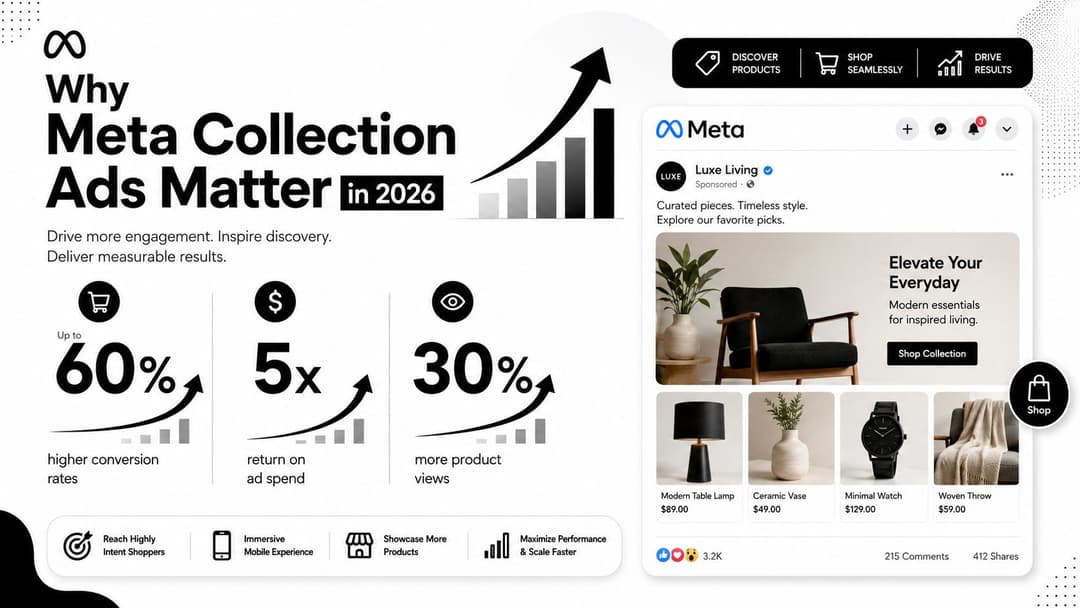
One benchmark set put Meta Collection ads at 4.2x ROAS, ahead of single-image ads at 3.3x ROAS. Another active-account study reported 45% lower CPA and 31% conversion rate for Collection ads versus standard formats Meta ads benchmarks 2026 Meta collection ads ecommerce framework. That is why the format matters in 2026. It is not a prettier ad unit. It is a mobile shopping surface that can behave like a mini storefront inside Meta's ecosystem.
For performance teams, that shifts the question from “Does it get engagement?” to “Does it move product with less friction?” The best-available benchmark data ties Collection ads to stronger commerce outcomes than simpler feed units, with account-level reporting showing 78% of viewers browse multiple products and 67% higher repeat-visit rate within 7 days Meta collection ads ecommerce framework. That behavior pattern matters more than reach alone if the goal is revenue.
A lot of marketers still compare Collection ads to single-image or carousel units as if they were just different creative shells. They are not. Collection ads combine a cover asset with a catalog grid and an in-app shopping experience, so the user can discover, compare, and move closer to purchase without bouncing out to a landing page Meta ads benchmarks 2026.
That changes how media buyers should judge the format. If your team still reports success at the click or lead level, Collection ads can look stronger than they really are. If you care about incremental revenue, downstream repeat visits, and catalog-driven purchase behavior, they deserve a direct comparison with single-image and carousel ads on ROAS, CPA, CTR, and revenue lift.
Why Meta Collection Ads Matter in 2026
Collection ads matter because they sit at the intersection of mobile browsing and purchase intent. Meta's network was reported to reach 2.35 billion people daily in 2026, with average cross-format costs at $0.83 CPC, $9.40 CPM, and 1.49% CTR Meta ads statistics. At that scale, reach is not the decision point. The question is whether the format can turn attention into revenue that shows up in the account, not just in the feed.
That is where Collection ads separate themselves from simpler units. They are built for shoppers who want to compare products without leaving the app, so the format can produce stronger commerce signals than a single-image post that depends on one static message. A practical read on that behavior belongs in digital commerce analytics, because the format only looks good if you measure what happens after the first tap.
The strongest Collection benchmark data points in that direction. One 2026 set reported 2.47% CTR, 3.6% conversion rate, 4.2x ROAS, and $19.30 CPM for Collection ads. That profile is more consistent with a buying unit than a pure awareness buy. Across accounts, Collection can also show heavier engagement with the product set itself, which is the kind of signal a media buyer should care about if the objective is downstream revenue rather than cheap traffic.
Why the format sits closer to bottom-funnel than prospecting
Collection ads work because they keep the shopping path inside Meta's environment. Users can browse multiple products before they leave the ad, which lowers the friction that often breaks intent between impression and purchase. That matters most for categories where discovery is part of the sale, because the format gives the user more ways to move from curiosity to consideration without asking for a separate landing-page visit.
Practical rule: if the creative cannot support multiple products, or if the catalog is thin, Collection ads lose much of their advantage.
That also explains why the format should be judged against single-image and carousel units on the metrics buyers manage, ROAS, CPA, CTR, and revenue lift. A static ad can still win on speed and simplicity, and a carousel can do a better job of sequencing a story, but Collection ads are meant to hold product intent longer and convert that browsing behavior into measurable commerce. Industry guidance in 2026 also pointed to stronger purchase intent than single-image formats in mobile-first categories, which fits the same pattern even when results vary by account.
The conclusion is straightforward. Collection ads deserve a place in the media mix when the goal is incremental revenue, because the format is built to keep product discovery and purchase intent inside the same session.
The Anatomy of a Meta Collection Ad
Meta Collection ads work as a three-part unit, and the format only makes sense when you judge those parts separately. The cover asset earns the scroll stop, the product grid creates browsing depth, and the Instant Experience keeps the user in a shopping flow after the tap. That structure matters because the benchmarks buyers care about, ROAS, CPA, CTR, and downstream revenue lift, depend on how well each layer does its job.
The cover image or video is the first filter. In feed placements, the common working spec is 1:1 or 4:5, with 9:16 for Reels, and production usually centers on 1080×1080 or 1080×1350 Meta collection ads guide. The cover does not close the sale on its own. It creates the pause that lets the rest of the unit matter, much like a strong subject line gets a user to open an email before the body content has any chance to work.
The product grid does the selling work
The catalog grid is the part that separates Collection ads from single-image units. Instead of forcing the user to infer assortment from one frame, the ad shows multiple products, prices, and availability pulled from the catalog. That gives the format breadth without requiring a carousel-style swipe sequence, and the product feed can do a lot of the explanation on its own.
The practical effect shows up in how buyers read the format. Product discovery is not the same as product explanation. A carousel can sequence a message card by card, but a Collection ad behaves more like a shopping shelf inside the ad unit itself. Users see options right away, which is why the format usually fits assortments, category-level promotion, and mobile commerce campaigns better than a narrow launch built around one hero SKU.
Instant Experience closes the loop
The final layer is the Instant Experience, Meta's in-app destination that keeps the session inside the platform. It gives the ad a second screen without a full site load, so the click path feels closer to continued browsing than to a hard redirect. That matters because performance teams should care less about shallow engagement and more about whether the ad contributes to downstream revenue, a point reinforced in Meta business help center.
A Collection ad also has to be evaluated against the format set buyers choose from. this guide to Facebook ad formats is a useful reference point for that comparison, because it places Collection ads alongside the simpler units they replace or support. The common thread is straightforward. Collection ads turn the feed into a merchant surface, and that changes the way attention converts into commerce.
How Collection Ads Compare to Single Image and Carousel Formats
Collection ads tend to make the most sense when product discovery is the bottleneck. Single-image ads are stronger when the offer is simple, the message is sharp, and the creative has to do all the work in one frame. Carousel ads sit between those two, since they give you multiple cards without the same storefront feel or in-app shopping depth.
The cleanest comparison comes from the metrics media buyers already watch. In benchmark readouts, Collection ads usually show the strongest ROAS, while single-image units reduce production friction and carousel ads are better for broader storytelling. The difference is not only visual. Collection ads let users browse several products in one session, which matters when the catalog is the main asset and the audience is already near purchase.
| Metric | Collection Ads | Single Image | Carousel |
|---|---|---|---|
| Attention capture | Strong on mobile, especially with a compelling cover | Clean and immediate | Better than static when multiple cards matter |
| Product discovery depth | Deep, because the grid shows multiple items | Shallow, one product or one idea | Moderate, card-by-card browsing |
| Purchase intent | Higher in mobile commerce categories | Good for direct response prompts | Good when the user needs more context |
| CPA | Reported 45% lower in account-level analysis versus standard formats Meta collection ads ecommerce framework | Typically simpler to scale, but not as commerce-native | Often competitive, but depends on card sequence |
| ROAS | Reported at 4.2x in one benchmark set Meta ads benchmarks 2026 | Reported at 3.3x in the same benchmark set | Reported at 3.7x in the same benchmark set |
Collection ads perform best when the catalog is rich, the shopper is mobile-first, and the campaign sits mid to low funnel. Single-image ads are still the better fit for simple launches, one-product offers, and quick creative testing. Carousel ads make more sense when the job is to explain a sequence, show product variation, or move through several benefit points card by card.
Decision rule: if the campaign depends on showing more than one product to make the sale, Collection ads usually deserve the first test. If one product or one offer closes the sale, start simpler.
The format loses some advantage when the audience does not need browsing support. That is why a narrow SKU launch or broad prospecting campaign can still favor single-image or carousel units, even if Collection ads win the commerce benchmark on paper.
Key Creative and Technical Specifications
The production choices for Collection ads are less about passing a checklist and more about how the ad reads on a phone. If the cover feels cramped or awkward in feed, the storefront loses attention before the product grid even has a chance to work. The specs below shape how well the format performs in real placements.
The cover media should be built for mobile-first placements. In feed, 1:1 or 4:5 is the practical range, while 9:16 fits Reels. Common production targets are 1080×1080 and 1080×1350. That choice matters because aspect ratio decides how much screen space your product gets before the user scrolls.
The file constraints shape your production pipeline
Spec guides around Collection ads place video uploads around 4 GB and images around 30 MB. Those limits do not tell you what creative to make, but they do shape the workflow. Teams that export too many oversized variants end up spending more time compressing assets than testing angles.
The product grid is only as strong as the catalog behind it. Clean product imagery, accurate pricing, and reliable inventory data all affect whether the ad feels like a store or a placeholder. That makes catalog quality a performance variable, not just an operations task.
| Spec | Practical target | Why it matters |
|---|---|---|
| Feed ratio | 1:1 or 4:5 | Preserves mobile screen space |
| Reels ratio | 9:16 | Fits full-screen vertical placements |
| Common cover dimensions | 1080×1080 or 1080×1350 | Keeps creative aligned to Meta feed standards |
| Video file format | MP4/MOV | Improves compatibility in production and upload workflows |
| Image upload cap | Around 30 MB | Reduces failed uploads and compression surprises |
If you need a broader reference for feed imagery, the Facebook image size guide is useful as a companion. The same principle applies across Collection creative, keep the cover legible, the product cards accurate, and the path to tap obvious.
Do not optimize Collection ads like display banners. They behave more like a shopping interface, and the technical spec should support that behavior.
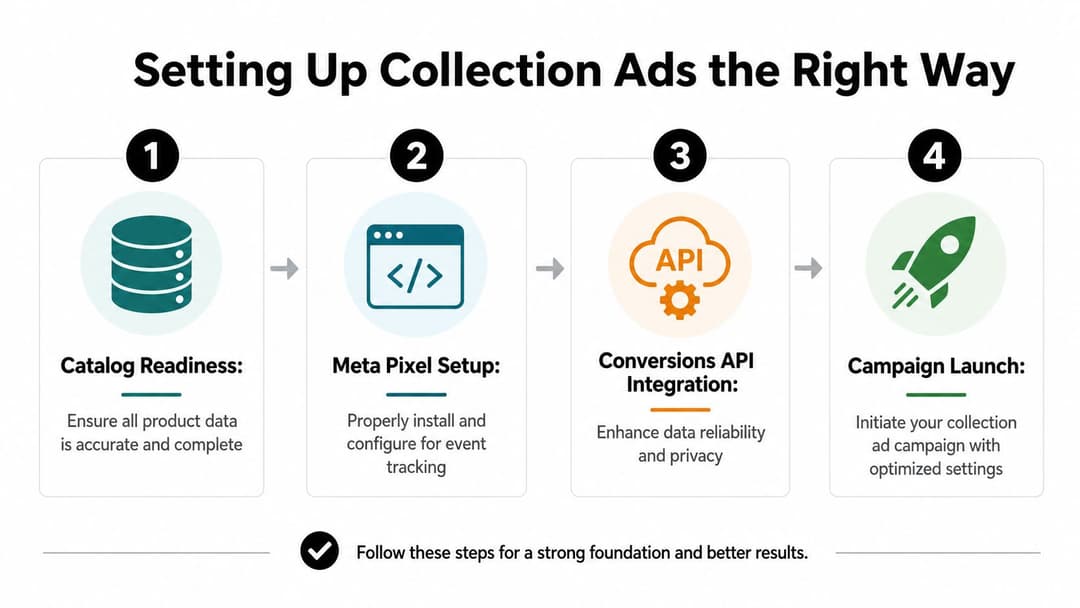
Setting Up Collection Ads the Right Way
A Collection campaign can look polished and still miss the mark if the catalog is messy, measurement is weak, or the campaign structure does not match the product range. The setup work starts before Ads Manager. Each step depends on the one before it, so errors early in the process show up later as weak CPA, soft CTR, or revenue that does not justify the spend.
Start with catalog readiness
The product catalog has to support browsing without friction. That means accurate titles, clear descriptions, current pricing, and image assets that make the grid feel like a storefront rather than a placeholder. If the feed is incomplete or inconsistent, the ad loses the one advantage Collection format has over a simple single-image unit, the ability to present a coherent mini-store inside the ad.
Catalog quality also affects how much trust the ad earns. Clean product imagery and current inventory data help the ad feel like a shopping surface. Weak catalog hygiene creates a disconnect between the cover creative and the product cards, which usually shows up as lower downstream revenue even when top-of-funnel engagement looks fine.
Then wire measurement to revenue
Meta's setup guidance covers the format mechanics, but advertisers still need to define success before launch. The target should be CPA or ROAS if the business outcome is sales, not clicks, opens, or add-to-carts. Collection ads can generate healthy engagement and still underdeliver on closed revenue if the measurement plan stops at platform activity.
For teams still tightening the link between spend and outcome, cost per lead calculation for founders is a useful reference point for the discipline involved. The same logic applies here, even though a Collection campaign usually needs revenue-level proof instead of a lead count. If the dashboard does not reflect what happened after the click, the campaign is easy to overrate.
Choose the campaign structure that matches the catalog
Catalog-driven setups make the most sense when the product set is broad enough to justify automatic selection. Manual structures can still work, but they tend to leave more merchandising decisions on the table when the catalog itself should be doing the sorting. The practical question is whether the assortment needs automation to surface the right products, or whether a narrower range can be curated by hand without losing efficiency.
Setup quality is also a catalog operations issue. A clear catalog ads management guide helps teams keep the product feed, creative assets, and inventory signals aligned before the campaign starts. That alignment matters because Collection ads are judged on more than a click, and a feed mismatch can depress both CTR and revenue lift even when the ad looks strong in the feed.
If measurement is not set up before launch, Collection ads become a creative test instead of a revenue test.
How to Measure the True Value of Collection Ads
Strong platform metrics can still hide weak downstream economics. That is the main risk with Collection ads, because the format can drive browsing behavior even when the business result is weaker than the dashboard implies. The right starting point is not the ad surface, but the measurement frame. For teams tightening the link between spend and outcome, cost per lead calculation for founders is a useful reference point for the discipline involved, and the same logic applies here even though Collection campaigns usually need revenue-level proof instead of a lead count. If the reporting stack does not reflect what happened after the click, the campaign is easy to overrate. For a cleaner way to inspect the full path, campaign performance analysis should sit alongside the campaign report, not after it.
The first rule is to set the target before launch. If the goal is revenue, then ROAS or target CPA should be the north star, not clicks, opens, or add-to-carts. Collection ads can improve engagement without proving incrementality, so the benchmark has to be business output, not platform activity.
Validate the format like a performance channel
The practical tools are familiar, but they matter more here than in simpler ad units. Holdout tests help separate real lift from natural demand. Longer conversion windows can capture the delayed purchase path that mobile shopping often creates. Revenue-level reporting through the Conversions API makes the data more reliable when browser signals are incomplete or noisy.
A useful way to read the results is simple. If the ad does not move closed revenue, the team is probably measuring creative resonance instead of commerce impact. Collection ads make that mistake easier because the format is visually rich and the in-app journey feels active.
Use the right benchmark frame
When the team reviews performance, it helps to compare Collection campaigns against the same business lens used elsewhere in the funnel. That keeps the discussion tied to outcomes a media buyer can defend.
- Target CPA first: Set the maximum cost per acquisition before launch, then judge Collection ads against that line.
- ROAS second: Use revenue, not click volume, to decide whether the catalog is monetizing.
- Lift testing third: Compare against holdouts or matched controls when the account has enough volume.
- Attribution sanity check: Confirm the path from ad exposure to purchase is visible in the reporting stack.
The most useful conclusion is that Collection ads are partly a measurement format. Their value shows up only when the full shopping path is tracked, not when the review stops at the first sign of interest.
Where Collection Ads Fit in a Modern Meta Mix
Meta's 2026 direction keeps pushing advertisers toward automation and modular creative testing. A recent LinkedIn post even claimed Collection Ads are being removed as a standalone activity, which hints at a bigger shift, the format may matter less as a named campaign type and more as one creative system inside a broader shopping stack. Whether that change is formalized everywhere or not, the strategic implication is already visible.
Collection ads now compete against other ways to package commerce intent inside Meta. Advantage+ Shopping absorbs some of the setup that used to make Collection distinct, while creative testing increasingly focuses on the angle rather than the format itself. In practice, that means your catalog quality and message variation matter more than whether the ad is treated as a separate lever.
Where the format still earns its slot
Collection ads still make sense when three things line up. The catalog is deep enough to warrant browsing. The audience is mobile-first. The campaign sits in a mid-funnel or lower-funnel context where product discovery can shorten the path to purchase.
They're less compelling when the goal is broad reach, when the SKU count is tiny, or when one hero product carries the offer by itself. In those cases, a single-image or video unit may be cleaner, faster, and easier to attribute. The benchmark data still favors Collection on commerce outcomes, but format fit matters more than raw upside.
Collection ads are a tool, not a strategy. The strategy is catalog quality plus testing discipline plus clean measurement.
The shift is that format choice no longer does the heavy lifting by itself. Modular creative systems, automated delivery, and better catalog feeds are taking over the role that manual setup used to play. That doesn't make Collection ads obsolete. It makes them more conditional.
Optimization Moves Performance Marketers Can Apply This Week
A weak catalog can make a strong ad look average. If product images are inconsistent, pricing is stale, or inventory signals do not match what is available, the grid will drag down the entire unit. Collection ads do not hide those problems, they surface them immediately.
Start with the cover, then judge it like a media buyer. Run benefit-led, product-led, and social-proof-led variants, while keeping the format, audience, and budget identical across each test. That is the cleanest way to separate creative impact from delivery bias and see whether one angle improved CTR, CPA, or ROAS on its own.
A practical weekly checklist
- Catalog hygiene: Refresh product images, pricing, descriptions, and stock signals so the grid stays current and shoppable.
- Creative angle testing: Swap the cover message while holding everything else constant, then review the change through ROAS and CPA.
- Audience discipline: Separate warm and cold audiences so browsing behavior does not blur the read on performance.
- Budget pacing: Avoid abrupt budget shifts that can send campaigns back into unstable learning behavior.
- Revenue review: Check whether the ad produced closed sales, not just on-platform engagement.
The best Collection programs usually look unremarkable from the outside. The catalog stays current, the team tests a few covers each week, reporting reaches revenue, and weak variants get cut quickly. That is the difference between a format that looks active and a format that scales.
For teams that want to build, test, and iterate on Meta creative without adding manual work, AdStellar AI can help generate ad variations and launch campaigns from the same workflow used to review performance. For marketers comparing Collection ads against simpler formats, that speed matters because the gain comes from cleaner testing, not from treating the format as a one-time fix.