Your Meta account is spending, but the creative process is stuck. The same polished product video appears across multiple ad sets, frequency climbs, comments get colder, and your team spends more time requesting new assets than learning from the ones already live. User generated content ads can break that cycle, but only when you treat UGC as an operating system, not a folder of random creator videos.
The performance lift comes from more than a handheld camera or an unscripted delivery. Strong UGC programs connect sourcing, consent, creative iteration, measurement, and scaling into one repeatable workflow. This playbook focuses on that operational layer, with benchmarks and caveats grounded in available research rather than one-off wins.
Why User Generated Content Ads Dominate Meta Performance
A common Meta pattern looks like this: a brand launches a carefully produced video, sees encouraging early results, and then gradually watches performance weaken as the audience becomes familiar with the message. The team responds by changing targeting, placements, or bidding before asking whether the creative still feels native to the feed.
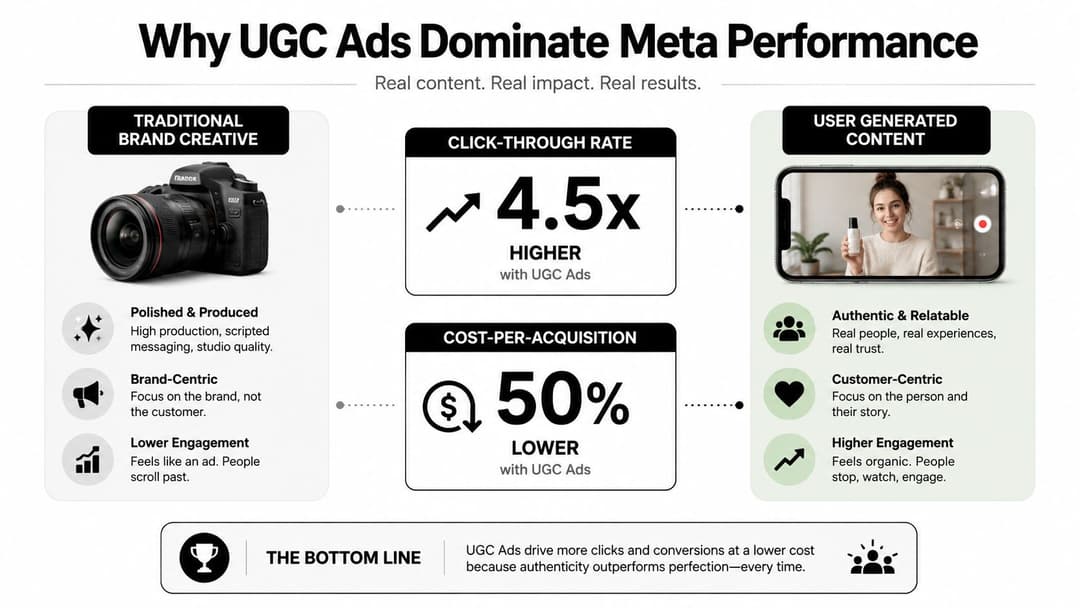
User generated content ads often address that problem because they present the product through a person's experience rather than through the brand's preferred visual language. A creator demonstrating a skincare routine, showing an inconvenient product problem, or explaining why a feature matters gives the viewer a reason to keep watching that feels closer to peer advice than a commercial.
Research-based summaries report that ads featuring UGC can produce 4× higher click-through rates and a 50% lower cost per click than standard ads, while another reported a 29% lift in conversion rates compared with campaigns without UGC. These figures come from the HubSpot summary of user-generated content statistics, and they point to a practical conclusion: UGC belongs in the performance creative mix, not only in awareness campaigns.
The trust mechanism behind the click
The strongest assets usually contain a visible experience. The creator names the problem, uses the product, shows the result, or explains a limitation. That sequence supplies social proof without forcing the viewer to accept a polished brand claim.
The same HubSpot-cited research reports that UGC-based ads can generate 73% more positive comments than traditional brand ads and are perceived as 2.4× more authentic than brand-created content. That authenticity matters on Meta because users evaluate ads in an environment built around personal recommendations, creator posts, and conversations.
Survey data cited in industry coverage also reports that 90% of consumers said UGC influences purchasing decisions, 79% said it strongly affects what they buy, and 88% said recommendations from people they know are the most trusted form of advertising, as summarized by Sepia Lab's UGC marketing statistics. The useful lesson isn't that every raw video will win. It's that the format gives a credible starting point for reducing skepticism.
Practical rule: Use UGC when the buyer needs proof, context, or reassurance. Keep polished brand creative when the campaign depends on premium presentation, visual control, or a tightly managed brand mood.
UGC also expands the number of messages you can test. One creator can produce a problem-led testimonial, a feature demonstration, an objection response, and a comparison angle. That variety helps performance teams fight fatigue without rebuilding the entire production process for every iteration. For a clear definition of the format and its role in paid media, see what UGC advertising means for modern campaigns.
Sourcing UGC and Securing Legal Consent
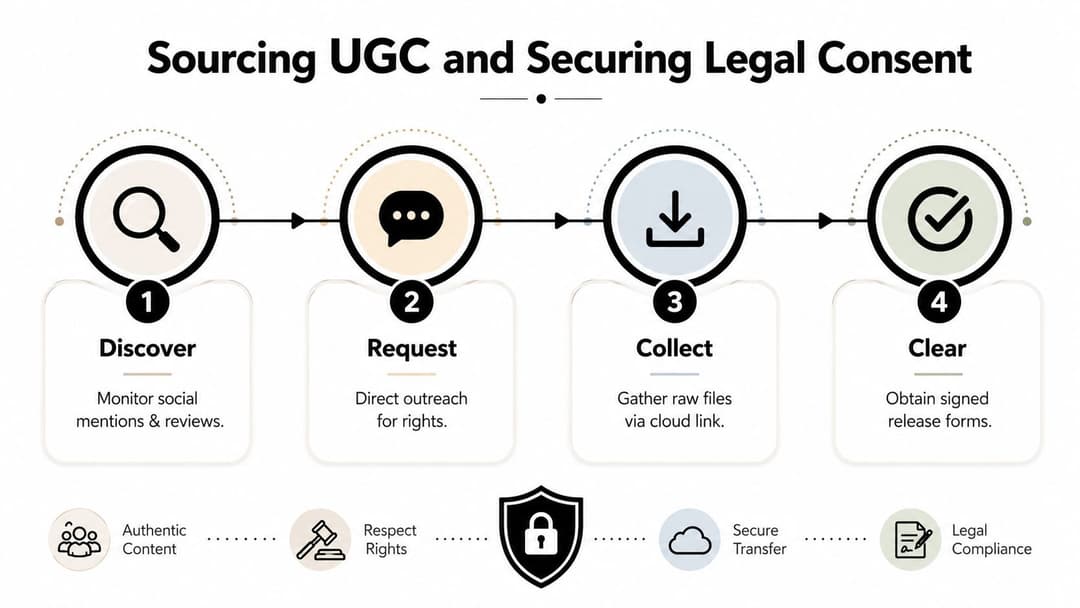
The fastest way to create a compliance problem is to treat a public post as an available ad asset. A customer may mention your product publicly, but that doesn't automatically give your brand permission to download, edit, publish, or run the content as paid media.
Build a sourcing pipeline that separates discovery from approval. Your media library should show where each asset came from, who created it, which rights were granted, where the asset may run, and when those rights expire.
Start with a controlled discovery process
Search four sources consistently:
- Customer reviews and support interactions: Look for specific product experiences, not generic praise. A review that explains a problem, use case, or result can become a strong script foundation.
- Social mentions and tagged posts: Save the post URL, creator handle, date found, and any visible engagement context before contacting the creator.
- Existing creator relationships: Ask creators for raw files, alternate takes, unused hooks, and permission to adapt the material for Meta placements.
- Dedicated creator marketplaces: Use platforms that centralize briefs, submissions, contracts, and payment records when internal outreach becomes difficult to manage.
The initial brief should specify the product, audience, claims the creator may make, prohibited claims, required disclosures, deliverables, aspect ratios, raw-file requirements, and paid usage terms. If you're budgeting creator work, use a structured reference such as this guide to UGC creator costs for ads, then validate the scope against the rights and production requirements of your campaign.
Permission needs to be explicit
Ask for written consent for the exact commercial use. The release should identify the creator, the brand, the content, paid advertising, editing rights, territories, platforms, duration, whitelisting or partnership-ad permissions where relevant, and any restrictions on sublicensing.
Don't rely on a casual “sure” in a comment thread. Keep the original message, the signed release, the final approved file, and the campaign record together. If the creator appears with other identifiable people, clear their participation too. If music, logos, artwork, or third-party footage appears in the video, review those elements separately because creator permission may not cover them.
Before launch, check that the finished edit still matches the approval. Cropping can remove a disclosure. A new opening line can alter the creator's meaning. Caption overlays can turn a personal observation into an objective product claim. Route final versions through the person who owns legal or compliance review, especially for health, finance, beauty, and regulated categories.
A clean rights process protects more than the ad account. It protects the relationship with customers and creators, gives your team confidence to reuse approved assets, and prevents a high-performing video from becoming unusable because nobody can prove what was authorized.
Creative Templates and Hook Frameworks for UGC Ads
Raw footage isn't automatically a finished ad. A creator can deliver a believable testimonial that still loses viewers because the first sentence arrives too late, the product appears only at the end, or the edit never answers why the viewer should act now.
Build templates around the buyer's information sequence. The opening earns attention, the middle demonstrates relevance, and the close removes friction.
Four reliable structures
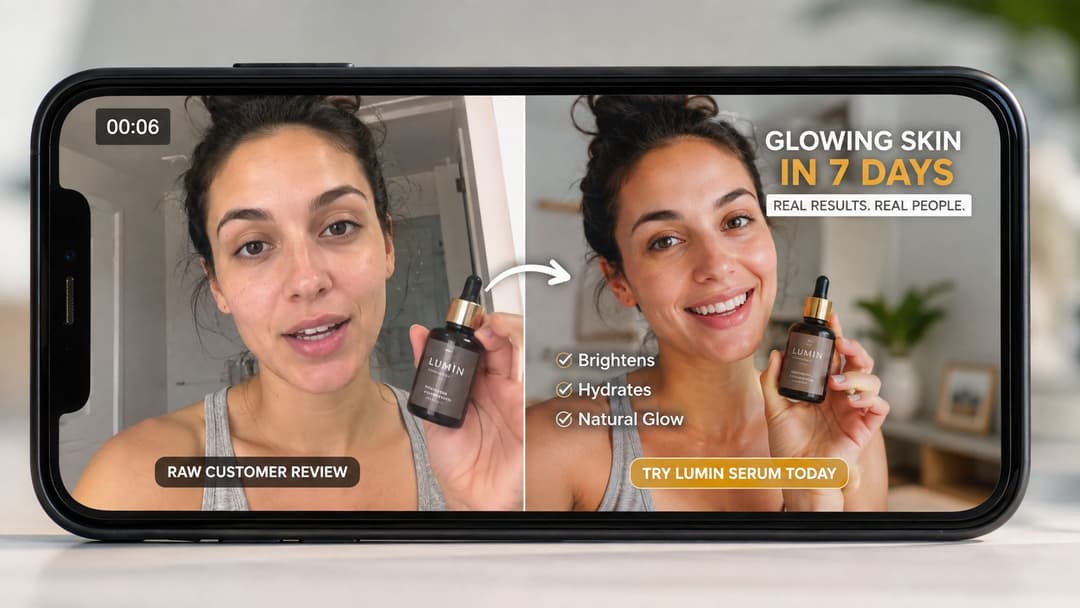
The problem and payoff format begins with a recognizable frustration. A skincare creator might open with, “My skin looked dull even after I changed my routine,” then show the product, explain how it fits into the routine, and finish with a clear next step. This structure works when the audience already knows the problem but hasn't committed to a solution.
The objection response starts with resistance. “I thought this would feel heavy under makeup” creates a reason to keep watching, especially when the creator demonstrates texture, application, or wear. Use the objection that appears repeatedly in comments, reviews, or sales calls.
The feature demonstration puts the product in motion immediately. A creator shows how a travel container closes, how a software workflow removes a manual task, or how a garment fits during movement. Keep the spoken explanation tied to what appears on screen.
The customer story uses a before, decision, and after sequence. It doesn't need an exaggerated transformation. A credible story can focus on convenience, confidence, reduced effort, or a specific use case.
Make the first seconds do real work
A hook should create a specific information gap, not announce that an advertisement is starting. Useful patterns include:
- A direct problem: “If your routine leaves your skin tight, check this step.”
- A personal discovery: “I changed one product and noticed the difference in how my skin looked.”
- A comparison: “I tested the lightweight option against the formula I used before.”
- A concrete use case: “This is what I pack when I need a simple morning routine.”
- A skeptical admission: “I didn't expect this serum to work well under makeup.”
Write several openings for the same body footage. Change the first spoken line, first visual, caption, and thumbnail together so you're testing a new angle rather than making cosmetic edits. For more variations and creator-ready structures, write compelling UGC ads with a larger hook library in mind, then adapt each script to your category and evidence.
Edit for Meta without removing the human signal
Shoot or crop for vertical viewing, keep captions legible on a phone, and place the product or relevant action early. Use burned-in captions because many users encounter ads without sound, but don't cover the creator's face, product labels, or important demonstrations.
The best edit usually preserves small signs of reality while removing dead air, repetition, and unclear transitions. Avoid adding so many effects that the video stops resembling the native content people expect in the feed. Use UGC ad script examples to build a modular library, with separate hooks, proof sections, objections, and calls to action that your team can recombine responsibly.
Testing Frameworks and Performance Benchmarks
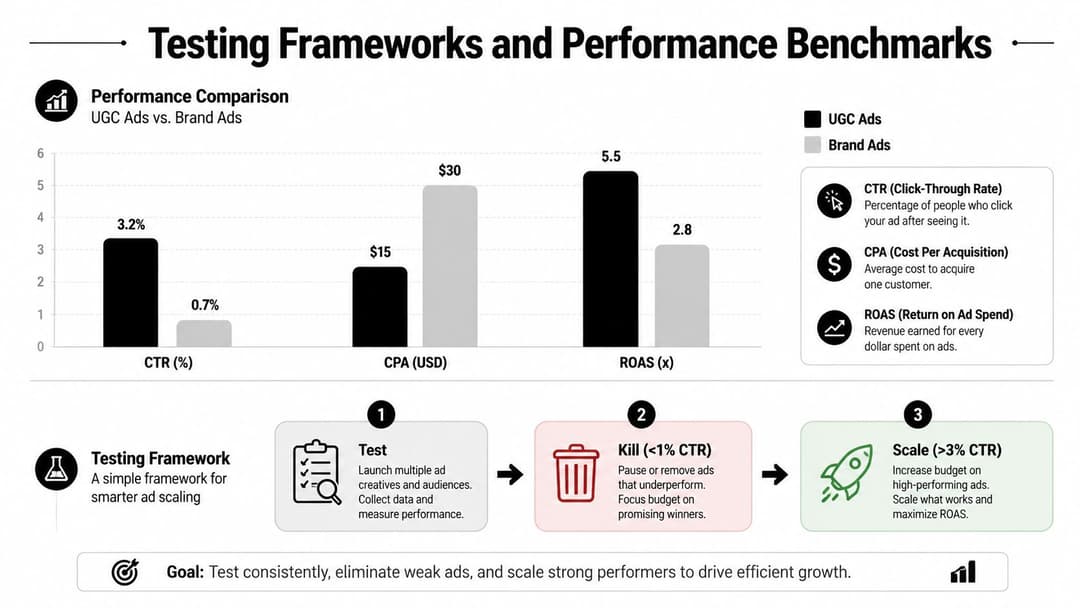
UGC testing fails when teams call a winner from one attractive metric. A high CTR can reflect curiosity without purchase intent, while a strong completion rate can indicate entertaining content that doesn't explain the offer. Evaluate the creative as a chain, from the opening view through the business outcome.
A practical framework starts by exporting 90 days of creative-level data and reviewing hold rate, CTR, CPA, spend, and frequency for each ad, as described in Influee's UGC statistics and benchmark framework. The historical window gives you a useful account-level reference instead of relying on an arbitrary universal target.
Read the funnel in sequence
The benchmark framework identifies strong paid-social UGC performance at roughly 55–70% three-second hold rate, more than 50% thumbstop ratio, 50–65% average watch rate, more than 45% completion for ads under 20 seconds, and more than 2% CTR, all from the Influee source above.
Interpret those metrics diagnostically:
- Weak hold rate: The first frame or opening line isn't earning attention.
- Strong hold but weak watch rate: The hook works, but the body loses clarity or momentum.
- Strong watch rate but weak CTR: The message may entertain without presenting a compelling reason to click.
- Healthy CTR but weak conversion: Check landing-page continuity, offer clarity, product-market fit, and the quality of the traffic.
- Rising frequency with declining results: Refresh the angle, creator, opening, or visual context before changing every campaign setting.
The same framework recommends a kill threshold around the account median after 72 hours, a scale threshold near the 75th percentile, and winner budget increases of 20–30% per day. Treat these as a testing reference, not a law. Delivery volume, conversion lag, spend distribution, and account history still determine whether the signal is mature enough to act on.
Separate iteration from replacement
Independent benchmark research cited by UGC Era reports a 21% average conversion-rate lift, a 17% CPA reduction, and ROAS gains of 14% on TikTok, 11% on Instagram, and 9% on YouTube Shorts for UGC-based ads, with stronger gains among Gen Z-targeted campaigns, as detailed in its UGC advertising whitepaper. The source also emphasizes that raw UGC alone isn't sufficient. Structured iteration and platform adaptation matter.
Don't delete an underperformer before identifying its failure point. Keep the creator and change the hook, keep the hook and change the proof, or keep the entire story and alter the landing-page promise. For additional context on account-level comparison, use these Meta Ads performance benchmarks, while keeping your own historical data as the primary decision reference.
Scaling Winning UGC with Automation
Scaling a UGC winner isn't the same as duplicating one ad across every audience. The original result may depend on a particular opening, creator identity, placement, offer, or audience context. Preserve the winning hypothesis, then create controlled variations around it.
Start by naming the variables in the asset:
- Creator and delivery style
- First three seconds
- Problem or use case
- Proof sequence
- Offer and call to action
- Caption and headline
- Crop, placement, and landing page
Create a version matrix before launching. Pair one proven hook with several product demonstrations, then test alternate creators against the same message. This makes the results easier to interpret than a batch where every variable changes simultaneously.
Tools such as ShortGenius automated ad generation can help teams turn scripts or product inputs into creator-style video variations. Use automation for production speed, but keep a human approval step for claims, brand suitability, disclosure placement, and whether the output still feels credible. AI-generated variations can multiply weak ideas just as quickly as strong ones.
AdStellar AI can centralize Meta campaign, creative, audience, media-library, and performance workflows, while its AI Insights ranks combinations against goals such as ROAS, CPL, or CPA. Its product-to-video workflows can also generate UGC-style avatar videos from a product input, which makes it one option for teams that need additional creator-style variations without coordinating every shoot manually.
Build scaling rules around evidence
A repeatable operating loop looks like this:
- Promote proven angles: Move ads that clear your account's performance criteria into a controlled winner pool.
- Generate adjacent versions: Change one meaningful variable at a time, such as the opening or objection.
- Launch in organized batches: Use consistent naming so creative, audience, placement, and offer remain visible in reporting.
- Monitor fatigue: Watch frequency, hold rate, CTR, CPA, and conversion quality together.
- Refresh before collapse: Brief the next creator or variation while the current winner still has usable signal.
For a deeper operational workflow, see how to scale Meta ads with automation. Automation should reduce repetitive setup and reporting, not eliminate judgment. The media buyer still decides which customer promise deserves more budget and which performance change reflects a real insight rather than noise.
When UGC Ads Underperform and What to Do Instead
UGC isn't universally superior. Recent research on user-generated AI ads found a trade-off: UGC-style ads performed better for engagement, while marketer-generated ads produced more positive consumer sentiment, as reported in the study on consumer responses to user-generated AI advertising. That distinction matters when the campaign objective involves premium positioning, reputation, or emotional brand control rather than immediate response.
UGC can underperform when the creator lacks category credibility, the product needs a precise technical explanation, the visual standard carries purchase intent, or the content makes the brand look less trustworthy. A shaky video may feel authentic for a personal-care routine, but careless execution can damage perceived quality for luxury goods or products where safety and precision dominate the decision.
Measurement also has limits. Independent coverage notes that the available evidence remains fragmented by platform. One benchmark reported UGC-engaged shoppers converting 10.38× more than shoppers who engaged with non-UGC content in Q3 2025, but the same coverage states that no independent study cleanly isolates UGC creative from static creative across the same audience, spend, and platform, as discussed by Whatmore's UGC versus static ads analysis.
Use a simple decision filter:
- Choose UGC when relatability, demonstration, and peer proof drive the decision.
- Choose polished creative when controlled presentation, brand distinction, or visual authority carries more weight.
- Test both when the objective includes engagement and sentiment, because one format may win attention while the other protects brand perception.
- Judge incrementality where possible, rather than treating every engaged viewer as a UGC-created conversion.
The operational answer isn't to replace brand creative with UGC. It's to maintain both systems, clear rights properly, test creative variables deliberately, and scale only the combinations that produce profitable business outcomes.
AdStellar AI helps performance teams create, organize, test, and scale Meta campaigns while connecting creative variations to performance goals such as ROAS, CPL, and CPA. Visit AdStellar AI to see how its campaign automation and UGC-style video workflows can support a more repeatable creative operation.