You can do everything “right” in Meta and still watch a campaign stall. The audience is tight, the offer is clear, the creative is polished, and the copy explains the product well, yet the ad feels like a brochure instead of something a person wants to respond to. That's the gap emotional marketing fills, especially when you need the ad to do more than sound smart.
A lot of performance marketers end up here late in the day, refreshing Ads Manager, wondering why a clean value proposition isn't converting. The answer is usually not better feature wording. It's a message that gives the buyer a feeling, then gives that feeling a path to action. If you want a practical example of how performance teams think about this problem, the framing in performance marketing for eCommerce is a useful complement.
What follows is built to answer three things in order. First, what is emotional marketing in plain English. Second, why it works psychologically and commercially. Third, how to turn that into Meta paid-social execution with rapid variation testing, especially when you need to connect creative choices to ROAS and CPA instead of vague brand language.
The Performance Marketer's Daily Struggle
At 6 p.m., the ad set looks fine on paper and dead in practice. The targeting is narrow, the offer is competitive, and the headline tells people exactly what the product does, but the click-throughs are soft and the conversions never catch up. That's the moment when many marketers realize that clear information and compelling persuasion are not the same thing.
Rational messaging tries to win by explaining. It lists features, repeats benefits, and assumes the buyer will choose the option with the strongest logic. Emotional marketing works differently. It gives the buyer a reason to care before it asks them to compare.
That distinction matters because the commercial payoff is not abstract. Industry summaries of the long-running emotional marketing benchmark report that emotionally driven ads have performed about 31% better than rational-only ads, while rational-only campaigns sit around 16% in the same comparisons, which is close to 2x the success rate for emotional appeals, and ads with above-average emotional response are also reported to drive around 23% more sales (Passive Secrets). Those numbers don't mean every sentimental ad wins. They do mean emotion is often the difference between being understood and being acted on.
Practical rule: if the ad reads like a product sheet, it usually needs a human feeling, not another feature.
The same pattern shows up in broader effectiveness work. In one cited analysis, emotionally designed campaigns hit or exceeded predefined KPIs in 34.7% of cases versus 16.2% for purely rational or feature-led campaigns (AMRA & Elma). That gap is why serious paid-social teams keep returning to emotional angles, not as a brand-only exercise, but as a way to improve measurable business outcomes.
What Emotional Marketing Really Means
A rational ad reads like a spreadsheet summary, while an emotional ad reads like a conversation. Emotional marketing shapes a message around a feeling people already have, or want to have, and then connects that feeling to the next action. One explains the specs. The other makes the promise behind the specs feel real.
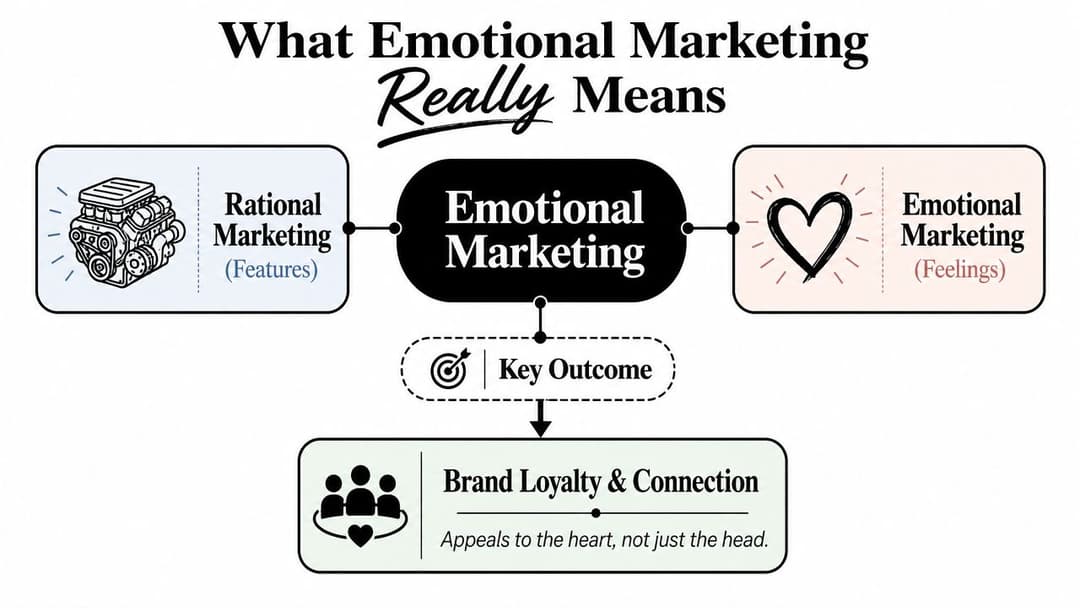
That is why emotional marketing is not guesswork. Modern emotional analytics systems can classify sentiment, discrete emotions, intensity, and trigger context from text, images, voice, and behavioral data. They can then map those signals to customer-journey stages so teams can optimize attention, dwell time, add-to-cart rate, conversion rate, and repeat rate rather than relying on demographics alone. Berger Team describes this kind of analysis as a way to turn emotion into a campaign input, not a vague creative mood.
The simplest way to explain it to a stakeholder
A spreadsheet can be accurate and still fail to persuade. Buyers rarely convert from facts alone, because the facts have to fit a felt need first, like relief, trust, belonging, pride, or urgency.
That is why emotional marketing belongs in performance strategy, not only in brand work. A buyer may compare products with logic, but the decision often happens under emotional pressure, and the logic comes later as a justification. If you want a concise primer on how that turns into ad language, ad copy best practices gives a useful framework for writing messages that sound like people, not product manuals.
The point is brand loyalty and connection that can be tied to campaign behavior. The strongest emotional ads do not avoid proof. They wrap proof in a feeling that makes the proof matter, and they often help you master storytelling for business growth by making the audience feel the story before they evaluate the offer.
Psychology and Types of Emotional Appeals
Emotional marketing works because buying decisions rarely move through a clean logic checklist. A person may notice a product because it signals safety, urgency, belonging, pride, or relief, then decide the facts matter afterward. That is why the same offer can be framed through several emotional lenses, depending on whether the goal is attention, trust, or conversion.
Five emotional triggers that show up again and again
Joy is the easiest to spot. It makes content feel warm, shareable, and rewarding. A joyful ad does not just say the product is useful, it gives the viewer a better feeling while they watch.
Trust matters when the buyer wants reassurance. It works like a sturdy handshake, especially in categories where risk feels high or the choice has long-term consequences. In B2B especially, emotional connections have been cited as accounting for about 66% of buying-decision influence, and emotionally connected customers have been reported to deliver 306% higher lifetime value (RevenueMemo).
Belonging turns the product into a signal that the buyer fits in with a group. That is one reason communities, memberships, and identity-based brands can be so effective. People want to feel recognized.
Fear creates urgency when delay carries a cost. Used carefully, it can move someone from passive interest to immediate action. The point is not panic, it is helping the audience see that waiting has consequences.
Aspiration points to a better version of the buyer. It fits products tied to status, progress, or self-improvement. The message says, “this helps you become who you want to be.”
The right emotion depends on the journey stage. Awareness often needs curiosity or belonging. Conversion usually needs trust, urgency, or aspiration.
These choices are part of the storytelling craft that business marketers use to connect meaning with action. Narrative gives the audience a reason to care before they start comparing details, and master storytelling for business growth is a useful companion read if you want to strengthen that side of the message.
Why this matters across consumer and business markets
It is easy to assume emotion only matters for consumer brands that sell lifestyle or entertainment. Research summaries point the other way. Emotional connections show up in B2C loyalty, and they also shape buying committees, vendor preference, and post-sale retention in B2B.
That means the appeal type has to match the job of the ad. A cold prospect usually needs a different feeling than a retargeting audience. If you are choosing audiences, demographic ad targeting becomes more useful when you pair it with emotional intent, not instead of it. Demographics tell you who might see the ad. Emotion tells you why they might care, and it helps AdStellar AI's bulk-variation testing compare which emotional frame is more likely to improve ROAS or lower CPA in Meta campaigns.
Emotional Ad Examples and Case Studies
A strong emotional ad usually shows up first as better campaign results, not as a louder message. In reporting on the IPA Effectiveness Databank, analysts at AMRA & Elma found that emotionally designed campaigns hit or exceeded predefined KPIs in 34.7% of cases, compared with 16.2% for purely rational or feature-led campaigns. That gap is the practical reason performance teams keep testing emotional angles.

A rational ad can be complete and still feel flat. It may explain the offer, the ingredients, the terms, or the differentiators, yet never give the viewer a reason to care. Emotional creative changes that shape. It starts with a feeling the audience already recognizes, then shows the product as a path toward relief, confidence, pride, or relief from friction.
What strong emotional creative tends to do
Story-led video often opens with a familiar frustration and then moves toward resolution. Sensory cues can do similar work more quickly, especially when they hint at comfort, surprise, or confidence. Relatable dialogue helps the audience recognize their own situation, which is often more persuasive than a long list of features.
That pattern also explains why some campaigns fall flat. If a brand borrows emotion without understanding the audience, the ad can feel tone-deaf or manipulative. The feeling can also be wrong for the category, especially when a product already carries clear social expectations and the creative ignores them. In emotional marketing, fit matters as much as feeling.
For more hands-on creative examples, campaign ad example shows how message shape changes the response an ad gets. The point is not to copy a format. It is to identify the emotional mechanism, then adapt it to your own product and audience. If you also need to keep the comments and replies around those ads organized, brand-safe ad management with Exerta gives a useful companion process for protecting the conversation around the creative.
How to read an emotional ad
Ask three questions when you look at any creative.
- What feeling does it start with? This could be curiosity, relief, pride, or concern.
- What moment does the ad resolve? The product usually removes friction or creates status.
- What action is the viewer supposed to take next? The emotional arc should end in a measurable step.
That lens turns emotional marketing from a vague creative instinct into something you can compare across variants. Once you can name the feeling and the resolution, you can test which version is more likely to improve ROAS or reduce CPA in Meta campaigns.
Implementing Emotional Marketing in Meta Campaigns
On Meta, emotional marketing becomes useful when it is treated like a testable variable. You are not launching “a more emotional ad.” You are launching distinct creative variants that express different feelings, then watching which one moves the metrics that matter. Modern emotional analytics make this easier because they classify sentiment, intensity, and trigger context from text, images, and behavior, which helps teams link creative intent to add-to-cart and repeat rate instead of guessing at response patterns (Berger Team).
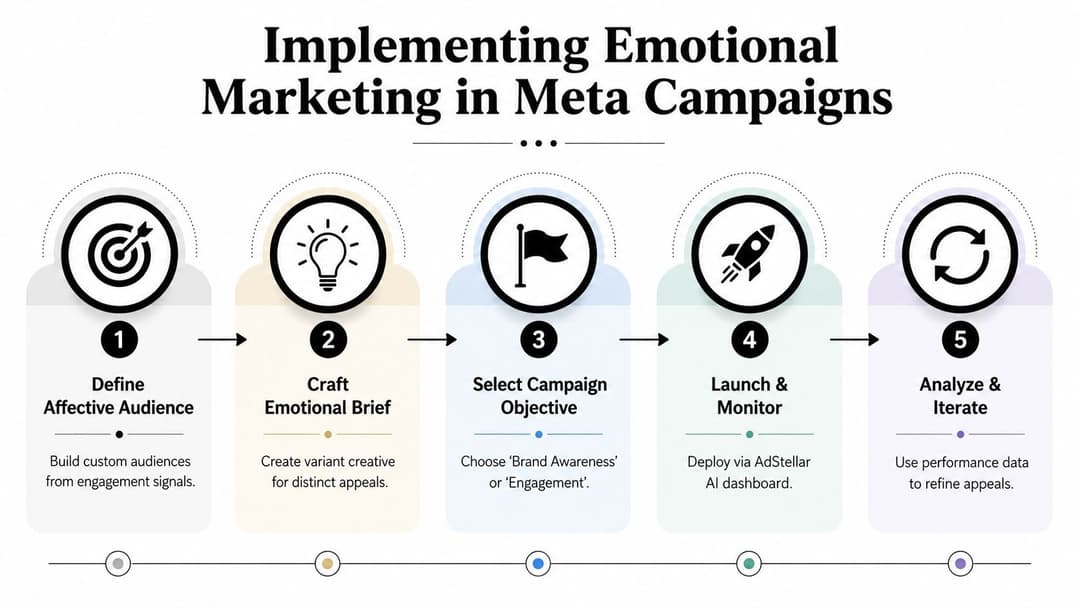
A practical Meta workflow
Define the emotional audience. Start with behavior, engagement, or past purchase signals, then decide what feeling the segment probably needs. A warm audience might respond to trust or belonging. A colder one may need curiosity or aspiration.
Write an emotional brief. Name one primary feeling per variation. If the ad is about relief, keep it about relief. If it is about ambition, don't muddy it with five other moods.
Choose the campaign objective carefully. Brand awareness and engagement often suit top-of-funnel emotional testing, while conversion campaigns are better when the emotion is already aligned with a purchase motive.
Launch multiple variants quickly. A bulk-testing platform like AdStellar AI can help by generating many creative and copy combinations from a single interface and pushing variants into Meta workflows. The point is speed, because emotional angles only become useful when you can compare them.
Review outcomes against business metrics. Compare the variants on ROAS, CPA, and downstream behavior, not just likes or comments. If a creative earns attention but never converts, the feeling may be right for awareness but wrong for the offer.
Measurement rule: if the ad changes the feeling but not the business outcome, the emotional angle is incomplete.
Why variation testing matters
Emotion is not a single switch. One audience may respond to reassurance, another to excitement, and another to urgency. Bulk variation testing lets you discover those patterns instead of assuming one message should carry every segment. That is especially useful on Meta, where creative fatigue comes fast and small message differences can change performance meaningfully.
If you need a model for brand-safe moderation and campaign control while you test, brand-safe ad management with Exerta is a useful reference point for thinking about workflow discipline around public comments and ad response management.
Best Practices and Common Pitfalls
The strongest emotional campaigns are specific. They pick one main feeling, one audience state, and one business goal. They do not try to be inspirational, urgent, humorous, and reassuring in the same ad, because mixed signals usually dilute response.
A good rule is to match the emotion to the funnel stage. Awareness can tolerate broader feelings like joy or belonging. Conversion usually needs something tighter, like trust or urgency. If you want the message to move CPA, make sure the emotional promise matches the friction the buyer feels right before purchase.
Do this and avoid that
- Do test one emotion per variant. If one ad is about relief and another is about aspiration, you can tell which feeling earns the click.
- Do keep the proof visible. Emotion should support the message, not replace it.
- Do measure more than sentiment. The research gap is clear, most explainers stop at feelings and never connect them to ROAS, CPA, loyalty, or advocacy.
- Don't use emotional cues to manipulate. The audience notices when the feeling is fake or opportunistic.
- Don't confuse brand warmth with performance. Friendly copy is not the same thing as profitable copy.
The measurement problem is where many guides fall short. They talk about sentiment, loyalty, or A/B testing, but they stop short of a framework that shows whether emotion changed business outcomes. That matters because marketers have to justify creative investment with performance data, especially when AI makes it easier to generate more variants than teams can manually review.
If you can't name the metric that proves the feeling worked, you don't really have a measurement plan.
You can tighten that loop with creative benchmarking. A useful next step is to compare emotional variants against historical winners, then keep the angle that improves the business metric rather than the one that merely sounds more polished. Creative benchmarking is where that discipline starts to become repeatable.
Bringing Emotion and Data Together
A Meta ad can be technically correct and still feel flat. That is the point where emotional marketing and performance work meet. Rational messaging tells people what the product does, while emotional messaging gives them a reason to care enough to stop, read, and click.
The pattern becomes easier to see once you treat emotion as a testable variable. Appeals such as joy, trust, belonging, fear, and aspiration work because they match how people make decisions in real feeds, not in theory. Analysts behind emotional marketing research have found that feeling-led creative often outperforms purely functional messaging, which is why the category is discussed as a measurable advantage, not just a creative preference. The job is to match the emotion to the moment, then test it with the same discipline you would use for any other performance lever.
A useful technical companion is emotion algorithm explained. It shows the same basic principle from another angle, emotions can be treated as structured inputs instead of vague instincts, which helps bridge creative thinking with measurement.
For Meta campaigns, the practical translation is straightforward. Start with one campaign, name the dominant emotion you want the ad to trigger, then build a few variants that differ clearly in angle, visual cue, or first line. AdStellar AI's bulk-variation testing can speed up that process by generating more emotional angles at once, so the team can compare outcomes without hand-building every version. The key is to judge each variant against the metric that matters most to the business, whether that is ROAS, CPA, or another conversion outcome.
Creative benchmarking helps make that process repeatable. A good next step is to compare emotional variants with your historical winners, then keep the angle that improves the business result rather than the one that sounds more polished. Creative benchmarking gives that comparison a clear method, which matters when you are trying to connect emotion to actual campaign performance.
If you want emotional ideas to turn into testable Meta campaigns faster, AdStellar AI helps teams generate bulk creative and audience variations, launch them through Meta-connected workflows, and rank what performs against goals like ROAS or CPA. That makes it easier to connect emotional angles to real campaign data, then scale the winners instead of guessing.