You launch a campaign with a clean creative set, a tight offer, and a healthy budget. Three days later, the spend is real, the clicks look decent, and the conversions are weak. You dig into the traffic and find the usual problem: the ads reached plenty of people, just not enough of the right people.
That's where demographic ad targeting still matters. Not as a magic switch, and not as the whole strategy, but as the first filter that keeps obvious waste out of the system. Age, parental status, education, household context, work profile, and location can all sharpen paid social performance when they match the offer. When they don't, they drain budget.
The catch is that static demographic targeting only gets you halfway. On Meta especially, profitable scaling comes from treating demographics as testable inputs, not permanent truths. Strong advertisers don't just pick a demographic audience and hope. They launch controlled variations, read the segment-level results, cut weak combinations fast, and let performance data reshape the targeting model over time.
Why Your Ads Are Missing the Mark
A premium B2B SaaS campaign is a good example of how this goes wrong. The funnel is built for decision-makers. The landing page speaks to teams, workflows, integrations, and payback. But the ad set goes out with broad targeting because the account wants scale fast. Spend rises. Results don't.
The problem usually isn't that the creative is terrible. It's that the message is reaching people who were never plausible buyers. College students may click. Retirees may browse. Neither group is likely to become a qualified pipeline opportunity for a mid-market software tool.
That gap between reach and relevance is why broad targeting feels efficient at launch and expensive later. A campaign can generate activity without generating buying intent.
Where the mismatch starts
Most weak campaigns fail at one of these points:
- Offer mismatch: The product is for one life stage or professional profile, but the audience setup ignores that.
- Channel assumption: The team assumes Meta will automatically find the right pocket of users without enough signal.
- Audience vagueness: “Business owners,” “shoppers,” or “parents” gets selected without narrowing the use case.
- No exclusion logic: Obvious non-buyers stay in the eligible audience.
A clearer audience definition usually fixes this faster than another round of creative tweaks. If you need to tighten that definition first, this guide on how to identify a target audience is a solid starting point.
Practical rule: If your campaign can't explain who should not see the ad, the targeting is probably too loose.
Demographic targeting won't solve everything. It won't rescue a weak offer, and it won't replace conversion data. But it does remove avoidable mismatch, which is often the cheapest performance gain available in an account.
Understanding Demographic Targeting Fundamentals
Demographic ad targeting is the practice of setting audience boundaries with traits such as age, gender, location, household status, education, or job profile. In a Meta account, those inputs are not the strategy by themselves. They are the starting conditions that shape who enters the learning phase and which conversions the system can learn from first.
That distinction matters.
A lot of advertisers still treat demographics as static descriptors. In live accounts, they work better as performance hypotheses. You start with the traits that are most likely to affect fit, then keep, loosen, or remove them based on conversion quality, cost, and delivery. That shift from fixed audience definitions to performance-based refinement is what separates basic targeting from profitable targeting.
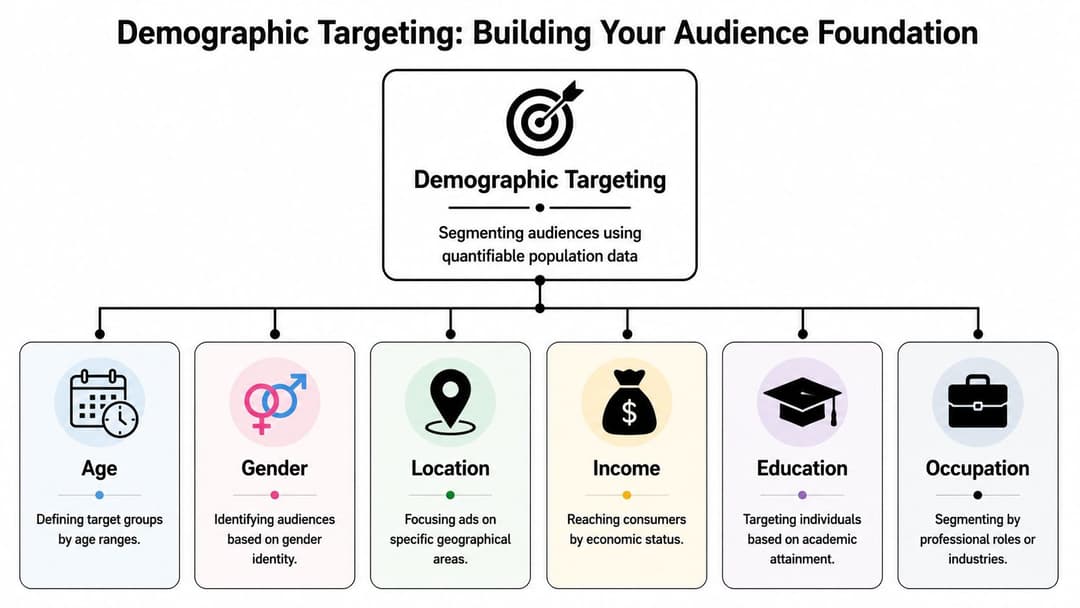
The core demographic pillars
These are the inputs that usually matter first:
- Age helps when the offer maps to life stage, budget, or urgency.
- Gender matters when response patterns or creative relevance differ enough to justify separate testing.
- Location affects shipping coverage, language, regulation, service availability, and local demand.
- Income or economic status can be useful for higher-priced offers, but it needs validation against actual purchase behavior.
- Education can help for training, finance, credentialed services, and some B2B offers.
- Occupation and work details are useful when buying intent is tied to role, industry, or company maturity.
- Parental and household status often improve relevance for family, home, and life-stage products.
The mistake is assuming every field deserves equal weight. It does not. In some accounts, age and geography do most of the work. In others, job function or household context matters more. Good setup starts with choosing the few variables that are tightly connected to the offer, not checking every box Meta makes available.
What good demographic use looks like
Strong demographic targeting is ranked, not piled on.
For a premium skincare brand, age and income bands may be stronger starting points than education. For a B2B software offer, job title, company region, and business maturity may matter more than gender. For a parenting product, household status may outperform broad interest targeting because it reflects real context instead of loose browsing behavior.
I usually group demographic inputs like this:
| Demographic layer | How to use it |
|---|---|
| Core filters | Traits tied directly to the offer and required for initial targeting |
| Helpful refiners | Traits that may improve fit but should earn their place through testing |
| Low-confidence inputs | Fields that can point you in a direction but should not carry the campaign alone |
This framework keeps teams from overbuilding audiences too early. It also creates cleaner inputs for automation later. If Meta's system is fed a narrower set of high-signal traits, plus conversion feedback, it can optimize faster than it can with a cluttered audience full of weak assumptions.
If you want more examples of how segmentation gets applied in commerce-heavy campaigns, this advanced eCommerce segmentation guide is worth reviewing.
A clean audience model also depends on knowing the difference between audience type and customer type. This breakdown of types of target audience helps sharpen that distinction so you're not mixing broad identity traits with actual buying segments.
Use demographics to improve the first round of traffic quality. Let performance data decide how much those constraints should stay in place.
Applying Demographics in Your Meta Ad Campaigns
A Meta campaign can look perfectly structured in Ads Manager and still waste spend fast. The usual problem is not access to targeting options. It is treating every demographic field as equally reliable, then building audiences that are too rigid for Meta's delivery system to learn from.

What Meta lets you target
Meta supports direct settings such as age range, gender, and location, plus detailed demographic filters like education, parental status, relationship status, and work information through Audience controls and Detailed Targeting. Meta documents these options in its own audience targeting setup guidance.
Those controls matter most at the campaign design stage. They shape who gets into the auction first, which affects CPMs, click quality, and how quickly the algorithm finds conversion patterns.
What to trust and what to test
Some demographic inputs are cleaner than others. Age and gender are usually safer starting points because they are often based on profile information. Fields tied to life stage or professional identity can still be useful, but they need validation through results, not assumptions.
A practical setup usually looks like this:
- Higher-confidence inputs: age, gender, location
- Moderate-confidence inputs: parental status, education, job titles, relationship status
- Best used as supporting filters: softer demographic traits paired with interests, custom audiences, or conversion signals
That last group is where advertisers often get into trouble. If a campaign is built around a weak inferred trait, Meta has less room to optimize against actual buyers. If the same trait is used as a light filter inside a broader ad set, it can still improve traffic quality without choking delivery.
How strong Meta setups are built
In mature accounts, demographics usually work best as a control layer, not the whole targeting strategy. The job is to set useful boundaries, then let performance decide whether those boundaries should stay tight, loosen up, or shift into exclusions.
Three setups show up repeatedly in profitable Meta accounts:
Use demographics to qualify the first click
Start with a clear age range, gender split, or location rule when the offer has obvious buyer constraints. Keep the rest broad enough for the platform to find converters.
Pair one demographic signal with one buying-context signal
A narrow age band plus a relevant interest, or parental status plus a custom audience seed, usually performs better than stacking five demographic assumptions into one small audience.
Turn weak segments into exclusions after they prove unprofitable
If one age bucket spends without converting, exclude it from prospecting and keep the rest of the campaign open. This protects margin without forcing a full rebuild.
That shift from static audience definitions to performance-based audience management is where better accounts separate themselves. Demographics help with initial direction. Conversion data determines how much those filters deserve to stay.
For teams comparing how demographic targeting behaves across acquisition channels, these paid media strategy insights are useful context.
If the audience structure itself is messy, this guide to audience segmentation strategies is a good reference for organizing segments before you automate them.
The next step is automation. Once demographic inputs are clean, Meta's algorithm and external rules can start reallocating budget toward the combinations that produce real revenue, not just cheap reach.
Strategic Best Practices for High-Performance Targeting
Checking age, gender, and location isn't a strategy. It's account setup. The primary lift comes from combining demographic constraints with buying context, then managing those combinations aggressively.
Layer demographics with intent signals
The most reliable use of demographic targeting is selective layering. That means you start with a demographic trait that has a clear relationship to the offer, then add a second signal that sharpens intent.
A few examples:
- Parents plus product category interest for family-oriented consumer goods
- Specific age range plus job-related context for career tools or B2B education
- Location plus household profile for region-specific services
- Education or work details plus retargeting pools when the offer has a longer consideration cycle
The mistake is stopping at the demographic layer. People who share the same age band often behave very differently. The demographic tells you who might fit. The second layer helps identify who's more likely to act now.
Working principle: Inclusion builds reach. Exclusion builds efficiency.
Use exclusions as an optimization tool
Advertisers often underuse exclusions because they feel restrictive. In reality, exclusions are where a lot of profit is protected.
If you know an offer is irrelevant to a segment, exclude it. If a segment consistently clicks but doesn't convert, isolate or suppress it. If a campaign is aimed at a narrow buyer stage, don't ask the platform to sort through every adjacent audience on its own.
This is the same thinking strong Google Ads buyers use with bid control. According to Google Ads detailed demographics benchmarks, campaigns using Detailed Demographics can see a 15-30% uplift in click-through rates and a 10-20% ROAS improvement when paired with A/B testing, because narrower segments reduce wasted spend.
Meta doesn't give you the same style of direct bid adjustment by demographic in every workflow. But the mindset transfers cleanly:
| Optimization move | Google mindset | Meta equivalent |
|---|---|---|
| Push stronger segments | Raise bids | Duplicate and scale winning audience clusters |
| Reduce waste | Lower bids or exclude | Exclude weak segments or separate them |
| Validate assumptions | Structured A/B tests | Split ad sets and compare segment-level outcomes |
Build audiences around the current buyer, not the average buyer
One of the biggest shifts in mature accounts is moving from “Who buys this product in general?” to “Who is most likely to buy this product from this ad right now?”
That change affects everything. Your best demographic segment for educational content may not be your best segment for hard conversion ads. Your top audience for a seasonal offer may not match your evergreen audience. A good demographic strategy stays tied to campaign objective, offer timing, and creative angle.
When teams do this well, demographic targeting stops being a static dropdown exercise and becomes a real performance lever.
Common Pitfalls and How to Avoid Them
Many advertisers talk about demographics as if platforms maintain clean, fixed identity labels for every user. They don't. That assumption causes a lot of wasted spend.

Pitfall one is trusting the labels too much
A U.S. study found that over 50% of users on ad platforms belong to overlapping age segments, including cases where a person may be profiled into both 18-24 and 35-54 groups, according to Adlook's analysis of socio-demographic targeting accuracy.
That's a serious warning for anyone building strategy on the assumption that demographic buckets are mutually exclusive. Shared devices, stale profile information, inferred modeling, and evolving life circumstances all distort targeting quality.
If a segment performs poorly, don't assume the demographic itself is useless. The label may be noisier than it appears.
Pitfall two is going too narrow too early
Hyper-targeting looks disciplined in the interface. In delivery, it often creates weak learning conditions.
A tiny segment built from stacked demographic assumptions can starve an ad set before the platform has enough room to optimize. This happens a lot with early-stage brands that try to force precision before they've gathered enough conversion evidence.
Watch for these warning signs:
- Delivery stalls: the audience is too constrained
- Erratic results: the segment is too small for stable decision-making
- Creative fatigue shows up quickly: the same users see the same message too often
- No room for discovery: the account never learns beyond the initial guess
Pitfall three is staying too broad after the evidence changes
The opposite error is keeping a broad setup long after clear segment differences appear. That usually happens when teams optimize at campaign level only and ignore audience breakdowns.
Broad targeting is useful for exploration. It's expensive when it keeps running after the winners are obvious.
A better operating model is to start broad enough to learn, then split out segments that prove they deserve their own budget and creative treatment.
How to protect the account
Use a simple response model:
- Treat demographic fields as signals, not facts
- Validate with conversion quality, not just top-of-funnel engagement
- Promote winning segments into dedicated structures
- Retire weak assumptions quickly
The marketers who avoid demographic waste aren't the ones with the most complicated audience trees. They're the ones who question the platform data instead of blindly trusting it.
Measuring the True Impact of Your Targeting
A demographic setup is only as good as the business outcome it produces. Clicks can point you toward interest. They can't tell you whether targeting is profitable.
Start with outcome metrics
For demographic ad targeting, the useful scorecard is simple:
- CPA tells you what each audience segment costs to acquire.
- ROAS shows which segments produce revenue efficiently.
- LTV helps you avoid overvaluing audiences that convert cheaply but churn or underperform later.
That framework matters because demographics can distort surface metrics. A segment might click often and still be a bad buyer pool. Another might look expensive on first purchase and become valuable over time.
Use Meta breakdowns to validate assumptions
Inside Meta Ads Manager, the Breakdown feature is one of the fastest ways to pressure-test demographic choices. Review performance by age, gender, placement, region, or other available segment views. Then compare conversion quality, not just traffic volume.
A simple review routine works well:
| Review layer | Question to ask |
|---|---|
| Acquisition cost | Which demographic segments are efficient enough to scale? |
| Revenue quality | Which segments produce stronger purchase value or lead quality? |
| Stability | Are results repeating over time or swinging wildly? |
This is the same discipline good retail media buyers apply when managing bids and margin tolerance. If you work across channels, this guide to profitable Amazon PPC bids is a useful reminder that targeting and bid logic should always be tied back to economics, not activity.
Build a repeatable decision loop
Use a fixed cadence. Review demographic performance, isolate clear winners, test one new audience angle, and cut one weak segment. That keeps the account moving without turning every week into a full rebuild.
If you need a stronger framework for tying channel metrics back to business outcomes, this guide on how to measure advertising effectiveness is a practical companion.
The right demographic audience isn't the one that gets the most attention. It's the one that survives contact with CPA, ROAS, and customer quality.
How to Scale Demographic Targeting with AI
Manual demographic testing breaks down fast. Once you start combining age bands, parental status, education, work traits, creative angles, hooks, placements, and offer variations, the number of possible combinations outgrows what a human team can launch and evaluate cleanly.
That's why the next step in demographic ad targeting isn't finer manual segmentation. It's performance-based automation.

Why AI changes the workflow
AI is useful here because it can evaluate more combinations, faster, and with less attachment to the original audience hypothesis. That matters because many losing campaigns aren't failing from lack of options. They're failing because the team can't test enough options consistently.
A strong AI-driven workflow usually does four things well:
- Generates combinations at scale instead of relying on a few hand-built audience sets
- Reads historical performance to rank which demographic layers are productive
- Finds interactions between variables such as age plus parental status plus a specific creative message
- Promotes winners quickly without making the team rebuild everything manually
Moving beyond static demographic assumptions
This is also how marketers get past the inaccuracy problem discussed earlier. If demographic labels are imperfect, then the answer isn't to trust them harder. The answer is to let actual conversion performance decide which demographic combinations deserve more spend.
That approach also helps uncover missed pockets of demand. Standard targeting often overlooks audiences that don't fit neat legacy segments. According to Exverus on multicultural media buying, multicultural audiences represent 40% of the U.S. population and are growing faster than the general market, yet they're often missed by standard demographic targeting.
AI can help surface those underserved audience patterns because it can test combinations humans often skip, especially where identity, household status, interests, and creative relevance intersect.
What scaled testing should look like
The operating model is different from old-school media buying. Instead of building a few “best guess” audiences, the team creates a structured test matrix, feeds back results, and lets the system keep refining.
A useful stack looks like this:
- Base demographic variables tied to offer fit
- Behavioral or interest overlays that add intent
- Creative variants matched to each audience angle
- Automated ranking based on the KPI that matters most
For a closer look at how machine learning improves audience quality on paid social, this article on how AI improves ad targeting is worth reading.
Here's a practical walkthrough to pair with that shift in mindset:
The key shift is simple. Demographics still matter, but they work best as ingredients in a learning system, not as fixed rules. The advertisers who scale Meta profitably are usually the ones who let performance data rewrite their audience strategy faster than manual workflows ever could.
If your team wants to launch more demographic audience variations, identify winners faster, and scale Meta campaigns with less manual setup, AdStellar AI gives you a faster way to do it. It helps marketers build, test, and optimize large volumes of audience, creative, and copy combinations using historical performance data, so you can spend less time in Ads Manager and more time scaling what works.