Identifying your target audience isn't guesswork—it's a deliberate process of discovery, validation, and iteration. It starts with your business goals, moves into analyzing the customers you already have, and then layers in broader market insights to build a smart hypothesis about who you should be targeting next.
Moving Beyond Guesswork in Audience Identification
Let's stop wasting ad spend hoping something sticks. Figuring out your target audience isn't about relying on a gut feeling; it’s about using a structured framework that top performance marketers use to get predictable results. This playbook is designed to shift you from vague assumptions to a data-first approach that sets the stage for profitable campaigns.
Everything starts with the end goal. Before you even think about demographics or interests, you have to define what success actually looks like for you.
The single most important step in audience identification is setting a clear, quantifiable campaign objective. Without a target, you can't aim.
Define Your Campaign Goals
Your primary goal dictates every single move you make afterward. Are you trying to maximize Return on Ad Spend (ROAS), drive down your Cost Per Lead (CPL), or hit a specific Cost Per Acquisition (CPA)? Nailing down this key metric is non-negotiable. It’s the benchmark you’ll use to measure every audience hypothesis you test.
Having a clear goal ensures your entire strategy is aligned, from the data you collect to the ads you create. For instance, a ROAS goal will naturally lead you to analyze your highest-value customers, whereas a CPL goal might have you zeroing in on users who are quick to fill out lead forms.
The simple flow below breaks down this three-part discovery process: setting goals, gathering data, and then forming a testable hypothesis.
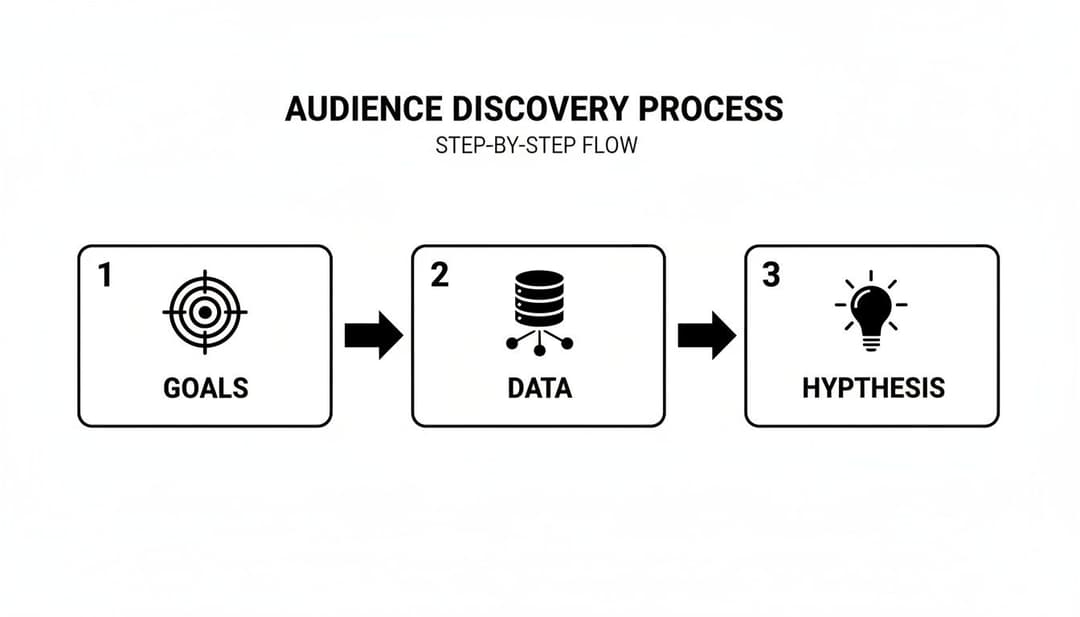
As you can see, a solid objective is the foundation for everything that follows. It makes your data analysis meaningful and your hypothesis strategic.
Combine First and Third-Party Data
Once your goal is set, it’s time to start building a foundational understanding of your audience. The best way to do this is by combining two critical types of data.
To start, it's helpful to see the core components laid out. This table summarizes the essential data and actions needed to kick off your audience definition process.
| Core Components of Audience Identification | ||
|---|---|---|
| Component | Description | Example Action |
| First-Party Data | Information you've collected directly from your audience. It's the most reliable source of truth about your existing customers. | Analyze your CRM for high-LTV customers. |
| Third-Party Data | Aggregated data from external sources that provides broader market context and helps you find lookalike audiences. | Use ad platform insights to identify demographic patterns. |
| Campaign Goals | The specific, measurable outcome you want your campaign to achieve. It aligns all your efforts toward a single target. | Set a goal to achieve a 4:1 ROAS within 90 days. |
This table shows how these elements work together to form a complete picture. Now, let's look closer at the data types.
You'll be working with:
- First-Party Data: This is the goldmine of information you own and have collected yourself. Think CRM lists, website pixel data from past visitors, and purchase histories. This data tells you what your best customers have already done.
- Third-Party Data: This is aggregated data from external sources, like ad platform demographics or industry reports. It tells you who these people are and where else you can find more people just like them. For a deeper look, check out our guide on how targeted advertising on social media puts this data to work.
By layering these two sources, you move from a fuzzy idea of "who might buy our stuff" to a sharp, actionable hypothesis about the specific segments most likely to convert. This sets you up perfectly for the deeper analysis ahead.
Find Your Best Customers Hiding in Your Own Data
The single most valuable asset you have for finding your target audience is the data you already own. Seriously. Your existing customers—especially the ones who come back again and again—have left a trail of breadcrumbs for you to follow. Digging into this first-party data is the most reliable way to sketch out who your ideal customer really is.
This isn't about buying expensive, complicated software. It all starts with the platforms you already use every day. Your customer information is a goldmine just waiting to be explored.
Mine Your Sales and CRM Data
Pop open your Shopify dashboard, your CRM, or whatever e-commerce backend you're using. This is ground zero. Your goal is to spot the patterns among your most valuable customers. Don't just look at who buys; you need to understand how they buy.
Pull a few reports and start asking the right questions:
- Who are my VIPs? Look at metrics like Lifetime Value (LTV) and Average Order Value (AOV). Who are your top 10-20%? Isolate that group and look for anything they have in common—demographics, location, you name it.
- What are their buying habits? Dive into their purchase history. Do they always buy a specific bundle of products? Do they only shop when there's a sale, or do they happily pay full price for premium items?
- When did they first become a customer? Was it during a Black Friday sale? A specific marketing campaign? This can tell you a lot about what first got their attention and convinced them to buy.
Let's say a skincare brand does this and realizes its highest AOV customers almost always buy an anti-aging serum and a vitamin C moisturizer together. That’s more than just a sales stat. It’s a huge behavioral clue. It points to a customer who is invested in their skincare routine and probably cares more about ingredient quality than getting a discount. That simple insight is pure gold for building a lookalike audience.
Analyze How People Behave on Your Site
Sales data tells you what people bought, but your website analytics can tell you why. Tools like Google Analytics and tracking pixels give you a direct window into what your audience is thinking and what they're interested in.
(If you need a quick refresher on this, our guide on how to set up the Facebook Pixel will get you up to speed.)
Focus on the data points that reveal actual behavior:
- Conversion Paths: Which pages do people visit right before they hit "buy"? If a blog post about "solving dry winter skin" is driving a ton of sales, that’s a massive hint about your audience's pain points.
- Content Affinity: What are your most popular pages or articles? The topics that get the most traffic are a clear signal of what your audience truly cares about.
- Device Usage: Are most of your sales happening on mobile or desktop? This has a direct impact on how you should design your ads and landing pages.
When you combine your sales data with your on-site analytics, you graduate from knowing who buys to understanding how they think. This is the bridge between raw numbers and actionable insights you can actually use.
If you want to go deeper than just demographics and truly understand what makes your customers tick, exploring behavioral segmentation is a game-changer. It’s all about grouping customers based on their actions, which allows for incredibly precise targeting.
By pulling all these first-party data points together, you’re building a solid, data-driven foundation for who your audience is. No more guessing—just informed decisions.
Your first-party data is a goldmine. It tells you exactly what your current customers are doing, what they buy, and how they behave on your site. But here's the catch: it can't tell you where to find millions more just like them.
That's where third-party data comes into play. It provides the crucial market context you need to validate your initial hunches and scale your campaigns without just guessing. By layering external data over what you already know, you turn a hypothesis into a strategic, testable plan.
Think of it as de-risking your ad spend. Let's say your internal data points to women aged 25-34 who love sustainable fashion as your top customer segment. That's a great start. Third-party platform demographics can then confirm whether Facebook or Instagram is the more efficient channel to reach that specific group at scale. This simple step ensures you put your budget where your audience actually spends their time.

Pinpoint Your Audience with Platform Demographics
One of the most solid ways to find your target audience is to start with hard platform demographics. Why? Because they show you exactly where different age groups and interest clusters already are.
The global social media user base is projected to be between 5.24–5.66 billion in 2025, a number so huge it's practically meaningless without segmentation. For performance marketers, demographic splits are the first cut that matters.
For instance, Facebook’s largest age group is 25–34, making up 31.1% of its users. Meanwhile, Instagram’s sweet spot is the 18–24 cohort at 31.7%. This tells you there's a massive addressable audience of over 953 million people aged 25–34 on Facebook alone. You can find more insights on the latest social media demographics at sproutsocial.com.
This data isn't just trivia; it’s a clear directional signal. If you're selling to young professionals, Facebook is a logical place to start. If your product is built for Gen Z, you'd probably get more traction on Instagram or even Snapchat.
Analyze Competitor Audiences for Hidden Opportunities
Good news—your competitors have already done a lot of the heavy lifting for you. Analyzing their audience gives you a shortcut to understanding what already resonates in your market. Tools like Meta’s Ad Library or any number of third-party social listening platforms can uncover some absolute gems.
Here's what to look for:
- Engagement: Who is liking, sharing, and commenting on their posts? Don't just look at the numbers; click into the profiles of their most engaged followers. This gives you a qualitative picture of who these people are.
- Messaging Angles: What pain points are they hammering in their ad copy? Which value propositions seem to get the most positive reactions?
- Creative Styles: Are they all-in on user-generated content? Polished studio shots? Influencer marketing? This is a huge signal for what their shared audience responds to visually.
By reverse-engineering your competitors' strategies, you can spot gaps they're missing or simply validate that your own assumptions are on the right track with the broader market.
You might find a competitor is successfully targeting an older demographic you hadn't even considered, opening up a whole new segment for you to test. This kind of analysis sharpens your understanding of how to identify a target audience and gives you a ton of creative inspiration.
These insights are especially powerful when you're building new campaigns. For example, you can use what you've learned to create incredibly potent Facebook Lookalike Audiences that combine the power of your own first-party data with these sharp competitive insights.
Transforming Raw Data Into Actionable Customer Personas
All that data you've gathered? It's just numbers on a spreadsheet until you breathe some life into it. Let's be honest, raw data is abstract and doesn't exactly inspire your creative team. This is where personas come in. They turn those numbers into relatable, human stories that can guide everything from your ad copy to your product development.
Think of it as moving from a pile of ingredients to a finished recipe. You're taking all your first- and third-party research and synthesizing it into a vivid character sketch that feels real. This isn't just about slapping a stock photo on a profile and giving it a catchy name; a truly useful persona gets into the goals, deep-seated motivations, and nagging pain points that actually drive a person's decisions.
From Data Points To A Human Story
Okay, let's get practical. Start by consolidating the key demographic, psychographic, and behavioral data you've collected. You're looking for the strongest patterns—the threads that tie these different data sets together.
Maybe your analytics show a cluster of customers who are women, aged 30-40, consistently buying your high-value items, and also binge-reading your blog posts on productivity. See? A pattern is emerging.
This combination of data points is the skeleton of your persona. Now it's time to add the flesh and bones. Give this composite character a name, something that hints at who they are.
Let’s call our example "Growth-Focused Grace."
- Demographics: She's a 32-year-old marketing manager at a B2B SaaS startup.
- Behaviors: You'll find her frequently buying premium software subscriptions and actively engaging with industry thought leaders on LinkedIn.
- Psychographics: She’s ambitious, chronically short on time, and completely driven by career progression and hitting measurable results.
Suddenly, the data is tangible. "Growth-Focused Grace" isn't just a segment; she's a person with specific needs you can actually address. To get a better handle on how these motivations work in practice, our guide on the psychology in commercials is a great next read.
Building The Complete Persona Profile
A good persona needs enough detail to be genuinely useful for your team. The end goal is a one-page document that anyone—from a copywriter to a media buyer—can glance at and immediately understand who they're trying to reach.
Here are the essential components your persona template should have:
- Goals & Motivations: What is Grace really trying to achieve? Her main professional goal is to drive scalable growth for her company, which is directly tied to her personal goal of climbing the ladder and earning a promotion.
- Pain Points & Challenges: What's standing in her way? She's wrestling with a tight budget, a small team, and constant pressure from above to prove the ROI on every single dollar spent.
- Media Consumption Habits: Where does she hang out online? She’s following marketing influencers on LinkedIn, listening to business podcasts on her commute, and has her inbox full of industry newsletters.
By spelling these details out, you create a clear roadmap. You know Grace’s pain points, so your ad copy can speak directly to solving them. You know where she spends her time, so you know exactly where to place your ads for maximum impact.
Demographic details are especially critical here. Research from Pew highlights just how different social media use is across age, gender, and ethnicity. For instance, a whopping 80% of U.S. adults aged 18-29 use Instagram, but that number plummets to just 19% for those 65+. These aren't just fun facts; they are foundational to getting your initial segmentation right. You can find more data in the full social media usage report from Pew Research.
By creating several distinct personas, you can tailor your messaging for different segments and connect on a much deeper level. For a complete walkthrough on creating effective buyer personas, check out this super helpful guide.
So, How Do You Validate and Refine Your Audience with Ad Experiments?

You've done the work. Your customer persona is beautifully crafted, complete with a name, a backstory, and a detailed map of their deepest pain points and goals. But let’s be honest—right now, that persona is just a well-researched hypothesis.
The real test, the moment of truth, happens when you put that theory in front of a live audience with a real budget on the line.
This is where the rubber meets the road. Ad experiments are your ultimate source of truth, the process that turns your educated guesses into cold, hard facts. By running controlled tests, you’re letting performance data—not your gut feeling—tell you which audiences actually drive profit.
Isolate Your Variables for Clean Results
The golden rule of testing is simple: isolate your variables. It’s a lesson I learned the hard way.
If you test a new audience, new creative, and new ad copy all at once, you learn absolutely nothing. If the campaign tanks, what was the culprit? The audience? The visual? The headline? You’ll have no clue.
Instead, you have to be methodical. Structure your tests to pit one audience segment against another while keeping every other element of the ad identical.
- Consistent Creative: Use the exact same image or video for every ad set in the test.
- Identical Copy: The headline, primary text, and call-to-action must be carbon copies.
- Controlled Budget: Give each audience the same budget to ensure it’s a fair fight.
For example, you could test your "Growth-Focused Grace" persona against a broader interest-based audience of "B2B marketing professionals." With the ad itself held constant, any difference in performance can be pinned directly on the audience targeting. This is how you find out what really works.
Your most important metrics—like Cost Per Acquisition (CPA) and Return on Ad Spend (ROAS)—are the ultimate judges. They will declare a winner, showing you which persona is a genuine profit driver and which one was just a good guess.
Speed Up Your Learning Curve with Advanced Testing
Manually setting up these kinds of isolated tests can be a real grind, especially when you have multiple personas or hypotheses you want to validate. This is where modern ad tech gives you a massive leg up.
For a deeper dive into the mechanics, you can learn more about what multivariate testing is and how it expands on these A/B testing principles.
Platforms like AdStellar AI are built to automate and accelerate this entire process. Instead of spending hours building a handful of tests by hand, you can launch hundreds of unique audience and creative combinations in minutes. This lets you test way more hypotheses much faster, giving you a tidal wave of performance data to analyze.
Let Performance Data Be Your Guide
Once your experiments are live, the data starts flowing in. Now, your job is to be ruthless. Analyze the numbers and act on what you see, not on what you hoped to see. Don't get emotionally attached to a persona you thought was a slam dunk. The numbers don't lie.
Keep a close eye on these key performance indicators (KPIs):
| Metric | What It Tells You | Action to Take |
|---|---|---|
| Click-Through Rate (CTR) | How well your ad is grabbing this audience's attention. | A high CTR signals a strong message-to-market match. |
| Cost Per Acquisition (CPA) | How much you're actually paying for each new customer. | Compare CPAs to see which audience is the most efficient. |
| Return on Ad Spend (ROAS) | The ultimate measure of profitability for your campaigns. | Funnel more budget toward audiences delivering the highest ROAS. |
By analyzing these results, you can confidently crown your winning personas. This iterative cycle—test, learn, refine—is the core of building a scalable customer acquisition strategy. You double down on what works, cut what doesn’t, and continuously push your campaign performance to new heights.
Common Questions About Identifying a Target Audience

Even with a solid game plan, you're bound to run into a few questions. That's normal. Defining an audience isn't a perfect science—it's more like an ongoing conversation that requires constant fine-tuning.
Let's tackle some of the most common hurdles I see marketers face. These sticking points can feel like major roadblocks, but the solutions are often more straightforward than you’d think.
How Specific Should My Audience Be?
This is the classic balancing act. Your audience needs to be specific enough for your message to land with real impact, but broad enough to actually grow your business.
Go too broad—like targeting all “small business owners”—and your ads become so generic they’re invisible. Your budget just evaporates.
But getting hyper-specific can backfire, too. An audience of “vegan dog owners in Boise, Idaho who also subscribe to The New Yorker” might have a sky-high conversion rate, but you're talking to a handful of people. You’ll max out your reach before you even get started.
The sweet spot is a well-defined persona that is both precise and scalable. Start with a core profile, prove it's profitable with some small tests, and then you can start expanding to lookalike audiences or similar segments.
What If My Product Appeals to Multiple Audiences?
First off, that’s a great problem to have. It's a clear signal you're ready for the next stage of growth. The trick here is to segment, not consolidate. Whatever you do, don't try to craft a single, watered-down message for everyone. It will resonate with no one.
Instead, build out distinct personas and run separate campaigns for each group. Think about a project management tool. It could be perfect for freelance creatives and, at the same time, enterprise-level marketing teams. These two groups live in different worlds—they have different pain points, different goals, and they definitely don't use the same jargon.
You have to treat them like two separate markets:
- For Freelancers: Your ads should scream affordability, time-saving features, and simplicity.
- For Corporate Teams: Shift the focus to collaboration tools, advanced reporting, and enterprise-grade security.
Tailoring your campaigns this way lets you speak directly to what each segment actually cares about, which will dramatically boost your relevance and conversion rates.
How Often Should I Revisit My Audience Definition?
Your target audience definition should be a living document, not a "set it and forget it" project. Markets change, new competitors pop up, and customer behavior is always evolving. You need to be plugged into your performance data to catch these shifts as they happen.
If you see a sudden performance drop from an audience that used to be a winner, that's your cue to dig in and re-evaluate. At the very least, you should formally review your personas once or twice a year.
But the real pro move is to always have small audience and creative tests running in the background. This constant feedback loop is the single best way to stay ahead of trends and uncover new pockets of growth. This proactive approach to how to identify a target audience is what keeps your strategy sharp year after year.
Ready to stop guessing and start scaling? AdStellar AI helps you launch hundreds of audience and creative tests in minutes, so you can find your most profitable customers faster. Learn more and book a demo at https://www.adstellar.ai.