Targeted advertising is the engine that powers modern social media marketing. It’s all about using data to show the right ads to the right people, making your campaigns more efficient and your message more relevant. Instead of blasting the same ad to everyone, platforms let you connect directly with users who are actually likely to be interested in what you’re selling. This move from generic, shotgun-style promotion to a focused, granular approach has completely changed how brands find and talk to their customers.
What Is Targeted Advertising on Social Media?
Think of it like a digital billboard that changes its message for every single person who looks at it. For a coffee lover, it shows an ad for a new local café. For a fitness enthusiast, it displays a promotion for yoga classes. That’s the core idea behind targeted advertising on social media. It’s not about shouting a message to a massive, indifferent crowd; it’s about whispering a genuinely helpful suggestion to the right individual at the right time.
This approach transforms advertising from a potential annoyance into a genuinely useful service. You stop wasting money showing ads to people who couldn't care less and instead focus your budget exclusively on users who fit your ideal customer profile. That precision is what makes the whole strategy so powerful and cost-effective.
From Broad Strokes to Fine Brushes
The technology behind this has evolved at a dizzying pace. Just over a decade ago, social media ads relied on pretty basic details like age, gender, and maybe a few general interests. Today, the process is light-years ahead, using thousands of data points—from recent online activity and browsing habits to actual purchase history—to build incredibly detailed audience profiles. This allows for hyper-specific campaigns that really connect with consumers on a personal level.
The impact of this shift is massive. Projections show that social media ads will account for 32.1% of all digital ad spend globally by 2026, which tells you just how effective this has become.
The real goal of targeted advertising isn’t just to find customers. It’s to create a more relevant, personalized online experience where ads feel less like interruptions and more like valuable recommendations.
Nailing that relevance is the key to winning. When you align your message with the specific needs and interests of a well-defined group, you don't just improve campaign performance—you build stronger, more authentic customer relationships. A perfectly executed campaign feels less like an ad and more like a discovery. Getting a handle on how to build a complete paid social media strategy is the first step toward mastering this incredibly powerful marketing tool.
Understanding the Core Audience Targeting Methods
If you want your social media ads to work, you have to get them in front of the right people. It’s that simple. Think of it as the difference between shouting from a highway billboard versus sending a personalized invitation directly to your ideal customer. Social platforms give us an incredible toolkit to do just that, letting us slice and dice audiences with amazing precision.
Each targeting method is like another layer you can add, refining your audience from a massive, general group down to a hyper-specific list of people who are most likely to care about what you’re selling. Getting a handle on these core types is the first real step to building an ad strategy that actually makes you money instead of just costing you it.
This hierarchy shows the evolution of advertising, moving from those broad, billboard-style campaigns to the microscopic precision we can achieve today, especially with AI leading the charge.
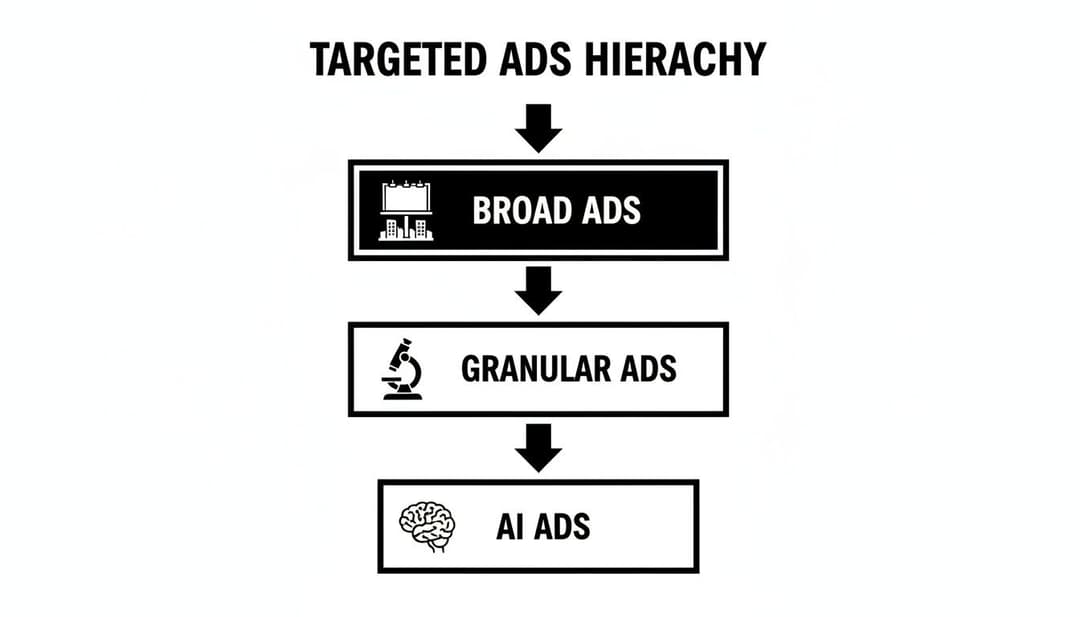
The big takeaway here is that modern advertising has shifted from casting a wide net to using a scalpel. And now, AI is here to automate the whole process, making it faster and more efficient than ever.
Let's break down the five foundational ways to target people on social media. I've put them into a table to make it easy to see how they differ, using a fictional online shoe store as an example.
Audience Targeting Types Explained
| Targeting Type | What It Is | Example for a Shoe Store |
|---|---|---|
| Demographic | The basics: age, gender, location, language, income. Think of it as census data. | Target women aged 25-45 living in major US cities who speak English. |
| Interest | What people like, based on pages they follow, content they engage with, and topics they search for. | Target people interested in "marathon running," "Nike," or "fitness blogs." |
| Behavioral | What people do, based on their past actions like purchase history, device usage, or travel habits. | Target users who are "Engaged Shoppers" or have recently bought fitness apparel online. |
| Custom Audience | Your own data. You upload a list or use a pixel to target people who already know you. | Retarget website visitors who viewed a specific pair of running shoes but didn't buy them. |
| Lookalike Audience | AI-powered targeting. The platform finds new people who look and act like your best existing customers. | Create a 1% lookalike audience based on a list of your top 500 repeat customers. |
As you can see, you can start broad with demographics and then get increasingly specific. The real magic happens when you start combining these and using your own data to build powerful, high-converting audiences.
Your Most Powerful Audiences
Once your business starts getting some traction, you unlock the most powerful targeting methods of all. These audiences aren't found by guessing—they're built directly from your own first-party data. That makes them incredibly valuable for scaling up.
The most powerful audiences aren't the ones you find; they're the ones you build. Using your own data to create Custom and Lookalike Audiences is the key to scaling campaigns profitably.
Custom Audiences let you reconnect with people who are already familiar with your brand. You're not talking to strangers anymore; you're re-engaging a warm audience. Common ways to build these include:
- Uploading a customer list (email addresses or phone numbers).
- Targeting people who have visited specific pages on your website (retargeting).
- Reaching users who have engaged with your social media page or watched your videos.
This is your go-to for upselling to existing customers or winning back shoppers who abandoned their carts. If you want to get really good at this, check out our deep dive on creating powerful Facebook Ads Custom Audiences to squeeze every drop of value from your data.
Lookalike Audiences are where the ad platforms' AI really shines. You give the platform a "source" audience—say, your list of top-spending customers—and its algorithm goes out and finds millions of new users who share similar characteristics. This is, without a doubt, the most effective way to find new, high-quality customers at scale.
Choosing the Right Social Media Advertising Platform
Figuring out where to put your ad budget is one of the most important calls you'll make. Not all social media platforms are the same; each one has its own unique vibe, user base, and set of targeting tools. It helps to think of each platform as a different venue. You wouldn't try to sell B2B software at a music festival, and you probably wouldn't promote a new streetwear brand at a corporate conference.
The secret to great targeted advertising is matching your message, product, and audience to the right environment. This alignment ensures you're not just screaming into the void, but reaching the right people in a place where they're actually open to hearing what you have to say. Let's break down the unique strengths of the major players.
Meta (Facebook and Instagram): The Versatile E-commerce Giant
Meta’s platforms, Facebook and Instagram, are the undisputed champs of social commerce. With a combined audience of over 3 billion people, their reach is staggering. But the real magic is in the sheer depth of their data.
Meta has spent years collecting incredibly detailed behavioral data, so it understands not just what people claim to like, but what they actually do. This makes it an absolute powerhouse for direct-to-consumer (DTC) brands and e-commerce. The targeting tools are insanely robust, letting you zero in on users based on past purchases, "Engaged Shopper" behavior, and even major life events.
Meta's core strength is its ability to connect intent with identity. It knows who is likely to buy, making it the default choice for businesses laser-focused on driving sales and hitting a high Return on Ad Spend (ROAS).
For instance, a sustainable home goods store can target users who have recently moved, are interested in eco-friendly products, and have bought from similar online stores before. It’s this multi-layered approach that makes Meta such a beast for conversions.
LinkedIn: The Professional B2B Powerhouse
If your customers are other businesses, LinkedIn is your playground. It's the only major network where people willingly hand over their professional data—job titles, company size, industry, seniority, you name it. This makes it the holy grail for B2B marketers.
While other platforms are making educated guesses about a user's profession, LinkedIn knows. You can target a "Marketing Manager at a SaaS company with 50-200 employees" with surgical precision. Good luck trying to replicate that anywhere else.
Advertising on LinkedIn is definitely more expensive, but the value of each lead is usually much, much higher. For companies selling high-ticket software, consulting services, or corporate training, the investment almost always pays off.
- Best for: B2B lead generation, account-based marketing (ABM), and recruiting.
- Key Targeting: Job title, company name, industry, seniority level, and professional skills.
- Strategy: Your best bet is to provide value through whitepapers, webinars, and case studies instead of going for the hard sell right away.
TikTok: The Cultural Trendsetter
TikTok completely flipped the social media script with its powerful, interest-based algorithm. The platform is brilliant at figuring out what users genuinely find engaging and then serving them more of it, creating a hyper-effective "interest graph."
This makes it the perfect place to reach younger demographics (Gen Z and millennials) and for brands that can plug into cultural trends. Advertising on TikTok is less about interrupting people's scrolling and more about becoming a natural part of their feed with authentic, entertaining content that doesn't feel like an ad.
Success here is all about the creative. Brands that embrace user-generated content (UGC) styles, jump on trends, and team up with creators are the ones that win. On TikTok, authenticity and entertainment are king.
X (Formerly Twitter): The Real-Time Conversation Hub
X is all about the now. Its power lies in its immediacy, giving you a direct line into real-time conversations, live events, and trending topics. It’s where news breaks and cultural moments happen instantly.
For advertisers, this is a golden opportunity to join conversations that matter. You can target users based on the keywords they use, the hashtags they follow, or the accounts they interact with. This is incredibly potent for brands in tech, news, entertainment, and sports.
Think about it: a streaming service could target users tweeting about a show's season finale with ads for a similar series. A fintech company could jump into conversations about stock market trends. X is all about being timely and relevant, putting your brand right in the middle of the action.
How to Navigate the New Era of Data Privacy
The ground is shifting beneath the feet of social media advertisers. Big privacy updates, especially Apple's App Tracking Transparency (ATT) framework, have completely rewritten the rules for how we collect and use data. This isn't just some small adjustment; it's a new reality where user consent is everything, and the free-flowing data streams we built our strategies on are running dry.
For advertisers, that means facing some serious new challenges. The pool of users you can retarget is getting smaller by the day as more and more iOS users opt out of tracking. This directly hits the size and accuracy of your custom audiences, making it tougher to re-engage with people who've already shown interest and even harder to prove your ads are working.
The old way of tracking is broken. But that doesn't mean effective advertising is dead. It just means it's time to get smarter by pivoting to privacy-friendly tools and focusing on the data you own.
Adapting Your Measurement Strategy
In this new privacy-first world, we have to embrace solutions designed to work with the new constraints, not against them. These tools help bridge the data gap left by tracking limitations, giving you a clearer picture of what's actually happening with your campaigns.
Two pieces of tech are leading the charge here:
- Meta's Conversion API (CAPI): Think of CAPI as a secure, direct pipeline from your website's server straight to Meta's. It lets you share important customer actions—like a purchase or a sign-up—without relying on the browser-based pixels that are so easily blocked. This server-to-server connection is far more reliable and helps you reclaim the conversion data that ATT would otherwise hide.
- Aggregated Event Measurement: This is Meta’s system for handling web events from iOS 14.5+ users. It groups and prioritizes conversion events, which allows for measurement to continue while still respecting a user's choice to not be tracked.
For any serious advertiser today, adopting these tools isn't really a choice anymore. They're essential for getting accurate measurement and making smart optimizations.
The big move away from third-party cookies is shaking up targeted advertising, which really underscores the impact of the death of third-party cookies on first-party data. It’s forcing brands to stop renting audiences and start owning their customer relationships directly.
Thriving in a Privacy-First World
From now on, success depends on building a strong foundation of first-party data—that's the information you collect directly from your audience with their full permission. We're talking about email lists, customer purchase histories, and website activity. This data is gold because it's not only more accurate, but it also represents a real relationship you've built with your customers.
Here are the moves you need to make:
- Go All-In on First-Party Data: Give people a real reason to hand over their information. Use valuable lead magnets like free guides, webinars, or exclusive discounts to build your email and SMS lists.
- Get Server-Side Tracking in Place: Set up Meta's CAPI to make sure you're capturing as much conversion data as you possibly can. This creates a much more resilient measurement system that doesn't rely on flaky browser tracking.
- Widen Your Targeting: Since your retargeting audiences are smaller, you need to lean more on high-quality Lookalike Audiences and broader interest or behavioral targeting. You have to learn to trust the platform algorithms to find the right people in these larger pools.
- Make Your Creative Work Harder: When targeting gets less precise, your ad creative has to do the heavy lifting. Invest in ads that are impossible to ignore and speak directly to your audience's core motivations. Great creative is now your sharpest tool.
Navigating this new era is about shifting your mindset. You have to move away from chasing granular tracking data and toward building direct relationships with your audience and trusting modern, privacy-safe tools. For those who want to dig deeper into managing data responsibly, you can learn more about AdStellar's approach to privacy and see how it aligns with these new standards. Adapting isn't just about surviving—it's about building a smarter, more sustainable advertising strategy for the long run.
Turning Campaign Data Into Smarter Decisions

Getting your targeting right is like perfectly tuning a race car for the starting line. It’s a huge first step, but the race itself—what you do after you launch—is what actually determines if you win. In the world of social media advertising, smart measurement and relentless optimization are what separate winning campaigns from wasted ad dollars.
It’s easy to get lost in surface-level metrics like clicks and impressions. But to truly succeed, you have to anchor your strategy to Key Performance Indicators (KPIs) that directly impact the health of your business. Focusing on the right numbers ensures every dollar you spend is pulling its weight and generating real, measurable value.
Measuring What Truly Matters
To get a clear picture of your campaign's actual impact, you need to zero in on the metrics that bridge the gap between ad spend and business results. This is where KPIs like ROAS and CPA become your north star, guiding your decisions with data instead of guesswork.
Two of the most important KPIs for any advertiser are:
- Return on Ad Spend (ROAS): This is the ultimate test of profitability. It answers the simple question: for every dollar I spend on ads, how much revenue do I get back? A 3:1 ROAS means you’re making $3 for every $1 spent. Simple, powerful, and essential.
- Cost Per Acquisition (CPA): This number tells you exactly how much it costs, on average, to win a new customer. Knowing your CPA is fundamental to managing your budget and making sure your growth is sustainable.
Nailing this efficiency is only getting more important. With 47% of small businesses planning to ramp up their social ad spend, the competition is getting fierce. That makes precise measurement more critical than ever for keeping your ROAS healthy.
Creating a Feedback Loop with A/B Testing
Data is completely useless if you don't act on it. The best advertisers build a powerful feedback loop: they launch, they measure, they learn, and they iterate. The most effective tool for this cycle is structured A/B testing, sometimes called split testing.
A/B testing is beautifully simple. You run two or more versions of an ad, changing just one thing at a time, to see which one performs better. This isolates the exact element that's driving results.
An A/B test is a conversation with your audience. It's how you ask them, "Do you prefer this message or that one?" and get a direct, data-backed answer that guides your next move.
Here's a straightforward framework you can use for continuous optimization:
- Form a Hypothesis: Start with a clear question you want to answer. For example, "Will a video ad with a customer testimonial get a lower CPA than a video showing just our product?"
- Isolate One Variable: This is the golden rule. Only test one thing at a time—the creative, the headline, the call-to-action (CTA) button, or even the target audience.
- Run the Test: Launch your different ad versions to similar audiences at the same time. This ensures you’re getting a fair, apples-to-apples comparison.
- Analyze and Iterate: Once you have enough data, pick a winner and roll that learning into your next campaigns. Remember, the "losing" ad often teaches you just as much as the winning one.
Ultimately, the entire point is effective post-campaign optimization for better ROI, turning raw numbers into smarter strategies. For a deeper dive on how to interpret these results, check out our guide on performance analytics for ads. This constant cycle of testing, learning, and improving is the real engine behind long-term success on social media.
How AI Is Revolutionizing Social Media Targeting

Let's be honest, artificial intelligence isn't some far-off concept anymore—it's the engine running the show behind the most effective targeted advertising on social media. The old days of manually stacking dozens of interest and behavior layers are fading fast. We're now in an era of smarter, automated targeting where platform algorithms find your ideal customers, often better than you ever could yourself.
Think of it like this: manual targeting is like handing a delivery driver a long, complicated list of turn-by-turn directions. AI-powered targeting is just giving them the final address and letting their GPS figure out the fastest, most efficient route. It’s a fundamental shift that makes an advertiser's job simpler and a whole lot more effective.
Trusting the Algorithm
Today’s ad platforms want one thing from you: your campaign goal. Whether it’s sales, leads, or app installs, you hand over the objective, and their AI does the heavy lifting. By churning through trillions of data points in real time, these systems spot patterns and predict user behavior with stunning accuracy.
The algorithm learns who is most likely to convert and automatically pushes your budget toward those high-potential users. What does this mean for you? You can often get better results by going with broader audiences and letting the AI uncover pockets of opportunity you would have completely missed.
The new golden rule in social media advertising is to focus on what you want to achieve, not just who you think you want to reach. Define your goals, feed the machine great creative, and let the AI find the clearest path to conversion.
AI as a Force Multiplier
While the built-in platform AI is a powerhouse, a new wave of third-party AI tools is emerging to act as a force multiplier. These platforms automate the entire campaign workflow at a speed no human team could ever hope to match. Tools like AdStellar are at the forefront, automating the creation, testing, and scaling of countless ad variations all at once.
This isn’t just a niche strategy; it’s becoming standard practice for any team serious about growth. Smartly’s 2026 Digital Advertising Trends report found that 46% of marketers already use AI to scale their creative production, and 33% have woven AI into their entire workflow. This is huge, especially when you consider that marketers estimate up to 30% of their budgets are wasted on slow testing cycles and failing to scale winning ads quickly enough.
The Power of Automated Iteration
Instead of spending hours manually building a handful of ad variations, an AI-first platform can generate hundreds of unique combinations of creative, copy, and audiences in minutes. It then launches all of them as micro-experiments to rapidly figure out which combinations are crushing your core KPIs.
This creates a powerful, continuous feedback loop:
- Generate: Instantly create a massive matrix of ad variations.
- Test: Deploy them all to find the statistically significant winners.
- Learn: Pinpoint the top-performing creative elements and audience pockets.
- Scale: Automatically shift budget to the winning ads to maximize your results.
This approach takes the guesswork and grunt work out of campaign management, turning it from a tedious chore into a strategic, data-backed process. It empowers teams to move faster, learn more, and unlock significantly better returns. For a deeper look at how this all works on Meta, check out our guide to using AI for Facebook Ads. AI is no longer just a nice-to-have advantage; it's an essential tool for hitting peak performance and scaling your advertising efficiently.
Common Questions About Targeted Advertising
Even with a solid game plan, it's natural to have a few questions when you're getting your hands dirty with targeted advertising. Getting straight answers to the common sticking points is what gives you the confidence to launch, test, and actually scale your campaigns. Let's break down some of the most frequent hurdles advertisers run into.
How Do I Start with No Customer Data?
This is a classic chicken-and-egg problem. If you're starting from scratch without a customer list, your best bet is to lean on interest and demographic targeting. Think about your ideal customer—not just their age and location, but their hobbies, what brands they love, what influencers they follow. Build a detailed persona and use that as your blueprint for your first audience.
As soon as your first campaigns are live, you'll start collecting your own precious data. This could be people who visit your website, watch your videos, or engage with your profile. This is the gold you'll use to build your first retargeting audiences. From there, you can create powerful Lookalike audiences based on your best customers or most engaged followers. It's a process: start with educated guesses, let the data guide you, and systematically layer on more sophisticated targeting.
The journey from zero data to a killer audience is all about layering. You start with what you think you know, then use real performance data to build smarter, more precise audiences over time.
What Is a Good Starting Budget?
There's no single magic number here. The goal is to set a budget that's big enough for the platform's algorithm to learn what works. A solid rule of thumb is to aim for enough budget to get 50-100 key actions—like purchases or leads—per ad set, per week.
For a smaller business just getting started, this might be somewhere in the ballpark of $25-$50 per day on one platform. Think of this initial spend as buying data, not just sales. Once you have enough information to see which audiences are converting and which ads are hitting the mark, you can start scaling your budget with a lot more confidence.
How Often Should I Update My Ads?
Keep a close eye on your ad frequency and performance metrics—they'll tell you when it's time for a refresh. If you notice your frequency climbing (meaning the same person is seeing your ad more than 3-4 times in a week) and your results are starting to dip, you've hit ad fatigue. That's your cue to swap in some new creative.
Audiences usually don't need to be updated as often, but you should still watch for any performance slumps. The best approach is to have a structured testing process humming in the background. This way, you always have new creative and audience ideas ready to go, which keeps your campaigns from getting stale and performance from tanking.
Ready to stop guessing and start scaling your campaigns with more speed and precision? AdStellar AI automates the entire process of launching, testing, and optimizing your Meta ads. You can generate hundreds of ad variations in minutes, pinpoint exactly what's working, and let AI automatically scale your winning combinations.
Discover how performance-driven teams are building better campaigns.