You've spent $50,000 testing cold audiences. Your ROAS is stuck at 1.8×. Then you create a custom audience from your best customers, and suddenly you're seeing 4.2× returns. The data is clear: precision targeting works.
But here's the problem nobody talks about.
You discover that segmenting your website visitors by behavior—homepage browsers versus product page viewers versus checkout abandoners—delivers 40% better ROAS than treating everyone the same. So you create 15 winning segments. Then you test 8 creative variations across each segment. Suddenly you're staring at 120 potential campaign combinations, each requiring separate setup, budget allocation, and daily monitoring.
The better your targeting gets, the harder it becomes to execute.
This is the custom audience paradox: the precision that drives your best results also creates operational chaos that limits how far you can scale. Each audience variation needs its own campaign structure. Each campaign demands budget decisions, performance analysis, and optimization attention. What started as a breakthrough targeting strategy becomes a full-time management job.
Most guides explain what Facebook custom audiences are and stop there. This one goes further. You'll learn the fundamentals—what custom audiences are, why they outperform cold targeting by such dramatic margins, and how to build them strategically. But you'll also understand the operational reality of managing them at scale, and how performance marketers are solving the scaling challenge without sacrificing the precision that makes custom audiences so effective.
Whether you're running your first custom audience campaign or managing dozens of variations, this guide covers everything from the psychology behind why they work to the systematic approaches that let you scale without drowning in manual campaign management.
Decoding Facebook Custom Audiences: The Precision Targeting Foundation
Facebook custom audiences are audiences you build from your own data—people who've already interacted with your business in some way. Instead of asking Facebook to find "people who might be interested," you're targeting people who've already demonstrated interest through their behavior.
Think of it like the difference between cold calling a phone book versus calling back people who requested information from you last week. One group is a complete unknown. The other has already raised their hand.
Custom audiences pull from three core data sources. First, your customer files—email lists, phone numbers, purchase records. Second, website behavior tracked through the Meta Pixel—visitors, page viewers, cart abandoners. Third, engagement on Facebook and Instagram—video watchers, form submitters, profile visitors.
The fundamental shift here is moving from demographic guessing to behavioral certainty. Standard interest targeting says "show this to women 25-45 who like fitness." Custom audiences say "show this to people who actually bought our protein powder in the last 90 days."
The difference in conversion rates is typically 3-5×. Not because the creative is better or the offer changed, but because you're targeting people who've already moved past the awareness stage. They know your brand exists. They've considered your solution. Your ad isn't introducing something new—it's reinforcing something they're already thinking about.
How Custom Audiences Differ From Standard Targeting
Standard Facebook targeting relies on probabilistic matching. Facebook looks at someone's profile data, their behavior across the platform, and their device activity, then makes an educated guess about whether they fit your target customer profile. It's sophisticated guessing, but it's still guessing.
Custom audiences use deterministic data. You're not asking Facebook to find people who might match your customer profile. You're uploading a list of people who actually are your customers, or targeting people who actually visited your website, or reaching people who actually watched your product video.
The precision difference is massive. Standard targeting might show your ad to 500,000 people Facebook thinks match your customer profile. Custom audiences show your ad to 5,000 people who actually visited your checkout page last week. The second group converts at 8× the rate despite being 100× smaller.
This is why experienced media buyers obsess over custom audiences. You're trading reach for precision, and the conversion rate improvement more than compensates for the smaller audience size. A 5,000-person custom audience that converts at 4% delivers more revenue than a 500,000-person cold audience that converts at 0.5%—and does it at a fraction of the cost.
The Business Impact Nobody Talks About
Custom audiences don't just perform marginally better than cold targeting. They fundamentally change your campaign economics across every metric that matters.
Cost per acquisition typically drops 40-60% when you switch from cold audiences to well-constructed custom audiences. Same product, same creative, same offer—the only variable is audience precision. A DTC brand running cold traffic campaigns at $45 CPA switches to custom audiences built from website visitors and email subscribers. Their CPA drops to $18 overnight.
Conversion rates improve 2-4× on identical creative. The ad hasn't changed. The landing page hasn't changed. But the person seeing it has already visited your site, read your content, or purchased before. They're not strangers—they're warm prospects or proven customers.
But there's a catch that most marketers discover too late: these results only scale if you can manage the operational complexity. The precision that drives superior performance also creates management challenges that quickly become overwhelming. Understanding challenges faced by advertisers requires looking beyond individual campaign metrics to systematic approaches that maintain precision while scaling execution.
How Custom Audiences Differ From Standard Targeting
Standard Facebook targeting asks the platform to guess who might be interested in your product. You select demographics, interests, and behaviors—"women 25-45 interested in fitness and wellness"—and Facebook shows your ads to people who match that profile. It's probabilistic targeting based on what Facebook thinks these people might like.
Custom audiences flip this model entirely. Instead of asking Facebook to find people who might be interested, you're targeting people who have already demonstrated interest through actual behavior. They visited your website. They engaged with your content. They're on your customer list. The data is deterministic—you know these people interacted with your business.
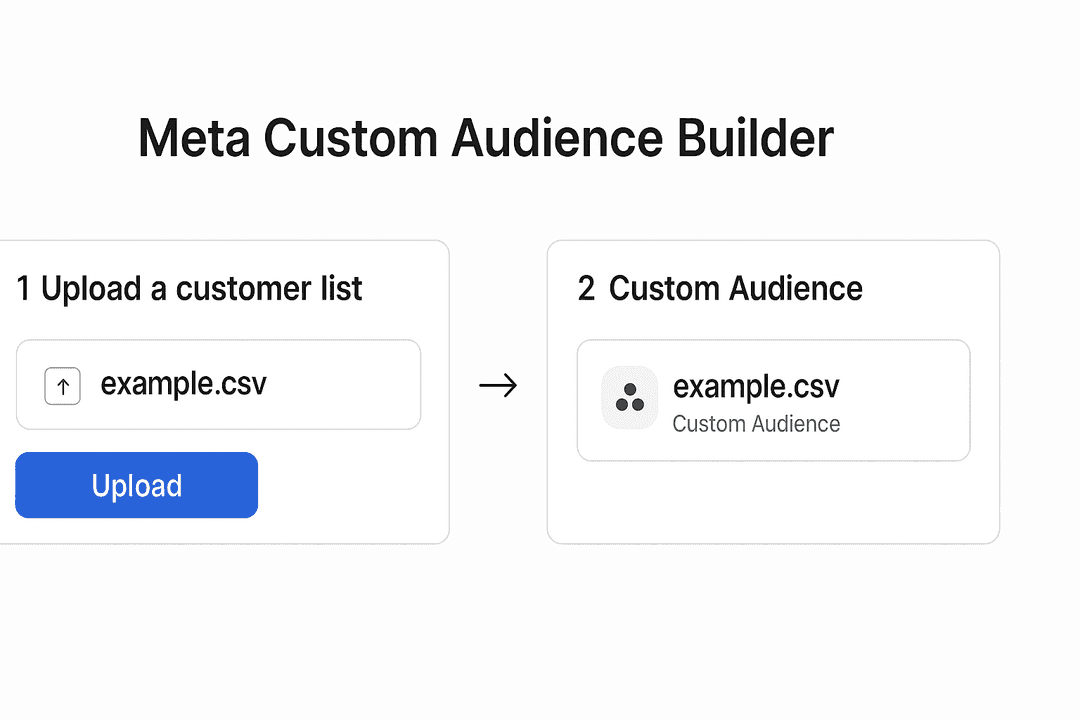
The precision difference is stark. Standard targeting might show your ad to 500,000 people Facebook believes match your ideal customer profile based on their platform activity and demographic data. Custom audiences show your ad to 5,000 people who actually visited your checkout page last week, added items to cart, or purchased from you in the past 90 days.
That second group converts at dramatically higher rates—often 5-8× better—despite being 100× smaller. You're not paying to educate strangers about your brand or convince skeptics your product solves their problem. You're re-engaging people who've already shown purchase intent or completed transactions.
Standard targeting optimizes for reach and discovery. Custom audiences optimize for conversion and efficiency. When you're testing new markets or launching brand awareness campaigns, broad targeting makes sense. But when you're focused on driving conversions and improving return on ad spend, custom audiences built from your own behavioral data consistently outperform interest-based guessing.
The trade-off is intentional: you sacrifice massive reach for surgical precision. But the conversion rate improvement more than compensates for the smaller audience size. A 5,000-person custom audience that converts at 4% delivers more sales than a 500,000-person cold audience converting at 0.5%—and does it at a fraction of the cost per acquisition.
The Business Impact Nobody Talks About
Custom audiences don't just perform better—they fundamentally change your campaign economics in ways that most guides gloss over. The improvements aren't marginal. They're transformational.
Lower CPAs represent the most immediate impact. Performance marketers consistently see 40-60% reductions in cost per acquisition when switching from cold audiences to custom audiences built from website visitors, email subscribers, or customer data. Same product. Same creative. Same offer. The only variable that changed: audience precision.
Conversion rates tell an even more dramatic story. Custom audiences typically convert at 2-4× the rate of cold audiences on identical creative. A landing page that converts 2% of cold traffic might convert 6-8% of warm traffic from custom audiences. This isn't optimization—it's a different game entirely.
Here's what that looks like in practice: A DTC brand running cold traffic campaigns at $45 CPA switches to custom audiences built from website visitors and email subscribers. Their CPA drops to $18 for the same product, same creative, same offer. The 60% reduction in acquisition cost doesn't just improve profitability—it changes what's possible. Products that were barely profitable at $45 CPA become highly profitable at $18 CPA. Budget that was constrained by marginal returns can now scale aggressively.
But there's a catch that most marketers discover too late: these results only scale if you can manage the operational complexity. The precision that drives superior performance also creates management challenges that quickly become overwhelming. Understanding how to achieve ROI in advertising requires looking beyond individual campaign metrics to systematic approaches that maintain precision while scaling execution.
The customer lifetime value advantage compounds these benefits further. Custom audiences built from existing customers aren't just converting better—they're bringing in buyers with proven purchase behavior. Someone who bought from you once is statistically more likely to buy again than a first-time customer acquired through cold targeting. You're not just lowering acquisition costs; you're acquiring more valuable customers.
This is where most guides stop: "Custom audiences work better, so use them." But the operational reality is more complex. As you segment audiences more precisely—homepage visitors versus product page viewers versus checkout abandoners—performance improves. But so does management complexity. Each segment needs its own campaign, budget allocation, and monitoring. The strategy that delivers your best results also creates the operational bottleneck that limits how far you can scale.
Why Custom Audiences Outperform Cold Targeting: The Psychology And Math Behind The Results
The performance gap between custom audiences and cold targeting isn't marginal—it's fundamental. Understanding why requires looking beyond surface metrics to the psychological and economic mechanisms that make precision targeting so effective.
Then we need to confront the operational reality that makes scaling these results so challenging.
The Awareness Advantage
Custom audiences start at a completely different point in the buyer's journey. Cold audiences require your ads to do the heavy lifting of awareness, interest building, consideration, and decision-making. Custom audiences skip the first two stages entirely.
Someone who visited your pricing page last week is fundamentally different from someone seeing your brand for the first time. They've already researched solutions, compared alternatives, and demonstrated purchase intent. Your ad isn't introducing a concept—it's closing a sale that's already in progress.
This creates a trust dynamic that cold targeting can't replicate. Previous interaction with your brand—whether a website visit, email engagement, or past purchase—establishes familiarity that lowers skepticism and increases receptivity. The psychological principle of "mere exposure effect" means people prefer things they've encountered before, even if that encounter was brief.
The conversion rate difference reflects this reality. While cold audiences might convert at 1-2%, custom audiences built from engaged website visitors often convert at 4-8%. You're not fighting for attention and building trust from zero—you're reinforcing existing awareness and nudging people toward action they've already considered.
The Economic Efficiency Model
Here's where the math gets interesting. Custom audiences typically have higher CPMs than cold audiences—often 20-40% more expensive per thousand impressions. At first glance, this looks like a disadvantage.
But CPM is the wrong metric to optimize. What matters is cost per acquisition.
Let's walk through the actual economics. A cold audience campaign might run at $8 CPM with a 1% conversion rate. That's $80 spent per 100 impressions, generating 1 conversion, for an $80 CPA. A custom audience campaign at $12 CPM (50% higher) with a 4% conversion rate spends $120 per 100 impressions but generates 4 conversions, delivering a $30 CPA.
The custom audience has a 50% higher CPM but delivers a 62% lower CPA. The math isn't even close.
This efficiency comes from budget allocation. With cold audiences, you're paying to educate people who will never buy—the vast majority of impressions are wasted on the wrong people. To consistently achieve these economics across multiple custom audience variations, you need robust performance analytics for ads that track not just impressions and clicks, but actual conversion economics by audience segment.
With proper analytics in place, you can identify which custom audience segments deliver the best unit economics and deserve increased investment. Custom audiences concentrate your budget on people who've already demonstrated interest, dramatically improving the efficiency of every dollar spent.
While these economics look compelling immediately, knowing when to scale ad campaigns built on custom audiences requires understanding both the performance metrics and the operational capacity to manage increasing complexity. Many advertisers face what are the benefits of programmatic ads when trying to automate this scaling process while maintaining the precision that makes custom audiences so effective.
Ready to transform your advertising strategy? Get Started With AdStellar AI and be among the first to launch and scale your ad campaigns 10× faster with our intelligent platform that automatically builds and tests winning ads based on real performance data.