Think of an automated marketing agency as your strategic partner, one that uses technology and AI to manage and scale your marketing campaigns without all the manual grunt work. It’s a hybrid model, blending the big-picture oversight of human experts with the raw speed and precision of software. This means tasks like creating ads, tweaking budgets, and pulling performance reports happen almost instantly.
What Is an Automated Marketing Agency?
If you've ever been involved in a traditional marketing campaign, you know it can feel like trying to conduct a massive orchestra where you have to personally cue every musician for every single note. It's incredibly labor-intensive, slow, and a breeding ground for human error.
Now, imagine a high-tech recording studio. A smart system coordinates every instrument perfectly, optimizing the sound in real-time based on how the audience is reacting. That’s the magic of an automated marketing agency.
This new breed of agency is the modern answer to painfully slow campaign management. Instead of relying entirely on teams of people to launch ads, adjust spending, and create reports, they plug into a powerful tech stack that does the heavy lifting. Guesswork gets replaced with data-driven precision, unlocking a level of scale and speed that’s just not possible by hand.
The Core Concept: Empowering Marketers
The big idea here isn't to get rid of the human element—it's to supercharge it. By automating all the repetitive, time-sucking tasks, an automated marketing agency frees up its strategists to focus on what actually moves the needle:
- High-Level Strategy: Pinpointing campaign goals and shaping the creative vision.
- Deep Data Analysis: Digging into complex performance data to find insights that inform the next move.
- Creative Innovation: Brainstorming new angles, fresh messaging, and compelling visuals.
- Client Relationships: Focusing on growth, clear communication, and building a real partnership.
This is a critical shift. It changes the agency’s role from just a "doer" of tasks to a strategic partner who’s all-in on driving measurable results for your business. The team isn’t stuck in the weeds anymore; they’re more like pilots guiding an intelligent system. We explore how this works for specific channels in our guide on automating Meta advertising for agencies.
A Market Driven by Smarter Tech
The rise of the automated marketing agency is happening for a reason—it’s directly tied to the explosion of the software that makes it all possible. And this isn't just some niche trend; it's a massive market shift.
The global marketing automation software market was valued at USD 7.23 billion in 2025 and is expected to rocket to an incredible USD 20.12 billion by 2034. That explosive growth, fueled by a compound annual growth rate of 12.00%, shows just how much businesses are leaning on these tools to get ahead. You can read the full research on this market growth to see the numbers for yourself.
An automated agency doesn’t just run campaigns faster; it creates a feedback loop where technology constantly learns and improves, turning every ad dollar into a data point for smarter future investments.
At the end of the day, partnering with an automated agency means you're investing in a system built for the future of marketing—one where efficiency, data, and strategy click together seamlessly.
How Automated Agencies Redefine Marketing Workflows
The best way to understand the difference between a traditional and an automated marketing agency is to compare a local workshop handcrafting custom furniture to a high-tech factory producing precision parts. Both create valuable products, but their processes, speed, and ability to scale are on completely different planets.
Traditional agencies usually follow a linear, manual path. A strategist briefs the creative team, who then designs the assets. Next, a media buyer manually sets up the campaigns, launches them, and pops in periodically to check performance and make a few tweaks. It’s a process that works, but it’s slow. A single campaign can easily take weeks to get from a concept to actually running.
An automated agency flips that entire model around by building its workflows on a foundation of technology. Instead of building one-off campaigns, they create systems that can launch, test, and optimize hundreds of campaign variations all at once. By using software to handle the repetitive, time-consuming tasks, they put the entire marketing lifecycle on fast-forward.
This concept map shows how an automated agency gets its people, tech, and data to work in harmony, creating a powerful engine for growth.
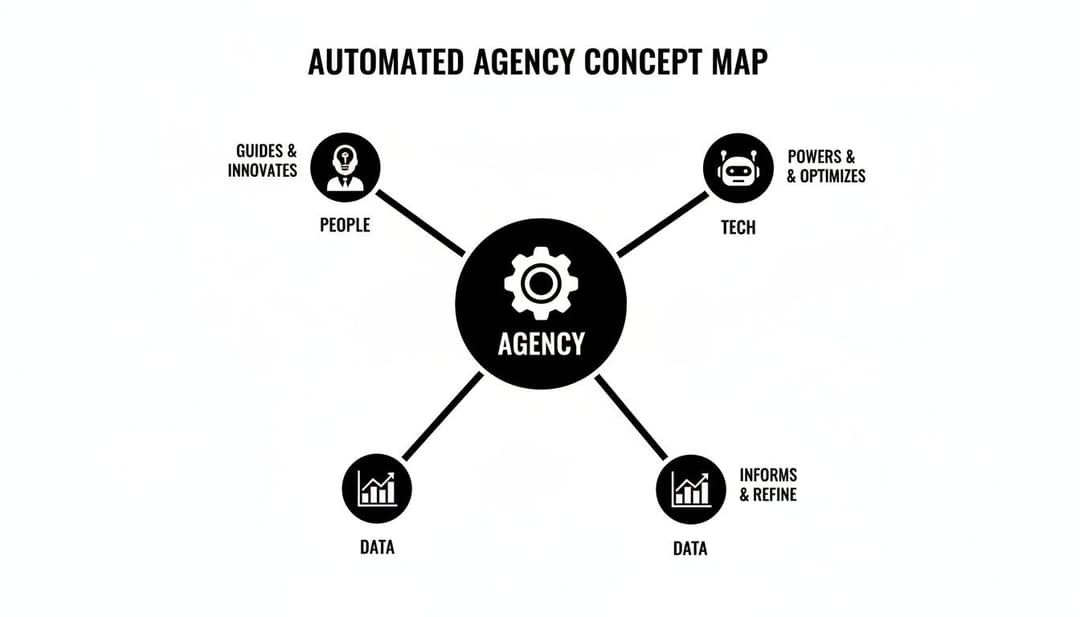
As you can see, the tech is just one piece of the puzzle. The real magic happens when skilled people use that tech with a constant flow of data to make smarter, faster decisions.
Speed And Scale Reimagined
The most dramatic shift is the sheer velocity of execution. A traditional team might spend an entire day getting a dozen ads set up and ready to go. An automated system? It can generate and launch over 500 ad variations—testing different images, headlines, and audiences—in just a few minutes.
This isn’t just about doing the same old work faster; it’s about doing work that was simply impossible before. This opens the door to exhaustive testing on a massive scale, uncovering winning ad combinations far more quickly and reliably than manual A/B testing ever could. If you want to see what this looks like in practice, you can get a closer look at automating Meta advertising workflows.
From Manual Analysis To AI-Driven Insights
Decision-making gets a major upgrade, too. In a traditional setup, strategists spend hours buried in spreadsheets and static reports, trying to connect the dots from last week’s or last month’s performance. The insights are always backward-looking.
An automated marketing agency, on the other hand, uses AI to analyze performance data as it happens. Algorithms can instantly spot underperforming creatives, identify when an audience is getting tired of an ad, and recommend shifting budget to the top performers—often without any human input needed. These agencies are already integrating advanced tech, and some are even exploring how future AI agents in networking could further streamline their operations.
Instead of waiting for a monthly report to discover what worked, an automated workflow provides a constant stream of insights, allowing for immediate adjustments that compound over time.
This continuous feedback loop means campaigns are always evolving based on fresh, incoming data, not on stale assumptions from the past.
Augmenting Strategists, Not Replacing Them
There's a common myth that automation makes human experts obsolete. In reality, it’s the exact opposite. By taking the tedious, low-impact tasks off their plate, automation frees up marketing strategists to do what they do best.
Instead of getting bogged down in campaign setup and manual reporting, their time is spent on high-value work:
- Creative Strategy: Digging into the why behind the data to come up with more resonant messaging.
- Audience Psychology: Reading the performance trends to build sharper, more accurate customer personas.
- Business Growth: Focusing on the big picture, like market expansion, competitive analysis, and long-term planning.
The table below really drives home the core differences and shows how the automated model transforms key marketing functions.
Automated Agency Vs. Traditional Agency A Head-To-Head Comparison
| Feature | Traditional Marketing Agency | Automated Marketing Agency |
|---|---|---|
| Campaign Launch Speed | Days or weeks for setup and approvals. | Minutes to hours for hundreds of variations. |
| Decision-Making | Based on manual analysis of past reports. | Driven by real-time, AI-powered insights. |
| Creative Testing | Limited A/B tests due to manual constraints. | Massive-scale multivariate testing is standard. |
| Reporting | Static weekly or monthly PDF reports. | Live, interactive performance dashboards. |
| Human Focus | Execution and repetitive manual tasks. | High-level strategy and creative innovation. |
At the end of the day, an automated marketing agency creates a powerful partnership between human intellect and machine efficiency. It’s a combination that leads to smarter, faster, and more scalable results every single time.
The Technology Stack Powering Automated Agencies
To really get what makes an automated marketing agency tick, you have to pop the hood and look at the engine. It’s not just one piece of software, but a smart, interconnected system of tools built for a single purpose: to run marketing tasks with incredible speed, intelligence, and scale. Think of it like a modern smart factory—each machine has a job, but they all talk to each other to create a perfectly seamless production line.
This integrated tech stack is the real dividing line between a traditional agency and an automated one. They’ve swapped out the manual processes and disconnected spreadsheets for a unified platform that pulls together data, creative, and execution. This is how they can go from a strategy session to a live campaign in a tiny fraction of the time.
At its core, this system is built on three pillars working together: AI and machine learning, a central automation platform, and advanced analytics dashboards. Each one is crucial for turning marketing from a list of manual chores into a self-optimizing growth machine.
AI and Machine Learning: The Predictive Brain
The first and most important layer is Artificial Intelligence (AI) and Machine Learning (ML). We're not just talking about automating simple tasks here; this is all about predictive intelligence. The AI is the strategic brain of the whole operation, constantly crunching data to make smarter decisions before a single ad dollar is spent.
For instance, an AI model can comb through thousands of data points from old campaigns—images, headlines, audience demographics, conversion rates—to predict which new ad combinations are most likely to hit it big. This shifts campaign creation from a game of guesswork to a data-driven science.
These models are the heavy lifters for several key functions:
- Predictive Audience Targeting: Finding high-value customer segments that a human might completely overlook.
- Creative Component Analysis: Picking apart ads to figure out which specific elements (like colors, keywords, or image styles) actually drive results.
- Budget Pacing and Allocation: Figuring out how to spread a budget across campaigns to get the best possible return on ad spend (ROAS).
By putting AI in the driver's seat, an automated agency can cut down on wasted ad spend and find winning campaign formulas much, much faster.
Central Automation Platforms: The Execution Engine
Once the AI sets the strategic direction, a central automation platform steps in as the execution engine. This is the “factory floor” where the actual work gets done at a scale no human team could ever hope to match. Platforms like AdStellar AI are designed to chew through the high-volume, repetitive tasks that bog down most marketing teams. You can get a deeper look at this process in our guide to AI marketing automation.
Instead of a person painstakingly building one ad at a time, these systems can generate and launch hundreds or even thousands of variations all at once. It works like this: a strategist defines the core ingredients—a set of images, headlines, and target audiences—and the platform assembles every single possible combination for testing.
The whole point of an automation platform is to demolish the manual bottleneck that stands between a great idea and a live campaign. It turns strategic inputs into scaled outputs almost instantly.
The shift toward these systems is impossible to ignore. Globally, 80% of marketers already use AI for content creation, and an incredible 75% use it for media production. With the marketing automation market expected to reach $13.97 billion by 2030, it’s obvious that agencies and brands are betting big on these tools. You can dig into more of these marketing agency statistics to see just how fast the industry is changing.
Advanced Analytics Dashboards: The Real-Time Scoreboard
Finally, the entire operation is monitored through advanced analytics and reporting dashboards. Think of this as the real-time scoreboard that shows what’s working, what’s not, and where the next opportunity is hiding. Forget about the static monthly reports you get from traditional agencies; these dashboards offer a live, interactive view of campaign performance.
These tools pull data directly from ad platforms and other sources, presenting key metrics in a way that’s easy to understand at a glance. This gives both the agency and the client the ability to track progress 24/7 and make smart, data-backed decisions on the fly. This level of transparency keeps everyone on the same page and focused on business outcomes, closing the loop on a truly intelligent and automated marketing workflow.
What Can You Expect From an Automated Agency?
An automated marketing agency isn’t just a traditional shop that’s bolted on a few new software tools. Its entire approach is built from the ground up on speed, data, and massive scale. Every service they offer is designed to take a slow, manual marketing task and replace it with an intelligent, automated workflow that gets better, more predictable results.
While the exact menu varies, the services usually fall into a few key categories. These are the powerful functions that let an automated partner manage campaigns with a level of speed and precision a human-only team just can't match. They’re the core components of a modern growth engine.
These services all work in concert, creating a closed-loop system where campaigns are built, tested, and optimized in a continuous, self-improving cycle. Let's break down the most common and impactful services you'll find.
AI-Powered Media Buying
Imagine a dedicated analyst watching your ad campaigns 24/7, ready to shift your budget to the best-performing ads the second the data changes. That’s pretty much what AI-powered media buying delivers. Instead of a human checking in a few times a day, algorithms are monitoring performance in real time.
This service uses machine learning to automatically handle the heavy lifting:
- Allocate Budgets: It smartly moves ad spend away from underperforming creatives and audiences, funneling it directly to the ones delivering the highest return on ad spend (ROAS).
- Adjust Bids: The system can raise or lower bids based on real-time auction dynamics and the probability of a conversion, making sure you never overpay for a click.
- Prevent Ad Fatigue: AI spots when an ad’s magic is starting to fade and can automatically pause it or swap in fresh creative to keep performance strong.
The impact is immediate. This frees up human strategists from the tedious grind of budget tweaks, letting them focus on bigger-picture strategy. More importantly, it ensures not a single dollar is wasted on a campaign that isn't pulling its weight.
Automated Creative Generation and Testing
One of the biggest bottlenecks in marketing is creating and testing enough ad variations to find a real winner. An automated agency completely shatters this limit by using tech to generate hundreds, or even thousands, of ad combinations in minutes.
A strategist just needs to provide the raw ingredients—a handful of images, a few headlines, and some calls-to-action—and the platform assembles every possible permutation.
This process transforms creative testing from a slow, limited A/B test into a massive, multivariate experiment. The agency can test every message against every visual for every audience, quickly identifying the specific combinations that resonate most powerfully.
This service directly translates to higher conversion rates and a much deeper understanding of what actually makes your customers click. It’s about trading guesswork for undeniable performance data.
Dynamic Audience Management
Having the right creative doesn't matter much if you're showing it to the wrong people. Automated agencies excel at building, testing, and refining audiences with a truly scientific approach. They go way beyond broad demographic targeting to find and engage niche, high-intent customer segments.
Their process usually looks something like this:
- Rapid Audience Creation: They can spin up dozens of lookalike audiences and interest-based segments to test against each other.
- Performance-Based Segmentation: Using real-time data, they pinpoint which specific audience pockets are driving the most value and create new segments based on those traits.
- Automated Exclusions: The system automatically weeds out low-performing or irrelevant audience segments to boost campaign efficiency and lower customer acquisition costs.
This dynamic method ensures your ads are consistently in front of the people most likely to convert, getting the absolute most out of every dollar you spend.
Integrated Performance Reporting
Forget about waiting a month for a stale PDF report filled with vanity metrics. An automated marketing agency gives you access to live, interactive dashboards that pull data directly from your ad platforms. This gives you a completely transparent, real-time view of what’s happening.
If you want to dig deeper into what modern reporting looks like, check out our guide on improving agency client reporting.
These integrated reports don't just show you clicks and impressions; they connect ad performance directly to your business outcomes. You'll see exactly how ad spend is impacting revenue, leads, and customer lifetime value. This level of clarity keeps everyone on the same page and makes sure every marketing decision is tied to a measurable business goal.
How to Choose the Right Automated Agency
Picking the right automated marketing agency is a massive decision for your growth. This isn't just about hiring another vendor; it’s about finding a partner whose tech, team, and communication style actually click with your business goals. A great partnership can put your growth on the fast track, while the wrong one is a quick way to burn through your budget and miss out on key opportunities.
The trick is to have a clear game plan for the selection process. You've got to look past the shiny sales decks and really dig into how these agencies work, what technology they're running, and the results they can actually prove. It all comes down to asking the right questions and knowing what a good answer sounds like.
Define Your Goals and Needs First
Before you even think about sending an email to an agency, take a good look in the mirror. What are you really trying to accomplish? A fuzzy goal like "we want to grow" is basically useless. You need to get specific about the results you need to see.
Are you trying to slash your customer acquisition cost (CAC)? Are you aiming to boost your return on ad spend (ROAS) by a specific amount? Maybe you need to pump up your lead generation to keep a hungry sales team fed. Nailing down these key performance indicators (KPIs) from the get-go gives you a ruler to measure every potential partner against.
This kind of internal clarity is your north star. It helps you weed out the agencies that aren't a match and zero in on the ones who are experts at solving your exact problems.
Key Questions to Ask Every Potential Agency
Once you've got a shortlist, it's time to put them to the test. Your mission is to get a deep understanding of their process, their tech, and their entire philosophy. Don't be shy about getting into the technical details.
Here are the must-ask questions:
- What’s your core technology stack? Ask for names. Do they run on a proprietary platform they built themselves, or is it a Frankenstein's monster of third-party tools? Their answer tells you how much control and flexibility they really have.
- How does your AI model learn and get smarter? A real automated agency can walk you through how their systems use data to improve campaigns over time. If all you get back is buzzwords, that's a red flag.
- Can you show me a live performance dashboard? Static, month-old PDF reports are a relic of the past. Ask for a live demo of a client dashboard to make sure they offer real transparency with data that's updated constantly.
- What’s your process for creative testing? One of the biggest wins with automation is testing creatives at a massive scale. They should have a clear, repeatable system for churning through hundreds of ad variations in a flash.
- How do you define and measure ROI? Make sure your definition of success is the same as theirs. The conversation should be about business metrics like revenue and profit, not vanity metrics like clicks and impressions.
How they handle these questions will tell you everything you need to know about their true capabilities and whether they've got the engine to back up their claims.
A great automated marketing agency won't just tell you what they do; they’ll show you. They will be transparent about their technology, open about their process, and confident in the data that proves their value.
Scrutinize Case Studies and Watch for Red Flags
Case studies can be gold, but you have to look at them with a critical eye. A solid case study is more than a chart that goes up and to the right; it tells a complete story. It should lay out the client's initial problem, the strategy the agency deployed, and the specific, measurable business results that followed.
Look for proof of cold, hard ROI. Did they drop a client's CPA by 30%? Did they help an e-commerce brand hit a 4x ROAS during the brutal holiday shopping season? Those are the numbers that actually move the needle.
While you're at it, keep your radar up for these red flags:
- Vague promises that aren't backed up by any hard data.
- Hesitation when you ask for client references.
- A "one-size-fits-all" pitch that completely ignores your company's unique situation.
- Hiding behind jargon instead of giving you straight answers.
Honestly, trust your gut. If something feels a bit off during the sales process, that’s a pretty good preview of what the partnership will be like. The best partners are direct, clear, and laser-focused on your success from the very first call.
Measuring Success with an Automated Partner
At the end of the day, any new partnership or strategy has to answer one simple question: does it deliver measurable growth? When you bring on an automated marketing agency, success isn't defined by clever concepts or slick presentations. It’s all about the cold, hard data. Automation isn't just about moving faster; it’s a machine built to drive significant, quantifiable results for your business.

The whole model is designed to give you a crystal-clear, real-time picture of your return on investment. You're not just "launching campaigns" anymore. You're deploying data-gathering experiments designed to maximize performance and profitability from the get-go.
From Vanity Metrics to Business Impact
This approach marks a huge shift away from chasing surface-level numbers like clicks and impressions. Instead, the focus is squarely on the metrics that actually move the needle for your business. An automated partner exists to draw a straight line from marketing activities to bottom-line results.
That means your success dashboard will be built around critical KPIs like:
- Return on Ad Spend (ROAS): How much revenue are you making for every single dollar spent on ads?
- Customer Acquisition Cost (CAC): What’s the total, all-in cost to bring a new paying customer through the door?
- Customer Lifetime Value (LTV): How much is a customer really worth to your business over their entire relationship with you?
- Conversion Rate: What percentage of people are taking the one action you want them to take, whether it’s buying a product or booking a demo?
By obsessively optimizing for these core metrics, an automated agency makes sure every decision is geared toward sustainable, profitable growth. To get a better handle on these, check out our guide on essential performance marketing metrics.
Real-World Success Stories
The true power of this model really clicks when you see it in action.
Picture an e-commerce brand that, by leaning on automation, tested 1,000 unique ad creatives in a single week. The system rapidly identified the winning formula and tripled their ROAS in under 30 days.
Or think about a SaaS company that was getting bogged down by a long, drawn-out sales cycle. By rolling out automated lead nurturing sequences, they managed to shorten their sales process by a massive 35%, getting qualified leads into the hands of their sales team faster than ever.
These aren't just lucky breaks. They are the direct result of a systematic, data-driven process. Automation finds what works and then scales it relentlessly, turning small wins into major business momentum.
The proof is in the numbers. Across the board, marketing automation delivers tangible results, with companies reporting an average revenue bump of 34% from better conversion and retention. On top of that, layering in AI and predictive analytics can boost ROI by another 10-20%. It’s no wonder nearly two-thirds of marketers are upping their AI spend. This is the new standard for performance—and intelligent automation is what powers it.
Quick Answers to Common Questions
Jumping into the world of automated marketing brings up a few common questions. Let's clear the air and give you some straight answers so you can see how this all fits into your bigger picture.
Will an automated agency replace my in-house team?
Not a chance. The goal is to make your team stronger, not replace it. An automated agency steps in to handle the grunt work—the high-volume, repetitive stuff that eats up so much time. Think bulk ad creation, constant budget tweaks, and sifting through mountains of data.
This frees up your people to focus on what they do best: big-picture strategy, brand building, creative direction, and pulling out the real insights from all the data the technology uncovers. See them as a force multiplier for the talent you already have.
How is pricing structured for these agencies?
Pricing models differ, but they usually land in one of three buckets. Knowing the difference helps you pick a structure that makes sense for your business and growth plans.
- Percentage of Ad Spend: This is a classic model. The agency takes a fee based on the amount of ad budget they manage, typically somewhere between 10-20%.
- Flat Monthly Retainer: Simple and predictable. You pay a fixed fee each month, which is perfect for businesses that have a steady budget and consistent needs.
- Performance-Based Model: With this setup, the agency gets paid when they hit specific targets, like a certain ROAS or cost per lead (CPL). It's a great way to make sure everyone is pulling in the same direction—your success is their success.
The best option really depends on what you're trying to achieve, but it should always offer a clear path to getting a solid return on your investment.
So what's the difference between automation software and an agency? The software is the tool, but an automated marketing agency is the team of experts who know exactly how to use it.
The platform provides the raw power, but the agency brings the strategic thinking, industry know-how, and hands-on management to make sure that power is actually driving your business forward.
How quickly can we expect to see results?
While an automated agency can execute at lightning speed, the AI needs a little time to learn the ropes. You’ll start seeing initial data and test results roll in within the first couple of weeks after a campaign goes live.
But the real magic—the stable, significant improvements in your key metrics like customer acquisition cost or return on ad spend—usually becomes clear within 60 to 90 days. That's enough time for the system to gather a ton of performance data and start making smart, data-backed optimizations that fuel consistent growth.
Ready to see how automation can change the game for your Meta ads? AdStellar AI is an AI-powered platform built to help you launch, test, and scale campaigns 10x faster. Discover how you can stop guessing and start growing today.