You launch a campaign that should work.
The creative is clean. The offer is clear. The landing page loads fast. But spend starts moving before results do. Clicks come in from people who were never going to buy, while the people who might convert barely see the ads.
That problem usually is not creative first. It is audience fit.
Many teams do not fail because they forgot what a target audience is. They fail because their audience definition is too loose to guide media buying, too static to survive real campaign data, or too manual to scale. They know the customer in conversation. They cannot translate that knowledge into a practical Meta setup.
A useful type of target audience framework does more than label people by age or interest. It tells you who to reach, who to exclude, what signal to trust, and how to test the next variation without rebuilding everything from scratch.
Beyond Guesswork Why Your Target Audience Matters
A weak audience strategy makes good ads look bad.
That shows up in familiar ways. CPMs may be fine, but downstream quality is poor. Lead forms fill with the wrong people. Product page traffic rises, yet purchases stay flat. The campaign reports activity, but the business does not feel the impact.
The root issue is simple. You are buying attention from people who do not match the problem, timing, or buying intent behind your offer.
Broad audience assumptions usually sound reasonable in a planning doc. “Women interested in wellness.” “Founders who need better software.” “Online shoppers in major cities.” But those are market descriptions, not buying audiences. They do not tell a media buyer which segment deserves budget now.
A reliable audience strategy narrows the gap between message and motivation. It gives you a working definition of the people most likely to care, click, and convert. It also tells you what not to target, which matters just as much when budgets are tight.
The fastest way to sharpen that definition is to stop treating targeting as guesswork and start treating it like segmentation work tied to campaign data. If you need a primer on that operating model, AdStellar’s overview of audience segmentation is a practical starting point.
What poor targeting costs
Poor targeting does not only waste spend. It creates operational noise.
- Misleading creative decisions: Teams kill ads that were shown to the wrong audience.
- Bad optimization loops: Platforms optimize toward cheap actions from low-quality users.
- Bloated reporting: Campaigns generate volume without helping pipeline or revenue.
- Message dilution: Copy gets watered down to appeal to everyone and persuades no one.
What good targeting changes
A strong audience definition improves every layer of the account.
It tightens copy. It improves offer selection. It makes exclusions smarter. It gives you a cleaner test plan because each audience has a job.
Tip: If a new audience cannot be described in one sentence with a clear buying reason, it is probably not ready for budget.
The Four Foundational Audience Types
Most audience strategies still rest on four basics: demographic, psychographic, behavioral, and geographic. Appinio’s 2025 breakdown identifies those as the primary audience types, while noting that marketers often expand into interest-based segments, purchase intention segments, and subcultures. The same source also notes that demographic segmentation remains the foundational approach for performance marketers, built from measurable traits like age, gender, education, income, and location, with platform examples such as Instagram’s 1.4 billion monthly active users, where 25-34 year-olds make up 28.3% and 18-24 year-olds make up 26.5%, plus LinkedIn where 47.3% of users are aged 25-34 globally and over half of US users fall into high-income brackets (Appinio target audience guide).
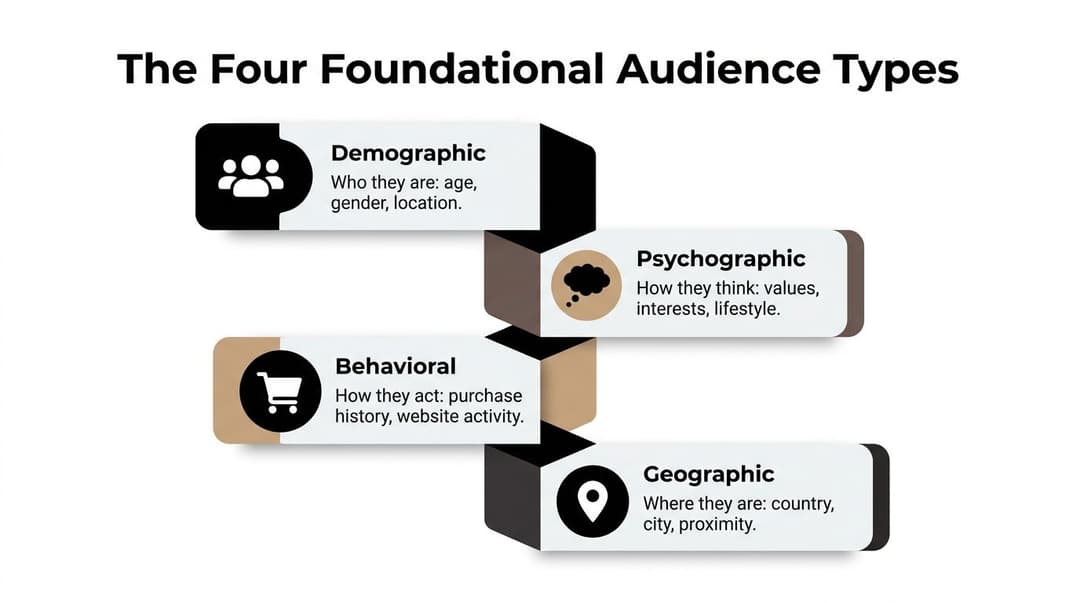
Think of these four as layers, not separate systems. One layer tells you who the person is. Another tells you what they care about. Another shows what they do. The last tells you where they are.
Demographic targeting
Demographic targeting answers who they are.
This is the easiest place to start because the inputs are measurable. Age, gender, income band, education level, family status, and location are all useful for forming the initial audience frame.
A financial planning app aimed at high-income millennials starting families is a clean demographic example. It narrows by life stage and buying capacity before any behavioral filtering begins.
Best used for:
- Initial account structure: Useful when launching a new offer with limited historical data.
- Message relevance: Helps align tone, imagery, and offer framing to life stage.
- Platform fit: Strong for channels where user base skews are known.
Psychographic targeting
Psychographic targeting answers how they think.
Values, priorities, identity, and lifestyle come in here. Two people can match the same demographic profile and still respond to entirely different hooks. One buyer cares about convenience. Another cares about status. Another only buys from brands aligned with personal values.
A sustainable apparel brand, for example, may need to speak to buyers who care about eco-conscious living, not just buyers within a certain age bracket.
Use psychographics carefully. They are powerful for messaging, but weak when treated as a substitute for evidence. They explain motivation. They do not prove intent.
Behavioral targeting
Behavioral targeting answers what they do.
Performance marketing usually gets sharper here. Instead of assuming interest, you observe actions. Did the user view pricing? Return repeatedly? Start checkout? Engage with a specific product category? Subscribe and then revisit?
Behavioral inputs matter because actions usually predict conversion better than assumptions do.
Key takeaway: Demographics help you enter the room. Behavior tells you who is ready to buy.
Geographic targeting
Geographic targeting answers where they are.
Sometimes location is the whole strategy. Local services, retail footprints, shipping constraints, event campaigns, and regional promotions all depend on it. In other cases, geography is a practical constraint layered onto another audience type.
For example, a B2B SaaS team may not care about city-level targeting at the start, but it may care a great deal about country-level exclusions, language fit, or market maturity.
How these types work together
The mistake new media buyers make is choosing one type of target audience and forcing it to carry the whole campaign.
That rarely works. The stronger setup combines them.
| Audience type | Core question | Strongest use |
|---|---|---|
| Demographic | Who are they | Framing the initial audience |
| Psychographic | How do they think | Shaping angle and message |
| Behavioral | What do they do | Prioritizing intent and retargeting |
| Geographic | Where are they | Applying market and delivery constraints |
If you want a more detailed breakdown of how marketers categorize these segments in practice, AdStellar’s guide to target market types is a helpful companion.
Advanced Audiences for Precision Targeting
Foundational audience types get you to a plausible audience. Advanced audiences get you to a buyable one.
The jump usually happens when you start using your own data instead of relying only on platform assumptions.

Behavioral segmentation inside Meta matters most here. In Meta campaigns, targeting based on purchase intention, past interactions, and product usage patterns can improve ROAS by 20-50% compared to broad demographic targeting alone when it uses first-party data to identify high-intent segments (SparkToro on finding your target audience with data).
Custom audiences
A Custom Audience uses your own business signals.
These audiences come from website visitors, customer lists, app activity, video viewers, lead form opens, or prior purchasers. They are usually your most practical retargeting tool because they are tied to real interaction.
Examples include:
- Cart abandoners: Best for recovery offers and urgency messaging.
- Pricing page visitors: Useful for direct-response offers and objection handling.
- Past purchasers: Good for upsells, cross-sells, and suppression in acquisition campaigns.
A common trade-off appears quickly. The more specific the audience, the better the intent signal. But specificity also reduces volume. A tiny high-intent segment can convert well and still cap spend.
Lookalike audiences
A Lookalike Audience is for acquisition, not retargeting.
You start with a strong seed audience, such as purchasers, qualified leads, or high-value customers. Meta then finds new users who resemble that seed audience. This is useful when your best customers share patterns that are hard to express manually.
The quality of the seed matters more than the cleverness of the setup. If you build a lookalike from weak leads, Meta will find more weak leads. If you build it from top purchasers, you give the system a better model.
Firmographic audiences
B2B teams need another lens. Firmographic targeting works like demographics for companies.
Instead of age and income, you think about:
- Industry
- Company size
- Team function
- Market maturity
- Regional footprint
This matters when the product fits certain business profiles better than others. A startup-focused product likely needs different targeting than an enterprise workflow tool. Even when Meta lacks the firmographic precision of dedicated B2B platforms, firmographic thinking still helps shape audience design, creative angles, and exclusions.
Transactional audiences
Transactional audiences are built around purchase history and buyer value.
This is the audience type many brands underuse. Not every customer deserves the same budget. Some buy once during discount periods. Others reorder consistently, buy full-price bundles, or respond well to new product launches.
When you segment by transaction pattern, you stop treating all conversions as equal.
Choosing the right advanced audience
Use this simple decision frame:
| If your goal is | Start with | Why |
|---|---|---|
| Retargeting recent intent | Custom Audience | It reflects direct interaction |
| Finding net-new buyers | Lookalike Audience | It expands from proven customer traits |
| Reaching businesses | Firmographic audience logic | It aligns campaigns with account fit |
| Improving customer value | Transactional audience | It separates low-value from high-value buyers |
If your team is testing many of these combinations across Meta, a workflow tool such as automated audience targeting can reduce the manual build work and make comparison cleaner.
Tip: Do not stack every advanced signal into one audience. When you combine too many filters, you often get a small audience that appears complex but cannot scale.
Actionable Audience Recipes for Meta Ads
Much targeting advice falls apart when you open Ads Manager.
You do not need another abstract explanation of type of target audience categories. You need combinations that map to actual campaign goals. The best audience recipes are simple enough to build fast and specific enough to learn from.
Recipe one for e-commerce high intent
This is the audience to build when product interest exists but conversion volume is inconsistent.
Goal: Recover buyers who showed strong intent without going broad.
Ingredients:
- Custom Audience: Product page viewers
- Behavioral signal: Repeat site visitors or users who engaged with a key product feature
- Exclusion: Recent purchasers
- Creative angle: Product proof, urgency, shipping clarity, objections
Why it works: this recipe focuses on users who already crossed the curiosity threshold. They do not need category education first. They need a reason to finish the decision.
Good fit for:
- Products with longer consideration windows
- Bundles or higher-ticket items
- Catalogs where shoppers compare multiple variants
Recipe two for first-purchase prospecting
This one is for acquisition when your brand has enough conversion history to build from existing buyers.
Goal: Find new people who resemble your strongest customers.
Build it with:
- Seed audience: Your best purchaser segment, not all customers.
- Lookalike setup: Use the seed to create a net-new prospecting audience.
- Demographic guardrails: Apply only if the offer has clear life-stage relevance.
- Creative angle: Social proof, category education, clear offer.
This recipe fails when brands use all buyers as the seed. Discount hunters, one-time gift buyers, and loyal repeat customers are not the same. If you blend them together, the expansion audience gets noisy.
For teams refining this motion, AdStellar’s explainer on the look alike model is useful for understanding how seed quality affects downstream targeting.
Recipe three for B2B lead generation
Meta can support B2B, but only if you stop treating “business owners” as a precise audience.
Goal: Generate leads from likely buyers inside a narrow business profile.
Ingredients:
- Firmographic logic: Define the company profile first
- Role-based audience cues: Job function or likely decision-maker groups
- Interest layer: Relevant software, workflows, or operational pain areas
- Geographic filter: Markets your sales team can serve
- Lead form or landing page message: Speak to one operational problem
A practical example: if the product serves growth teams at scaleups, do not write broad “grow faster” copy and target generic marketing interests. Use language tied to campaign throughput, reporting friction, or audience testing bottlenecks.
Recipe four for reactivation
Some audiences are not lost. They are just quiet.
Goal: Re-engage people who know the brand but stopped moving.
Ingredients:
- Custom Audience: Past customers, old leads, previous engagers
- Behavioral split: Separate recent inactivity from long-gap inactivity
- Offer choice: New feature, product update, return incentive, fresh use case
- Exclusion: Current active customers if the message is win-back specific
This works best when the ad acknowledges timing. A buyer who has not engaged in months should not receive the same message as someone who visited last week and bounced.
Recipe five for local demand capture
This is the practical version of geographic targeting.
Goal: Reach buyers within a serviceable region where speed, proximity, or availability matters.
| Ingredient | Example use |
|---|---|
| Geographic core | City, region, or service radius |
| Demographic fit | Homeowners, parents, or another relevant life-stage group |
| Behavioral clue | Prior site visits or local service interest |
| Creative hook | Availability, convenience, trust, proximity |
How to use recipes without overcomplicating the account
Do not launch every recipe at once.
Pick a few based on funnel stage:
- Cold acquisition: Lookalike or broad prospecting with a clear persona angle
- Warm demand: Product viewers, page engagers, or lead starters
- Hot retargeting: Cart, checkout, pricing, or repeat visit audiences
Key takeaway: A recipe is only useful if each ingredient has a reason to be there. If you cannot explain the role of a layer, remove it and test a cleaner version.
How to Test and Scale Your Audiences with AI
Audience building is only the opening move. The hard part is deciding what deserves more budget and what should be retired before it drains the account.

Many teams sabotage this stage by changing too much at once. They test a new audience, new creative, new offer, and new landing page in the same launch. Then they cannot tell what caused the result.
What to test first
If the creative is already competent, test audiences before rewriting everything.
A simple testing order works well:
- Start with one offer and one core creative angle
- Run distinct audience variants against that same package
- Compare quality, not just cheap top-of-funnel actions
- Promote winners into the next round with small refinements
Manual testing breaks down once the combinations grow. As soon as you have several buyer personas, multiple intent stages, and different exclusions, the build work starts consuming the time you should spend on interpretation.
The audience groups many teams ignore
One of the more useful audience concepts is not about active engagers at all. It is about the people sitting outside your usual retargeting pool.
Destination CRM cites four audience types from Zoe Devitto: active audiences who engage regularly, aware audiences who view occasionally, latent audiences who view but do not engage, and non-audiences who fit the target but never encounter your marketing. The same source notes that marketers often overlook latent and non-audiences, even though AI-driven testing of hundreds of audience combinations can help convert them (Destination CRM on underserved markets).
That distinction matters because many accounts keep spending on active and aware groups long after they are saturated.
Tip: If performance stalls, do not assume the market is exhausted. Check whether you are only speaking to the same visible audience over and over.
A latent audience might include users who consume content, browse product pages, or fit your profile but never click the obvious call to action. A non-audience might include people in the right role, region, or use case who have not been introduced to the brand yet.
That is where AI helps. Not because it replaces strategy, but because it can process many more combinations than a human team can build and monitor by hand.
Here is a practical walkthrough on the topic:
How scaling should work
Scaling is not “raise budget on everything that had a good day.”
A cleaner process looks like this:
- Keep the audience logic intact: Do not widen winners too early.
- Scale adjacent variants: Expand from a strong audience into nearby combinations.
- Use exclusions aggressively: Prevent overlap before you add spend.
- Refresh creative around proven audiences: Preserve the audience while changing the message angle.
When AI is used well, it acts like an operations layer. It helps rank combinations, spot audience fatigue, and surface hidden clusters that would take too long to find manually.
Automate Your Audience Strategy with AdStellar
The practical bottleneck in audience work is not understanding the type of target audience. It is production volume.
Many media buyers can sketch a solid targeting plan on a whiteboard. The friction starts when that plan turns into dozens of audiences, exclusions, creative pairings, and retest rounds inside Meta. The account becomes hard to manage before the learning cycle is complete.
That is where automation earns its place.
One option is AdStellar AI, which connects to Meta Ads Manager through secure OAuth, ingests historical performance data, and helps teams generate large sets of audience combinations alongside creative and copy variations. It also ranks performance against goals such as ROAS, CPL, or CPA and uses fresh results to guide the next launch cycle.
What automation should handle
The useful automation layer is not only “create more audiences.”
It should also do three jobs well:
- Bulk creation: Turn audience recipes into many testable combinations without repetitive setup.
- Performance ranking: Show which audience patterns are worth keeping, cutting, or expanding.
- Learning loops: Use prior account data to inform the next audience batch instead of starting from zero.
That last point matters more than teams realize. Audience strategy gets stronger when the tool remembers what the account has already taught you.
Moving from reactive to predictive targeting
A more advanced gap in audience work is identifying underserved segments before everyone else piles in.
A 2026 IndexBox analysis describes a workflow that uses trade data, import origins, and search signals to identify high-growth categories and demand gaps. The same analysis notes that auto-learning models can ingest this kind of information to rank emerging audiences and help growth teams become more predictive rather than reactive (IndexBox on underserved market angles).
That matters for marketers because audience selection should not only react to last month’s click data. It should also reflect where demand may be forming.
If your team wants a closer look at this kind of workflow, AdStellar’s AI optimization page shows how performance-driven automation can fit into campaign operations.
The operational payoff
A key benefit is not convenience. It is consistency.
Teams with a repeatable audience system make fewer random changes, document tests more clearly, and protect winning segments from account chaos. They spend less time rebuilding structures and more time making better targeting decisions.
Frequently Asked Questions on Audience Targeting
What is the difference between a Custom Audience and a Lookalike Audience
A Custom Audience is built from people who already interacted with your business. A Lookalike Audience finds new people who resemble that source group.
Use Custom Audiences for retargeting, suppression, and customer messaging. Use Lookalikes for acquisition.
How many audiences should I test in one campaign
Test only as many as you can evaluate cleanly.
If your budget or conversion volume is limited, fewer audiences are usually better. A smaller set gives clearer signals and reduces overlap. If you launch too many at once, results blur and optimization gets messy.
When should I use broad targeting instead of layered targeting
Use broader targeting when your pixel data is strong, your offer is widely relevant, and narrow filters are shrinking delivery too much.
Use layered targeting when the offer is niche, the sales process is specific, or the account needs clearer signal separation.
Which audience type matters most for performance
In practice, behavioral signals often do the most work once enough data exists. They reflect actual user actions, not just profile assumptions.
That said, no single type of target audience wins in every account. Demographics may matter more for some products. Geography may drive local campaigns. Transactional history can dominate for repeat-purchase brands.
Should I keep audience and creative tests separate
Yes, when possible.
If you test a new audience and a new creative at the same time, the result is harder to interpret. Keep one variable stable when you need cleaner learning.
How do I know an audience is exhausted
Look for repeated exposure without meaningful business improvement. Rising spend with weaker downstream quality is another sign.
Exhaustion does not always mean the segment is bad. It may mean the creative is stale, the offer is wrong, or exclusions need cleanup.
Should I exclude existing customers from prospecting
Usually yes, unless the campaign is intentionally designed for repeat purchase or upsell.
Prospecting should find new demand. Existing customers often belong in separate retention or reactivation flows.
If your team wants to launch, test, and scale Meta audiences with less manual setup, AdStellar AI offers a practical way to turn audience recipes and historical performance into repeatable campaign workflows.