You're probably in one of two situations right now. Either your Meta campaigns are getting clicks and maybe even leads, but sales aren't following. Or you already know Facebook can drive revenue, yet every attempt to scale turns messy fast. Costs drift, reporting gets fuzzy, creative burns out, and the sales team says the leads are weak.
That gap is why most advice on facebook ads for sales disappoints. It treats Meta like a traffic machine instead of a revenue system. Traffic is only one piece. The ad has to attract the right buyer, the tracking has to tell Meta what a real sale looks like, the campaign structure has to give the algorithm room to learn, and the handoff after the click has to convert interest into money.
When people talk about turning ads into revenue, that's the part they often skip. Revenue comes from the full chain, not just the ad unit. If you need a practical primer on the platform itself, this guide on how to advertise your business on Facebook is a useful companion. What matters here is how to make Meta work like a sales engine, not a vanity channel.
Building Your Sales Engine on Meta
A familiar pattern shows up in almost every account audit. The creative looks polished. Targeting seems reasonable. CTR is healthy enough to keep everyone calm for a few days. Then the sales report lands and nothing lines up with the optimism inside Ads Manager.
That's usually not because Facebook ads stopped working. It's because the account was built to generate activity, not revenue.
What a real sales setup looks like
A sales-focused Meta program starts with one hard question. What event represents business value? For ecommerce, that's usually purchase and purchase value. For lead generation, it's rarely just a form fill. It might be a qualified lead, a booked appointment, or a deal stage that sales accepts.
If you optimize for easy actions, Meta will find more easy actions. That sounds obvious, but teams still make this mistake every day. They launch campaigns optimized for clicks, celebrate cheap traffic, and then wonder why buyers don't appear.
Practical rule: If the optimization event doesn't match the way your company makes money, the campaign will drift away from sales.
The shift most teams need to make
The better mental model is simple. Meta handles demand capture and demand shaping. Your business handles the rest. That includes the landing page, the form, the offer, the follow-up sequence, and the sales process itself.
Think of the engine as four connected parts:
- Signal quality: Meta Pixel, Conversions API, and clean event mapping
- Persuasion: Creative angle, offer framing, and message-market fit
- Delivery: Campaign structure, audience design, and budget allocation
- Revenue capture: Checkout flow or lead handoff, then follow-up from sales
Break one of those and the whole system weakens.
A junior buyer often asks, “Should I fix audience, creative, or bids first?” The honest answer is that you fix the part closest to revenue first. If leads aren't closing, don't spend a week refreshing thumbnails. If purchase tracking is wrong, don't touch budgets yet. Diagnose the system in order of impact.
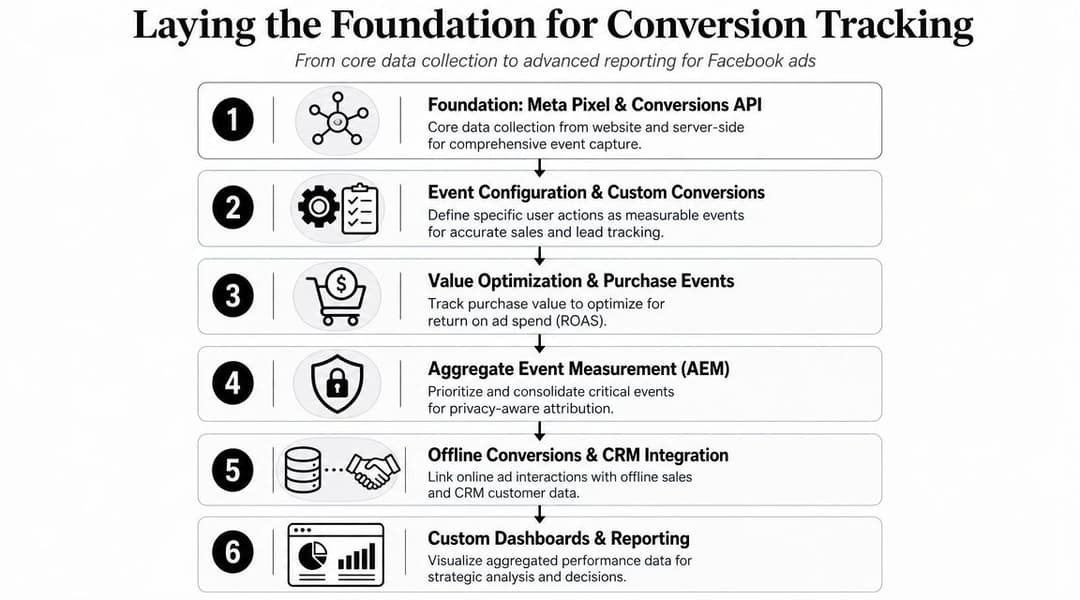
Laying the Foundation for Conversion Tracking
Before spending on Meta, build the measurement layer like you'd build a cash register before opening a store. If the register misses transactions, records the wrong totals, or can't tie purchases back to traffic sources, you won't know what's working. Worse, Meta won't know either.
That matters because Facebook is still one of the largest ad channels in the world. In 2026, Facebook's global advertising revenue is projected to exceed $230 billion, and benchmark data shows lead-generation campaigns average a 2.59% click-through rate and a 7.72% conversion rate according to SQ Magazine's Facebook ad statistics roundup. Scale is not the problem. Signal quality is.
Pixel alone is not enough
You still need the Meta Pixel. It records browser-side behavior such as page views, add-to-cart actions, lead submissions, and purchases. But browser-side tracking on its own leaves gaps. People switch devices, block scripts, or complete the sale in ways the browser doesn't capture cleanly.
That's why serious advertisers pair the Pixel with Conversions API. CAPI sends events from your server or backend systems, which helps preserve the conversion signal when browser tracking is incomplete. If you need a practical walkthrough, this guide on setting up your Facebook Pixel is useful for the browser-side piece, and this overview of Meta Conversions API explains how the server-side layer fits in.
What to configure first
Most accounts overcomplicate naming and underinvest in event quality. Keep the setup clean.
Install the core data sources
Fire standard events through Pixel and mirror them through CAPI where possible. The point isn't technical elegance. The point is reliable business signals.Map events to real outcomes
For ecommerce, purchase matters more than browsing behavior. For lead gen, use the closest event you can get to actual sales value, not just the easiest top-of-funnel action.Pass value with purchase events
If your business cares about revenue quality, Meta needs value data. Otherwise it may optimize toward volume while ignoring order quality.Prioritize events inside your measurement setup
Privacy constraints and attribution limits mean event prioritization matters. Decide what your business wants Meta to learn from.
A lot of “bad Facebook performance” is just bad instrumentation wearing a media-buying disguise.
What good tracking changes
Once tracking is clean, campaign management gets simpler. You stop arguing over whether a campaign “feels strong” because you can see what happened after the click. You can break down results by audience, placement, and creative, then compare those against purchases or qualified outcomes instead of surface metrics.
The practical effect is bigger than reporting. Meta's system learns from the conversion data you feed it. Better event quality improves optimization. That's why this foundation comes before creative refreshes, audience experiments, and scaling plans.
Crafting Ad Creative That Sells
A campaign can show a healthy click-through rate, cheap traffic, and plenty of add-to-carts, then still miss the sales target by a mile. In live accounts, that usually traces back to creative that wins attention but does not qualify intent, set the offer up properly, or prepare the buyer for what happens after the click.
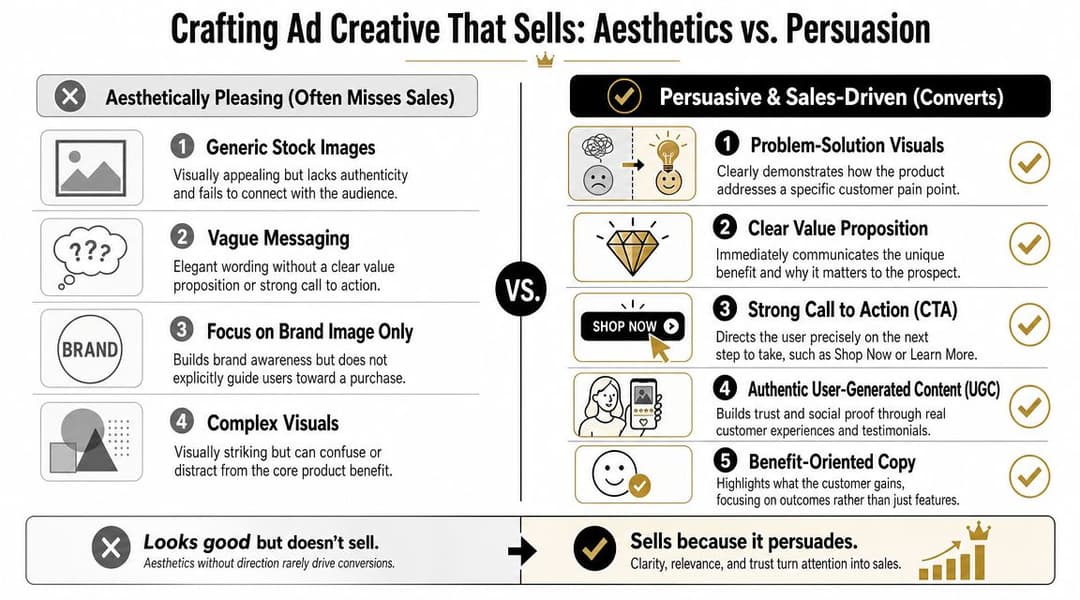
Creative for facebook ads for sales has a harder job than getting engagement. It needs to attract the right buyer, frame the value fast, and hand landing pages or sales teams a prospect who is more likely to convert.
Angles matter more than formats
A lot of in-house teams and junior media buyers start with the wrong debate. They ask whether video beats static or whether carousel beats single image. That question matters later. First decide what sales argument the ad is making.
Format affects delivery. Angle affects conversion quality.
The same product can sell through completely different angles:
- Pain-point angle: Show the problem the buyer already wants solved and make the cost of inaction clear.
- Benefit angle: Lead with the outcome. Show what gets better after purchase.
- Proof angle: Use demonstration, customer results, or creator-style testimonials to lower skepticism.
- Stage-of-awareness angle: Match the message to buyer intent. Colder audiences often need context. Warmer audiences usually need proof, specifics, and a reason to act now.
This matters even more in lead generation tied to revenue. If the ad promises convenience but the sales call requires budget, urgency, and operational fit, the creative can flood the pipeline with people who never had real buying intent. The ad did its job poorly, even if the CPL looks good.
Video-first does not mean video-only
Meta serves ads across feeds, Stories, Reels, and other placements with different viewing behavior. That changes how creative should be produced and tested. Smart Marketer's 2025 Facebook Ads Report points to a practical pattern. Product visibility early in the ad matters, and short-form video continues to earn a large share of user attention.
Use that as a production rule, not a creative religion.
In practice, strong accounts test multiple combinations at the same time. Creator-style video can work for cold acquisition. Statics can still win on retargeting. Carousels can help when buyers need to understand product range, pricing logic, or before-and-after proof. The point is not to force every offer into one format. The point is to match the message to the sale.
If you are rebuilding your testing process, this guide to Facebook ad creative best practices is a useful reference for separating production decisions from conversion strategy.
This short video is worth reviewing when you're thinking about how structure affects ad performance.
What to put inside the ad
High-converting sales creative usually includes the same core ingredients, even when the ad looks simple or native to the feed.
Immediate product clarity
Show what is being sold early. If viewers need several seconds to figure that out, drop-off rises and click quality usually gets worse.A specific promise
Broad claims attract weak intent. Concrete outcomes, use cases, or buyer-specific value propositions give serious prospects something to evaluate.Proof that reduces risk
Demonstrations, customer clips, reviews, comparison points, and founder-led explanation all help the buyer answer the same question. Why should I believe this?A CTA that matches the next step
If the sale happens online, ask for the purchase. If the sales process starts with a demo or consultation, the ad should prepare the prospect for that step instead of implying an instant result.
A useful creative review question is simple: would sales want more leads from people who respond to this message? If the answer is no, the ad may be generating activity without generating revenue.
One practical note for product-heavy brands. If you need to create a larger volume of on-brand visual variants without organizing full photo shoots, tools like an ai fashion model can support testing workflows. That helps when production speed is the constraint. It does not fix weak positioning, a vague offer, or poor alignment between the ad and the post-click sales process.
Structuring Campaigns for Scalable Sales
A bad campaign structure can choke a good creative set. As a result, many talented marketers lose efficiency. They build accounts like filing cabinets. Too many campaigns, too many ad sets, too much fragmentation, and not enough conversion data flowing into any single pocket of delivery.
Meta's system usually performs better when you give it cleaner inputs and fewer artificial walls.
Keep the objective tied to revenue
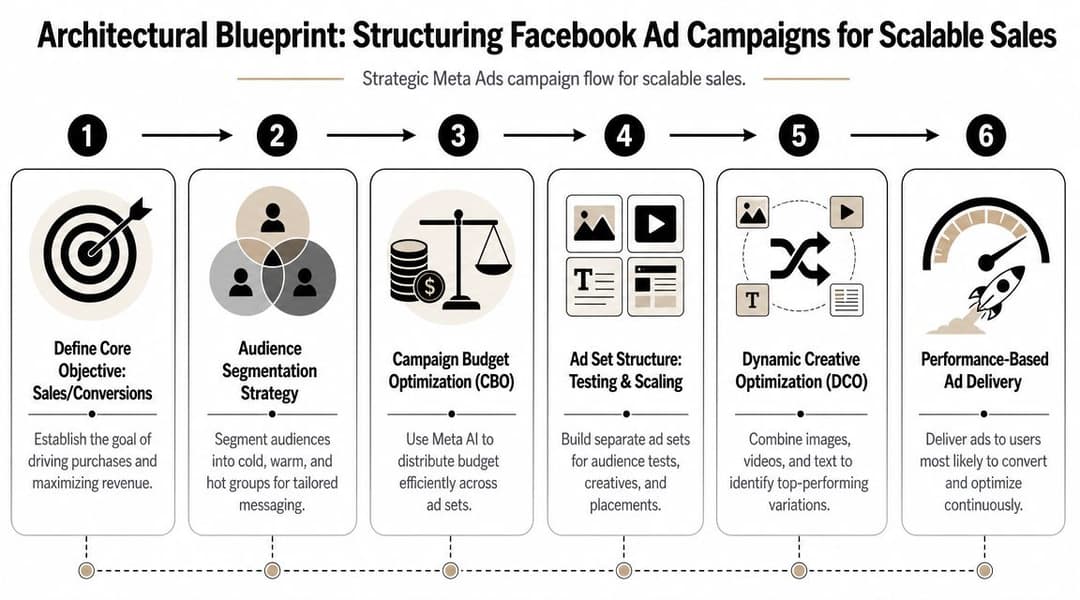
For sales-focused accounts, choose the objective that aligns with the business result. If you want purchases, optimize toward purchases. If you want qualified pipeline, optimize toward the closest event that reflects that outcome.
The mistake is building a campaign around a cheaper but weaker event because it makes reporting look healthier in the short term. Meta will absolutely find those easy conversions. It just may not find buyers.
A practical structure that scales
For most brands, a consolidated setup works better than a sprawling one. That often means using campaign budget optimization and grouping ad sets by strategic audience type rather than by every minor variation.
A useful baseline looks like this:
| Campaign element | How to structure it |
|---|---|
| Campaign | Use one sales-focused campaign per core offer or funnel stage |
| Budgeting | Let campaign-level budget allocation push spend toward stronger ad sets |
| Ad set 1 | Broad targeting with strong creative and clean exclusions |
| Ad set 2 | Lookalike or modeled audiences built from high-value customer signals |
| Ad set 3 | Warm retargeting based on site visitors, engaged users, or existing intent pools |
| Ads | Multiple creative angles inside each ad set, not endless tiny audience splits |
If you want a more detailed walk-through, this guide on Facebook ads campaign structure is a useful reference point.
Why consolidation usually beats complexity
Meta's delivery system needs data concentration. When you split spend across too many tiny ad sets, each one learns slowly and the account becomes harder to read. Buyers then start forcing decisions off noisy data. They pause things too early, duplicate too often, and create a false sense of control.
Consolidation helps in three ways:
- Faster learning because more conversion data accumulates in fewer places
- Cleaner comparisons between audiences and creative themes
- Easier scaling because budget can flow to the ad sets proving actual value
This doesn't mean you never separate campaigns. Separate when the business model demands it. Different countries, sharply different offers, or distinct funnel economics can justify separate structures. But don't multiply campaigns just to feel organized.
What to test inside the structure
Once the architecture is stable, test where it matters.
- Audience strategy: Broad versus modeled audiences versus warm pools
- Creative themes: Pain-point, proof, offer-led, and demonstration-led
- Offer presentation: Discount, bundle, urgency, consultation, free trial, or product education
- Landing page alignment: The ad promise has to match what the user sees next
Some teams also use platforms such as AdStellar AI to generate and launch larger sets of creative, copy, and audience combinations directly into Meta Ads Manager. That can help when the operational bottleneck is ad production volume, but the campaign still needs a sensible structure and a clear optimization goal.
Optimizing and Scaling with AI and Data
Once a campaign is live, the job isn't to babysit every fluctuation. The job is to interpret business signals correctly and act only when the data points to a real problem or a real opportunity.
That sounds simple, but most account damage happens during optimization. Buyers panic, chase short-term swings, and start editing campaigns that haven't had enough time or enough conversion data to stabilize.
Watch the metrics that map to money
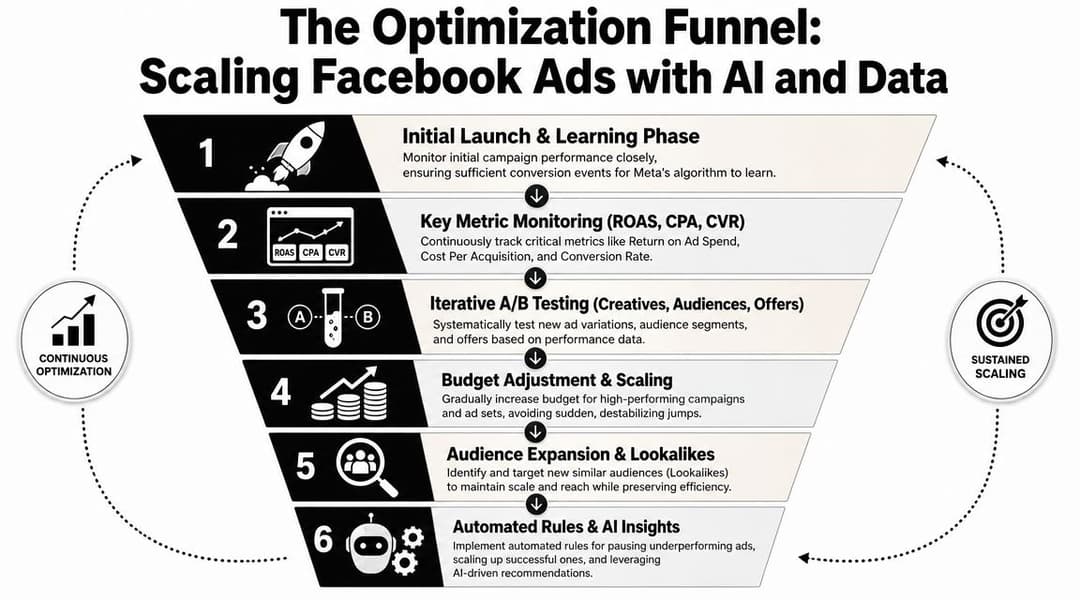
The cleanest workflow is the one performance teams use when they're serious about revenue. Optimize against primary KPIs such as amount spent, purchases, cost per purchase, and ROAS. Use secondary metrics like CTR, CPC, CPM, and frequency only to explain performance changes, not to define success.
That approach is laid out clearly in Improvado's Facebook ads guide. It also matches what strong operators do in practice. If ROAS drops, you investigate creative fatigue, audience saturation, delivery cost, offer fit, and landing page quality. You don't declare victory because CTR still looks pretty.
Low CTR and high CPC usually point to a message problem. High CPM can point to delivery cost pressure. Neither one tells you whether the campaign is actually making money.
How to read a live account
Use a simple hierarchy when diagnosing performance:
Start with purchases or qualified revenue outcomes
If those are healthy, don't overreact to secondary noise.Check cost per purchase or cost per qualified action
Rising costs can be acceptable if order value or close quality improves.Review creative and audience breakdowns
Find where results concentrate. Most accounts have a small number of clear winners.Use secondary metrics only as diagnostics
Weak CTR can suggest poor hook or offer framing. Expensive CPC can signal weak click intent or low relevance.Inspect post-click behavior
If the ad gets qualified traffic but the page or funnel leaks, the fix isn't inside Ads Manager.
This guide on performance marketing AI is helpful if you're trying to understand where automation should assist and where human judgment still matters.
Scaling without breaking performance
Scaling is not the art of making budgets bigger. It's the discipline of increasing spend while preserving signal quality.
A few rules hold up well in practice:
Scale winners, not maybes
A campaign that barely works rarely becomes strong because you spend more on it.Refresh creative before forcing budget
If frequency pressure is rising and conversion quality is slipping, more spend often magnifies the weakness.Expand with intent
Broaden audiences or add modeled audiences when the account has enough quality conversion data to guide delivery.Protect measurement
During scaling, tracking issues become expensive fast because they distort automated optimization.
Where AI helps and where it doesn't
Meta's AI is excellent at delivery optimization when your conversion signals are clean and your inputs are strong. It is not a substitute for a weak offer, broken follow-up, or lazy creative strategy.
So let the platform do the micro-decisions. Let it allocate across placements, process auction signals, and find pockets of conversion efficiency. Your job is to control the big levers. Offer, message, economics, creative pipeline, and event quality.
That division of labor is what keeps scaling rational instead of emotional.
Beyond the Click Closing the Loop on Sales
A familiar scenario. Meta is generating form fills at an acceptable cost, the dashboard looks healthy, and revenue still misses target. The failure usually sits after the click.
In ecommerce, the break often shows up on the product page or at checkout. The ad sets a clear expectation, then the landing page adds friction, weak proof, confusing bundles, or a slow checkout flow. The media team responds by changing audiences or bids, even though the actual loss is happening in the buying path.
In lead generation, the handoff is usually the bigger problem. A prospect submits a form with real intent, then waits hours or days for a reply. By the time sales reaches out, urgency is gone. Marketing reports low CPL. Sales reports poor lead quality. The better question is simpler. Did the business follow up well enough to turn paid demand into pipeline and revenue?
If someone was interested enough to submit the form, the next step has to match that level of intent.
That changes how campaigns should be built. If the sales team only closes high-intent prospects, the ad and landing page should screen harder with pricing cues, use-case specificity, or qualification questions. If fast contact drives close rate, routing and response time matter as much as cost per lead. If the product needs explanation, the first email, call, or SMS should continue the conversation the ad started, not force the prospect to begin again.
Weak alignment gets expensive. Meta may keep finding people likely to convert on the event you chose, but if your team cannot contact them quickly, qualify them correctly, or move them through the next step, ad efficiency on paper will hide a sales operations problem.
The strongest accounts treat media buying and sales follow-up as one system. Shared definitions help. A qualified lead should mean the same thing in Ads Manager, the CRM, and the sales team's pipeline review. Feedback loops help too. If a campaign produces plenty of submissions but few real opportunities, the answer may be tighter targeting, sharper pre-qualification, or a different offer. If leads are good but close rates stay weak, fix speed to lead, call quality, calendar flow, or demo no-show prevention before touching spend.
Facebook ads for sales work when the click starts a process the business is prepared to finish. That is how ad spend turns into revenue instead of reports.
FAQ Common Questions About Driving Sales on Meta
| Question | Answer |
|---|---|
| Should I optimize for clicks first, then switch to sales later? | Usually no. If your goal is revenue, start with the event that most closely matches revenue. Optimizing for clicks teaches Meta to find clickers, not buyers. |
| Why do my leads look cheap but never close? | The issue is often lead quality, weak offer alignment, or a broken post-click process. Check the ad message, landing page promise, qualification steps, and how sales follows up after submission. |
| When should I scale a campaign? | Scale when the campaign is producing stable business outcomes, not just attractive secondary metrics. If purchases or qualified outcomes are holding and the breakdowns show clear winners, increase budget carefully and monitor conversion quality. |
If you're running Meta seriously and need a faster way to launch, test, and iterate on campaign variations, AdStellar AI is built for that workflow. It connects with Meta Ads Manager, generates combinations of creatives, copy, and audiences, and helps teams evaluate performance against business goals like ROAS, CPL, or CPA instead of relying on guesswork.