You open Facebook Ads Manager to run a simple campaign for your business, and within minutes you're staring at campaign objectives, ad sets, placements, attribution settings, audience controls, reporting columns, and a payment warning you didn't expect. Many businesses don't fail because Facebook ads can't work for their business. They fail because they boost posts, copy what competitors appear to be doing, and hope the platform fills in the strategic gaps.
That approach burns budget fast.
The businesses that get repeatable results from Facebook don't treat it like a posting tool. They treat it like a performance system. They know what they're optimizing for, how they structure tests, when to leave a campaign alone, and how to refresh creative before performance slides. That's the key difference between amateur promotion and disciplined media buying.
If you sell physical products, local services, subscriptions, appointments, or digital offers, the mechanics are similar. The playbook changes a bit by business model, but the strategic backbone stays the same. For operators in ecommerce, especially apparel, this practical guide to Facebook ads for POD apparel from Skup is also useful because it shows how offer type and product economics shape campaign decisions.
Your Starting Point in a Complex Ad Landscape
A business owner usually comes into Facebook ads with one of two problems. Either sales have slowed and they need a dependable acquisition channel, or they've gotten a few wins from boosted posts and now want something more controlled. In both cases, the mistake is the same. They enter Ads Manager looking for a tactic when what they need is a workflow.
That distinction matters.
A tactic is “try a video ad” or “target people interested in yoga.” A workflow is deciding what business outcome matters, choosing the correct objective, building the right audiences for each stage of intent, matching the message to awareness level, and reviewing performance in a way that leads to action. Without that workflow, every result feels random.
Businesses rarely struggle because Facebook has too many options. They struggle because they make decisions in the wrong order.
The first order problem isn't creative. It isn't even targeting. It's account discipline. If you launch without a clean setup, clear tracking, and a plan for how campaigns will move from broad discovery to retargeting, you'll spend your time reacting to noise. You'll pause ads too early, chase vanity metrics, and keep rebuilding from scratch.
Professional performance marketers don't work that way. They reduce uncertainty by using a repeatable operating system:
- Build the account correctly: Payment method, Page connection, and business email verification inside Account Overview need to be handled before anything else.
- Track behavior from day one: If you can't see what visitors do after the click, you can't optimize with confidence.
- Separate exploration from exploitation: Broad campaigns teach you what resonates. Retargeting campaigns convert existing intent.
- Treat creative as a testing program: Winning ads are usually discovered through structured variation, not one inspired brainstorm.
- Review on a schedule: Good media buyers don't constantly poke campaigns. They check the right metrics at the right cadence.
Facebook has become a cornerstone platform for structured, data-driven campaign execution because it centralizes campaign management, creative testing, audience analysis, and reporting in one place, while allowing recurring weekly reports and segmented performance views through Meta Ads Reporting, as outlined in this breakdown of Facebook ads analytics workflows.
That's why learning how to advertise your business on facebook isn't really about learning buttons. It's about learning decision frameworks.
Laying the Foundation for Profitable Campaigns
A campaign can show strong click-through rates and still lose money if the account is set up in a way that blocks clean attribution, disciplined testing, or budget control. Profit starts earlier than ad creative. It starts with the operating conditions inside the account.
Start with the account and asset layer
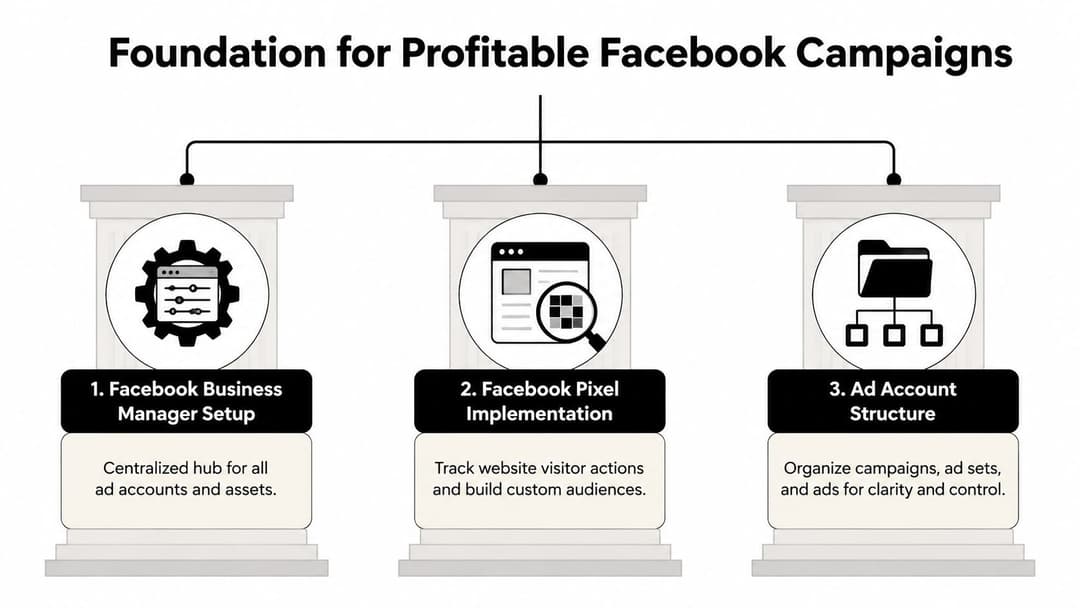
Before building campaigns, finish the business setup inside Meta first. Add the payment method, connect the correct Facebook Page, confirm business email access, and make sure the right people have the right permissions. If you are still setting up the business presence itself, this walkthrough on how to create a new Facebook account for business is a practical reference.
Then impose structure before spend. Use a naming convention that tells your team the objective, audience, offer, geography, and date range at a glance. Keep prospecting, retargeting, and testing campaigns separate. That sounds administrative, but it affects performance work directly. If campaign names are vague and assets are mixed together, reporting breaks down, duplicated audiences slip through, and nobody can tell whether a result came from targeting, creative, or offer.
Install tracking before you spend
Tracking has to be live before the first click. If someone lands on your site, Meta Pixel, conversion events, and UTM parameters should already be configured in Events Manager and your analytics stack. Otherwise, you are buying traffic without a reliable way to judge what happened after the click.
A common mistake is rushing to launch and treating tracking as a cleanup task for later. That usually creates a bigger problem than a delayed start. Once data is missing, you cannot reconstruct it well enough to make sound optimization decisions.
Practical rule: If you cannot explain how a purchase, lead, or booked call is attributed after the click, wait to launch.
Tracking also sets up better testing. Professional advertisers do not just ask, "Did this ad get clicks?" They ask which creative angle produced qualified traffic, which landing page held attention, and which audience generated the lowest cost per real business outcome. You only get those answers if the tracking layer is clean.
Pick the objective that matches the job
Campaign objectives shape delivery, optimization, and the type of user Meta tries to find. If the job is lead generation, choose an objective built around leads. If the job is purchases, optimize for purchases once enough conversion signal exists. Mismatching the objective and the business goal is one of the fastest ways to get low-quality results and misleading performance data.
The budget framework below is a useful starting point for teams that want to balance learning and conversion pressure:
| Campaign phase | Primary job | Recommended budget share |
|---|---|---|
| Awareness | Reach broad qualified audiences | 30-40% |
| Consideration | Engage warmer users such as site visitors or video viewers | 40-50% |
| Conversion | Capture high-intent actions such as purchases or leads | 10-20% |
The same planning approach often pairs best with concentrated spend, not fragmented spend. As noted earlier, a higher daily budget per audience is usually recommended when you need enough data to judge performance reliably. A common mistake is splitting a modest budget across too many audiences, which leaves every ad set underfed and keeps the account stuck in weak learning cycles.
That is one of the clearest differences between boosting posts and running performance campaigns. Amateur setups spread budget thin because more audiences feels safer. Professional setups protect signal density so the account can learn.
For a broader strategic view, Sup Growth's ad mastery guide is a good companion read because it connects account setup choices with creative and channel execution.
Daily budget versus lifetime budget
This choice affects how you test and how clearly you can read results.
- Daily budgets give Meta a steady spending target each day. They are usually better for ongoing testing because pacing is easier to monitor and changes in performance are easier to interpret.
- Lifetime budgets set a total campaign cap across a fixed period. They can work for scheduled promotions or event-based campaigns, but day-to-day spend becomes less predictable and analysis gets murkier.
For newer accounts, daily budgets are usually easier to manage. They support a cleaner workflow: change one variable, let it run, review the result, then make the next decision. If you change budget, audience, placement, and creative at the same time, you do not have a test. You have noise.
Mastering Your Facebook Audience Strategy
Two advertisers can sell the same product with the same budget and still get very different results. The usual reason is not the ad account setup. It is audience strategy. One account is built to learn who responds and why. The other is built on assumptions.

Use broad targeting to generate signal
Broad targeting works best at the start because it gives Meta room to find pockets of demand you would not have picked manually. HubSpot notes that strong campaigns often begin broad and get sharper as Custom Audiences and behavioral data accumulate in this guide to Facebook marketing audience strategy.
The mistake junior buyers make is confusing narrow with strategic. They stack interests, behaviors, and demographics until the audience looks impressively specific, then wonder why delivery stalls and CPA swings all over the place. A tight audience can work, but only after you know which message, offer, and buyer traits are already producing results.
Start with enough structure to control relevance. Age range, geography, language if needed, and one or two meaningful traits are usually enough. Then watch who clicks, watches, adds to cart, and buys.
That is the workflow difference between amateur boosting and professional buying. Amateurs try to predict the winner in advance. Performance marketers build campaigns that create evidence.
Build audiences around intent
Audience quality improves when segments reflect actions people took, not guesses about what they might like.
The core stack usually looks like this:
- Website visitors: Useful for returning interested traffic that did not convert.
- Customer lists: Useful for retention, upsell, suppression, and lookalike source quality.
- Video viewers and engaged users: Useful for warming up accounts that do not have much site traffic yet.
- Page and profile engagers: Useful when content is creating qualified attention before the click.
The trade-off is scale versus intent. A 75 percent video viewer pool is usually larger than a cart abandoner pool, but it is also weaker. Treating both groups the same usually hurts efficiency. Cart abandoners can handle a direct offer or urgency. Video viewers often need proof, education, or a stronger reason to click.
If you want a clearer framework for segmenting buyers by age, income, location, and fit, this guide to demographic ad targeting is a strong companion.
Broad audiences help you find demand. Custom Audiences help you convert the demand you already observed.
Use local and community context when it affects buying behavior
For local businesses, audience strategy extends beyond the targeting panel. Community behavior often explains purchase intent better than interest targeting does.
A med spa, gym, realtor, or restaurant should pay attention to the language people use in local groups, the offers competitors push repeatedly, and the objections that come up in community discussions. Those patterns often point to better hooks, exclusions, and retargeting windows. This resource on mastering Facebook groups for local growth is useful if community-led demand matters in your market.
Structure audiences by funnel stage
Strong accounts separate audiences by temperature and decision stage because each group needs a different job from the ad.
- Cold audiences are for discovery, angle testing, and first-click efficiency.
- Warm audiences are for education, social proof, and objection handling.
- Hot audiences are for conversion, urgency, and recovery of missed sales.
Keep those layers clean. A person who visited a product page yesterday should not be lumped in with someone who watched three seconds of a video last month. The more disciplined the segmentation, the easier it is to rotate creative angles, read performance accurately, and decide whether an ad failed because of the message, the audience, or the offer.
Marketplace can also matter for local sellers and smaller brands because it creates another discovery path inside Facebook, especially for products with obvious local intent. Use that signal as part of your audience planning, not as a reason to blur every audience together.
What usually breaks performance is not lack of targeting options. It is weak audience logic. Good media buyers do not build giant lists and hope Meta sorts it out. They define intent tiers, protect signal quality, and test audiences in a way that produces decisions you can trust.
Developing Winning Creative and Copy
A campaign can have clean targeting, correct tracking, and enough budget to learn. It still fails if the ad says the wrong thing to the wrong level of buyer awareness.
That is why experienced media buyers spend less time arguing about format first and more time building a creative testing system. Carousel versus single image matters. Video versus static matters. The bigger lever is usually the angle. The message has to match what the audience already believes, what they still doubt, and what action the ad needs to earn.

Leadenforce makes this point well in its explanation of why Facebook ad creative angle matters more than format. The practical takeaway is simple. Build creative around awareness stage before you worry about polishing production style.
Match the message to awareness
Accounts lose money here all the time. The ad looks polished, but the ask is out of sequence.
An unaware prospect usually does not need a discount first. They need a sharper articulation of the problem. A problem-aware prospect needs help naming the cause. A solution-aware prospect is comparing options, so mechanism and differentiation carry more weight. A product-aware prospect is often close to buying, but friction remains. Trust, effort, timing, and fit need clear answers.
Use that logic in the ad itself:
| Awareness level | What the ad should do | Weak approach | Stronger approach |
|---|---|---|---|
| Unaware | Surface a hidden cost or overlooked issue | “Shop now” | “The routine that quietly creates the problem” |
| Problem-aware | Clarify root cause | “We can help” | “Why the usual fix doesn't hold” |
| Solution-aware | Differentiate mechanism | “Better quality” | “How this approach works differently” |
| Product-aware | Reduce risk | “Limited time offer” | “What removes hesitation from trying it” |
This is the part many junior teams skip. They test three videos and call it creative testing. That is format testing. Real creative testing changes the framing while keeping the offer and audience logic stable enough to learn from the result.
Build a creative angle matrix, not a pile of random ads
A stronger workflow starts with a message map. List the top buying triggers, objections, and pain points for one audience segment. Then turn each one into a distinct angle.
For the same product, one ad can focus on wasted time. Another can focus on hidden cost. Another can focus on skepticism about whether the product will work. Another can focus on the effort required to switch. Same offer. Different angle. That gives you a clean way to see what belief moves the click and what belief moves the conversion.
In practice, I want each angle to do one job well. If a single ad tries to teach the problem, explain the mechanism, prove credibility, and close the sale at once, the message gets soft. Facebook ads work better when they earn the next step.
Copy should create momentum
Good ad copy does three things.
- Hook fast: Lead with tension, contrast, specificity, or a familiar frustration.
- Build relevance: Show the prospect you understand their situation and the stakes.
- Direct the click: Give them a clear reason to take the next step now.
A lot of weak copy reads like a homepage introduction. It opens with brand mission, stacks generic benefits, and delays the main point. Feed ads do not get that luxury. Attention is rented for a moment. The copy has to spend it well.
This guide to Facebook ad creative best practices is a useful reference for tightening hooks, visual hierarchy, and copy flow.
Creative quality comes from iteration, not inspiration
Strong creative systems rotate angles on purpose. They do not wait for one ad to fatigue before scrambling for a replacement.
Start with a small batch of distinct concepts. Keep the hook, body copy, headline, and visual aligned to the same core idea. After spend comes in, review results by angle rather than by format alone. If testimonial framing beats feature-led framing across multiple variants, that is a strategic signal. If one concept gets clicks but weak downstream conversion, the hook may be attracting the wrong intent. If a concept converts on warm traffic but fails on cold traffic, the message likely assumes too much awareness.
A quick visual breakdown helps here:
Do not ask whether the ad is good. Ask whether the angle fits the awareness level and buying resistance of the audience seeing it.
That question leads to better creative decisions, cleaner tests, and a campaign account that can scale without guessing.
Your Launch and Optimization Workflow
A launch day mistake can pollute the next two weeks of analysis.
Launching isn't the time to improvise with structure, budgets, or naming. The goal is to create a clean test environment so early results mean something. If the setup is sloppy, optimization turns into guesswork because too many variables moved at once.

Structure tests so you can trust the outcome
Professional buyers launch campaigns to answer a specific question. Amateur boosters launch a bundle of ads and hope Meta sorts it out.
Keep the first round focused. If the question is audience fit, hold the creative angle steady and test audiences. If the question is message-market fit, keep the audience stable and rotate angles. If you change audience, offer framing, creative, placements, and landing page at the same time, you may get a winner, but you will not know what caused it. That makes the next decision harder, not easier.
Before spend goes live, check the basics:
- Confirm tracking: Pixel events, conversion events, destination URLs, and UTM parameters need to fire correctly.
- Check naming: Campaign, ad set, and ad names should show objective, audience, angle, and version.
- Review exclusions: Existing customers, recent purchasers, and overlapping warm audiences often need separate treatment.
- Match the ad to the page: The promise in the ad should appear immediately on the landing page.
- Set reporting views first: Decide which breakdowns and metrics will drive decisions before data starts coming in.
If your team needs a tighter operating process, this Facebook ad launch workflow for structured testing and QA is a useful reference.
Give the system stable conditions before judging performance
Early edits create false signals. A campaign that gets three changes in its first 48 hours rarely gives clean feedback.
That does not mean letting bad spend run unchecked. It means separating obvious setup problems from normal early volatility. Broken tracking, rejected ads, wrong URLs, or a landing page outage need immediate action. Small swings in CPM, click-through rate, or conversion rate during the first stretch usually do not.
A common junior mistake is pausing ads too quickly, then relaunching near-identical versions and calling it optimization. In practice, that resets the read on performance and slows down learning across the account. Stability matters because Meta performs better when it has enough consistent inputs to find likely converters.
Watch for this mistake: Teams react to short-term noise, edit too often, and lose the ability to tell whether the audience, the angle, or the setup was actually responsible for the result.
Build a review cadence with clear decision rules
Optimization works best as a repeatable operating rhythm. Daily spot checks are useful for catching delivery problems. Real decision-making usually belongs in a scheduled review, with enough data to compare segments and enough discipline to avoid random edits.
A solid weekly review usually covers four areas:
- Creative review: Which angles are still producing qualified actions, and which are fading after the click?
- Audience review: Which segments produce buyers or leads with real intent, not just cheap traffic?
- Placement review: Which placements add volume, and which ones lower lead quality or purchase rate?
- Breakdown review: Do age, gender, device, or geography splits show clear mismatch between spend and outcome?
The difference between platform mechanics and actual media buying becomes apparent. The job is not just to find a winning ad. The job is to identify why it wins, decide whether the result is repeatable, and feed that insight back into the next test cycle. That is how angle rotation becomes a system instead of a scramble after fatigue sets in.
Operational scale matters too. Platforms like AdStellar AI can generate and launch larger sets of creative, copy, and audience combinations into Meta, which helps teams run structured tests without building every variation by hand.
Measuring What Matters for Sustainable Growth
Facebook gives you plenty of numbers. Most of them aren't the ones that should drive budget decisions.
Likes, comments, shares, and low-cost clicks can be useful signals, but they aren't proof that the campaign is helping the business. A campaign can look active in the interface and still fail commercially. That's why performance marketers anchor on ROAS, CPA, and the broader economics behind the conversion.
Separate business metrics from platform signals
Platform metrics tell you how people interacted with the ad. Business metrics tell you whether that interaction mattered.
Here's the difference:
- Vanity metrics can tell you an ad is attracting attention.
- Efficiency metrics such as CPA tell you what it costs to acquire the desired action.
- Revenue metrics such as ROAS tell you whether spend is returning enough value.
- Customer economics such as lifetime value tell you whether an expensive acquisition is still rational over time.
A junior buyer often gets trapped by the first category. They'll keep a weak campaign alive because click-through rate looks healthy or because comments seem positive. An experienced buyer asks whether those interactions turn into qualified leads, purchases, booked demos, or retained customers.
Read results by segment, not just totals
Account-level averages hide the reason performance changes. One audience can be carrying the account while another wastes spend. One age band can be profitable while another drags down blended results.
Build custom reporting views that break results down by audience, creative angle, and conversion path. If the account produces leads, compare lead quality by source and message angle. If it produces purchases, separate new customer acquisition from returning customer revenue if your setup allows it.
This guide on how to measure advertising effectiveness is a practical reference if you want a stronger reporting framework.
A campaign isn't healthy because the dashboard is busy. It's healthy when the metrics that tie to profit stay within an acceptable range.
Attribution also matters. Facebook measures its contribution through the signals available inside its system, but your business may see value over a longer window or across multiple touches. Don't treat one dashboard as perfect truth. Treat it as one decision tool, then compare it against what your site, CRM, or order data says happened after the click.
How to Scale Your Wins Systematically
A winning ad set creates a new problem. You need more volume without damaging the thing that made it work.
There are two basic ways to scale. Vertical scaling means increasing budget on an existing winner. Horizontal scaling means duplicating the winning logic into new audiences, angles, or adjacent setups. Both can work. Both can also wreck performance if you move too aggressively or scale before the campaign has a stable base.
The bigger issue is usually creative fatigue. Most guides tell you to find “new advertising angles” when performance softens, but they don't offer a real system for deciding what to rotate next. That gap matters because, for growth teams, manually brainstorming and testing new variations becomes a bottleneck. This summary of the creative fatigue and angle rotation problem captures the issue well.
A practical scaling rhythm looks like this:
- Keep proven audiences active: Don't shut off a working segment just because you want something new.
- Rotate angles, not just formats: If one message frame is fading, test a different problem, objection, use case, or value hierarchy.
- Separate scale tests from core control: Protect the original winner while you test expansions.
- Use observed behavior to guide expansion: The best next audience usually resembles something that has already worked.
- Refresh before collapse: Teams that wait until results crater usually replace under pressure and learn less.
When teams handle scaling well, they stop thinking in terms of “the winning ad” and start thinking in terms of a repeatable system for finding the next winner.
If your team wants a faster way to turn that system into execution, AdStellar AI helps launch, test, and scale Meta campaigns by generating large sets of creative, copy, and audience combinations, pushing them live in bulk, and ranking what performs against goals like ROAS, CPL, or CPA. It's a practical fit for marketers who already know the strategy and need less manual setup between idea, launch, and learning.