Your campaign was stable, then it wasn't. CPMs climbed, click quality softened, and the ad that carried the account last month now looks tired. The common response is to make more ads faster. Strong teams do something else first. They view competitor ads with a system.
That doesn't mean scrolling a rival's Instagram page and saving a few screenshots. It means using platform transparency tools, tracking what changes week to week, and turning visible patterns into testable hypotheses inside your own account. Done well, competitor research helps you answer practical questions: Which offers keep showing up? Which hooks survive for weeks? Which formats are getting repeated across channels? And just as important, what is nobody in the category saying?
The difference between useful competitor research and wasted time is structure. Without structure, you collect random examples. With structure, you build a real intelligence process.
Beyond Guesswork Why Top Marketers Watch Competitor Ads
A familiar pattern shows up in almost every growth team. Performance dips, the team debates audience fatigue versus offer fatigue, and someone says, “Let's see what competitors are running.” Then they do a few searches, save a handful of ads, and walk away with opinions instead of insight.
That approach doesn't help much because isolated ad sightings don't tell you what changed, what persisted, or what mattered. What does help is consistent observation. Public ad archives have changed this process. Tools such as Google's Ad Transparency Center and Meta's Ads Library let you search an advertiser's active inventory and often review ad history over several months, which makes it possible to track creative evolution, launch timing, and message frequency through public systems rather than one-off manual checks, as described in this overview of competitor ad archives.
Practical rule: If you only check competitor ads when your account is under pressure, you're already late.
Top marketers don't use competitor research to copy. They use it to reduce blind spots. If three competitors suddenly lean into proof-heavy testimonials, that doesn't mean you should clone testimonial ads. It means the market may be responding to trust-building language. If everyone keeps repeating the same promise, that may reveal a crowded angle you should avoid.
A lot of teams also miss the operational side. Competitive monitoring works better when it's tied to execution. If you're building faster test cycles, a resource like this search automation strategies guide is useful because it pushes the same discipline: reduce manual drift, standardize decision-making, and react to patterns faster than the market.
The point isn't to become obsessed with rivals. The point is to stop making decisions in a vacuum.
Accessing Ad Libraries on Major Platforms
Native ad libraries are the starting point because they're public, fast, and good enough to reveal a lot of market behavior. They're not complete intelligence systems, but they're the cleanest way to begin.
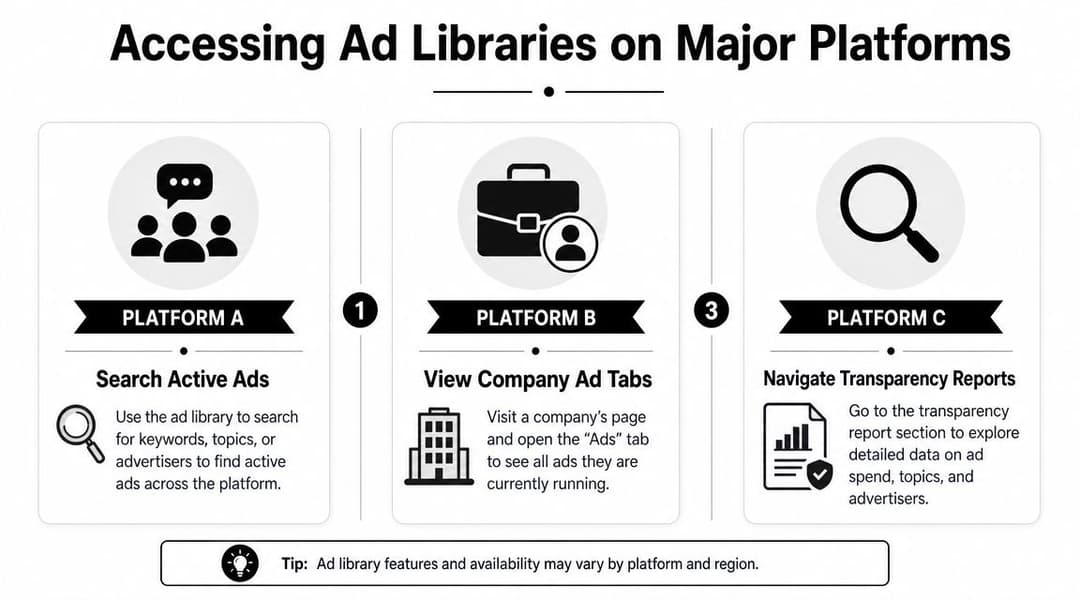
Meta Ads Library
For most paid social teams, Meta is the first stop. Search by brand name, page name, or sometimes a keyword tied to the advertiser. Once you're inside, the useful part isn't just the creative itself. It's the pattern across creatives.
Review these elements on every brand page:
- Creative repetition: Are they repeating one concept across multiple visuals?
- Copy variation: Do they keep the same hook and rotate only the body text or CTA?
- Format choice: Are they leaning on video, static image, carousel, or creator-style assets?
- Offer framing: Are they pushing a discount, a demo, social proof, or a pain-point angle?
The fastest way to get better at this library is to see how other practitioners break it down. This Meta Ads Library walkthrough is a practical reference for how marketers use the library for competitive review.
What Meta won't show you is just as important. You won't see budgets or targeting. That limitation matters because a polished creative in the library may be a small test, not a scaled winner.
If you can't see spend or targeting, treat the ad as evidence of a hypothesis, not proof of success.
Google Ad Transparency Center
Google's system is useful for viewing active ads across Google surfaces and checking how a brand presents itself in Search, Display, and YouTube environments. Search by verified advertiser name or website URL where available, then filter by region, format, and date range when those options apply.
What I look for first on Google is messaging consistency. Search ad language tends to be more deliberate than social copy because it maps closer to query intent. If a competitor keeps repeating the same promise, that message is usually important to their acquisition strategy.
Google also gives advertisers a more analytical view inside their own accounts through Auction Insights. For Search campaigns, Google Ads Help states the report includes exactly 6 statistics: impression share, overlap rate, outranking share, position above rate, top of page rate, and absolute top of the page rate in its Auction Insights documentation. Google also notes the report can be generated for one or more keywords, ad groups, or campaigns, and segmented by time and device in that same documentation.
That matters because viewing competitor ads on Google shouldn't stop at “I saw their headline.” If you're actively competing in the same auctions, you can pair creative observation with auction-level benchmarking inside your own account.
TikTok Creative Center
TikTok is useful when your category depends on trend velocity, creator-native formats, or short-form hooks. Search for brand terms, then study how the brand adapts to platform language rather than how polished the asset looks.
What usually matters most on TikTok:
| Platform cue | What to inspect | Why it matters |
|---|---|---|
| Opening seconds | Visual hook and spoken hook | TikTok ads live or die on immediate attention |
| Native feel | Whether the ad looks creator-led or brand-produced | Reveals how the brand is managing trust and interruption |
| Message density | How much product explanation appears early | Shows whether they're selling impulse or consideration |
TikTok is less helpful for pure benchmarking and more useful for spotting creative behaviors that are moving into the category.
LinkedIn Ad Library
LinkedIn matters more for B2B, recruiting, and higher-consideration offers. The ad library is usually less crowded than Meta, which makes pattern detection easier. Search the company and inspect the ads tied to demand generation, webinars, lead magnets, or product education.
On LinkedIn, focus on these questions:
- Who are they speaking to? Job function clues often show up in the headline.
- What stage are they targeting? Awareness messaging looks very different from bottom-funnel demos.
- How formal is the positioning? Some brands sell with polish, others with plain-spoken problem language.
What the libraries are good for and what they aren't
Ad libraries are strong at showing what exists in public. They're weak at explaining why it works.
Use them to find:
- Messaging themes
- Creative formats
- Offer repetition
- Launch timing
- Cross-platform consistency
Don't use them to assume:
- Budget scale
- Audience targeting
- Profitability
- Conversion rate
- True account strategy
That distinction saves a lot of wasted testing.
Beyond the Libraries Third-Party Ad Intelligence Tools
Native libraries are free and useful, but they're clumsy for ongoing analysis. Once you're tracking multiple brands across multiple platforms, manual browsing turns into tab overload.

Third-party tools solve an operational problem. They help you collect, organize, compare, and revisit ads without rebuilding the same workflow every week. That's the main reason to pay. Not because the tool magically reveals performance, but because it reduces friction.
When a paid tool earns its place
A paid platform starts to make sense when your team needs one or more of these:
- Historical tracking: You need to see how a brand's creative changed over time.
- Cross-platform review: You don't want separate workflows for Meta, Google, and other channels.
- Team collaboration: More than one person needs to log findings and act on them.
- Pattern detection: You want to group ads by angle, offer, or format rather than save screenshots in folders.
A good category overview is this guide to competitor ad analysis software, which shows the type of workflow these tools are built to support.
The trade-off is simple. The more automation you add, the easier it becomes to overreact to noise. If a competitor launches several new ads this week, that doesn't mean their strategy changed. It may mean they're testing broadly.
What to ignore in tool demos
Vendors often sell speed and visibility. That's useful, but it's not enough. A flashy dashboard doesn't matter if your team still can't answer basic questions like:
- Which message has stayed in market the longest?
- Which offer appears across more than one platform?
- Which concepts are being iterated versus abandoned?
- Which landing pages match the ad promise?
Those are the questions that move a media plan.
Here's a helpful explainer before you evaluate any software:
The real output you want
The best output from a third-party tool isn't a swipe file. It's a decision file. You should be able to walk away with a short list of active patterns in the market, a log of changes by competitor, and a ranked set of hypotheses for your next round of tests.
If the tool helps you watch more ads but doesn't help you make better decisions, it's adding volume, not insight.
A Framework for Meaningful Competitor Ad Analysis
Organizations often collect competitor ads backwards. They start with the creative they like, then build a story around it. A better method starts with a repeatable audit and ends with a test plan.
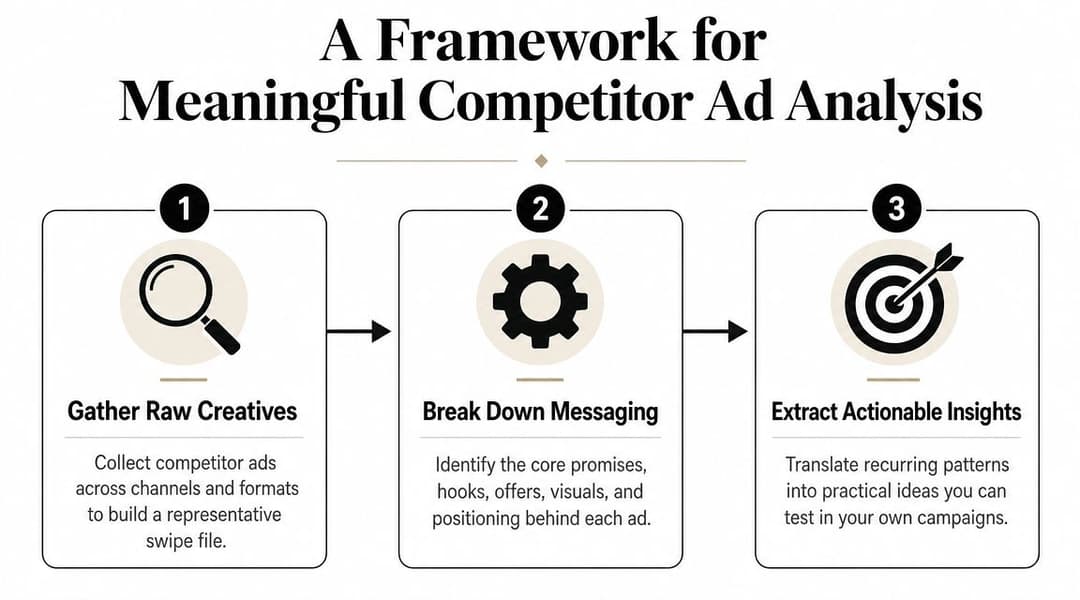
A strong workflow is straightforward. Select 5 to 7 direct competitors, log each ad in a standardized sheet, and review the same set every week. The tracked fields should include date reviewed, format, hook or headline, visual approach, offer type, and estimated run duration. This approach comes from a competitor ad analysis framework, which also warns that sporadic checks create fragmented observations that don't reveal meaningful patterns.
Build a sheet that forces clarity
The sheet matters because it keeps your team from debating impressions. I want columns that make subjective creative easier to compare.
Include fields like these:
| Field | What to log | Why it matters |
|---|---|---|
| Brand | Competitor name | Keeps analysis grouped by advertiser |
| Review date | The day you saw the ad | Lets you track recurrence |
| Format | Image, video, carousel, UGC-style | Helps separate concept from execution style |
| Hook | Primary opening claim or headline | Usually the first thing worth testing |
| Offer | Discount, demo, bundle, proof, urgency | Reveals the conversion mechanism |
| Landing page note | Whether the page matches the ad promise | Exposes weak post-click journeys |
The hidden benefit of a sheet is that it makes disagreement productive. Instead of saying “their ads look stronger,” someone has to say “they're testing three trust-heavy hooks against one urgency offer.”
Analyze the ad and the click after it
A lot of marketers stop at the ad unit. That's a mistake. The post-click experience tells you whether the ad is part of a real funnel or just a loud top-funnel asset.
When you inspect the landing page, look for:
- Hook match: Does the first screen continue the same promise?
- Offer continuity: Is the advertised incentive visible right away?
- CTA clarity: Does the page keep the same action path?
- Feature emphasis: Which proof points get highlighted after the click?
Many weak campaigns leak when the ad gets attention, but the page shifts tone, changes the promise, or buries the reason to act.
The ad is a promise. The landing page either keeps it or breaks it.
Turn observations into coded patterns
Once you have enough entries, code the ads by pattern. Not by brand aesthetic. By strategic role.
I usually group them into buckets like:
- Problem-first
- Outcome-first
- Founder-led
- Testimonial-led
- Offer-led
- Demo-led
Then I compare what gets repeated versus what disappears. Repetition is usually more useful than novelty. A concept that survives multiple review cycles deserves attention. A concept that appears once may just be a test.
If you want a broader operating model for this kind of work, these effective competitive intelligence strategies are a good complement because they reinforce process over one-off research.
For teams that want to sharpen the creative side of this audit, this resource on identifying winning ad elements fits well with the same discipline.
Applying Competitor Insights to Scale Your Own Ads
Competitor research becomes valuable when it changes your testing queue. Until then, it's entertainment.
A useful benchmark here is ad longevity. One competitor-analysis source notes that ads running for 30+ days often signal profitability, and recommends comparing longevity, multi-platform presence, and creative iteration frequency to judge whether a concept is being optimized or merely tested in this guide to competitor ad benchmarks.

What to do with a repeated competitor pattern
If you notice a repeated pattern, don't copy the surface. Extract the variable.
For example:
A competitor keeps running creator-style testimonials.
Your test isn't “make their ad.” Your test is whether first-person proof outperforms your current brand-led angle for the same audience.Several brands repeat the same benefit statement.
Your move may be to challenge that framing and lead with a neglected benefit instead.One offer appears across multiple channels.
That may mean the offer is central to their acquisition strategy. Test your own version of the incentive logic, not their wording.
Build a testing roadmap from competitor intelligence
A clean workflow looks like this:
- Capture the recurring signal. One hook, offer type, or format keeps showing up.
- Define the underlying hypothesis. Why might that pattern be working in this market?
- Create one controlled variant. Change one major variable at a time.
- Map it to your funnel stage. Don't test a broad awareness concept against a retargeting ad and call it insight.
- Decide the next branch fast. If the angle works, iterate. If it doesn't, archive the idea and move on.
Teams often get sloppy by taking three competitor observations and mashing them into one ad. Then they can't tell what mattered.
Field note: Competitor research should narrow your test design, not expand your chaos.
Where your edge usually comes from
The biggest wins usually don't come from matching the strongest competitor. They come from finding what the category underuses. Maybe nobody is talking to a skeptical buyer. Maybe everyone sounds premium and polished, while a direct educational voice would cut through. Maybe the market over-relies on discount framing and underuses product proof.
If you're running a high-volume Meta workflow, tools can help operationalize this. One option is how to reuse winning ads, which is relevant when you want to adapt proven structures without cloning them outright. AdStellar AI also fits this kind of workflow because it focuses on generating and launching many Meta ad combinations from structured inputs rather than relying on ad hoc production.
The standard to hold is simple. Use competitors to improve your hypotheses. Use your own data to decide.
The Smart Marketer's FAQ on Competitor Research
Is it ethical to view competitor ads?
Yes, if you're using public transparency tools and normal market research practices. Ad libraries exist for public visibility. Looking at publicly available ads and landing pages isn't the same as accessing private account data.
The line is clear. Review public ads, public pages, and your own auction data. Don't confuse competitor research with trying to obtain confidential information.
What's the biggest mistake people make?
They confuse visibility with validation. Seeing an ad doesn't tell you whether it's profitable, broadly targeted, or only running in a narrow segment.
One of the better explanations of this problem comes from Ahrefs. Their guidance notes that ad libraries don't show the keywords a business is targeting, and the more useful strategic question often becomes what competitors are not testing. This competitor ad analysis perspective is worth reading because it reframes the work away from imitation and toward market gaps.
How often should you review competitor ads?
Weekly is a strong cadence. That's frequent enough to catch meaningful changes without turning the process into a distraction.
If you're in a fast-moving category, you may scan more often but still summarize weekly. The summary matters more than the browsing.
How do you tell whether a competitor ad is actually working?
You infer carefully. You don't declare victory for them based on one sighting.
Better clues include:
- Longevity: Ads that remain visible across time deserve attention.
- Iteration: A family of similar ads can suggest active refinement around one concept.
- Platform spread: Consistent messaging across channels can indicate strategic conviction.
- Landing-page alignment: Strong congruence often signals disciplined campaign building.
What you can't see matters too. Libraries don't show targeting, spend, or conversion outcomes, so your job is to treat competitor ads as directional signals.
What should you do if every competitor seems to say the same thing?
That's usually useful. Uniformity often reveals an opening.
Look for:
- Underserved audiences
- Neglected objections
- Outdated positioning
- Benefits that no one leads with
That same logic applies in organic search research too. If you're studying SERP positioning alongside ad messaging, a tactical SEO resource like wRanks' featured snippet solution can help you think about how competitors frame answers publicly, not just how they buy clicks.
What's the simplest way to start without overbuilding the process?
Pick a small competitor set, keep one sheet, and review the same fields every time. That's enough to build discipline.
If you need a practical example focused specifically on Meta, this guide to hard Facebook ads competitor research is a solid place to pressure-test your process.
If you want to turn competitor ad research into faster campaign execution, AdStellar AI is built for that workflow. It helps teams work from structured creative inputs, launch large batches of Meta variations quickly, and use performance feedback to refine what gets tested next.