A Facebook boost can cost as little as $1 per day, and in 2026 boosted post budgets commonly ranged from $1 to $100 per day, with $5 to $10 per day often used as a starting point for awareness. But if you care about performance, the actual cost of boosting posts on facebook is measured in CPC, CPM, and CPL, and broader Facebook benchmarks put average CPC around $0.44 to $0.58 and CPM around $8.77 to $14.40, while structured Ads Manager campaigns can outperform boosts on efficiency.
You're probably staring at a post that did well organically and wondering whether to click the blue button or build a real campaign. That's a normal decision point for any junior media buyer, founder, or social lead trying to move fast without wasting budget.
The trap is simple. Boosting feels cheap because the entry price is low. It feels safe because Meta reduces the setup friction. It feels logical because the post already has traction. None of that tells you whether the spend will produce efficient traffic, qualified leads, or incremental reach.
A boost is a convenience product. Sometimes convenience is worth paying for. Sometimes it's the most expensive choice you can make.
The Real Cost of That 'Boost Post' Button
That button exists for speed, not precision.
A boosted post can start at a tiny daily budget, which is why so many marketers use it first. Industry guidance cited $1 to $100 per day as the usual range for boosted posts in 2026, with $5 to $10 per day often enough to begin awareness testing, while broader Facebook ad pricing sat around $0.51 to $0.58 CPC and $8.77 to $8.96 CPM in the same guide, showing that boosts still run on the same auction mechanics as other Meta ads (Facebook boost cost benchmarks from LYFE Marketing).

Why daily budget is the wrong first question
If a marketer asks, “How much does it cost to boost this post?” the honest answer is “That depends on what result you want.”
If your goal is visibility, the budget floor matters. If your goal is traffic, signups, demos, or purchases, the budget floor matters a lot less than your effective cost per result.
That's the shift junior marketers need to make. Don't judge a boost by what you spent. Judge it by what you bought.
- For awareness, look at reach, CPM, and engagement quality.
- For traffic, look at link clicks, CTR, and CPC.
- For leads or sales, look at qualified visits and downstream conversion cost.
- For decision-making, compare the boost against what a structured campaign could have done with the same spend.
Practical rule: If you can't name the metric that defines success before launch, don't boost the post yet.
The hidden line item
The visible cost is your daily spend. The hidden cost is reduced control.
Boosted posts are easy because Meta strips out a lot of the campaign decisions that experienced buyers use to improve performance. That simplicity is useful when you need a quick read on a piece of content. It gets expensive when you need real optimization.
That's why the cost of boosting posts on facebook isn't just “can I afford $10 today?” It's “am I okay paying for speed with weaker targeting, limited testing, and less room to improve efficiency later?”
For awareness, maybe yes.
For acquisition, often no.
What Boosting a Post Actually Means
A boosted post is an ad built from an existing Page post. It's still paid distribution. It still enters Meta's ad system. It just comes through a simplified workflow.
The easiest way to explain it to a junior marketer is this: Ads Manager is cooking from scratch. Boosting is ordering from a set menu. You'll eat faster with the set menu. You won't control the ingredients as tightly.
What boosting is
When you boost, you take a post that already exists on your Facebook Page and put budget behind it so more people see it. You usually choose a basic outcome like engagement, traffic, or messages, define an audience, set a budget, and launch.
That makes it useful for teams that need speed. If you're trying to get broader visibility on a strong post, boosting is often the shortest path from organic signal to paid amplification.
For marketers learning the difference between lightweight promotion and full campaign work, this overview of what a boost post on Facebook is is a useful companion because it frames boosting in the context of actual ad operations, not just social publishing.
What boosting is not
Boosting is not the same thing as building a campaign in Ads Manager with full control over structure, testing, optimization, and reporting.
That matters because effective social media advertising usually depends on more than getting impressions on a post. It depends on matching objective, audience, creative, and measurement. Teams that need that broader discipline usually work from a more complete framework like effective social media advertising, where campaign design starts with business goals rather than the post itself.
Here's the practical difference:
| Setup path | Best description | Trade-off |
|---|---|---|
| Boost Post | Fast promotion from an existing Page post | Less control |
| Ads Manager | Full campaign build with structured optimization | More setup time |
When the set menu is fine
Boosting makes sense when the post is the asset you want to amplify and the decision needs to happen quickly.
It starts breaking down when:
- You need granular conversion control
- You want to test multiple audiences or messages
- You care about scaling spend based on efficiency
- You need cleaner performance reporting across funnel stages
A boost is a valid ad format. It just isn't a full media buying workflow.
That distinction is where most wasted spend starts. Not because boosting is bad, but because marketers ask it to do a job it wasn't built to do.
The 6 Primary Drivers of Your Boosted Post Costs
No fixed rate exists for boosting a Facebook post. You're entering an auction, and auction pressure decides what your budget can buy.
That's why two marketers can each spend the same amount and get very different results. One buys cheap reach and decent clicks. The other buys expensive impressions that never turn into action.
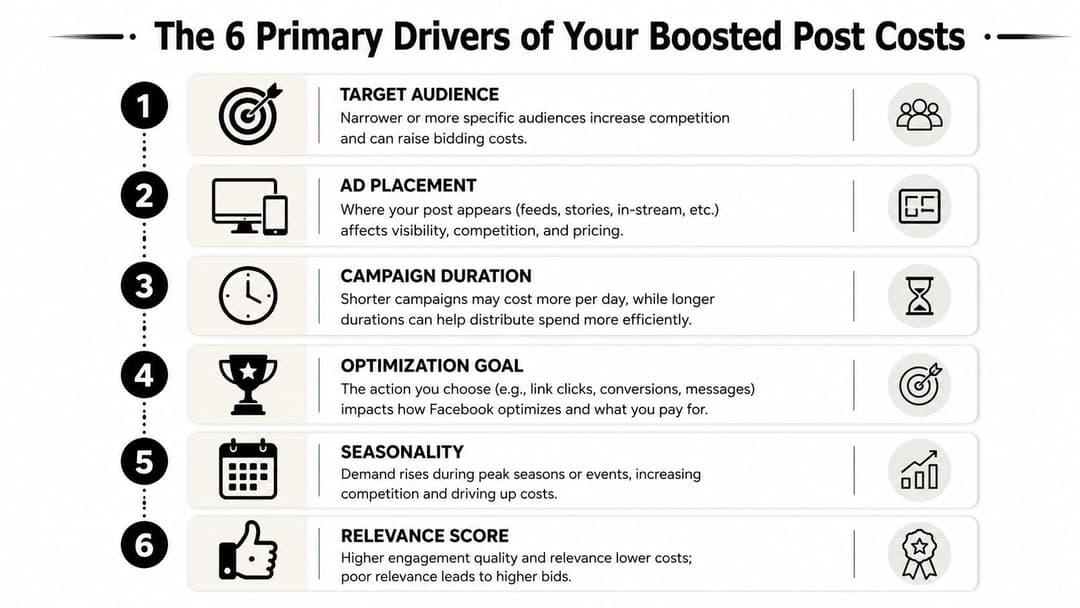
Audience and competition
The more contested your audience is, the harder Meta has to work in the auction.
A narrow audience isn't automatically bad. A broad audience isn't automatically cheap. What matters is how many advertisers are trying to reach the same people and how likely those people are to act on your post.
If you're targeting a high-intent group that every brand wants, your costs usually tighten upward fast. If you're targeting a less competitive segment with a relevant message, delivery often becomes easier.
Placement and duration
Boosts give you less placement control than a full campaign, and that matters. Some placements naturally generate cheaper impressions than others. Some produce better clicks. Some do neither.
Duration matters too. Short tests can tell you whether a post deserves more budget. Long boosts often drift into inefficient delivery because you're asking the system to keep spending on a limited creative concept.
Objective and optimization goal
What are you asking Meta to buy for you?
Buying engagement is different from buying website traffic. Buying awareness is different from buying a lower-funnel action. The interface may feel simple, but the system still optimizes against the goal you selected.
If you choose the wrong objective, you can hit the platform metric and still miss the business outcome.
Creative strength and relevance
A critical point is that most junior marketers underestimate cost.
The strongest technical point in boosted-post pricing is that auction pressure, not just budget, drives cost, and weak creative raises effective cost while strong creative can lower it by improving engagement and click-through rate (AdMetrics on what actually drives boost costs).
Weak creative doesn't just perform worse. It makes Meta pay more to find people willing to respond.
Seasonality
Auction conditions change during sales periods, launches, and heavy buying windows. That doesn't mean you should avoid boosting during busy periods. It means you should expect your benchmark assumptions to get less stable.
When competition rises, mediocre posts get punished first.
Why this matters in practice
Use this mental model before every boost:
- Check the audience pressure
- Match the goal to the business outcome
- Use only posts with proven creative traction
- Keep the first test short enough to judge
- Watch CPM and CPC together, not separately
- Assume busy market periods will distort your results
A boost is rarely expensive because of the button itself. It gets expensive when the audience is crowded, the post is average, and the objective is wrong.
Facebook Boost Cost Benchmarks in 2026
A boosted post can look cheap at $20 a day and still be expensive if it buys low-intent clicks or shallow engagement. That is the benchmark mistake I see most often. Teams compare spend to spend, when they should compare outcome to outcome and factor in what they gave up by staying inside the Boost flow.
Benchmarks still matter. They give you a reality check before you spend, especially if you do not yet have enough account history to price a test confidently.
Baseline numbers for planning
Broader Meta ad benchmarks are the best starting point because Facebook does not publish a reliable boosted-post cost table by objective. In one industry benchmark, average CPM was around $8.96 to $14.40, average CPC was around $0.44 to $0.58, and cost per lead was around $5.83 (Meta ads performance benchmarks).
Use those numbers as reference points, not promises. A boost that lands inside those ranges can still be a poor buy if the traffic is weak, and a boost that looks expensive on CPC can still be useful if it quickly proves a creative angle worth scaling in Ads Manager.
2026 Facebook Ad Cost Benchmarks by Objective
| Objective | Average CPM (Cost Per 1,000 Impressions) | Average CPC (Cost Per Click) | Average CPL (Cost Per Lead) |
|---|---|---|---|
| Broader Meta advertising baseline | $8.96 to $14.40 | $0.44 to $0.58 | $5.83 |
| Boosted post awareness planning | Use CPM as the main benchmark | CPC is secondary unless clicks matter | CPL is usually the wrong benchmark |
| Boosted post traffic planning | CPM still affects total efficiency | Compare your CPC against broader Meta ranges | Lead cost is often less stable than in Ads Manager |
| Boosted post engagement planning | Judge against efficient reach and interaction quality | CPC matters only if visits are part of the goal | Not a reliable lead-gen setup |
How to use these numbers without fooling yourself
Start by matching the benchmark to the job.
For awareness, watch CPM and the quality of engagement. For traffic, watch CPC and landing page behavior. For lead generation, boosted posts are often the wrong tool unless the goal is very light intent, such as message starts or early interest signals.
The bigger cost question is opportunity cost. Boosting is faster, but you pay for that speed with less control over targeting, optimization, and reporting. If a post is only meant to test whether a message gets attention, that trade-off can be fine. If you need qualified leads or clean conversion data, the benchmark that matters is whether a proper campaign would have done the job more efficiently.
Use three filters before you call a boost successful:
- Awareness boost: acceptable CPM plus signs that the audience cared
- Traffic boost: CPC in a reasonable range plus useful on-site behavior
- Lead-oriented boost: evidence of real intent, not just cheap clicks or soft engagements
If a boosted post produces efficient reach and gives you a clear creative signal, the spend did its job. If it struggles to drive qualified traffic or any action tied to revenue, stop paying the convenience tax and move the concept into Ads Manager.
How to Estimate Your Budget and Potential ROI
You don't need a complicated spreadsheet to estimate whether a boost is worth testing. You need the right math and the right question.
The wrong question is, “What budget should I put in?” The better question is, “What result am I trying to buy, and what am I giving up by using a boost instead of a campaign?”

A simple estimation method
Start with your goal metric.
If the post is for awareness, estimate from CPM. If the post is for traffic, estimate from CPC. If you're trying to produce leads, be careful. A boost can still contribute, but you should judge it against lead quality, not vanity clicks.
Use this process:
Choose the primary outcome
Reach, clicks, messages, or qualified visits.Use a benchmark as your starting assumption
Broader Facebook ad benchmarks cited CPC around $0.44 and CPM around $14.40 in one industry benchmark, which is enough to create a rough planning range before your own account data takes over (Undullify on evaluating boost cost versus opportunity cost).Calculate an initial budget range
For click-based planning, multiply your target clicks by the CPC assumption.
For awareness planning, divide target impressions by 1,000 and multiply by the CPM assumption.Set a stop or graduate threshold
Decide in advance when the post earns more budget and when it gets paused.
If you want a practical framework for doing those first-pass calculations, a Facebook ad cost calculator can help structure the estimate.
Opportunity cost matters more than most marketers admit
The same source above makes the key point often ignored: the cost of a boost should be judged against opportunity cost, not just spend. That means asking what the same budget could buy if measured by incremental reach, holdout-tested lift, or qualified visits instead of raw impressions.
That's a serious issue for performance teams. A cheap boost can still be a bad buy if a structured campaign would have produced better traffic quality or a lower downstream acquisition cost.
A practical ROI lens
Use a three-part check before you approve spend:
Direct cost
What are you spending?Result quality
Are the clicks useful, or just cheap?Alternative use of budget
Would the same amount be better spent in Ads Manager with stronger targeting and optimization?
Don't call a boost profitable because it generated activity. Call it profitable when the activity was worth more than the budget and better than the next-best use of that budget.
That's budgeting discipline behind the cost of boosting posts on facebook.
Boosting Posts vs Ads Manager Campaigns
Many advertisers don't need help clicking the button. They need help deciding when not to.
That decision gets easier when you stop treating boosting and Ads Manager as versions of the same thing. They solve different problems. One is built for speed and simplicity. The other is built for controlled media buying.

Where boosting wins
Boosting is useful when:
- You need a fast read on a piece of content
- The post already has organic traction
- The goal is visibility, engagement, or simple traffic
- You don't need a complex testing structure
If a junior marketer asks me whether they should ever use boosts, the answer is yes. They're fine for rapid signal gathering. They're often fine for local awareness. They're also convenient when you need to amplify a post today, not tomorrow.
A practical walkthrough on how to promote a post in Facebook can help newer teams understand the mechanics before they decide whether the speed trade-off is worth it.
Where Ads Manager wins
Ads Manager is the better tool when performance matters enough that control has value.
That includes:
| Decision factor | Boosted post | Ads Manager campaign |
|---|---|---|
| Setup speed | Faster | Slower |
| Targeting control | Limited | Deeper control |
| Testing options | Narrow | Stronger A/B testing and structure |
| Optimization levers | Fewer | More campaign-level controls |
| Best fit | Fast amplification | Performance scaling |
Hard data matters. In a Reforge experiment that compared a Facebook Ad and a Boosted Post using identical $600 spends, the Ads Manager version produced a 1.347% CTR versus 0.670%, a $3.336 CPC versus $7.220, and a $6.324 cost per conversion versus $7.581 for the boosted post, even though the boost showed a higher raw conversion rate (Reforge comparison of Facebook Ads versus Boosted Posts).
That's the clearest evidence for the trade-off. The boost may look simpler. The campaign may buy the result more efficiently.
Here's a visual explainer if you want the side-by-side framing in a different format:
The decision rule I'd give a junior buyer
Use Boost Post when you're paying for speed.
Use Ads Manager when you're paying for efficiency.
If you're trying to prove a creative angle quickly, a boost can be acceptable. If you're trying to lower CPC, improve conversion cost, segment audiences, or scale spend with confidence, build the campaign properly.
Boosting becomes a waste of money when the post is weak, the goal is lower funnel, and the team pretends convenience is a strategy.
Actionable Tips to Optimize and Report on Boosts
A boost earns its keep when it buys speed, not when it replaces campaign discipline.
Use boosts to answer a narrow question fast. Will this post pull a strong enough click-through rate, engagement rate, or comment quality to justify building it out in Ads Manager? If that answer comes quickly, stop paying for convenience and move the asset into a proper campaign. The actual cost of a boost is not just the spend. It is the opportunity cost of limited targeting, weaker optimization, and less control over what happens after the first signal.
The practical workflow is simple. Boost for a short test window. Read the signal. Escalate winners. Cut losers early.
What to do
Boost posts that already showed organic traction
If a post could not earn attention from your existing audience, paid reach rarely fixes the core problem. It usually just buys more weak impressions.Judge boosts on early signal metrics
For this format, focus on CPM, CTR, click quality, saves, shares, and comment quality. Those tell you whether the creative is worth another dollar. Lower-funnel metrics matter later, once the post moves into a campaign built for conversions.Set a graduation rule before launch
Decide in advance what result earns a handoff into Ads Manager. That might be a target CTR, a cost-per-click ceiling, or a minimum volume of qualified landing page visits. Pre-set rules stop teams from defending mediocre posts because they like the creative.Cap the test budget and timeline
A boost should reach a decision point quickly. If performance is mixed after a modest spend, the post is probably not strong enough to justify broader rollout in its current form.Report in a format the team can act on
Keep the readout short. What was tested, what happened, what earned more budget, and what got cut. Teams that want a cleaner framework for this handoff can use this guide to mastering Facebook ads reporting to drive real growth.
What not to do
A few habits burn through boost budget fast:
- Don't boost every post that looks polished
- Don't call likes a win if clicks are weak
- Don't keep spending after the test question has been answered
- Don't use boosts as your default acquisition setup
- Don't leave winning posts stuck in boosted form when they need campaign-level controls
Report like a performance marketer
Good boost reporting starts with intent. Who was this post supposed to attract, and did the traffic match that intent?
That is why frameworks like Lumi Humanizer's approach to searcher intent translate well beyond SEO. The same principle applies here. A boost can produce cheap engagement and still fail if the clicks come from the wrong audience or never turn into meaningful site behavior.
One practical note on tools. If your team is turning winning boosts into broader Meta testing programs, platforms like AdStellar AI can be relevant because they are built to launch and compare many creative, copy, and audience combinations inside Meta Ads Manager faster than manual setup.
A boost should answer one question quickly. Does this creative deserve a real budget?
If yes, escalate it. If no, stop spending.
If your team is ready to move beyond one-off boosts and build a repeatable Meta testing workflow, AdStellar AI is designed for that transition. It helps performance teams launch large sets of creative, copy, and audience combinations inside Ads Manager, learn from historical results, and scale winners with more structure than the Boost Post button can offer.