Your competitors are running ads right now. Some are working brilliantly. Others are flopping. The difference between advertisers who consistently win and those who struggle often comes down to one thing: systematic competitive intelligence.
Most marketers check competitor ads occasionally, usually when they're stuck for ideas or notice a competitor's campaign everywhere. But this reactive approach misses the real opportunity.
A competitor ad analysis manual transforms sporadic observation into strategic advantage. It's your documented system for tracking what's working in your market, identifying creative patterns before they become obvious, and building a library of proven approaches you can adapt and test.
The goal isn't to copy what competitors do. It's to understand the landscape so thoroughly that you can make faster, smarter creative decisions. When you know which ad formats are gaining traction, which messaging hooks are resonating, and which offers are driving conversions, you stop guessing and start testing from a position of knowledge.
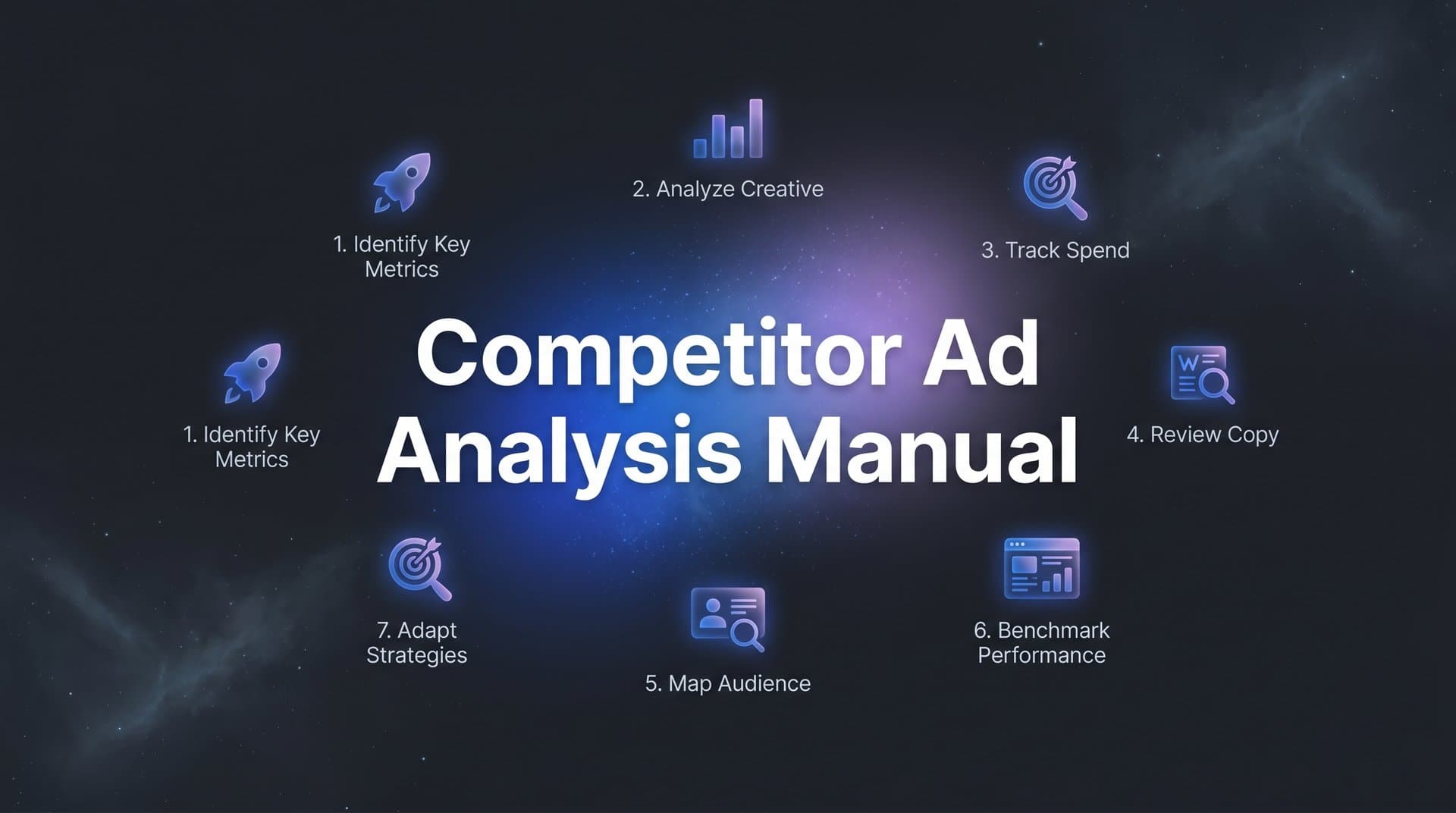
This guide breaks down seven practical strategies for building and using a competitor ad analysis manual that actually improves your advertising performance. Whether you manage Meta Ads for a single brand or run campaigns across multiple clients, these approaches will help you turn competitive intelligence into winning ad creative.
1. Build a Structured Observation Framework
The Challenge It Solves
Random competitor checks create inconsistent insights. You might notice a competitor's video ad one week, then forget to check back for a month. Without structure, you miss patterns, can't track changes over time, and end up with fragmented observations that don't inform strategy.
A structured framework ensures you're tracking the right competitors, reviewing them consistently, and documenting observations in a way that reveals meaningful trends rather than isolated data points.
The Strategy Explained
Start by selecting five to seven direct competitors who target similar audiences and offer comparable products or services. These should be brands actively running Meta Ads in your market, not just companies you admire.
Create a simple spreadsheet or document with standardized categories: competitor name, ad format (image, video, carousel, UGC), primary headline, key visual elements, offer type, and estimated run duration. Add a notes column for observations about messaging approach or creative quality.
Set a consistent review schedule. Weekly works well for most markets. During each review session, check the same competitors using the Meta Ad Library and document what you find using your established categories. This consistency is what transforms random observations into strategic intelligence. Understanding why Facebook ads competitor analysis is hard helps you appreciate the value of a structured approach.
Implementation Steps
1. Identify your top five to seven direct competitors who are actively advertising on Meta platforms and target similar audiences to your brand.
2. Create a tracking document with columns for date reviewed, competitor name, ad format, headline/hook, visual approach, offer details, and strategic notes.
3. Block 30 minutes weekly on your calendar specifically for competitor ad review, treating it as non-negotiable research time rather than something you do when convenient.
4. During each session, systematically review all selected competitors and document new ads or changes to existing campaigns using your standardized categories.
5. After four weeks, review your accumulated data to identify patterns in format preferences, messaging themes, or offer structures emerging across multiple competitors.
Pro Tips
Track both new ads and ads that disappear. When a competitor stops running an ad after just a few days, it likely underperformed. When an ad runs for weeks or months, it's probably working. This longevity tracking reveals performance signals without access to their analytics.
Don't limit yourself to direct competitors. Add one or two aspirational brands or adjacent market leaders to see how more sophisticated advertisers approach creative and messaging.
2. Master the Meta Ad Library for Deep Analysis
The Challenge It Solves
The Meta Ad Library is a powerful free tool, but most marketers only scratch the surface. They search a competitor name, glance at a few ads, and move on. This surface-level approach misses valuable intelligence hiding in plain sight.
Deep analysis techniques help you uncover not just what competitors are running, but how long they've been running it, which variations they're testing, and how their creative strategy evolves over time.
The Strategy Explained
The Meta Ad Library shows all active ads from any advertiser on Facebook and Instagram, plus inactive ads from recent months. Learning to use advanced features transforms this from a basic lookup tool into a competitive intelligence goldmine. Our guide on Meta Ad Library competitor analysis covers these techniques in depth.
Pay attention to ad start dates. Ads running for several weeks or months signal strong performance, since advertisers typically pause underperforming creative within days. Look for multiple variations of the same core concept, which indicates systematic testing rather than one-off creative.
Track how competitors structure their ad accounts. Some brands run dozens of variations simultaneously, testing everything. Others run just a few polished ads. These different approaches reveal strategic philosophies and resource allocation you can learn from.
Implementation Steps
1. Navigate to the Meta Ad Library at facebook.com/ads/library and select your country and "All Ads" category to see the complete advertising picture.
2. Search for your first competitor by exact business name, then filter results by platform (Facebook, Instagram, or both) to see where they focus their advertising efforts.
3. Sort ads by start date to identify which creative has been running longest, as longevity often correlates with performance in competitive markets.
4. Click through to view all variations when you see similar ads with slight differences, documenting the elements being tested (headlines, images, CTAs, or offers).
5. Bookmark or screenshot ads that have been running for 30+ days, as these represent proven creative worth deeper analysis and potential adaptation.
Pro Tips
Check the Ad Library from different locations if you serve multiple markets. Competitors often run different creative strategies in different geographic regions, and you might spot winning approaches being tested elsewhere before they reach your primary market.
Look beyond your immediate competitors. Search for terms related to your product category to discover new players entering the market or adjacent brands whose creative approach might translate to your niche.
3. Categorize Competitor Creatives by Strategic Intent
The Challenge It Solves
Not all competitor ads serve the same purpose. An awareness-focused video introducing a brand concept requires different analysis than a conversion-focused carousel showcasing specific products. When you lump all competitor ads together, you miss the strategic context that makes them effective.
Categorizing ads by funnel stage and strategic intent helps you understand not just what competitors are running, but why they're running it and how different creative approaches serve different business objectives.
The Strategy Explained
Map each competitor ad to a funnel stage: awareness (introducing the brand or problem), consideration (explaining solutions or building interest), or conversion (driving immediate action with specific offers). This framework reveals where competitors are investing their creative energy.
Awareness ads typically focus on storytelling, problem identification, or brand positioning. They use broader messaging and often prioritize engagement over immediate conversion. Consideration ads demonstrate value, compare solutions, or educate prospects. Conversion ads feature clear offers, urgency elements, and direct calls to action.
When you categorize systematically, patterns emerge. You might discover competitors are heavily investing in top-of-funnel awareness while you've focused exclusively on conversion creative. Or you might find gaps in their strategy you can exploit. Leveraging Meta ad historical data analysis helps you track these patterns over time.
Implementation Steps
1. Add a "Funnel Stage" column to your competitor tracking document with three options: Awareness, Consideration, or Conversion.
2. For each ad you document, identify the primary objective based on messaging, offer presence, and call-to-action strength rather than your assumptions.
3. Look for awareness signals like problem-focused headlines, brand story content, or educational messaging without specific product offers or strong CTAs.
4. Identify consideration ads by their focus on solution explanation, feature comparisons, social proof elements, or "learn more" style calls to action.
5. Flag conversion ads by the presence of specific offers, pricing mentions, limited-time urgency, or direct purchase/signup CTAs like "Shop Now" or "Get Started."
6. After categorizing 20-30 competitor ads, analyze the distribution across funnel stages to understand where competitors are focusing their creative resources.
Pro Tips
Track how individual competitors balance their funnel investment. Brands running primarily conversion ads might be struggling with top-of-funnel awareness. Those running mostly awareness content might have strong brand recognition but weak conversion mechanisms. These insights reveal competitive vulnerabilities.
Notice when competitors shift their funnel focus over time. A sudden increase in awareness ads might signal a new market expansion or product launch. A shift toward conversion creative could indicate pressure to hit short-term revenue targets.
4. Decode Messaging Patterns and Hook Structures
The Challenge It Solves
Great ad copy isn't random. Successful competitors use repeatable messaging formulas, emotional triggers, and hook structures that resonate with your shared target audience. But these patterns are invisible unless you actively look for them.
Systematic messaging analysis helps you identify the psychological approaches and copywriting frameworks that work in your market, so you can adapt proven formulas rather than starting from scratch with every new ad.
The Strategy Explained
Create a dedicated section in your manual for messaging patterns. Document the opening hooks competitors use to grab attention in the first line or headline. Track the emotional angles they emphasize: fear of missing out, desire for status, solution to frustration, or promise of transformation.
Pay attention to structural patterns. Some competitors lead with questions. Others use bold statements or surprising statistics. Some open with relatable problems before presenting solutions. These aren't random choices but tested approaches that work with your audience.
Build a swipe file organized by message type rather than just saving ads you like. Categories might include: problem-agitation hooks, benefit-focused headlines, social proof angles, urgency-driven CTAs, and objection-handling copy. This organization makes your swipe file actually useful when you need inspiration.
Implementation Steps
1. Create a "Messaging Swipe File" section in your competitor manual with categories for different hook types and emotional angles you observe.
2. For each compelling ad you find, copy the exact headline and opening lines into your swipe file under the appropriate category (question hook, problem statement, benefit promise, etc.).
3. Note the emotional trigger being used: does the ad tap into fear, desire, frustration, aspiration, curiosity, or social belonging?
4. Document the CTA approach separately, tracking whether competitors favor soft CTAs ("Learn More"), medium urgency ("Get Started Today"), or high urgency ("Limited Spots Available").
5. After collecting 15-20 examples in each category, look for formula patterns like "How [target audience] can [achieve desire] without [common objection]" or "[Number] ways to [solve problem] in [timeframe]."
Pro Tips
Track which messaging angles appear across multiple competitors. When three or four different brands use similar hooks or emotional triggers, it signals a proven approach for your market rather than one company's experiment.
Notice the language sophistication level. Are successful competitors using simple, conversational language or more technical terminology? This reveals how your shared audience prefers to be addressed and helps you match the right tone. Understanding Facebook ads data analysis challenges can help you interpret these patterns more effectively.
5. Track Visual and Format Trends Over Time
The Challenge It Solves
Creative formats shift constantly in digital advertising. What worked six months ago might feel stale today. Video dominance rises and falls. UGC-style content surges in popularity, then everyone does it and effectiveness dilutes. Static images make comebacks when feeds become oversaturated with video.
Without systematic format tracking, you miss these shifts until they're obvious to everyone. By then, the early-mover advantage is gone. Tracking visual and format trends helps you spot emerging patterns while there's still opportunity to capitalize on them.
The Strategy Explained
Add format tracking to your weekly competitor reviews. Document not just what competitors are running, but shifts in their creative approach. Are they moving from polished studio photography to authentic UGC-style content? Increasing video usage? Testing carousel formats more aggressively?
Track visual style elements separately from format. Note color palette trends, typography choices, composition approaches, and the balance between product-focused versus lifestyle imagery. These subtle visual shifts often precede broader market changes. Using Meta ads historical analysis tools makes tracking these shifts much easier.
Look for format experimentation patterns. When a competitor suddenly tests multiple carousel ads after months of static images, they're likely seeing signals that format performs better. When several competitors shift toward similar visual approaches simultaneously, it indicates emerging best practices worth testing.
Implementation Steps
1. Add format columns to your tracking document: Static Image, Carousel, Video (short/long), or UGC/Testimonial style.
2. During each weekly review, calculate the rough percentage distribution of formats across all competitor ads you observe (e.g., 40% video, 35% static, 25% carousel).
3. Track format distribution changes month-over-month by comparing your current percentages to previous periods, noting significant shifts like a 20% increase in video usage.
4. Document visual style elements separately: authentic/UGC versus polished/professional, bright colors versus muted tones, minimal text versus heavy copy overlays.
5. When you notice a format shift (like three competitors suddenly testing more UGC content), flag it as a trend worth testing in your own campaigns.
Pro Tips
Don't just track what's increasing. Pay attention to what's decreasing. If competitors are pulling back on a format you're heavily invested in, it might signal performance issues worth investigating before you waste more budget.
Consider seasonal factors when analyzing format trends. Video usage often increases during Q4 holiday periods, while static image ads might dominate during slower periods when budgets tighten. Distinguish between seasonal patterns and genuine strategic shifts.
6. Analyze Landing Page and Offer Alignment
The Challenge It Solves
Ad creative is only half the equation. The post-click experience determines whether attention converts to action. Many marketers analyze competitor ads but never click through to see where they lead. This incomplete analysis misses crucial insights about offer strategy and conversion optimization.
Understanding how competitors align ad messaging with landing page experience reveals sophisticated strategies around offer positioning, value proposition communication, and conversion friction reduction that you can adapt.
The Strategy Explained
Make landing page analysis a standard part of your competitor review process. Click through on ads that have been running for extended periods, since longevity suggests the complete funnel (ad plus landing page) is performing well.
Document the offer structure: is it a direct product sale, free trial, lead magnet, webinar registration, or consultation request? Note how the landing page headline relates to the ad headline. Strong campaigns maintain message consistency while expanding on the promise made in the ad.
Analyze conversion friction elements. How many form fields do competitors require? Do they use trust signals like testimonials, security badges, or money-back guarantees? How do they handle pricing transparency versus "contact us" approaches? These tactical choices reveal testing insights competitors have discovered. Tools like Similarweb for competitor analysis can complement your landing page research.
Implementation Steps
1. Add a "Landing Page URL" and "Offer Type" column to your competitor tracking document for systematic post-click analysis.
2. Click through on ads that have been running for 30+ days, as these likely represent successful ad-to-landing-page combinations worth studying.
3. Take screenshots of landing pages and document the headline, primary CTA, form length, and any trust elements (testimonials, guarantees, social proof) present.
4. Note the message alignment between ad and landing page: does the landing page headline match or expand on the ad promise, or is there a disconnect?
5. Document the offer structure: free trial duration, discount percentage, lead magnet format, or consultation positioning to understand competitor offer strategies.
6. Track changes to landing pages over time by revisiting URLs monthly, as successful advertisers continuously optimize their post-click experience.
Pro Tips
Pay special attention to how competitors handle objections on landing pages. Do they address price concerns, time commitment, or complexity fears? The objections they proactively handle reveal the resistance points your shared audience expresses.
Notice the balance between information and conversion push. Some landing pages provide extensive detail before asking for action. Others minimize information and push hard for immediate conversion. These different approaches reveal assumptions about where prospects are in their decision journey.
7. Transform Analysis into Actionable Creative Briefs
The Challenge It Solves
The biggest mistake with competitor analysis is letting insights sit in a document without acting on them. You've invested time tracking competitors, documenting patterns, and identifying trends. But if that intelligence doesn't inform your actual creative production, it's just interesting research with no ROI.
The final strategy is about conversion: transforming competitive intelligence into hypothesis-driven test plans and rapid creative execution that lets you validate insights before competitors move on to the next trend.
The Strategy Explained
Create a monthly process where you review accumulated competitive insights and extract three to five testable hypotheses. These should be specific creative approaches you've observed working for competitors that you haven't tried yet.
Frame each hypothesis clearly: "Based on competitor analysis, UGC-style video ads with problem-focused hooks outperform polished product videos for our audience." Then design a test to validate or disprove it using your own campaigns.
The key is speed. Competitive advantages from market intelligence are temporary. If you spend weeks getting perfect creative produced, competitors might shift strategies or the trend might saturate. You need systems for rapidly generating variations based on competitive insights and getting them into market quickly. Understanding why manual ad creation is too slow highlights the importance of streamlined processes.
Implementation Steps
1. Schedule a monthly "Competitive Intelligence Review" session where you analyze patterns across all competitor data collected that month.
2. Identify three to five specific creative approaches, messaging angles, or format strategies that multiple competitors are using successfully based on ad longevity.
3. Frame each observation as a testable hypothesis: "If we adopt [specific approach], we expect [specific outcome] because [reasoning based on competitive data]."
4. Prioritize hypotheses based on potential impact and ease of execution, focusing on tests you can launch within one week rather than complex productions requiring months.
5. Create brief creative briefs for each test that reference the specific competitor examples inspiring the approach while adapting them to your brand voice and positioning.
6. Set clear success metrics before launching tests so you can objectively evaluate whether the competitive insight translated to performance for your brand.
Pro Tips
Use AI-powered creative tools to accelerate the testing process. Platforms like AdStellar let you generate ad variations rapidly based on competitive inspiration, then launch and test them at scale without waiting for designers or video editors. This speed advantage means you can validate more hypotheses faster than competitors who rely on traditional production processes. Learn more about AI vs manual Facebook ad creation to understand the efficiency gains.
Document test results back into your competitor manual. When a competitive insight translates to strong performance for your brand, that validates the pattern and makes it worth monitoring for future evolution. When it doesn't work, note that too so you don't waste time testing similar approaches later.
Putting It All Together
Building a competitor ad analysis manual is not about copying what others do. It is about developing systematic awareness of your market landscape so you can make smarter creative decisions faster.
Start simple. Choose five to seven direct competitors who actively advertise on Meta. Set a weekly 30-minute review schedule and commit to it like any other important business activity. Use the Meta Ad Library to systematically document what you find using consistent categories: format, messaging approach, funnel stage, and estimated run duration.
Over the first month, you'll build a foundation of competitive intelligence. By month two, patterns emerge. You'll notice which formats are gaining traction, which messaging angles resonate, and which offers competitors are pushing hardest. By month three, your manual becomes a strategic asset that reveals market movements invisible to those who only check competitors occasionally.
The real power comes when you translate these insights into rapid creative testing. Competitive intelligence without action is just interesting research. The brands that win are those who spot patterns, form hypotheses, and test adaptations quickly before the market shifts again.
Tools like AdStellar let you move from insight to execution at unprecedented speed. When you spot a winning competitor approach in the Meta Ad Library, you can generate your own variations, build complete campaigns with AI-optimized audiences and copy, and launch hundreds of ad combinations in minutes rather than weeks. The platform's AI analyzes your historical performance data to select winning elements, then continuously learns from each campaign to improve future recommendations.
This combination of structured competitive intelligence and AI-powered creative execution is what separates reactive advertisers from proactive ones. Your competitor ad analysis manual becomes the foundation for consistently outperforming the market, not by copying what others do, but by understanding the landscape so thoroughly that you can identify opportunities and test them before they become obvious to everyone else.
The competitive advantage goes to those who see patterns early and act on them fast. Your manual gives you the seeing. The right tools give you the speed. Start Free Trial With AdStellar and be among the first to launch and scale your ad campaigns 10× faster with our intelligent platform that automatically builds and tests winning ads based on real performance data.