Most media buyers don't lose time on strategy. They lose it in the gaps between strategy and execution.
A campaign brief gets approved. Then someone has to duplicate ad sets, rename assets, rebuild tracking, swap headlines, adjust audiences, push variants live, monitor spend, export results, sort winners, and explain performance in a spreadsheet that goes stale by afternoon. On Meta, that cycle repeats fast enough that even good teams end up reacting instead of operating with intent.
That’s why performance marketing ai has moved from an interesting add-on to an operating layer. It changes the job. The old workflow rewarded patience for manual setup and tolerance for repetitive work. The new workflow rewards clean inputs, strong hypotheses, and fast decisions based on what the system surfaces.
The market shift behind that change is obvious. The AI marketing market was valued at $12.05 billion in 2020 and reached $47.32 billion in 2025, reflecting a 31.5% CAGR, according to Charisma Digital’s 2025 AI marketing statistics roundup. That growth doesn't matter because it's a big number. It matters because it reflects what teams already feel in day-to-day execution. Manual campaign management doesn't scale well enough anymore.
The End of Manual Campaign Grinding
If you're running Meta ads at any meaningful volume, the pain is familiar. One campaign turns into six. Six turn into dozens of ad sets with slight audience shifts, creative swaps, and offer variants. By the time the account is live, half the team's energy is already gone.

Before AI entered the workflow, campaign building was mostly controlled chaos. Media buyers copied what worked last month, added a few new angles, and hoped the account structure stayed manageable long enough to learn something useful. The work wasn't hard in the strategic sense. It was hard because it was repetitive, fragile, and easy to bottleneck.
What the old workflow actually looked like
A typical manual launch usually meant:
- Rebuilding variations by hand: Creative tests were limited by how much setup work the team could tolerate.
- Reviewing fragmented data: Results sat across Ads Manager, internal trackers, and spreadsheets.
- Making calls too slowly: By the time underperformers were obvious, spend had already leaked.
- Scaling inconsistently: Winners often got extra budget late because no one had time to validate them quickly.
That kind of account management creates false confidence. Teams think they're testing broadly, but they're usually testing what fits inside the available labor.
Practical rule: If your team spends more time assembling tests than interpreting them, the bottleneck isn't creative. It's operations.
The practical appeal of performance marketing ai is simple. It removes the repetitive layer so people can focus on deciding what deserves scale. That shift is especially visible in Meta accounts, where variation count, audience overlap, and creative fatigue can overwhelm even experienced buyers.
A good explanation of that exact problem shows up in this piece on eliminating manual ad building tasks. The core issue isn't that media buyers don't know what to test. It's that manual execution slows down how many valid tests they can run.
What changes after AI is introduced
Once AI handles bulk assembly, ranking, and pattern detection, the operating rhythm changes. The buyer stops behaving like a production manager and starts behaving like an analyst and strategist.
That doesn't mean less control. It means control moves up a level. Instead of clicking through endless setup screens, the team sets goals, guardrails, inputs, and review rules. Then they spend their time on message angles, audience logic, landing page fit, and spend decisions.
What Is Performance Marketing AI Exactly
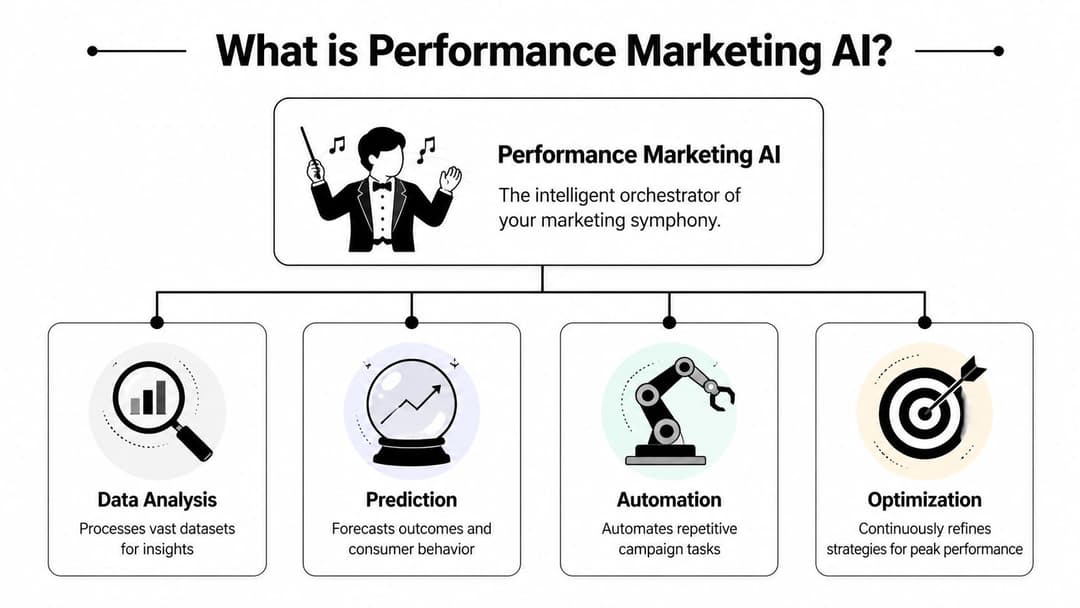
The cleanest way to think about performance marketing ai is as a co-pilot for paid acquisition. You still choose the destination. The system handles far more of the flight operations than a human team can manage at scale.
That matters because Meta advertising isn't one decision. It's a stack of linked decisions. Which audience gets which message, with which asset, at what spend level, in what structure, under what objective. Humans can make those decisions. Humans struggle to make them across a large matrix of combinations without losing speed or consistency.
The four parts that matter
Data analysis
The system first needs access to the account history. That usually means pulling in Meta campaign, ad set, ad, and creative performance data so it can understand what has already happened.
AI-powered performance marketing platforms can ingest large datasets to forecast strategy outcomes, and in practice platforms like AdStellar connect to Meta Ads Manager via OAuth, learn from historical data, rank top creatives and audiences by ROAS, CPL, or CPA, and reach automation accuracy above 90% in opportunity identification, as described by MarTech’s analysis of AI in performance marketing.
Prediction
Once the system has enough history, it starts identifying patterns. Not magic. Patterns. Certain hooks may correlate with stronger ROAS. Certain audience clusters may repeatedly absorb budget better. Certain combinations may fail early in ways a buyer would only spot after a longer review cycle.
AI stops being simple automation and becomes operationally useful. It isn't just doing the work faster. It's helping the team decide what to test next.
Automation
The third layer is execution. Instead of building combinations one by one, the platform can assemble many variants from approved inputs. That turns launch volume from a labor problem into a rules problem.
If you want a broader view of adjacent tooling, this roundup of top AI tools for social media is useful because it shows how fast content production and campaign operations are converging. For paid teams, the important distinction is that performance marketing AI doesn't stop at content generation. It connects creative variation to live delivery and measured outcomes.
Optimization
The final layer is continuous adjustment. The system watches what happens after launch, identifies early traction or decay, and surfaces which creatives, audiences, and messages deserve more attention.
A lot of teams say they want AI. What they usually want is fewer blind spots between launch and learning.
For Meta teams, this usually means the platform becomes a second operating interface on top of Ads Manager. Meta still delivers the ads. The AI layer helps the team structure tests, interpret performance, and move faster with less manual work. A straightforward overview of that workflow sits in this guide to AI for ads.
What performance marketing AI is not
It's not a replacement for positioning, offer strategy, or creative judgment. It won't rescue weak economics, poor landing pages, or unclear messaging. It also doesn't eliminate the need for review.
What it does is remove the mechanical drag that keeps strong teams stuck in execution loops.
Moving Beyond Guesswork to Guaranteed Insights
Most paid teams don't have a creativity problem. They have a signal problem. They can generate angles, produce assets, and build offers. What slows them down is figuring out which combinations deserve more budget before waste piles up.
That's where performance marketing ai changes the commercial case for paid acquisition. It gives the team a way to move from opinions and fragmented reads to ranked, actionable insight.
Faster setup changes what you can test
The biggest operational change isn't glamorous. It's speed.
According to SurveyMonkey’s AI marketing statistics, 93% of marketers use AI to generate content faster, 81% use it for quicker insights, and 90% use it for faster decision-making. In performance contexts, that translates to reducing manual ad setup by up to 75% and enhancing CTRs by 47%.
That kind of time compression matters because setup speed directly affects test volume. If launching a full round of creative and audience combinations takes hours or days, teams narrow the scope before they even begin. If the setup burden drops, they can test more seriously.
Better signals improve budget allocation
ROAS doesn't improve because a dashboard looks cleaner. It improves when the team can identify winners and losers earlier, then reallocate spend with confidence.
In a manual workflow, budget shifts often happen too late for two reasons:
- The data review is delayed: Buyers wait until enough spend accumulates to feel safe making a call.
- The account is too busy: There are too many moving parts to isolate what really caused the result.
- The reporting logic is inconsistent: Different stakeholders read different cuts of the same account.
AI improves this by ranking variables against specific goals. Not just "what got clicks," but what moved toward the KPI you're buying against. That can be ROAS for ecommerce, CPL for lead gen, or CPA for a subscription funnel.
A useful companion to this idea is this article on AI-driven marketing insights, because it gets to the core value of AI in paid media. The tool isn't useful because it produces more output. It's useful because it reduces uncertainty around what to do next.
When a buyer can see top-performing themes, audiences, and messages in one place, they stop debating symptoms and start acting on patterns.
CPA and CPL improve when underperformers are found earlier
Performance deterioration usually starts small. A creative angle weakens. Frequency rises. A once-reliable audience starts absorbing spend less efficiently. In manual systems, those signals are easy to miss because no one reviews every variation with the same rigor.
AI helps by narrowing the field. Instead of asking the team to inspect everything equally, it highlights what looks healthy, what looks fragile, and what should probably be paused or deprioritized.
A simple comparison makes the shift clearer:
| Workflow area | Manual account management | AI-supported workflow |
|---|---|---|
| Test building | Constrained by labor | Expanded through automation |
| Performance review | Spreadsheet-heavy and delayed | Faster ranked insight |
| Budget decisions | Often reactive | More evidence-led |
| Buyer role | Operator and analyst | Strategist and analyst |
That doesn't create guaranteed business outcomes in the literal sense. Paid media never works like that. Markets change, offers miss, and creative fatigue still happens. What AI does guarantee is a much stronger operational basis for making decisions.
Insight speed compounds
The best effect of performance marketing ai isn't one isolated improvement. It's compounding speed.
When setup is faster, you test more. When testing expands, your pattern recognition improves. When the signal gets cleaner, budget decisions get better. When budget decisions improve, the team earns back time and confidence to push harder on strategy.
That cycle is why some teams now treat AI not as a tactic, but as part of the media buying stack itself.
Concrete Use Cases for AI in Meta Ads
The most useful way to judge performance marketing ai is by looking at where it removes friction inside a real Meta workflow. Not in theory. In the repetitive moments that usually slow down launch, learning, and scale.
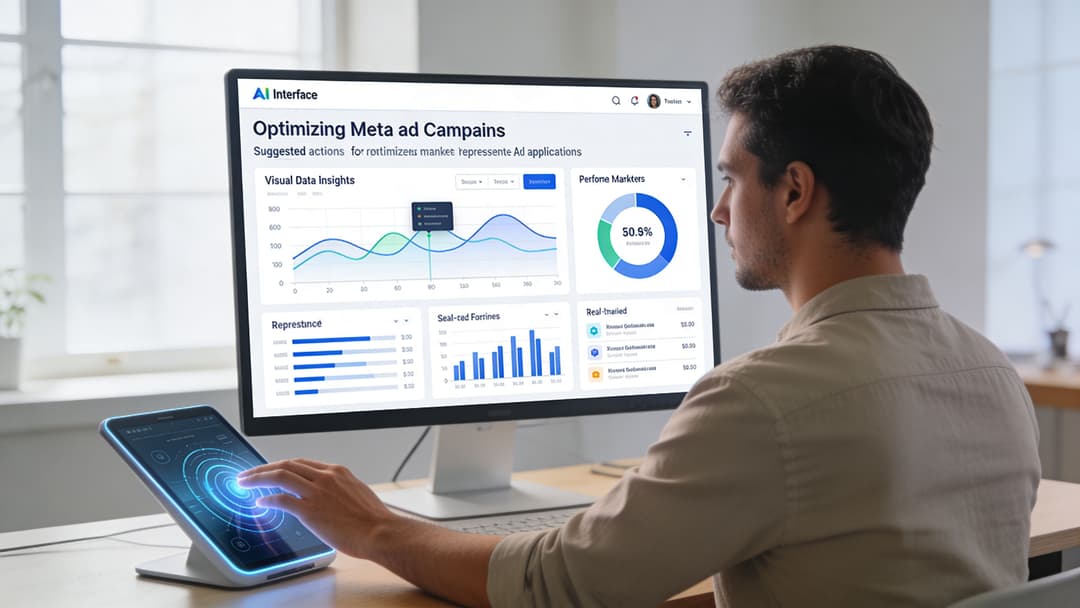
A strong Meta team usually works through the same loop. Build concepts. Pair them with audiences. Launch. Watch spend. Pull reports. Cull losers. Try again. AI doesn't erase that loop. It tightens it.
Bulk creative and audience testing
One of the most practical use cases is mass combination testing. Instead of manually building each ad variation, the team can define inputs across creative, copy, headline, and audience layers, then launch combinations at once.
That matters because Meta performance often comes from combinations, not isolated assets. A strong image can fail with the wrong headline. A reliable audience can underperform when paired with the wrong offer framing. Manual workflows usually leave those relationships under-tested because setup takes too long.
According to Turbamedia’s guide to AI performance marketing, advanced AI uses pattern recognition and hypothesis-driven testing across 100+ creative-audience combinations, with auto-learning models scaling winners based on real-time feedback, leading to 20-40% improvements in KPIs like CPA and ROAS.
A sensible workflow looks like this:
- Define variable groups: Creative themes, hooks, headlines, and audience buckets are organized before launch.
- Set the evaluation metric: The team chooses whether the system should prioritize ROAS, CPA, or CPL.
- Push combinations live in batches: Variants are launched with enough structure to compare outcomes cleanly.
- Review ranked outputs: The team sees which combinations are worth expanding and which should be retired.
If you're working in ecommerce, ECORN's expert AI insights are worth reading alongside this because they connect AI tooling to the practical realities of online retail growth, where testing velocity and merchandising context both matter.
AI insight generation after launch
The second use case is less visible but often more valuable. AI can analyze results at the pattern level, not just the ad level.
That means the system may show that a certain message family is consistently outperforming another across multiple audiences. Or that one visual treatment keeps generating cheaper conversions even when headlines change. Humans can find those patterns too, but usually only after a labor-heavy review.
Good AI reporting doesn't just tell you which ad won. It tells you why similar ads tend to win.
A platform layer can save hours. Rather than exporting, cleaning, and pivoting account data manually, the team gets an interpreted view of what's working. In Meta-specific workflows, that can be the difference between scaling a valid pattern and overreacting to one noisy result.
A practical example of that operating model appears in this walkthrough of AI-powered Meta ads, which shows how historical performance can inform future campaign assembly instead of treating every launch as a fresh guess.
Automated scaling and budget reallocation
The third use case is scaling. Many teams lose efficiency at this stage, even when they identify winners correctly.
A buyer spots a strong ad, waits for more confirmation, shifts spend, watches another ad fade, and then revisits the account later. That process works, but it leaves a lot of performance trapped in review lag.
Later in the cycle, seeing the process in motion helps more than reading another feature list.
Auto-learning models help by watching fresh data and flagging emerging winners earlier. The buyer still needs to set guardrails. Budget movement shouldn't be blind. But the system can reduce the delay between signal and action.
Three stories teams will recognize
The overloaded ecommerce account
A DTC brand has too many product angles, seasonal offers, and audience hypotheses for the team to test manually. AI helps batch the combinations, then ranks which creative themes keep producing efficient purchases. The human team focuses on merchandising logic and landing page fit.
The agency account with too many clients
An agency buyer can't give every account the same depth of manual review every day. AI surfaces anomalies, winners, and weak spots account by account. That lets the buyer spend time where judgment matters most instead of trying to inspect everything equally.
The startup growth team with a lean bench
A small growth team often has strong instincts but limited operating bandwidth. AI gives them leverage. They can test broadly without hiring a larger trafficking layer, then use the saved time on offer testing, retention loops, and funnel analysis.
In all three cases, the primary benefit is the same. The team spends less time manufacturing tests and more time learning from them.
Your Implementation Roadmap for AI-Powered Ads
Adopting performance marketing ai isn't mainly a software decision. It's an operating decision. Teams get the most value when they treat implementation as a workflow redesign, not just a tool rollout.

A lot of companies still approach AI too narrowly. Media Performance reports that 87% of marketers use AI for content creation, while strategic use cases like budget allocation and cross-channel attribution remain underused. That's a warning. If AI only writes copy faster, you've improved output but not operating efficiency.
Phase one connects the right data
Start with data access and nothing else. If the AI layer can't read clean historical performance, its recommendations won't be useful enough to trust.
For Meta teams, this usually means secure OAuth access to Ads Manager plus clean conversion signal handling. You also want consistency in naming conventions, campaign taxonomy, and event quality. Bad structure creates bad learning.
A practical dependency here is server-side data quality. If your tracking foundation is weak, AI gets fed partial truth. That’s why many teams pair implementation with a better event pipeline, often starting with Meta Conversions API setup guidance.
Phase two calibrates the model to your account
Once connected, the system needs time to learn how your account behaves. This isn't about waiting for magic. It's about helping the model understand what your brand has historically rewarded.
Some teams rush this stage and immediately ask the platform to generate broad recommendations. That's usually a mistake. Start narrower.
Use a calibration checklist like this:
- Audit historical winners: Confirm whether past "top performers" were real business wins, not just platform-friendly outliers.
- Tag recurring creative themes: Group assets by angle, format, offer framing, or hook style.
- Clarify optimization hierarchy: Decide what matters most when trade-offs appear, such as ROAS versus scale or CPL versus lead quality.
- Exclude distorted periods: If the account had unusual promos, broken tracking, or major stock issues, treat those periods carefully.
The model doesn't need every datapoint. It needs the right context around the datapoints that shaped your account.
Phase three validates with controlled testing
Trust in AI should be earned in production, not assumed in a kickoff call. The safest path is controlled validation.
Run a contained set of campaigns where the AI helps structure tests, rank opportunities, or recommend budget shifts, but keep the scope narrow enough that the team can audit results closely. You're not trying to automate the whole account on day one. You're trying to see whether the system identifies the same patterns your strongest buyer would identify, and whether it does so faster.
A simple validation table can help:
| Validation area | What to check |
|---|---|
| Creative ranking | Do the top-ranked assets align with real business outcomes? |
| Audience insight | Are surfaced audiences genuinely scalable or just temporarily cheap? |
| Budget recommendations | Do suggested reallocations match observed efficiency trends? |
| Reporting clarity | Can the team understand why the system made the call? |
Phase four changes team roles
This is the step many companies underestimate. AI works best when the team stops organizing around manual production.
The media buyer's role changes first. Instead of spending the day inside setup tasks, the buyer starts reviewing insights, forming hypotheses, setting experiment rules, and deciding where human judgment should override the system. Creative teams benefit too because they get feedback in more useful language. Not just "this ad lost," but "this promise, image style, or message structure keeps underperforming against this audience type."
What to operationalize weekly
To make the system stick, teams need a repeatable review rhythm. Not a loose promise to "use AI more."
A workable weekly cadence often includes:
- Signal review early in the week: Identify winning themes, weak combinations, and spend leaks.
- Creative planning midweek: Turn insight into fresh variants with clear testing logic.
- Launch windows with defined scope: Push new combinations without turning the account into a random pile of tests.
- Scale and pause decisions: Let evidence drive changes, not internal enthusiasm for a new concept.
This is also the point where one dedicated platform can be useful. AdStellar AI is one example of a Meta-focused system that connects through secure OAuth, ingests historical performance, supports bulk ad creation, ranks creatives and audiences against goals like ROAS, CPL, or CPA, and uses auto-learning models to help teams scale winners. For teams that mainly buy on Meta, that kind of dedicated workflow matters more than a generic AI layer.
What usually goes wrong
Implementation fails when companies do one of three things:
- They automate bad account structure: AI accelerates noise if the setup is messy.
- They skip human review: A recommendation engine still needs business context.
- They expect immediate account-wide transformation: Strong adoption happens in layers.
The teams that get value fastest treat AI as a disciplined operating system. Clean data in. Clear goals set. Controlled testing first. Wider automation second.
Common Risks and Essential Best Practices
AI improves execution. It can also magnify weak discipline.
That’s the trade-off people often skip when they talk about performance marketing ai. The same system that helps you scale testing can also scale bad assumptions, poor tracking, and low-quality creative logic. The answer isn't to avoid AI. It's to use it with operating rules.
Risk one is black-box dependence
A lot of buyers get into trouble when they stop asking why the system made a recommendation. If a platform tells you to scale an audience or favor a creative family, you still need to know what evidence likely drove that conclusion.
This matters most when results drift. If CPA spikes or lead quality drops, a buyer who understands the logic behind the recommendation can troubleshoot much faster than a buyer who treated the system like an oracle.
A good rule is simple. Every important recommendation should be explainable in plain language. If the team can't articulate why a spend shift happened, they shouldn't fully trust it yet.
Risk two starts with dirty data
AI doesn't create clarity from broken signals. It organizes whatever signal quality you give it.
That means poor naming conventions, missing conversion data, mismatched attribution expectations, or mixed campaign objectives can all produce weak recommendations. Before blaming the model, inspect the account hygiene.
Use this diagnostic list when outputs look wrong:
- Check event quality: Make sure the conversion signal reflects the business outcome you care about.
- Inspect structural consistency: Campaign naming, objective use, and audience grouping should be understandable.
- Review historical anomalies: Promotions, outages, or stock issues can distort learning.
- Separate volume from quality: Cheap leads or purchases don't always mean efficient growth.
AI is often blamed for problems that actually started in tracking, taxonomy, or offer quality.
Risk three is over-automation
The temptation with any strong automation layer is to let it run too much of the account unchecked. That's usually where brand risk and strategic drift creep in.
Creative testing at scale doesn't mean every generated or assembled variation should go live without review. The same goes for spend movement. An automated budget shift may be directionally sensible while still being strategically wrong for the week, the promotion window, or inventory constraints.
Human oversight still matters most in these areas:
| Area | Human decision matters because |
|---|---|
| Offer messaging | AI can't fully judge nuance, positioning, or legal sensitivity |
| Brand safety | Volume testing can introduce weak or off-brand combinations |
| Spend priorities | Business context often sits outside the ad account |
| Success criteria | Teams must decide what "good performance" actually means |
What to do when recommendations don't work
Sometimes the AI call won't hold up. That doesn't mean the platform is useless. It means the team needs a response process.
Start by narrowing the failure. Was the issue creative quality, audience mismatch, delayed conversion lag, or wrong KPI weighting? Don't label the whole system inaccurate because one recommendation failed.
Then compare recommendation quality across categories. Some AI layers may be excellent at ranking creative themes but weaker on spend pacing. Others may spot audience opportunities well but need tighter human review on message fit.
A practical troubleshooting sequence looks like this:
- Freeze major scaling changes until the issue is understood.
- Review the underlying data window used for the recommendation.
- Check whether the KPI weighting was appropriate for the campaign goal.
- Audit the creative and landing page pair rather than blaming targeting first.
- Rerun the test in a controlled scope before expanding again.
Best practices that hold up
The teams getting the most from performance marketing ai usually share the same habits:
- They keep humans in approval loops: Especially for messaging, spend shifts, and major structural changes.
- They define one primary KPI per test: Mixed success criteria confuse both people and systems.
- They review patterns, not single winners: One ad can spike. A repeated theme is more trustworthy.
- They document overrides: If a buyer rejects an AI recommendation, the reason should be captured and revisited.
- They train the team, not just the tool: Adoption fails when only one person understands the new workflow.
Performance marketing ai works best as a disciplined assistant. It gets risky when teams treat it as autonomous strategy.
Making AI Your Unfair Advantage in 2026
The primary shift isn't that campaign work gets faster. It's that the role of the marketer changes.
In a manual setup, the media buyer is trapped inside production. Build the variations. Fix the naming. Pull the report. Check spend. Repeat. In an AI-supported setup, the buyer spends more time on the questions that move performance. Which message should the brand push harder. Which audience deserves expansion. Which offer is strong enough to support scale.
That's why performance marketing ai matters more than most tooling changes. It doesn't just shave time off a task. It restructures the work itself.
The teams that benefit most
The biggest gains usually show up in teams that already know what good performance looks like but can't execute broadly enough to reach it consistently.
That includes:
- Ecommerce brands with too many products, angles, and seasonal changes to test manually
- Agencies trying to maintain depth across multiple client accounts
- Growth teams at startups that need to boost their productivity before they can add more headcount
- B2B acquisition teams that need cleaner signal across creative, audience, and funnel stages
The practical edge is speed with discipline. Not more activity for its own sake.
What stays human
Even with strong AI support, the hard parts remain human. Offer strategy. Positioning. Taste. Judgment. Prioritization. Teams that understand that distinction tend to get much more value from the tools they adopt.
For brands that want to tighten the path after the click, these practical steps for Shopify brands are a useful reminder that ad efficiency and on-site conversion work together. Better testing on Meta helps, but the landing experience still has to carry its share.
The strongest use of AI in paid media isn't replacing marketers. It's giving strong marketers enough operating leverage to act on more of what they already know.
By 2026, that distinction will be hard to ignore. Teams still running heavy manual workflows won't just be slower. They'll learn more slowly, scale more slowly, and spend more time on tasks that no longer deserve human attention.
Performance marketing ai is the layer that lets a buyer stop being the person who keeps the machine moving and become the person who decides where it should go.
If your team is spending too much time building Meta campaigns and not enough time learning from them, AdStellar AI is worth a look. It’s built to help media buyers launch bulk variations, use historical Meta data through secure OAuth, rank creatives and audiences against goals like ROAS, CPL, or CPA, and shift more of the workflow from manual setup to strategic execution.