You open Ads Manager to launch a new campaign, and the bottleneck usually isn't budget. It's production. Too many combinations, too many creative angles, too many audience assumptions, and not enough time to build, review, and publish all of it cleanly.
That's why ai powered meta ads matter now. The shift isn't merely that Meta added a few automation features. It's that campaign building, audience discovery, testing, and optimization have moved from a mostly manual operating model to a signal-driven system where the machine does more of the execution work than the media buyer.
That change is good for speed, but it also creates a new job for practitioners. You don't win by clicking faster in Ads Manager. You win by feeding Meta better inputs, structuring tests so the algorithm can learn, and keeping strategic control when the platform turns into a black box.
The End of Manual Ad Management
Launch week used to look the same across many teams. One spreadsheet with headline versions. Another with image hooks. A few saved audiences copied from prior accounts. Then someone spends hours building ad sets by hand, naming every variation, checking UTMs, fixing duplicate copy, and hoping the structure is clean enough to test.
That workflow still exists. It's just losing relevance.
Meta's ad business tells the story better than any platform pitch. In 2024, Meta reached $200.97 billion in annual revenue, up 22% year over year, driven primarily by AI-powered advertising innovation, with ad impressions up 18% YoY in Q4 and average ad price up 9% in the same period, according to Campaign Asia's reporting on Meta's AI-powered ad surge. That doesn't happen because advertisers got better at manual duplication. It happens because the platform got much better at automated delivery, prediction, and monetization.
What broke in the old workflow
Manual campaign management struggles in three places:
- Production load: Teams can think of more tests than they can build.
- Decision lag: By the time a marketer reviews results and makes changes, the opportunity window may already be gone.
- False precision: Hours go into tiny targeting tweaks that don't create meaningful lift.
If your current process still relies on hand-built combinations for every creative, copy, and audience variant, you're spending energy where the platform is already automating aggressively. A lot of teams need the same operational reset they apply in other parts of marketing when they improve workflow efficiency with smart automation.
Practical rule: If the task is repetitive, rule-based, and tied to versioning, the machine should probably handle it.
What replaces it
The replacement isn't “let Meta do everything.” That's where many accounts drift into lazy automation and weak analysis. The better model is operational automation with strategic oversight.
That means fewer manual builds, broader structures, and more energy spent on creative inputs, offer quality, measurement, and interpretation. If you want a clean breakdown of how those approaches differ in practice, this comparison of automated vs manual Facebook ads is useful.
The media buyer's job isn't disappearing. It's moving up a level.
How Meta's AI Engine Actually Works
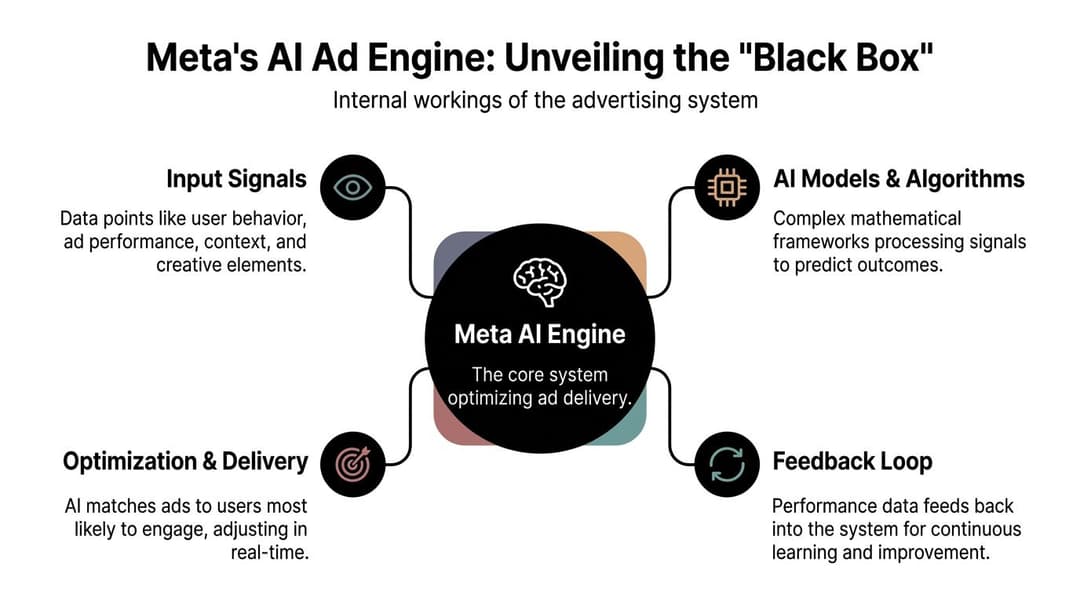
Meta's optimization is frequently described as a black box, as one can see the outputs but not the internal logic. That's fair, but it becomes easier to work with once you stop treating it like magic.
The simplest way to think about it is this. Meta's system takes in signals, processes them through prediction models, and decides which ad to show to which person at what moment. The quality of the outcome depends on the quality of those signals and the variety of creative options available to test.
The ingredients Meta uses
Meta's Andromeda AI model powers Advantage+ by analyzing historical performance data ingested through secure APIs. It automates targeting and creative delivery, and has been reported to outperform human-selected audiences by 15% to 20% in ROAS benchmarks while achieving 22% higher returns than standard ads, according to eMarketer coverage of Meta's AI ad features.
Here are the core inputs that matter most in day-to-day account work:
- On-site behavior: Pixel events such as product views, add-to-cart actions, and purchases.
- Server-side events: Conversions API signals that help preserve useful performance data.
- Ad interaction data: Clicks, video views, saves, comments, and other response patterns.
- Commercial context: Product feed quality, value signals, and event prioritization.
- Creative metadata: Format, message style, visual structure, and how people respond early.
If those inputs are weak, delayed, or inconsistent, the model has less to work with. Advertisers often blame the algorithm when the actual issue is thin signal quality.
What the model is actually trying to do
A useful analogy is an AI chef. Your data is the ingredient set. Your creative library is the menu. The model's job is to decide which dish to serve, to which diner, at which time, based on what similar diners ordered and enjoyed before.
That means Meta isn't just matching an ad to a demographic profile. It's predicting probability. Who is most likely to click, convert, or generate value under the objective you selected?
This is why account structure has changed so much. Over-segmented campaigns can restrict learning. Every tiny audience split reduces the system's ability to pool data and identify patterns across users.
What media buyers should do with that knowledge
You don't need to know the engineering details. You do need to know how to work with the system rather than against it.
A practical operating model looks like this:
Send stronger signals
Make sure your tracking setup reflects real business actions, not vanity behavior. If your account optimizes on weak events, the model will chase weak outcomes.
Reduce unnecessary fragmentation
Consolidated structures usually give Meta more room to learn than a maze of tiny ad sets with overlapping logic.
Feed the model creative range
If all your ads say roughly the same thing, the system can't discover many useful differences.
Use value-aware data where possible
When the platform can distinguish between low-value and high-value outcomes, optimization gets closer to business reality.
Meta's AI isn't replacing strategy. It's replacing manual pattern matching at a scale no human team can maintain consistently.
Why this matters for workflow
This changes what “campaign setup” means. The old view was mechanical: choose audience, set placements, duplicate ads, launch. The current view is architectural: define the right objective, connect reliable signals, give the model enough breadth to learn, then monitor the pattern of outcomes.
If you're trying to understand how these systems assemble campaigns from historical data and structured inputs, this overview of how AI builds Facebook campaigns is a useful companion.
The important mindset shift is simple. Meta's AI engine is a prediction system. Your job is to improve its predictions.
Creative Is The New Targeting
Most account audits still over-focus on audience setup. That's old muscle memory.
Post-iOS 14.5, creative quality became a primary driver of audience discovery. Meta's algorithm reads early-hour ad responses, and if a specific message or format resonates with a demographic cluster, delivery expands to similar users. Agencies also report needing 100+ variations to feed the algorithm adequately, as noted in MarTech's analysis of how brands use AI in Meta's Advantage campaigns.

Why audience-first thinking now underperforms
A common mistake is assuming a perfectly defined audience guarantees a strong campaign. It doesn't. If the ad gets weak early engagement, Meta won't keep forcing it into that audience just because you selected it carefully. The system starts making decisions from response signals.
That changes the planning question from “Who do I want to target?” to “What message will pull the right people into the learning process?”
This is why a mediocre ad paired with a highly researched audience often loses to a sharper creative concept running broad. The algorithm needs something worth amplifying.
What strong creative testing looks like now
Good creative strategy for ai powered meta ads isn't just volume for the sake of volume. It's structured variation.
Build around hypotheses such as:
- Problem angle: Pain-point led message versus aspiration-led message.
- Format angle: Founder video versus UGC-style demonstration versus static proof graphic.
- Offer angle: Discount, bundle, free trial, or social proof-led CTA.
- Awareness angle: Product education versus objection handling versus direct conversion push.
The goal is to give Meta multiple distinct signals, not twenty near-identical ads with slightly different punctuation.
Field note: When teams say “Meta found a new audience,” what usually happened is that one creative gave the system a much clearer pattern to scale.
If you're refining that side of your process, this guide to Mastering AI Powered Ad Creatives is worth a read because it focuses on the production logic behind variation, not just design polish.
The practical implication for media buyers
You need a bigger creative bench than you used to. Not because more is always better, but because narrow creative inventory limits what the model can learn.
That also means the feedback loop needs to change. Don't just ask which ad won. Ask:
- Which hook got traction fastest?
- Which format held attention better?
- Which message expanded beyond the initial pocket of users?
- Which creative themes kept spending efficiently after the first burst?
Teams either evolve or stall. The old habit is to hunt for one winner and milk it. The better habit is to identify what the winner is teaching you.
A useful walkthrough on systematizing that process is this resource on creative automation tools.
Later in the cycle, platform-native and AI-assisted tools can help extend useful assets into more placements and formats, as the machine learns from contrast and variety, not from a single polished ad repeated everywhere.
Here's a useful example of the broader shift in how marketers are thinking about that creative-to-delivery loop:
The key point is simple. In modern Meta buying, creative doesn't just communicate the offer. It helps the system find the customer.
Your Workflow for AI Powered Ad Campaigns
Once you accept that creative is the main input and Meta's AI is the main delivery engine, workflow has to change. Slow, sequential testing doesn't fit a system that can reallocate traffic in real time.
Meta's AI-powered A/B testing dynamically shifts traffic toward stronger variations and can include format swaps during the campaign. That approach has shown up to 18% higher ROI and a 22% engagement lift compared with static tests, according to this analysis of AI-powered A/B testing in Meta ads.
The operating model that works
The practical workflow is volume plus velocity.
You launch enough meaningful variation for the algorithm to detect patterns quickly. Then you read those patterns at the component level instead of treating every ad like a standalone island.
A strong process usually has five parts.
Start with a consolidated structure
Don't build a maze.
Use a campaign structure that gives Meta room to learn across a meaningful pool of signals. Advertisers often overbuild because manual workflows trained them to isolate everything. In AI-driven buying, over-segmentation often creates noise, duplicated effort, and weaker learning.
Keep your structure simple enough that you can answer three questions fast:
- What objective is this campaign optimizing toward?
- What creative hypotheses are being tested?
- What signal will tell us whether to scale, revise, or cut?
Build variation at the input level
Instead of manually creating one ad, reviewing it, then making a second ad, build batches of variation around distinct hypotheses. The difference sounds small, but operationally it's massive.
For example, vary these elements on purpose:
- Hook style: direct claim, story-led opening, objection-first, or demo-first.
- Visual language: product close-up, person-led shot, testimonial frame, or offer card.
- CTA framing: urgency, curiosity, value, or clarity.
- Format mix: short video, static image, carousel, or adapted vertical asset.
That gives the model something useful to sort through. It also gives your team cleaner learning because each variable family has a reason to exist.
Let the model allocate, but don't stop analyzing
One of the biggest workflow mistakes is assuming automation removes the need for interpretation. It doesn't. It just changes where analysis happens.
You still need to review:
Early signal quality
Which creatives are pulling strong initial engagement?Spend concentration
Where is the system choosing to put budget, and does that align with business goals?Message durability
Which ads keep performing once initial novelty fades?Commercial quality
Which variations are driving the outcomes that matter to your account, not just cheap clicks?
Don't read AI-driven tests like old-school split tests. Read them like a prioritization engine showing you which combinations deserve more room.
Manual versus AI-powered testing
| Phase | Manual Workflow (Old Way) | AI-Powered Workflow (New Way) |
|---|---|---|
| Ideation | Marketer picks a few combinations to test | Team prepares a broader set of purposeful variations |
| Build | Ads are duplicated one by one in Ads Manager | Variations are assembled in batches and launched faster |
| Traffic allocation | Spend is split rigidly or adjusted later by hand | System reallocates toward stronger performers in real time |
| Mid-flight optimization | Buyer reviews reports and manually pauses or duplicates | Model adapts delivery while buyer interprets patterns |
| Learning output | Results stay tied to single ads or ad sets | Insights can be mapped back to hooks, formats, and messages |
| Scale decision | Winning ad gets copied into new structures | Best components become inputs for the next wave of testing |
Create a weekly rhythm
The accounts that get the most from ai powered meta ads usually don't run on random launch days. They run on a review rhythm.
A simple cadence looks like this:
- Early week: Launch a fresh batch of structured creative tests.
- Midweek: Review spend distribution, signal quality, and early winners.
- Later week: Cut obvious misses, preserve useful learners, and prepare the next set of variations.
- End of cycle: Document what worked at the angle level, not just the ad ID level.
That last point matters. If your learning lives only inside Ads Manager rows, the account gets smarter slowly. If your learning gets translated into reusable creative rules, the account compounds.
Use tools for speed, not to avoid thinking
Workflow software should remove repetitive build work and centralize learnings. It shouldn't become a substitute for judgment.
The best tools help teams move from “we have ideas but no production capacity” to “we can generate, launch, and evaluate enough variation to let the algorithm do its job.” If you're redesigning that end-to-end process, this guide to a complete Meta ads workflow solution lays out the operational side well.
The key shift is this. Your workflow is no longer about manually controlling every test path. It's about creating a system where good inputs move fast enough for the model to find signal.
Navigating the Black Box Common Pitfalls
Automation makes scaling easier. It also makes mistakes easier to hide.
The biggest risk in ai powered meta ads isn't that the algorithm does nothing. It's that it does exactly what you asked for, but not what your business needs.
Meta's own system design creates a real tension here. The black box nature of AI-powered ad delivery can push optimization toward short-term measurable outcomes while missing broader business value, and without human oversight, AI-mediated targeting can reduce effectiveness by failing to capture goals beyond simple conversion metrics, as discussed in Meta's engineering write-up on GEM and ad recommendation systems.

Where accounts get into trouble
The most common failure modes are operational, not technical.
- Wrong optimization target: Teams choose the easiest event to generate, then wonder why lead quality or purchase quality is weak.
- Blind trust in automation: Budget gets concentrated into patterns that look efficient inside Meta but don't hold up in the business.
- Creative lock-in: The system finds a local winner and keeps leaning into it while the broader market signal shifts.
- Poor feedback hygiene: Weak tracking, missing value cues, or inconsistent naming make interpretation harder.
A lot of this comes from confusing convenience with control. Automated delivery can save time, but it doesn't define strategy for you.
How to regain strategic control
You don't need to fight the algorithm on every setting. You need guardrails.
Three approaches help:
Feed better business signals
If your business cares about profit quality, repeat purchase quality, or margin quality, your setup should reflect that as closely as your tools allow. The platform can only optimize on what it can observe.
Review at the component level
Don't just accept that “Campaign A worked.” Break performance down by message, format, and offer angle. That prevents the platform from becoming an unexplainable winner-picker.
Keep a human override layer
Some creative should stay live longer for learning. Some should be cut faster than the system would cut them. Some offers should never scale, even if they pull cheap conversions that hurt downstream economics.
A healthy Meta account isn't fully manual or fully automated. It's machine-executed and human-directed.
If explainability matters in your reporting stack, this overview of explainable AI for advertising is a useful framework.
What doesn't work
Two reactions usually fail.
First, some buyers retreat into old-school control and start slicing campaigns into narrow ad sets again. That often starves the system.
Second, others hand everything to Advantage+ and stop asking hard questions. That usually works for a while, then drifts.
The middle path is better. Let the platform optimize delivery, but stay strict about inputs, measurement, and interpretation.
How AdStellar AI Accelerates Your Workflow
The struggle isn't due to a lack of ideas. It arises because execution capacity is too low for the way Meta now works.
You need more creative combinations, faster launch cycles, and a clearer read on what the algorithm is rewarding. That's exactly where a workflow platform becomes useful. Not as a replacement for Ads Manager, but as an operating layer around it.

Where the tool actually helps
A practical platform should solve three problems.
First, it should reduce production drag. Building large batches of creative, copy, and audience combinations manually is still one of the biggest time sinks in paid social operations.
Second, it should make the learning loop clearer. Meta gives performance data, but it doesn't always make it easy to isolate which message, angle, or component is carrying results.
Third, it should shorten the distance between insight and action. If your team knows what's working but still needs hours or days to rebuild that into the next campaign wave, the account stays slower than the market.
One option for that workflow
AdStellar AI is built around that exact operational gap. It connects to Meta Ads Manager through secure OAuth, ingests historical data, supports bulk creation of creative, copy, and audience combinations, and ranks outputs against goals such as ROAS, CPL, or CPA. It also supports AI-assisted launch workflows and ongoing optimization based on incoming results. If you want the product-level breakdown, the core feature set is outlined on its AI optimization page.
That matters because the strategic model described throughout this article only works when the workflow can keep up. If your team needs large-scale variation but your process can only build a handful of ads per cycle, you won't give Meta enough useful input.
The bigger shift
The deeper value isn't just speed. It's role clarity.
When repetitive build work gets compressed, the media buyer can spend more time on:
- Creative direction: defining stronger hypotheses before launch
- Performance interpretation: reading patterns at the component level
- Offer strategy: deciding which propositions deserve more budget
- Account governance: checking that automation is aligned with business outcomes
That changes the day-to-day job from assembly-line execution to system management.
A lot of “AI in advertising” content stops at the platform feature level. The more useful view is operational. Can your team generate enough variation, learn fast enough from it, and launch the next iteration before the window closes? If the answer is no, the issue isn't your targeting settings. It's workflow design.
Your Strategy for AI Advertising in 2026
The media buyer who wins with ai powered meta ads in 2026 won't be the person with the most granular audience map. It'll be the person who manages inputs, learning loops, and business constraints better than everyone else.
That means thinking less like a campaign operator and more like a portfolio manager.
The mindset that holds up
The job now is to curate and direct a system.
You supply the machine with a wide enough range of creative signals, give it clean measurement, and keep pressure on whether the outputs match actual business goals. That's the durable skill. Not manual ad set craftsmanship.
Three habits matter most:
- Lead with creative variety: If your messages are narrow, Meta's learning will be narrow.
- Structure for learning: Consolidated campaigns and clear objectives usually beat overbuilt account trees.
- Stay commercially honest: Cheap delivery isn't the same as good business performance.
What to carry forward
If you're rebuilding your process, keep it simple.
Use automation for repetitive production. Use analysis for pattern recognition. Use human judgment for trade-offs the platform can't see clearly, especially around offer quality, margin quality, and long-term account direction.
The strongest Meta advertisers don't try to out-click the algorithm. They train it, audit it, and keep it pointed at the right goal.
That's the practical takeaway from the current shift. Meta's AI is powerful. It can also hide bad assumptions under attractive platform metrics. The edge comes from knowing when to trust the machine, when to challenge it, and how to build a workflow that gives it better material to work with.
If your team needs a faster way to launch, test, and scale Meta campaigns without getting buried in manual setup, AdStellar AI is worth evaluating. It fits the current reality of paid social: more creative variation, faster feedback loops, and tighter operational control around ai powered meta ads.