You open Meta Ads Manager, sort by cost per result, and feel that familiar jolt. Yesterday the number looked manageable. Today it looks wrong. Maybe your purchase campaign is suddenly expensive. Maybe your lead campaign is bringing in names that never book. Either way, you're asking the same question every paid social team asks: is this CPA bad, or is it just uncomfortable?
That's the cost per acquisition Facebook problem in a nutshell. The metric matters because it gets closest to the thing the business cares about: what you paid to get a lead, a trial, a booked call, or a customer. But it also creates confusion because teams treat it like a universal benchmark instead of a business-specific constraint.
I've seen junior buyers obsess over platform averages while ignoring the actual issue. Their target audience was too cold, the creative stopped resonating, or the landing page made people work too hard. If you want a more honest read on why Meta feels pricier lately, this breakdown on why Facebook ads are getting expensive is a useful reality check.
The Facebook CPA Dilemma
The hard part about Facebook CPA isn't finding the number. Meta puts it right in front of you. The hard part is deciding what the number means.
A campaign can show a low CPA and still hurt the business. That happens all the time in lead generation. The form is easy, the leads are cheap, and sales hates them. On the other side, a campaign can show a higher CPA and still be healthy if the close rate is strong, the average order value works, or customer lifetime value gives you room.
Why the number feels slippery
Teams often want one answer to “what's a good CPA?” They want a benchmark they can hand to a buyer or plug into a weekly report. That instinct makes sense, but it creates bad decisions.
A profitable CPA depends on things benchmarks can't fully capture:
- Your conversion type matters. A newsletter signup and a purchase aren't interchangeable.
- Your sales model changes the math. A SaaS free trial, an e-commerce purchase, and a booked demo each have different economics.
- Your traffic quality changes everything. Cheap clicks can produce expensive acquisitions if the audience has weak intent.
- Your margin structure sets the actual ceiling. If the unit economics don't support the acquisition cost, no amount of dashboard optimism fixes it.
Benchmarks are useful for context. They're bad as marching orders.
The right question to ask
Instead of asking whether your current CPA is good in the abstract, ask two sharper questions:
- Is this CPA profitable for our business model?
- What lever changed when CPA moved?
That second question is where many teams get stuck. They blame bidding first because it's visible in the platform. In practice, the biggest swings usually come from audience quality, creative fatigue, offer strength, and the post-click experience.
Once you stop treating cost per acquisition Facebook as a static industry number, the metric becomes much more useful. It stops being a verdict and starts becoming a diagnostic tool.
What Is Facebook Cost Per Acquisition
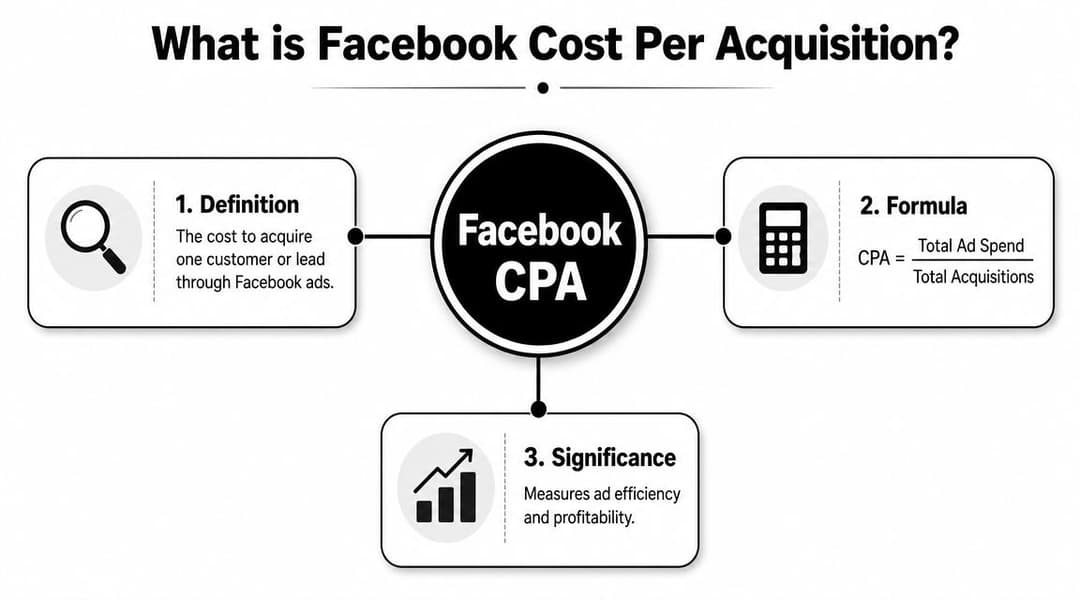
Facebook cost per acquisition is the amount you spend to generate one conversion from your Meta ads. That conversion might be a purchase, a lead, a signup, or another tracked result tied to your campaign objective.
The basic formula is simple:
CPA = Total ad spend / Total acquisitions
Meta describes it in practical terms inside Ads Manager. The platform calculates spend divided by conversions and surfaces it under labels like Cost per result or Cost per conversion, depending on the objective, as explained in this guide to how CPA works in Facebook ads.
How it appears in Ads Manager
Newer buyers sometimes get tripped up because Meta doesn't always call it “CPA.”
If you're running different objectives, you may see:
- Cost per purchase for sales campaigns
- Cost per lead for lead campaigns
- Cost per result as a more generic label
- Cost per conversion in some reporting views
The label changes. The math doesn't.
For a broader primer on how this metric fits with the rest of paid social reporting, this explanation of Facebook ad performance metrics is worth keeping handy. If you want a non-platform-specific refresher on cost per acquisition, that overview is also useful context.
Why CPA matters more than CPC or CPM
Think of CPM and CPC as paying for ingredients. You bought impressions. You bought clicks. Useful, but incomplete.
CPA tells you what it cost to produce the finished meal.
A campaign can have cheap clicks and still be inefficient if those visitors don't convert. That's why CPA is the more outcome-oriented metric. One widely cited 2026 benchmark puts average Facebook CPA at $18.68 globally, with a typical range of $13.29 to $55.21, while average CPC is $1.14 and average CPM is $11.76 in the same cost environment, according to this Facebook ads cost guide from Stackmatix.
Tracking is not optional
Reported CPA is only as good as your conversion tracking. If your Meta Pixel setup is incomplete, your attribution will be incomplete too. Then the number in Ads Manager looks cleaner than reality.
Practical rule: Never evaluate CPA before you trust the event tracking behind it.
That's especially important for teams optimizing purchases, booked calls, and qualified leads. If the platform can't reliably see the conversion, it can't optimize toward it, and your CPA reporting becomes a weak signal.
Facebook CPA Benchmarks You Should Know
If you need a benchmark, use one. Just don't worship it.
The most widely cited platform-wide benchmark puts average Facebook CPA at $18.68 across industries, while another benchmark set reports a much higher median CPA of $38.17 across all industries, as summarized by WordStream's Facebook advertising benchmarks. That gap matters. It tells you the distribution is uneven, and that some expensive accounts or verticals distort the picture.
Average versus median changes the story
An average can make Facebook acquisition look cheaper than what many advertisers experience. A median can pull you in the other direction. Neither figure is wrong. They answer different questions.
If you're in a competitive vertical, broad platform numbers won't help much. If you're in a simpler purchase path or a strong retargeting setup, they may look too pessimistic.
Here's useful context from the 2026 benchmark data often cited in market discussions:
| Industry | Average CPA |
|---|---|
| Education | $7.85 |
| Fitness | $13.29 |
| Apparel | $10.98 |
| Healthcare | $12.31 |
| Real Estate | $16.92 |
| Retail | $21.47 |
| B2B | $23.77 |
| Legal | $28.70 |
| Consumer Services | $31.11 |
| Industrial Services | $38.21 |
| Finance & Insurance | $41.43 |
| Auto | $43.84 |
| Home Improvement | $44.66 |
| Technology | $55.21 |
Those figures are context, not targets.
Costs are moving, not fixed
Static benchmarks also hide the fact that Meta's cost environment has become more expensive. One 2025 industry analysis reports a 14% increase in ad costs while impressions rose only 6%, and the same benchmark set shows average Facebook lead generation cost per lead at $27.66, up from $22.87 the prior year. That same analysis also cites an average Facebook CPA of $20.15 across industries and notes that more competitive verticals like finance and SaaS often run higher than retail or entertainment, according to this review of rising Facebook advertising costs in 2025.
If you want a practical benchmark lens for current planning, this guide to Meta ads performance benchmarks is a better framing than chasing one universal “good CPA.”
A benchmark should tell you where to investigate, not what to believe.
What to do with benchmark data
Use industry data in three ways:
- Sanity check your expectations. If your target sits far below common market ranges, your model may be unrealistic.
- Spot structural problems. If your CPA is outside the expected band for your audience and funnel type, something in the system needs work.
- Set guardrails, not goals. Your real target should come from margin, close rate, and customer value.
That last point is the one most advertisers skip. It's also the one that decides whether Meta is a growth channel or just an expensive dashboard.
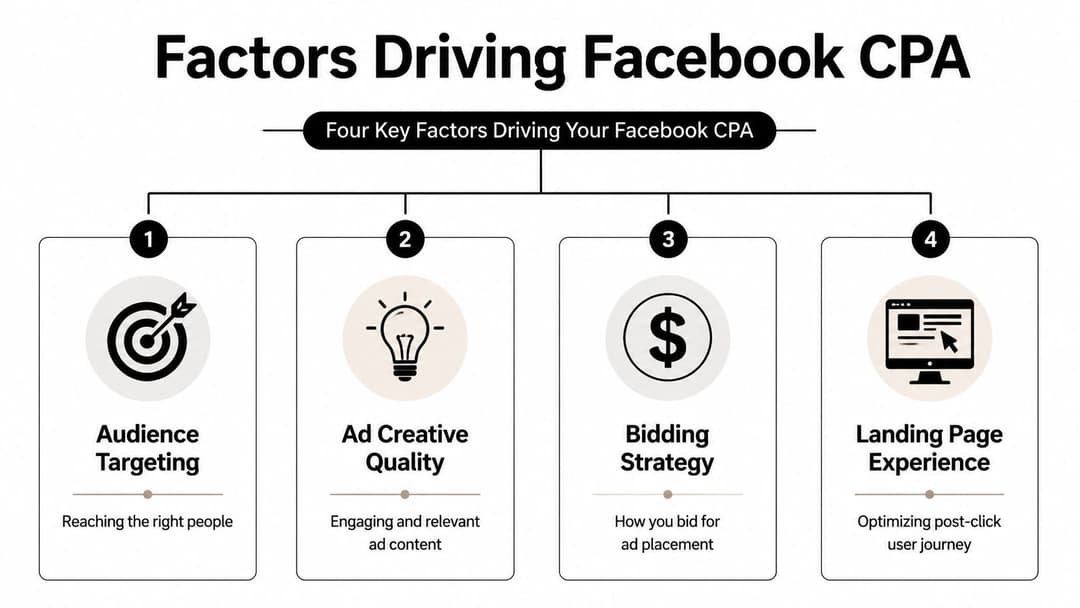
The Four Key Factors Driving Your Facebook CPA
Most CPA problems come from four places. If you can diagnose these cleanly, you stop making random optimizations and start fixing the actual constraint.
Audience targeting
Audience quality controls how hard the rest of the funnel has to work. A broad cold audience gives you scale, but it usually needs stronger creative and a better offer. Retargeting pools often convert more efficiently, but they cap out fast.
WordStream notes that retargeting and segmented audiences can materially reduce CPA, which lines up with what most buyers see in real accounts in this discussion of Facebook ad cost drivers. If you want to push beyond blunt targeting, this guide to Meta lookalike audiences is useful for building higher-intent prospecting sets.
What doesn't work is overcomplicating targeting too early. Teams build tiny ad sets, stack exclusions everywhere, and choke delivery before the algorithm can learn.
Ad creative quality
Creative is often the biggest hidden driver of CPA. When the message doesn't match the audience, click quality falls. When the audience has seen the same angle too many times, response weakens even if spend stays steady.
This is why “better bidding” rarely saves stale ads. If the creative no longer earns attention or trust, you're paying more to force weaker traffic into the funnel.
A few practical signs the problem is creative, not audience:
- CTR softens while frequency rises
- Post-click behavior gets weaker even though targeting didn't change
- One message angle worked, then faded
- Fresh variants recover performance without major bid changes
If CPA jumps suddenly, check whether buyers changed their behavior or whether your ads stopped giving them a reason to act.
Bidding strategy and campaign objective
Bidding still matters. It's just not the first place I'd look.
Your campaign objective tells Meta what outcome to pursue. Your bid approach tells it how aggressively to pursue it. If you optimize for a soft event, don't be surprised when the platform finds lots of low-quality cheap conversions. If you optimize for the actual business event, volume may tighten but quality usually improves.
Teams need discipline. A low reported CPA to the wrong event is a reporting win and a revenue loss.
Landing page and post-click experience
Plenty of campaigns die after the click. The ad is fine. The page is the leak.
If the landing page doesn't continue the message, loads poorly, or asks for too much too soon, CPA climbs because you're wasting paid traffic. The same WordStream discussion above also points to landing-page alignment as a major lever. That's one of the cleanest cause-and-effect relationships in paid social.
Use this simple diagnostic:
| Symptom | Likely issue |
|---|---|
| Cheap clicks, expensive acquisitions | Post-click conversion problem |
| Strong retargeting, weak prospecting | Audience or creative mismatch |
| Sudden drop after stable results | Creative fatigue or auction pressure |
| Good lead cost, bad sales feedback | Wrong conversion event |
How to Lower Your Facebook CPA Actionable Strategies
Lowering CPA starts with a mindset shift. Don't chase the cheapest conversion the platform can produce. Chase the cheapest conversion your business can profit from.
A lot of teams still ask, “What's a good Facebook CPA?” The better question is, “What CPA can we afford, given our funnel economics?” Narrative BI makes this point clearly. Facebook CPA should be judged by funnel stage and conversion type, and the stronger approach is to reverse-engineer the target from budget, click rate, conversion rate, and customer lifetime value in this breakdown of average Facebook CPA and funnel economics.
Start with your real target
Before you touch targeting or creative, define the number you can support.
For e-commerce, that usually means looking at gross margin, contribution margin, repeat purchase behavior, and refund patterns. For lead gen, it means backing into an allowable cost from lead-to-opportunity rate, close rate, and average customer value. For SaaS, it often means deciding how much payback period you're willing to tolerate.
That exercise does two things:
- It protects you from false wins. Cheap but low-intent leads don't look good once sales quality enters the picture.
- It tells you how aggressive you need to be. If your allowable CPA is tight, you need stronger qualification and stronger conversion efficiency.
Fix the highest-leverage inputs first
Once your target is grounded in business math, attack the levers that move CPA most.
Tighten audience intent
Segment retargeting by behavior, not just recency. A product viewer and an add-to-cart user shouldn't always see the same message. For prospecting, feed Meta stronger source audiences instead of endlessly slicing interests.
Increase creative volume
A common pitfall is to under-test creative and over-tweak bids. Build multiple hooks, angles, formats, and offers. Keep the message consistent with the page. Refresh before fatigue becomes obvious.
Match the page to the promise
If the ad says one thing and the page says another, people bounce mentally before they bounce technically. Message match matters because it reduces friction at the exact point where acquisition is won or lost.
Choose bidding based on stability
When you have a well-understood target and enough conversion data, more controlled bidding approaches can help. When the account is still learning, over-constraining bids can suffocate delivery.
Operating principle: Lower CPA by improving intent and conversion rate first. Use bidding controls to shape efficiency after the system has signal.
Build a creative testing routine
Creative testing works when it's a system, not an occasional brainstorm.
A practical routine looks like this:
- Test new angles regularly. Problem-aware, benefit-led, proof-based, founder-led, UGC-style, and offer-led concepts each reveal different demand pockets.
- Separate diagnosis from scaling. Don't mix brand new concepts with mature winners in the same read. You'll blur the signal.
- Track qualitative patterns. Some creative attracts curiosity. Some attracts buyers. Those are not the same audience.
- Keep winners alive with variation. A strong concept can often keep working if you refresh the opening, visual treatment, or call to action.
After you've got the core framework, this video is a solid companion for sharpening execution:
Don't optimize for bad conversions
At this point, a lot of reported CPA wins fall apart.
If you optimize to a weak event because it looks cheaper, Meta will find more of that event. The dashboard improves. The business doesn't. Lead forms are the classic example. A lower cost per lead can be worse than a higher one if the cheaper leads never progress.
I'd rather pay more for a conversion with downstream value than celebrate a cheap number tied to low intent.
Know when not to spend more
Sometimes the right response to a rising CPA isn't “scale through it.” It's to pause and diagnose.
If acquisition costs rise while creative gets tired, audience pools saturate, or the page underperforms, adding budget usually magnifies waste. Spend should follow signal, not hope.
Measuring and Scaling with Advanced Tools
Monitoring CPA in Meta Ads Manager is straightforward. Measuring it well at scale isn't.
Start with the basics. Customize your columns so the cost metric tied to your actual conversion event is always visible. For purchase campaigns, that may be cost per purchase. For lead campaigns, cost per lead. Then compare that number against the business-specific target you calculated earlier, not a generic benchmark.
Where manual workflows break down
The moment you run multiple audiences, multiple hooks, several offers, and different post-click paths, manual management becomes the bottleneck. Buyers end up spending more time naming ads, duplicating sets, and exporting reports than learning from performance.
That's where stronger measurement infrastructure helps. If attribution is incomplete, CPA becomes less trustworthy, which is why many teams pair pixel tracking with server-side approaches such as Conversion API Gateway for Meta tracking resilience.
Tools that support CPA control
The useful tools in this category do three jobs well:
- They speed up testing. You can launch many creative and audience combinations without rebuilding everything by hand.
- They improve visibility. You can see which message, segment, or ad structure is driving the efficient conversions.
- They reduce operational drag. Less time on setup means more time analyzing why CPA moved.
One option here is AdStellar AI, which connects to Meta Ads Manager, automates bulk ad creation, and ranks creatives, audiences, and messages against metrics such as CPA. That's relevant when your strategy depends on testing more combinations than a lean team can comfortably launch manually.
The teams that control CPA consistently usually aren't guessing better. They're testing faster and reading cleaner data.
The practical point is simple. If your process can't support frequent creative iteration, audience segmentation, and clean reporting, your strategy won't survive contact with the auction for long.
From Cost Center to Profit Driver
Facebook CPA gets easier to manage once you stop treating it like a trivia question with one correct answer. There isn't a universal “good” number. There's only a number your business can support, given your margins, funnel, conversion quality, and customer value.
The useful way to approach cost per acquisition Facebook is to build a system. Understand how Meta calculates it. Use benchmarks for context, not instruction. Diagnose performance through audience, creative, bidding, and post-click experience. Then lower CPA by improving conversion quality and alignment across the funnel, not by forcing the platform to find cheaper but weaker results.
That shift changes how teams spend. CPA stops being a scary dashboard metric and becomes a control lever. When you know your allowable target and can identify which lever moved, Meta spend becomes easier to defend, easier to scale, and much less chaotic.
If you're ready to apply this approach with less manual setup, AdStellar AI helps teams launch and test large numbers of Meta ad variations, analyze which creative and audience combinations are hitting CPA goals, and scale the combinations that keep acquisition profitable.