Somebody on your team is probably looking at three dashboards right now and getting three different answers. Meta says one campaign is fine. Shopify says new customer margin is thinning. Finance is asking why revenue is up but contribution is flat. Meanwhile, your creative team is still running ads built on learnings from a tracking environment that no longer exists.
That's the state of performance marketing for ecommerce in 2026. The problem isn't access to channels. It's knowing what to trust, what to scale, and what to kill before it burns margin.
The good news is that the model still works when it's run with discipline. Performance marketing for ecommerce delivers an average return of $15 in revenue for every $1 spent according to BigCommerce's overview of performance marketing for ecommerce. That's why serious operators keep leaning into it. But the old playbook of “watch ROAS, trust platform attribution, refresh creative when results dip” isn't enough anymore.
The teams winning now do two things better than everyone else. First, they measure profit, not just revenue efficiency. Second, they rebuild signal quality with better tracking so AI systems can optimize on current reality instead of stale historical patterns.
Your Guide to Performance Marketing in Ecommerce
A lot of ecommerce brands don't have an ad problem. They have an operating system problem.
The pattern is familiar. A brand launches campaigns across Meta and Google, sees some early traction, then starts chasing the dashboard. Spend goes up on whatever platform shows a clean return. A few weeks later, CAC drifts, blended margin tightens, and nobody can explain why the “winning” campaign isn't translating into healthier cash flow.
That's where performance marketing for ecommerce needs to be understood correctly. It isn't just paid social, paid search, or affiliate deals. It's a way of running acquisition where every dollar has to justify itself against a measurable business outcome. Clicks matter only if they lead to profitable actions. Reach matters only if it feeds revenue with traceable economics.
What performance marketing actually changes
Traditional advertising buys exposure and hopes outcomes follow. Performance marketing flips that logic. The team starts with the business result, then works backward into channel, audience, creative, landing page, and offer.
That shift sounds basic, but it changes day-to-day decisions:
- Budget allocation becomes conditional. Campaigns earn more spend when they hit efficiency targets.
- Creative becomes an operational lever. Ads aren't “approved and live.” They're inputs in a constant testing cycle.
- Measurement gets closer to finance. Media buyers need to understand margin structure, not just platform metrics.
Performance marketing works best when the growth team and finance team are looking at the same reality.
Why 2026 feels different
Two issues make the current environment harder than most published guides admit.
First, basic ROAS can hide bad decisions. A campaign can look efficient inside the ad account and still lose money once product cost, shipping, discounts, and fulfillment are included.
Second, privacy changes have weakened the historical data that many optimization systems relied on. If your setup still assumes platform-reported conversion paths are complete, your bidding and creative decisions are probably lagging behind what's happening.
The brands growing cleanly right now treat performance marketing for ecommerce as a closed loop. They launch faster, measure harder, and scale only what survives a profit check.
The Core Philosophy of Results-Based Advertising
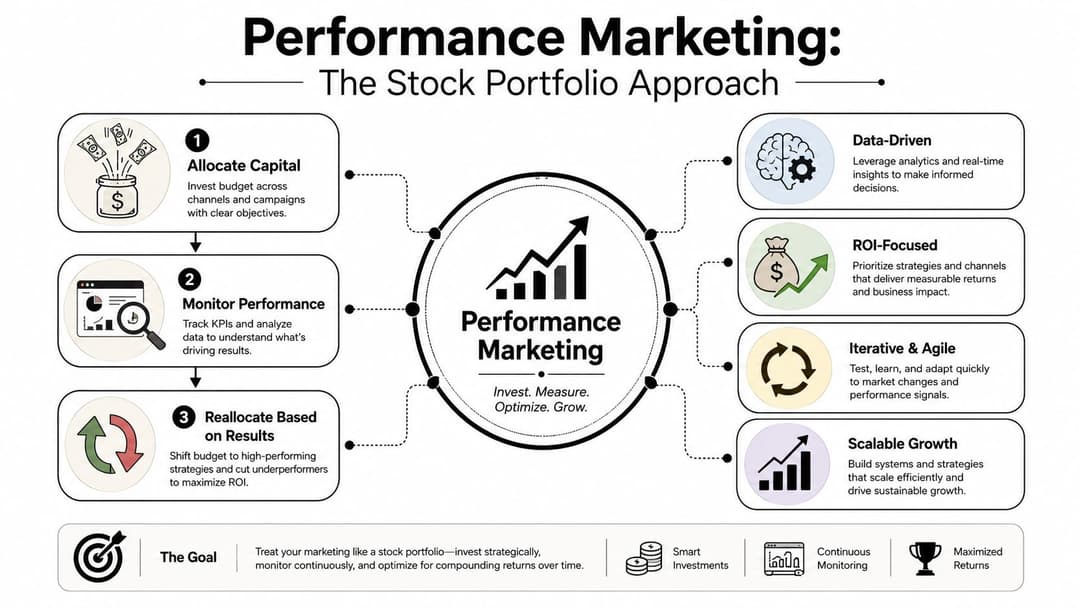
Think of performance marketing like running a stock portfolio.
You don't put all your capital into one asset and hope for the best. You spread budget across positions, watch performance closely, and reallocate based on what's producing returns. A campaign that compounds gets more capital. A campaign that keeps missing target gets cut or reworked.
That mindset is the foundation.
Pay for outcomes, not exposure
A billboard charges you for placement whether anybody buys or not. Results-based advertising is different. The spend is tied to actions you can measure, such as clicks, leads, or purchases.
That changes how teams behave. Instead of debating whether a campaign “feels strong,” they look at whether it moved a target metric in a way the business can use. That creates accountability, but it also creates speed. Weak ideas are cheaper to identify. Strong ideas earn more budget faster.
The real engine is the feedback loop
Every durable account runs on the same loop:
- Launch a controlled test
- Measure against a target
- Optimize the variables that matter
- Reallocate spend
- Repeat
The loop sounds obvious. Most teams still break it.
They launch too many variables at once. They let spend drift without a clear threshold. They hold onto underperforming campaigns because the ad looked expensive to produce or because it worked last quarter.
What separates disciplined operators
The difference isn't usually secret tactics. It's capital discipline.
A strong performance team treats campaigns like assets under management. It asks:
| Decision area | Weak approach | Strong approach |
|---|---|---|
| Budgeting | Spread spend evenly | Concentrate on proven pockets |
| Creative | Refresh only after decline | Refresh on a planned cycle |
| Measurement | Trust platform surface metrics | Validate against business metrics |
| Scaling | Increase spend because volume is available | Increase spend only when economics hold |
Practical rule: Don't protect campaigns because they used to work. Protect margin by moving budget where current data says it should go.
Why this matters more in ecommerce
Ecommerce gives marketers fast feedback, but that speed can create bad habits. Teams often overreact to one-day swings or overvalue the channel that claims the conversion last.
Results-based advertising works when the team keeps a portfolio view. Search captures intent. Social creates demand and retargeting depth. Display supports reach and recall. The job isn't to crown one channel the winner. The job is to decide where each incremental dollar produces the best outcome right now.
That's the operating philosophy behind high-performing ecommerce accounts. Everything else is execution detail.
Your ROI-Focused Measurement Playbook
Most ecommerce teams track a lot and still miss the number that matters.
They'll watch click-through rate, CPC, add-to-cart volume, and platform ROAS. Those are useful diagnostics. They are not enough to decide whether a campaign deserves more budget. If you don't connect acquisition to actual unit economics, you can scale revenue and still make the business weaker.
The KPIs that deserve dashboard space
A practical performance dashboard starts with a short list.
- CAC tells you what it costs to acquire a customer.
- LTV tells you what that customer is worth over time.
- Conversion rate tells you whether traffic and post-click experience are doing their jobs.
- ROAS tells you how much revenue came back per ad dollar.
If your team needs a cleaner framework for what to report and why, this guide to campaign performance metrics is a useful reference point.
The mistake is stopping there.
Why ROAS alone misleads teams
A 2025 analysis argues for a Profit-First Approach because many marketers keep scaling campaigns that look healthy on traditional ROAS while hurting net margin once COGS, shipping, and fulfillment overhead are included, as explained in Analytica House's article on performance marketing strategies for ecommerce brands.
That's the issue in plain terms. Revenue efficiency is not the same as business profitability.
A campaign selling low-margin SKUs with expensive shipping can post attractive top-line ROAS and still be the wrong place to put another dollar. Another campaign may look weaker at first glance but drive better contribution because the product mix, repeat purchase behavior, or fulfillment profile is stronger.
A simple way to think about profit-aware ROAS
Use a basic operational formula:
Profit-aware ROAS = ROAS x gross margin
It's not a full finance model, but it's a better filter than raw ROAS alone.
Here's how to use it in practice:
| Metric view | What it tells you | What it misses |
|---|---|---|
| Basic ROAS | Revenue returned from ad spend | Product and operating costs |
| CAC | Cost to win a customer | Whether the order mix is profitable |
| Conversion rate | Post-click efficiency | Margin quality |
| Profit-aware ROAS | Revenue efficiency adjusted by margin | Full contribution details beyond gross margin |
That view gets sharper when you segment by product category, offer type, and customer cohort. Brands usually find that one “good” campaign is carrying a lot of low-value orders, while another is attracting customers who buy again and tolerate less discounting.
The practical measurement stack
A useful reporting habit is to split your analysis into three layers:
Channel efficiency
Look at spend, CAC, conversion rate, and revenue return by channel. This tells you where demand is coming from and which platforms are becoming more expensive.
Margin reality
Overlay gross margin, shipping burden, discount intensity, and fulfillment impact. This keeps media decisions tied to actual business health.
Landing page quality
Even strong traffic can fail on a weak page. If your traffic is relevant but conversion lags, focus on the post-click experience. A solid place to sharpen that side is this guide on how to improve conversion performance.
When teams say a channel stopped working, the issue is often the economics around the conversion, not the click itself.
The best measurement playbook is boring by design. It strips away vanity, ties media to margin, and gives buyers a clear answer to one question. If we put more money here tomorrow, will profit improve or get worse?
Key Performance Channels and Actionable Tactics
Most ecommerce accounts still make money in the same core places. Search captures active demand. Paid social creates and harvests demand. Programmatic display supports prospecting, remarketing, and reach outside the largest walled gardens.
The mistake is treating these channels like separate silos. In practice, they work best when each one has a defined job.
Paid search through Google Ads
Search remains the cleanest place to capture intent. People are already telling you what they want. That doesn't mean it runs itself.
Tighten product grouping and feed logic
If you're using Shopping or Performance Max, weak feed structure creates weak optimization. Product titles, categorization, image quality, and margin tiers need to be treated like performance levers, not catalog admin work.
Group products in ways that reflect actual business priorities. Don't lump hero SKUs, low-margin products, and seasonal inventory into one undifferentiated machine and expect stable results.
Use search query analysis to protect budget
Automation is useful, but you still need active search term review. The account should tell you where intent is drifting and where spend is being pulled into softer queries than you want.
Strong operators use automation for bidding while keeping a human grip on exclusions, product segmentation, and offer alignment.
Match landing pages to buying intent
High-intent search traffic shouldn't land on generic collection pages unless that page is intentionally built to close the query. The page has to remove friction fast. Product detail depth, delivery clarity, reviews, and mobile speed matter more than clever copy.
Paid social through Meta
Meta remains one of the fastest ways to test audiences, offers, and creative angles. It's also one of the fastest ways to waste budget if your account relies on stale ads and weak tracking.
If your team needs a current tactical reference, this breakdown of Facebook ads for e-commerce is worth keeping in the toolkit.
Build around creative systems, not one-off winners
On Meta, creative is often the targeting. Teams that keep waiting for one breakthrough ad usually fall behind. The better approach is to run a repeatable system that constantly introduces new hooks, formats, and message angles.
The most efficient ecommerce content formats in 2025 were short-form videos at 21%, images at 19%, and live-streamed videos at 16%, according to 3P Digital's performance marketing statistics for 2025. That tells you where production effort should go first.
Let AI handle repetition, not strategy
AI is useful for bulk variation, copy adaptation, audience packaging, and launch speed. It's less useful when the offer is weak or the product positioning is unclear.
Use automation to expand test volume. Keep human judgment on angle selection, merchandising priorities, and profit targets.
Programmatic display
Display isn't usually the hero channel in ecommerce, but it can do valuable work when used with restraint.
Use it to support known pathways
Display works better when it reinforces existing demand than when it's expected to invent demand from nothing. Retargeting, category reinforcement, and sequential messaging tend to be stronger use cases than broad untargeted prospecting.
Control frequency and message timing
A lot of display waste comes from poor sequencing. If a user viewed a product but didn't buy, the next ad should answer a likely objection or show a relevant alternative. It shouldn't just repeat the same static image until the audience tunes out.
How the channels work together
A simple operating model looks like this:
- Search captures demand that already exists.
- Social creates demand and discovers audiences.
- Display extends message coverage and supports recall.
Teams lose efficiency when they ask every channel to do every job. Performance improves when each one has a defined role, a matching creative strategy, and measurement rules tied back to margin.
Building a High-Velocity Creative Testing Framework
Creative fatigue is no longer a side issue on paid social. It's one of the fastest ways to wreck account economics.
In 2026, Meta CPMs for DTC ecommerce can hit $50 to $70 in Q4, and creative fatigue can drive a 2.3x increase in CPA, according to AdMetrics benchmark reporting for DTC ecommerce. When media gets that expensive, stale ads don't just underperform. They punish the whole account.
Why manual testing breaks first
A lot of teams still run creative testing like it's a quarterly exercise. They brief concepts, wait on design, launch a few variations, then spend too long debating results. That pace doesn't survive high-cost auctions.
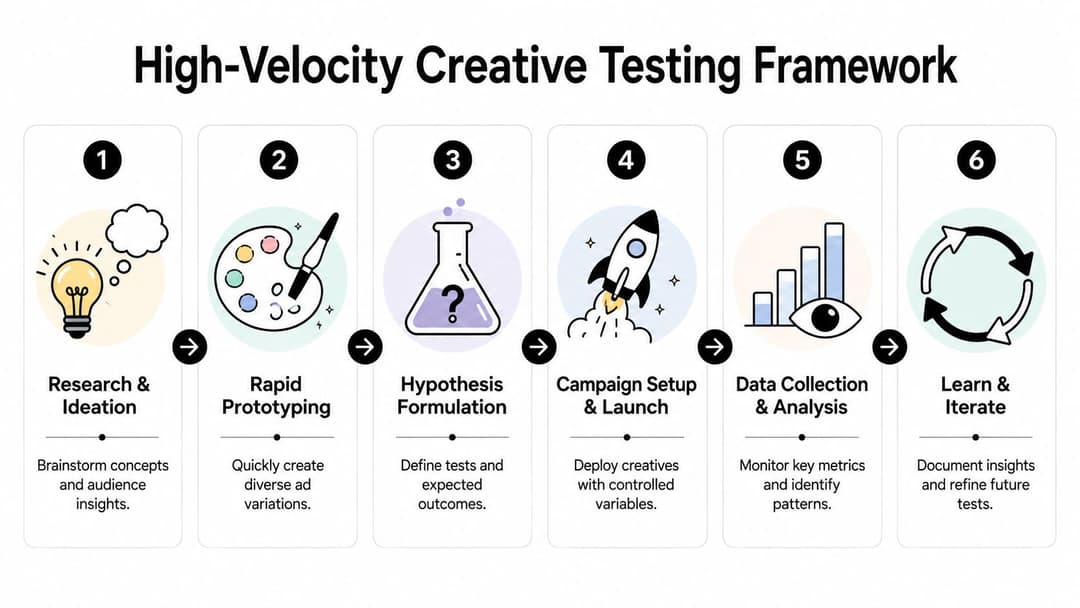
Manual testing usually fails for three reasons:
- Too few variations to isolate what impacted performance
- Too much delay between insight and next launch
- Too much attachment to polished assets that should have been treated as disposable tests
At scale, the team that learns faster usually wins before the team with the prettier brand book.
What a workable testing system looks like
The framework needs structure, not chaos.
Start with one variable family at a time
Don't test headline, opening hook, primary visual, CTA, offer framing, and audience logic all at once unless you're intentionally running broad exploration. Most of the time, isolate a family of variables so the account gives you a usable answer.
Good variable families include:
- Hook testing for the first line or first seconds of the ad
- Format testing across video, image, and creator-style variants
- Offer framing such as bundle logic, urgency, or problem-solution positioning
Build creative in batches
Winning teams don't wait for a perfect asset. They create batches. One concept becomes multiple intros, multiple body lines, multiple visuals, and multiple CTAs. That creates enough surface area for the platform to reveal patterns.
For teams running Meta at volume, tools can reduce production bottlenecks. One option is creative benchmarking for paid media teams, especially when you need a tighter way to compare angles and identify what's repeating or stalling. AdStellar AI is another workflow option for bulk Meta variation generation and launch when teams need to produce many combinations quickly from existing winners.
Operating principle: Fresh creative is not a campaign enhancement. It is budget protection.
A practical walkthrough of the testing mindset is worth watching before your next sprint:
The tests that usually matter most
Not all tests deserve equal urgency. In ecommerce, these often move results fastest:
| Test area | What you're learning | Why it matters |
|---|---|---|
| Opening hook | What stops the scroll | Determines whether the ad gets a chance |
| Creative angle | Which problem or desire resonates | Shapes audience fit |
| Format | How the message lands visually | Affects attention and clarity |
| Offer framing | What makes the purchase feel worth it | Changes conversion intent |
| Landing page match | Whether promise and destination align | Prevents drop-off after click |
What to document after every cycle
Teams often launch tests and forget the institutional memory part. That's a mistake.
Keep a record of:
- What changed
- What held constant
- What the account did
- What you believe the result means
- What gets repeated or retired
That documentation matters because performance doesn't usually improve from one breakout ad. It improves from pattern recognition across many tests. High-velocity testing is less about creative volume for its own sake. It's about building a faster learning machine.
Navigating Measurement and Attribution in 2026
Attribution got messier before measurement habits changed.
Many ecommerce brands still operate as if the platform can see the customer journey clearly enough to make reliable optimization decisions on its own. That assumption no longer holds. Privacy changes, browser restrictions, and fragmented user paths have reduced visibility across touchpoints. The result is a lot of false confidence.
The attribution models most teams use
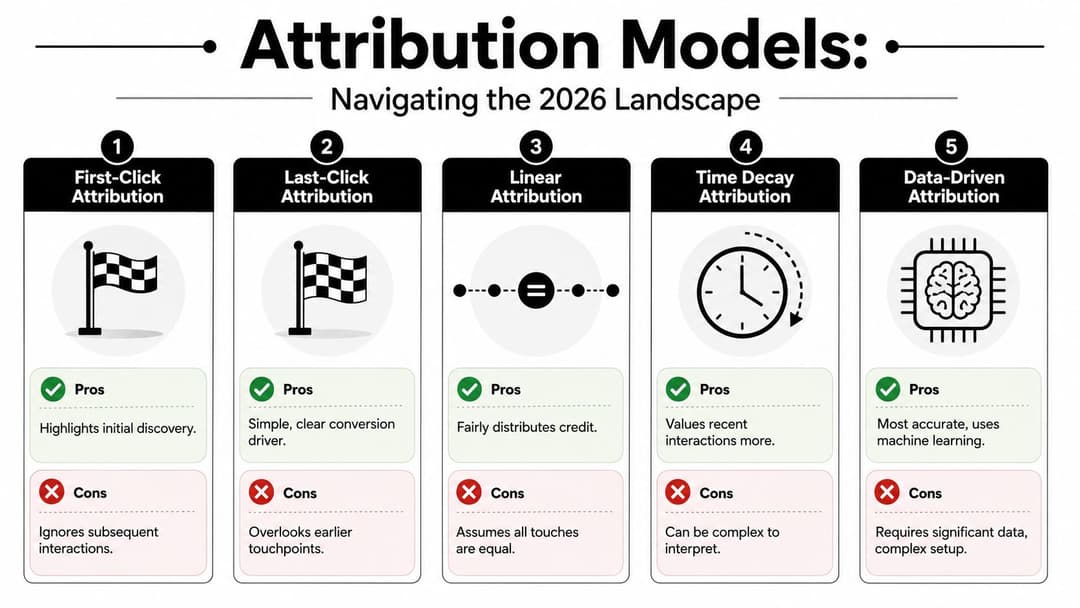
At a basic level, attribution answers one question. Which marketing touchpoint gets credit for the conversion?
First-click attribution
This gives credit to the first interaction. It's useful for understanding discovery, but it tends to under-credit the touchpoints that closed the sale.
Last-click attribution
This gives credit to the final interaction before purchase. It's easy to understand and still common, but it often over-rewards bottom-funnel channels.
Linear and time-decay models
These spread credit across multiple interactions. They're closer to reality than single-touch models, but they can still flatten meaningful differences between touchpoints.
Data-driven attribution
This uses machine learning to assign credit based on patterns in the path. In principle, it's the strongest model. In practice, it depends on data quality. If the signal feeding the model is weak, the output won't save you.
The real problem is data decay
Meta's move toward privacy-first targeting has reduced audience signal accuracy by 30% to 40%, which causes AI models to underperform unless they receive real-time server-side conversion data through tools such as the Conversions API, according to MediaPlus on effective performance marketing tactics for ecommerce growth.
That single shift explains a lot of what operators have felt over the last two years. Historical patterns became less trustworthy. Audience pools looked familiar on paper but behaved differently in-market. Optimization systems trained on incomplete browser-side events started making weaker decisions.
If your AI model is learning from partial conversion data, it isn't optimizing. It's guessing with confidence.
What to do about it
The fix is not “trust the platform less and use gut instinct more.” The fix is to improve the data pipeline.
Prioritize server-side tracking
Server-side tracking, including Meta Conversions API implementations, helps restore event quality by sending conversion information directly from your systems instead of relying only on browser-side signals. That gives bidding systems and reporting layers a cleaner stream of current outcomes.
Align event quality with business value
Don't just send purchase events. Send useful value signals. Product value, order quality, and meaningful conversion definitions matter. If the optimization system can only see shallow events, it will optimize shallow outcomes.
Add a broader measurement layer
Platform attribution is one input, not the whole truth. Use it alongside store data, finance visibility, and channel-level trend analysis. For teams trying to understand performance outside platform self-reporting, a primer on what media mix modeling is can help frame a broader measurement approach.
A practical attribution stance
The smartest teams don't chase one perfect model. They use multiple views with clear intent.
- Platform reporting for in-channel optimization
- Store and margin reporting for commercial truth
- Broader measurement models for cross-channel direction
The goal isn't attribution purity. It's decision quality. In 2026, measurement gets stronger when you accept that no single dashboard has the full answer and build a system that cross-checks the important ones.
Budgeting and Scaling Your Campaigns Profitably
Scaling isn't the same as increasing spend. Plenty of brands spend more and buy less efficient revenue.
A useful budgeting model separates the account into three buckets: explore, prove, and scale. That keeps new ideas from eating the whole budget and keeps proven campaigns from being starved by constant experimentation.
Explore, prove, scale
Explore
This bucket is for new audiences, new creative angles, new offers, or new channels. The purpose is learning. Keep expectations realistic and judge these campaigns by whether they generate useful signal, not whether they immediately deserve a large budget jump.
Prove
Once a setup shows repeatable efficiency, move it into a proving phase. In this phase, you test whether results hold across several days, different placements, and slight budget adjustments. A lot of campaigns look promising once. Fewer hold up under pressure.
Scale
Only scale campaigns that clear both performance and profit checks. If the campaign is producing revenue but weakening margin quality, it hasn't earned more budget yet.
A practical companion for this work is a guide on how to increase ROAS, especially when you need a more structured way to assess whether efficiency can hold as spend rises.
Use a traffic-light review system
This keeps daily decisions simple.
| Status | What it means | Action |
|---|---|---|
| Green | Efficiency is holding and delivery is stable | Increase budget carefully or expand adjacent tests |
| Yellow | Mixed signals or softening results | Hold budget, inspect creative, audience, and landing page |
| Red | Economics are breaking | Cut spend, isolate cause, or pause |
Scaling rules that prevent self-inflicted damage
A few habits matter more than complicated forecasting.
- Increase budget gradually. Large jumps can reset behavior and make analysis harder.
- Scale winners, not whole accounts. One strong ad set doesn't mean every campaign deserves more spend.
- Watch blended outcomes. A channel can look stronger while total account profitability slips.
- Respect operational constraints. If fulfillment, inventory, or customer service can't support the volume, media efficiency will eventually reflect that.
The best budget managers act less like gamblers and more like portfolio managers. They add exposure when evidence is strong, they reduce exposure when the economics soften, and they never confuse platform momentum with business quality.
Common Pitfalls and Your Execution Checklist
Most failed ecommerce campaigns don't fail because the idea was terrible. They fail because execution drifted.
The team trusted basic ROAS too much. Tracking wasn't validated before launch. Creative stayed live too long. Budgets were raised because spend capacity was available, not because margin supported it. None of those mistakes are dramatic on their own. Together, they create expensive confusion.
The mistakes that show up most often
Scaling before economics are clear
A campaign gets early traction, the team pushes budget, and only later realizes the product mix or customer quality wasn't worth the volume. Fast scaling amplifies hidden weaknesses.
Treating attribution as truth instead of evidence
Platform dashboards are useful. They are not finance statements. Teams that forget this usually over-credit one channel and under-invest in the systems that support clearer measurement.
Letting creative age out in market
Even strong ads decay. If the team doesn't have a refresh rhythm, media costs rise while the account fights yesterday's battle.
Ignoring post-click conversion friction
A lot of media buying problems are really landing page and offer problems. When traffic quality looks decent but purchases lag, the answer often sits on the site.
Pre-launch checklist for your next campaign
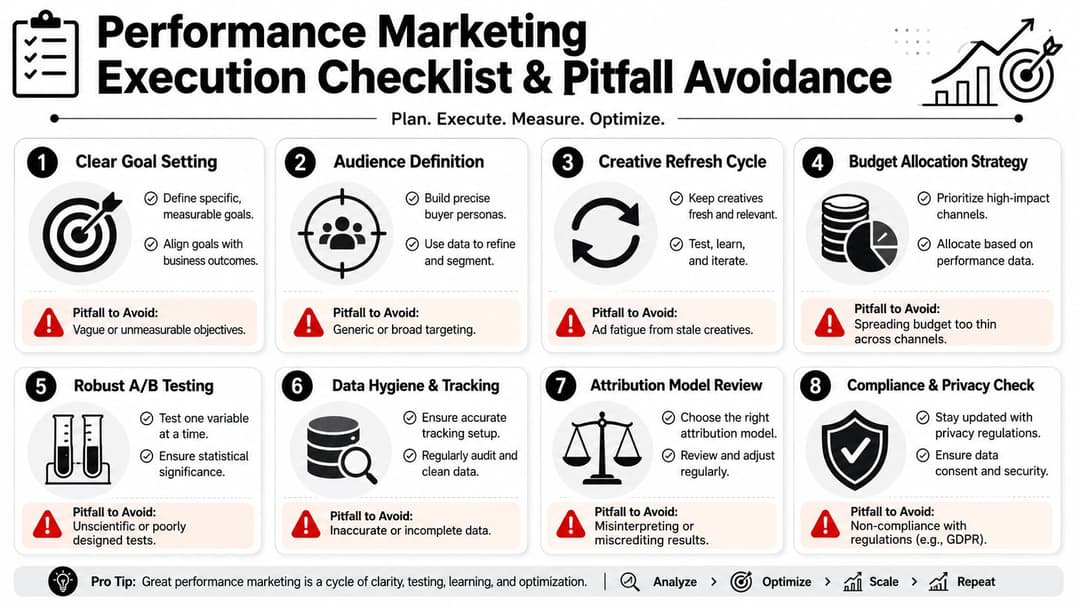
Run this before anything goes live.
- Goal clarity: Define the business outcome, not just the platform metric.
- Margin check: Confirm the offer and product set can support paid acquisition.
- Tracking validation: Verify browser-side and server-side events are firing correctly.
- Attribution stance: Decide which dashboard informs optimization and which one confirms commercial truth.
- Creative plan: Launch with enough variation to learn, not just enough to fill placements.
- Audience logic: Match prospecting, retargeting, and customer exclusion rules to the campaign objective.
- Landing page match: Make sure the destination reflects the promise in the ad.
- Decision rules: Set pause, hold, and scale conditions before spend starts.
Final check: If the team can't explain what would make this campaign a winner, a hold, or a pause, it isn't ready to launch.
Performance marketing for ecommerce still offers some of the clearest growth opportunities in digital acquisition. But the easy era is over. The operators who keep winning are the ones who measure profit accurately, maintain data quality aggressively, and turn creative testing into a repeatable operating habit instead of an occasional task.
AdStellar AI helps ecommerce and performance teams launch, test, and scale Meta campaigns with less manual setup. If you need a faster way to generate creative combinations, build campaign structures from historical winners, and keep testing velocity high without adding operational drag, AdStellar AI is worth a look.